Adding dependents to citizenship by investment can involve extra government fees, but there is no single fee across programmes. The amount and type of charge depend on the country, the relative’s age and relationship to the applicant, and whether they join the original application or are added later. Some programmes include eligible family members in the main contribution; others charge additional contributions or fees.
It is understandable to focus on the added cost, but eligibility and timing matter just as much. A relative may qualify under one programme but not another, and an age limit can determine whether they can be included.
This article explains which relatives may qualify, how age limits and application timing affect dependent-child eligibility, and when extra government charges may apply. It also compares rules and fee structures across Caribbean citizenship programmes to help you understand the relevant factors before deciding whether to apply as a family.
Key Takeaways
- Assess each child’s age, dependency, and education status against the selected programme’s eligibility rules before filing.
- Compare parent and grandparent age thresholds across Caribbean programmes, as the qualifying relationship alone may not be enough.
- Separate the main investment or contribution from additional charges that may apply when relatives are included or added later.
- Reduce the risk of refusal by understanding how timing, family relationships, supporting evidence, and due diligence can affect an application.
Age limits for dependent children
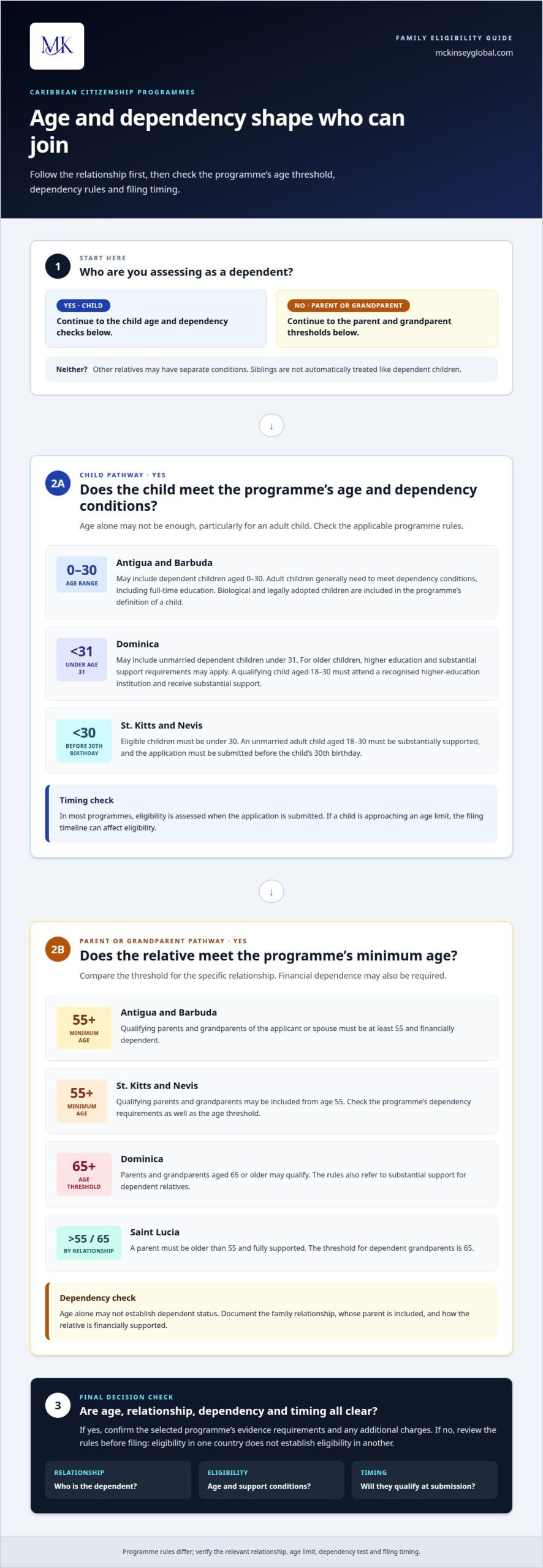
Age limits vary by programme, and dependency can matter as much as a child’s age. Antigua and Barbuda may include dependent children aged 0-30; adult children generally need to meet dependency conditions, including full-time education. Dominica may include unmarried dependent children under 31, with higher-education and support requirements applying to older children. St. Kitts and Nevis permits eligible children under 30, but an application for an unmarried adult child must be submitted before their 30th birthday.
Timing matters. In most programmes, eligibility is assessed when the application is submitted, so an approaching age limit can affect whether a child qualifies. When adding dependents to citizenship by investment, account for the child’s age and supporting circumstances as you plan the filing timeline.
Family eligibility is broader than children alone. Antigua and Barbuda permits a spouse and qualifying parents or grandparents aged 55 or older; Dominica’s parent and grandparent threshold is 65. A dependent sibling may qualify under specific programme rules, but siblings are not automatically treated like dependent children. Marriage and financial dependence can also affect whether an adult relative meets the relevant criteria.
Citizenship by investment and citizenship by descent are separate routes. Under Antigua and Barbuda’s descent policy, a child born after October 31, 1981, may qualify if at least one parent was an Antiguan citizen at the child’s birth. Dominica also has child additions through its citizenship-by-descent framework, distinct from including a child in an investor’s application.
A child born or legally adopted after approval may need a separate registration or application rather than inclusion in the original file. Newborns may be eligible for a simplified registration process. For an adopted child, the programme’s definition of a qualifying child matters. Antigua and Barbuda, for example, includes biological and legally adopted children.
For U.S. citizens and residents, dependent eligibility is determined by the destination programme’s rules, not U.S. status alone. U.S. immigration and tax considerations are separate from whether a relative qualifies as a dependent.
Can parents be added as dependents?
Yes, some Caribbean citizenship programmes allow qualifying parents or grandparents to join an application. Eligibility can depend on their age, relationship to the applicant, and financial dependence.
Parent and Grandparent Age Thresholds
Age thresholds are minimum ages a parent or grandparent must meet to qualify as a dependent. Antigua and Barbuda and St. Kitts and Nevis allow qualifying parents and grandparents from age 55. Dominica sets the threshold at 65 for dependent parents and grandparents. Saint Lucia allows a parent older than 55, while its threshold for dependent grandparents is 65. These distinctions matter when choosing a programme and structuring a family application.
Dependent Parents and Grandparents
Age alone may not establish dependent status; financial support is also relevant under programme rules. Antigua and Barbuda requires a financially dependent parent or grandparent of the applicant or spouse to be at least 55. Dominica’s rules cover parents or grandparents of the applicant or spouse who are older than 65 and substantially supported. Saint Lucia allows a parent older than 55 who is fully supported. The applicant’s spouse may therefore be the relative through whom a parent qualifies.
Prepare a clear record of the family relationship and support arrangement. The application should identify whose parent is included, how that person depends on the applicant, and which programme threshold applies. These details help show whether a parent meets the stated criteria. A residency option, such as the United Arab Emirates, is distinct from citizenship and may have different family rules.
Custody can affect a child’s inclusion, even when the parents are separated. For a child in the custody of someone acquiring Turkish citizenship, the other parent’s consent is required under Article 20(2). If consent is refused, a judge in the other parent’s country of habitual residence decides the matter. Resolve this issue before submitting the family application; it can affect whether the child joins the file and later obtains a passport.
For families assessing Antigua and Barbuda, citizenship-by-investment planning can help align dependent eligibility with the application structure.
Eligible dependents by Caribbean citizenship program
Caribbean citizenship programmes define eligible relatives differently, so family composition can affect which route fits. Compare each programme’s qualifying relationships, dependency tests, and application limits before applying. Eligibility in one country does not establish eligibility in another.
- Antigua and Barbuda: A spouse may join the main applicant’s family application. An adult child aged 18 or older may qualify if physically or mentally handicapped, living with the applicant, and fully supported. A dependent child’s future spouse may also qualify when the dependent is no older than 35 at application.
- St. Kitts and Nevis: Eligible parents and grandparents may be included, alongside qualifying children. An unmarried child aged 18 to 30 must be substantially supported, and the application must be submitted before the child’s 30th birthday. The Sustainable Island State Contribution covers the applicant and up to three eligible dependents.
- Dominica: An unmarried daughter under 25 may qualify if she lives with and is fully supported by the applicant or spouse. A dependent child aged 18 to 30 may qualify while attending a recognised higher-education institution and receiving substantial support. Parents and grandparents aged 65 or older may also qualify as dependents.
- Saint Lucia: An unmarried sibling under 18 may apply as a dependent with parental or guardian consent. A fully supported child of the applicant or spouse who is physically or mentally challenged may qualify at any age. Its National Economic Fund pathway covers the applicant and up to three eligible dependents.
These distinctions matter for international families with adult children, siblings, or older relatives. For example, a sibling’s eligibility in Saint Lucia does not mean that the sibling qualifies under Dominica’s rules. Match each relative to the programme’s qualifying relationship and dependency conditions, then consider whether consent or education evidence is relevant. This makes the family structure clearer before applying, without assuming that Caribbean programmes share one definition of a dependent.
What are the risks or reasons a dependent may be denied?
A dependent can fall outside a programme’s eligibility rules because of age, relationship, or dependency status. For example, a child approaching an age ceiling may qualify when an application is submitted but not after turning 30. In most programmes, age eligibility is assessed at application, so filing timing can affect whether an adult child remains eligible.
Dependency criteria also matter. An adult child may need to be unmarried, financially supported, or enrolled in full-time education, depending on the programme. Dominica, for instance, requires a dependent aged 18 to 30 to attend a recognised higher-education institution and receive substantial support. If the relationship or support circumstances do not meet the applicable criteria, the dependent may not qualify.
Due diligence is another assessment point. Most Caribbean citizenship-by-investment jurisdictions require background checks for dependent children over 12 or 16, depending on the jurisdiction. Antigua and Barbuda also requires applicants and dependents aged 16 or older to attend virtual interviews after approval. An interview or screening requirement can therefore affect an older child’s inclusion and application preparation.
Family documentation and consent can create further complications. For a child in the custody of a parent acquiring Turkish citizenship, the other parent’s consent is required under Article 20(2). If consent is refused, a judge in the other parent’s country of habitual residence decides the matter. A custody arrangement that is not reflected in the application could therefore delay or affect the child’s inclusion.
Timing after approval also requires attention. Most programmes allow dependents to be added after citizenship or residency is obtained, but the main applicant may undergo due diligence again. Newborns can often use simplified registration rather than a full application. For Antigua and Barbuda, applicants and dependents aged 16 or older must attend virtual interviews after approval, so the route for a later addition may involve distinct requirements.
For a structured review of eligibility factors and application risks, discuss dependent application planning.
McKinsey Citizenship and Residency Solutions
McKinsey Citizenship and Residency Solutions helps families assess citizenship and residency options against dependent eligibility, age limits, and application timing. Its guidance can help clarify how a family’s circumstances align with Antigua and Barbuda Citizenship by Investment, St. Kitts and Nevis Citizenship, Dominica, or Greece Residency by Investment.
This support is relevant when relatives have different dependency circumstances, an age threshold may affect eligibility, or a family is deciding whether to include dependents in an initial application. Understanding these factors early can help shape a coherent application strategy while keeping programme rules central to the decision.
For guidance on your family’s circumstances and suitable programme options, contact McKinsey Citizenship and Residency Solutions.
Plan the Next Stage of Your Family Application
The next step is to turn programme rules into a clear family application plan. Before proceeding, identify the relatives you intend to include, the basis for their eligibility, and whether the application timing fits their circumstances. This provides a focused framework for discussing costs, documentation, and any later additions.
McKinsey Citizenship and Residency Solutions supports applicants considering Antigua and Barbuda Citizenship by Investment, St. Kitts and Nevis Citizenship, and Greece Residency by Investment. Its guidance can help you assess how adding dependents to citizenship by investment fits your family’s plans and the programme under consideration.
For a tailored discussion of your circumstances and available options, contact McKinsey Citizenship and Residency Solutions. A measured, well-structured conversation can help you approach the next decision with greater clarity and confidence.
Frequently Asked Questions
Are There Additional Government Fees?
Yes, some programmes impose government charges or additional contributions for dependents. Antigua and Barbuda charges an additional US$2,000 due diligence fee for dependents over 12. Under Saint Lucia’s National Economic Fund pathway, each additional eligible dependent younger than 18 requires a further USD 10,000 contribution; an eligible dependent aged 18 or older requires USD 20,000. Charges depend on the programme and dependent category.
Can adult children be included in a citizenship by investment application?
Yes, adult children can qualify under some programmes if they meet specific dependency conditions. For example, Saint Lucia allows a fully supported child of the applicant or spouse who is physically or mentally challenged to be included at any age. Eligibility is not automatic. The programme may consider marital status, education, financial support, and when the application is submitted.
Do dependent rules differ by country?
Yes, each country sets its own rules for eligible relatives, age thresholds, and dependency evidence. Türkiye’s citizenship law provides a route for dependent children who have reached the age of majority, while European residency programmes generally cover dependent children to 18, or up to 26 for full-time students. Compare the specific programme rules rather than assuming one country’s criteria apply elsewhere.
Does adding family change the investment amount or the cost?
It can. Some programme contributions cover the main applicant and a defined number of eligible dependents; others require an additional contribution for each person. Government fees, due diligence charges, and the investment contribution are separate cost components.
How Long Does the Process Take?
Processing time depends on the programme, application completeness, and the checks required for each family member. Security and archive research can extend timelines; some Turkish citizenship-by-investment family files in 2026 reportedly waited well beyond four months during those checks. Adding a dependent after approval may also involve a separate registration or assessment, rather than simply updating the original application.
How does family inclusion compare to applying separately?
Including eligible relatives in the principal applicant’s file can connect their applications to the same investment route. Applying separately may require a different eligibility basis and process. For example, a child who reaches majority before applying for Turkish citizenship and was not included in the parents’ investment application falls under ordinary naturalization, which requires five years of residence. Family timing can therefore affect the route available.