A second passport may be the wrong solution if your priority is secure residence rather than nationality. The alternatives to citizenship by investment extend beyond another passport: they include investment-based residency and pathways based on ancestry, employment or income.
It’s understandable to view citizenship as the clearest route to greater mobility and long-term security. Yet residency and citizenship confer different rights, involve different obligations and lead to different outcomes. Residency may support a move or a base abroad without granting citizenship, while non-investment routes often depend on personal circumstances such as family heritage or a qualifying job.
This comparison examines investment-based residency, citizenship and non-investment pathways, including options such as Portugal and Greece residency by investment and UAE residency solutions. It will help you assess legal status, residence conditions and family considerations, then build a shortlist around your objectives. McKinsey Citizenship and Residency Solutions is an independent boutique advisory firm, not affiliated with McKinsey & Company, advising on investment-based citizenship and residency pathways. Program rules can change, so verify current requirements against official government sources before making decisions.
Key Takeaways
- Start with the outcome you need, such as residence, work authorization, family reunification or a second citizenship, before comparing routes.
- Use the alternatives to citizenship by investment framework to weigh legal status, residence plans, family composition, mobility needs and documentation.
- Consider descent, employment, study, family-based routes and ordinary naturalization as distinct options, each with eligibility tied to personal circumstances and jurisdiction-specific rules.
- Assess investment pathways against your long-term plans, including how residency differs from citizenship and what future options it may create.
- A structured comparison can narrow relevant investment pathways across the Caribbean, Europe and the Middle East to better fit your objectives.
Alternatives to Citizenship by Investment: Start with the Outcome You Need
A second passport is one possible objective, but it is not the only useful outcome. You may instead need lawful residence for your family, a base for business, greater travel access or a route that could support settlement over time. These goals involve different legal statuses, so the best alternatives to citizenship by investment depend on what you need the status to do.
Three pathways, three different outcomes
- Citizenship by investment: A pathway to citizenship, subject to the country’s eligibility criteria, due diligence and application rules.
- Residency by investment: Residence permission connected to a qualifying investment. It does not itself confer citizenship or a second passport.
- Non-investment routes: Pathways based on factors such as ancestry, employment, study or family relationships, with eligibility determined by the destination’s laws.
Immigrant investor programs include both citizenship and residency models. The practical difference is that citizenship concerns nationality, while residence permission authorizes a person to live in a country under specified conditions. Neither label alone tells you how much travel access a route provides, whether family members can qualify or how much physical presence it requires.
Citizenship, residence, and permanent residence are different statuses
Residence permission does not, by itself, make its holder a citizen or provide a second passport. Permanent residence, where a country offers it, is a distinct status that may allow ongoing residence but remains separate from citizenship. Investment routes associated with Portugal and Greece, for example, are residency pathways rather than direct citizenship grants. Any later naturalization possibility depends on the applicable law and the applicant meeting its requirements.
Rights and obligations are jurisdiction-specific and can change. Conditions may address permitted activities, renewal, physical presence, family members and the evidence required to maintain status. Do not assume that a residence permit grants unrestricted travel, that family members qualify automatically or that time spent in a country will necessarily lead to citizenship.
Which outcome matters most to your family or business?
Rank your priorities before comparing programs: travel mobility, lawful residence, relocation with family, business needs and long-term settlement. Then distinguish an immediate need to live in a country from a possible future objective of naturalization. A route suited to a near-term residence plan may not deliver the nationality outcome you ultimately want.
Residency by investment is a route to qualifying residence through an investment, not an automatic promise of citizenship. Use that distinction to frame your comparison. Assess each pathway against your family’s circumstances, intended use and ability to meet ongoing requirements.
Residency by Investment Compared with Citizenship by Investment
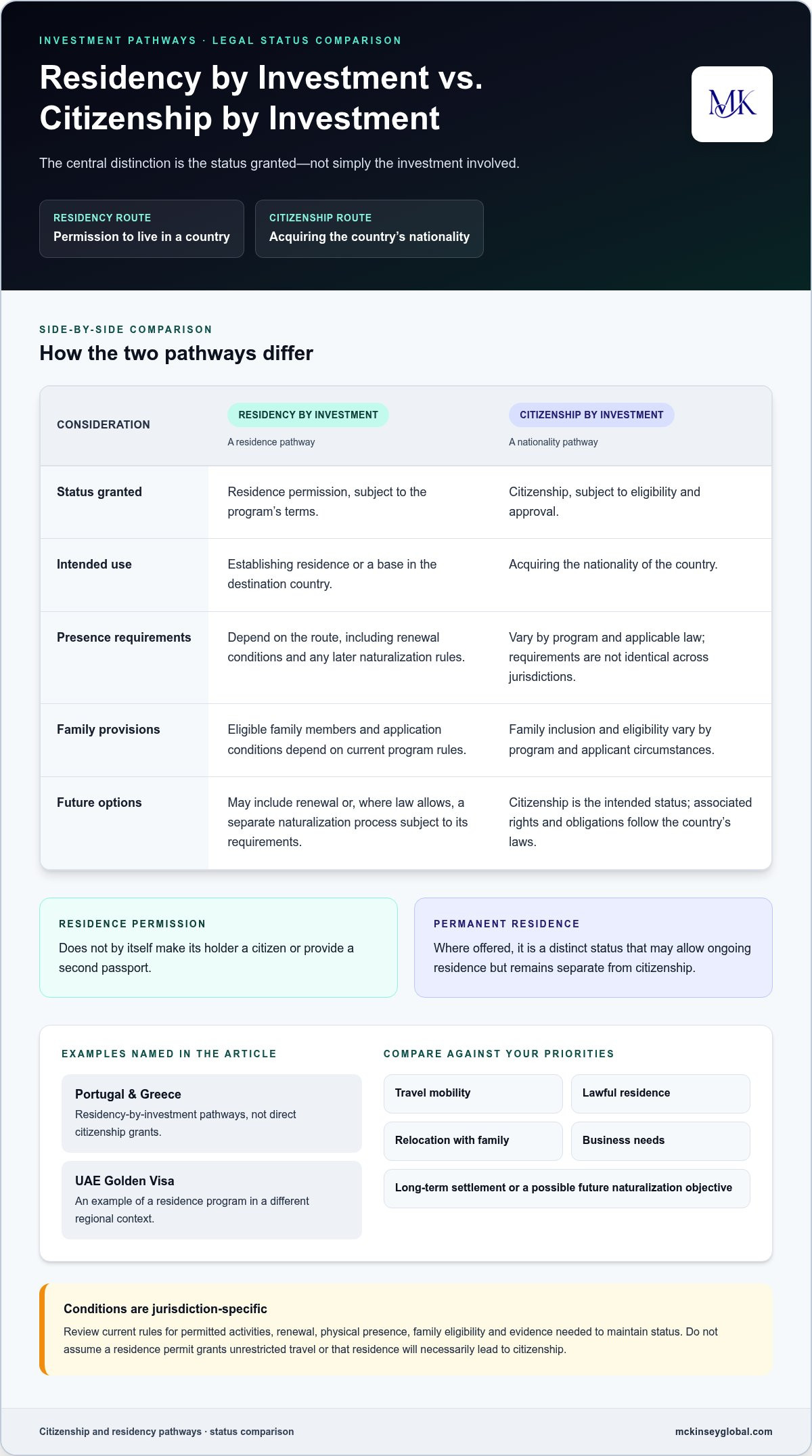
The central distinction is the status granted, not simply the investment involved. Residency by investment may suit someone who wants a lawful place to live without seeking a new nationality. Citizenship by investment is relevant to someone whose objective is citizenship itself. A useful comparison also considers presence obligations, family eligibility and possible future options.
| Consideration | Residency by investment | Citizenship by investment |
|---|---|---|
| Status granted | Residence permission, subject to the program’s terms. | Citizenship, subject to eligibility and approval. |
| Intended use | Establishing residence or a base in the destination country. | Acquiring the nationality of the country. |
| Presence requirements | Depend on the route, including its renewal conditions and any later naturalization rules. | Vary by program and applicable law. Do not assume they are identical across jurisdictions. |
| Family provisions | Eligible family members and application conditions depend on current program rules. | Family inclusion and eligibility also vary by program and applicant circumstances. |
| Future options | May include renewal or, where law allows, a separate naturalization process subject to its requirements. | Citizenship is the intended status. Associated rights and obligations follow the country’s laws. |
When residency by investment may be the closer fit
If your priority is lawful residence rather than another citizenship, compare residency pathways by their conditions and permitted use. Portugal and Greece offer residency-by-investment examples, while the UAE Golden Visa illustrates a residence program in a different regional context. Criteria, renewal rules, family provisions and benefits differ, so review current requirements carefully.
Schengen travel access and residence rights are not interchangeable. A residence permit from a Schengen country does not, by itself, grant the right to settle or work in every other Schengen country. Short-stay travel is subject to applicable Schengen rules and documentation. Check current official requirements before relying on a travel or residence assumption.
When citizenship may remain the relevant objective
If you specifically seek citizenship status, assess citizenship pathways directly rather than treating a residence permit as an equivalent. Caribbean options include programs associated with Antigua and Barbuda, St. Kitts and Nevis, Dominica and St. Lucia. Eligibility, family provisions and travel access depend on each program’s current rules and an individual’s circumstances.
A residence permit grants permission to reside under defined conditions. It is not citizenship and does not automatically become citizenship. A structured comparison of investment-based citizenship and residency options with McKinsey Citizenship and Residency Solutions, an independent boutique advisory firm not affiliated with McKinsey & Company, can help align a route with your intended outcome.
Non-Investment Alternatives: Descent, Naturalization, Work, and Family Routes
Some alternatives to citizenship by investment depend on an existing personal connection or a planned activity rather than a qualifying investment. Citizenship by descent may be available through a parent or other qualifying ancestor. Family-based residence may depend on a relationship with someone entitled to sponsor relatives. Employment and study routes are generally tied to a job or course, while ordinary naturalization may become relevant after meeting a country’s residence and other legal requirements.
- Descent: The qualifying basis is ancestry and documented family relationships. The objective may be citizenship, subject to nationality law.
- Family-based residence: Eligibility may depend on the relationship to a sponsor and that sponsor’s status. The immediate objective is often permission to reside.
- Employment: A qualifying job or employer relationship may support a work-based status, with residence connected to work authorization.
- Study: Admission to an eligible course may support permission to live in the country for study, rather than immediate citizenship.
- Ordinary naturalization: This is a possible later citizenship route for eligible residents, subject to country-specific legal conditions.
Could ancestry or family connections create another pathway?
Potential eligibility rests on the law and documented facts, not a surname, birthplace or family story alone. For example, Ireland’s rules distinguish between applicants with an Irish-born parent and those with an Irish-born grandparent, while Italy’s 2025 reform narrowed eligibility by descent. These are jurisdiction-specific illustrations, not general rules. Establishing a claim may require records linking each generation, alongside an assessment of how current nationality law applies.
Family-based residence is separate from citizenship by descent. A qualifying relationship may support a residence application under a country’s family rules, but does not necessarily confer citizenship. The sponsor’s status, the nature of the relationship and required documentation can all affect eligibility.
How work, study, and naturalization routes differ
Work and study permissions are purpose-based: the applicant’s employment or enrollment is central to the route, and the permission’s conditions may govern residence and activity. They are not immediate substitutes for citizenship. Naturalization is a distinct legal process, and residence alone should not be treated as a guarantee of eligibility or approval.
Compare each route by its qualifying basis, expected residence commitment and intended outcome. For context, investment-based residence is a separate category: the U.S. EB-5 Immigrant Investor Program is an official example, not a non-investment pathway. McKinsey Citizenship and Residency Solutions advises on investment-based citizenship and residency options.
How to Compare Alternatives to Citizenship by Investment
A disciplined shortlist starts with the status you need, not a program name or a projected benefit. Compare each route against your intended use, family circumstances and capacity to meet its conditions. This helps distinguish published government requirements from assumptions, promotional language and outcomes that are not guaranteed.
A five-step framework for building a shortlist
- Define the desired status and purpose. Decide whether your priority is citizenship, lawful residence or relocation for a particular reason, such as family life or business activity. A route that grants residence may not meet a citizenship objective.
- Map family requirements. Identify which relatives need to be included, their relationship to the main applicant and any individual eligibility considerations. Compare how each jurisdiction treats family members under its current rules.
- Set realistic residence expectations. Consider where family members will actually live, how often they can be present and whether renewal or later naturalization conditions fit those plans. Compare your preference for limited presence with the route’s published requirements.
- Test eligibility and compliance capacity. Review qualifying criteria, source-of-funds documentation, background checks, renewal duties and ongoing obligations. Consider whether your records can substantiate the application and whether your family can meet continuing requirements.
- Verify current rules and future options. Use official government sources to check eligibility, application procedures, presence expectations and any potential route to permanent residence or naturalization. Treat future outcomes as conditional, not automatic.
Questions that reveal a poor strategic fit
Before advancing a route, ask whether it grants the legal status you want and whether its conditions align with your circumstances. Can your family satisfy residence or renewal requirements? Can you assemble the required financial and identity records? Does the route address your mobility needs, or are you assuming a residence permit provides broader travel rights than it does?
Also assess your risk tolerance. Rules may change, applications require scrutiny, and a possible long-term route should not be treated as a guaranteed result. Keep a comparison record that separates verified government requirements from personal assumptions and commercial claims. Revisit it before making a decision, particularly if your objectives or family situation change.
For investment-based options, McKinsey Citizenship and Residency Solutions, an independent boutique advisory firm not affiliated with McKinsey & Company, can help structure a comparison around your objectives, eligibility and family requirements. Discuss your investment-migration objectives to begin narrowing the relevant pathways.
Planning an Investment-Based Alternative with McKinsey Citizenship and Residency Solutions
A focused investment-migration discussion begins with the outcome you want, then tests it against eligibility, family needs and practical obligations. McKinsey Citizenship and Residency Solutions is an independent boutique advisory firm, not affiliated with McKinsey & Company. It advises on investment-based citizenship and residency pathways across the Caribbean, Europe and the Middle East, helping applicants compare relevant options against their objectives.
From personal objectives to a focused program comparison
Mobility, residence plans, family inclusion and timing priorities shape which pathways merit closer assessment. If citizenship is the objective, Caribbean programs such as Antigua and Barbuda and St. Kitts and Nevis may be part of a comparison. If residence is the priority, Portugal and Greece residency by investment or UAE residency solutions may be more relevant. Each has distinct criteria and conditions, which should be assessed against current rules rather than assumed benefits.
Readers considering Antigua and Barbuda can use an Antigua and Barbuda investment options guide to examine the pathway in more detail. A useful comparison also accounts for each applicant’s circumstances, documentation, family composition and intended use of the status. Program names alone do not establish eligibility or determine whether a route fits your plans.
Due diligence and source-of-funds preparation are central to an informed application. Organize supporting records early and consider how they document the origin and movement of funds. Application procedures, eligibility criteria and residence conditions can change, so verify current requirements against official government sources before making decisions. No advisory assessment can guarantee approval.
Practical next steps for an informed decision
Before evaluating an application, assemble a clear record of your objectives and circumstances:
- Identity and family: List the principal applicant and family members whose inclusion may be relevant, with the identity and relationship documents available.
- Residence plans: Note where you expect to live, how often you can be present and any practical constraints on relocation.
- Financial documentation: Organize records that explain the source of funds and support the investment-related review.
- Decision priorities: Rank citizenship, residence, mobility and timing so the comparison reflects your actual objective.
McKinsey Citizenship and Residency Solutions can use these priorities to structure a comparison across relevant investment-based pathways. Individual eligibility, due diligence and the rules in force at the time of application govern outcomes. Careful planning supports an informed decision but does not replace official requirements. To take the next step, explore investment-based citizenship and residency solutions.
Make Your Next Move with a Clearer Strategy
The right route depends on the outcome you need. A residence permit, citizenship and a pathway based on ancestry, work or family each involve distinct eligibility criteria and obligations. Compare alternatives to citizenship by investment against your intended use, family requirements, residence plans and ability to meet current rules, rather than judging them by passport access alone.
For investment-based options, McKinsey Citizenship and Residency Solutions advises on Caribbean citizenship pathways and residency programs in Europe and the Middle East. Its offerings include Antigua and Barbuda and St. Kitts and Nevis citizenship, alongside Greece and Portugal residency and UAE solutions. The firm is an independent boutique advisory firm and is not affiliated with McKinsey & Company. Application outcomes remain subject to individual eligibility, due diligence and the rules in force.
With your priorities defined, you can narrow the landscape to pathways worth assessing and prepare for a more informed decision. Explore investment-based citizenship and residency solutions to consider options that may align with your objectives and family plans.
Frequently Asked Questions
Is residency by investment a real alternative to citizenship by investment?
Yes, residency by investment can be a relevant alternative when your objective is lawful residence rather than citizenship. The status granted, permitted activities, renewal conditions and family provisions depend on the jurisdiction and program. A residence permit does not itself confer citizenship or a second passport. Compare the legal outcome with your actual objective, and verify current requirements against official sources before relying on a program description.
Can I get citizenship through ancestry instead of investment?
Possibly. Some countries provide citizenship by descent or other nationality routes based on a documented family relationship, but eligibility rules vary. Requirements may depend on dates, generations, registration history and supporting records. A family connection alone does not establish eligibility, and a surname or family story is not sufficient evidence. Assess descent under the relevant country’s current nationality law rather than assuming it is available or equivalent to an investment-based application.
How much does it cost to pursue alternatives to citizenship by investment?
There is no single cost for these pathways. Investment programs, residency applications and non-investment routes can involve different government charges, professional fees, document expenses and ongoing obligations. The total varies by jurisdiction and individual circumstances. Compare the full financial commitments using current program information and a case-specific assessment. A headline investment amount, where applicable, is not a complete estimate of the costs and responsibilities involved.
What happens if I choose residency by investment but later want citizenship?
Residency by investment does not guarantee or automatically convert into citizenship. Some jurisdictions may allow residents to pursue naturalization later, subject to separate legal conditions that can include residence, language or documentation requirements. Rules vary and may change. Before choosing a program, distinguish the initial residence status from any possible future citizenship route, and verify the current naturalization conditions for that jurisdiction.
Is a work or family visa an alternative to citizenship by investment?
It may be an alternative if you qualify through employment, study or a family relationship and your objective is residence. These permissions are generally tied to specific eligibility conditions and do not necessarily lead to permanent residence or citizenship. Assess the legal basis, permitted activities, duration, renewal rules and family implications separately. The suitable route depends on your circumstances and the destination country’s current requirements.
Which countries offer residency by investment instead of citizenship by investment?
Program availability and requirements change, so no static list should be treated as definitive. Examples of residency pathways include Portugal and Greece in Europe and the UAE in the Middle East, each with distinct eligibility and residence conditions. Citizenship programs operate separately in jurisdictions such as Antigua and Barbuda, St. Kitts and Nevis, Dominica and St. Lucia. Verify current rules before comparing program outcomes.
Do I need to live in a country to qualify for citizenship by investment?
Residence and physical-presence requirements depend on the country and specific program, so they should not be generalized across jurisdictions. Requirements for a citizenship-by-investment application may differ from those for ordinary naturalization, and rules may also treat family members differently. Check current official program information and distinguish application eligibility from any continuing obligations after citizenship is granted. Do not assume that an absence of residence requirements applies universally.