
What if the headline contribution is only part of your family’s citizenship budget? For a family of four, the National Development Fund route has a minimum contribution of USD 230,000, while an estimated total of about USD 264,700 to USD 270,000 may apply once fees are included. The Antigua citizenship for family of four cost depends on more than the route: dependent ages and the fee categories that apply to each person can change the final figure.
It’s understandable to look for one clear total, but estimates can differ when they use different assumptions about dependants or leave out additional charges. This guide explains how the investment, government processing, due diligence, passport and interview fees contribute to the budget, and compares the real estate and other investment routes. It also shows which family details to assemble for a more reliable, itemized estimate. Planning around your family’s circumstances makes it easier to assess each cost instead of relying on a headline figure alone.
Key Takeaways
- See why an all-in estimate must distinguish the investment commitment from government and other application charges.
- Learn how each dependant’s age and status can affect the Antigua citizenship for family of four cost.
- Compare the available investment routes by their capital requirements, additional fees, and family-level considerations.
- Use a step-by-step budgeting workflow to create a dated estimate based on your family profile and chosen route.
- Understand how structured advisory support can organize application assumptions, documents, and cost categories without treating an investment route as property brokerage.
Antigua Citizenship for a Family of Four: What the 2026 Cost Includes
The all-in cost combines the selected investment or contribution with applicable government charges and other expenses involved in preparing and submitting the application. For the Antigua citizenship for family of four cost, the number of applicants alone is not enough to produce a dependable estimate. Each dependant’s age and status can affect which fees apply.
Use the current 2026 Citizenship by Investment Unit (CIU) schedule as the basis for official amounts. Record the route contribution, government processing charge, due diligence fees, passport fees and any applicable interview fee as separate line items. Private advisory fees, banking costs, translations and document-related expenses are separate from CIU charges and may vary with the application and service arrangements.
What counts as the total Antigua citizenship cost?
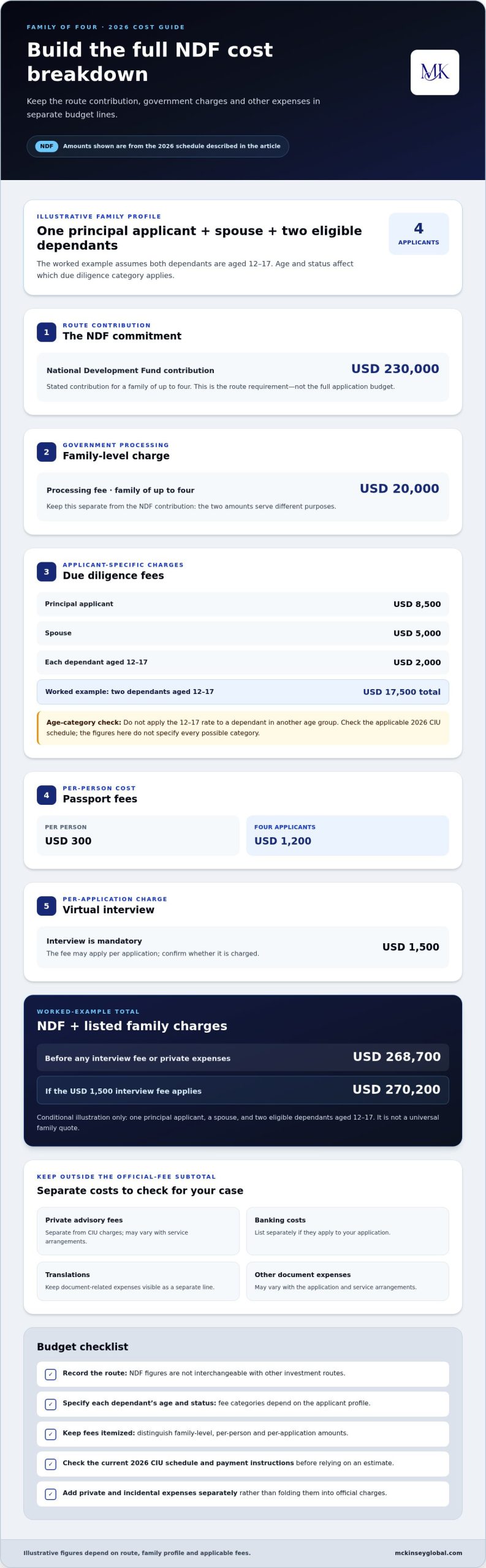
Separate the selected route’s investment or contribution from the costs of processing the family’s application. Under the National Development Fund route, for example, the stated contribution is USD 230,000 for a family of up to four. The family-level government processing fee is USD 20,000. These amounts are distinct and serve different purposes.
Next, identify charges assessed per person or application. The 2026 schedule lists due diligence fees of USD 8,500 for the main applicant, USD 5,000 for a spouse, USD 2,000 for a child aged 12-17, and USD 4,000 for a dependent aged 18-30. Passport fees are USD 300 per person, or USD 1,200 for four applicants. A virtual interview is mandatory and may carry a fee of USD 1,500 per application.
Keep these categories separate rather than combining them under a single “government fee” figure. The investment is route-specific, processing is listed for a family of up to four, due diligence depends on the applicant category, and passport charges apply per person. Advisory, banking, translation and document expenses sit outside these official amounts. Add them as separate lines if they apply to your case.
Why family composition changes the estimate
For a clear example, define the household as one principal applicant, a spouse and two eligible dependants. Their ages and statuses still need to be specified. A dependant aged 12-17 falls into a different due diligence category from one aged 18-30, while the schedule figures cited above do not specify a due diligence amount for every possible age group. Do not infer an unlisted charge or assume that no charge applies without checking the applicable 2026 CIU schedule.
Two families of four may therefore have different fee profiles. A published total is useful only when its assumptions match your household, including each dependant’s age and eligibility category, the chosen route, and whether private and incidental expenses are included. Record those assumptions alongside each figure. Otherwise, a precise-looking total can hide a material difference in what it covers.
Antigua Citizenship Fees for Four Applicants: Build the Full Cost Breakdown
A useful family estimate separates the route investment from official application charges and private expenses. For the Antigua citizenship for family of four cost, the table below uses the 2026 figures and states the family assumptions behind each amount. Check the applicable schedule and payment instructions on the Antigua and Barbuda Citizenship by Investment Programme official website before relying on an estimate.
| Charge | 2026 amount | Source and applicability | Payment stage |
|---|---|---|---|
| NDF contribution | USD 230,000 | Programme route requirement; family of up to four | Follow current route-specific CIU instructions |
| Government processing fee | USD 20,000 | Government charge; family of up to four | Follow current CIU instructions |
| Due diligence: principal applicant | USD 8,500 | Government fee; per principal applicant | Follow current CIU instructions |
| Due diligence: spouse | USD 5,000 | Government fee; per spouse | Follow current CIU instructions |
| Due diligence: each dependant aged 12-17 | USD 2,000 | Government fee; per dependant in this age category | Follow current CIU instructions |
| Passport fee | USD 300 per person | Government fee; four applicants total USD 1,200 | Confirm timing against current instructions |
| Virtual interview | USD 1,500 per application, if charged | Mandatory interview; fee may apply per application | Confirm timing against current instructions |
Which costs are fixed, per person, or route-dependent?
The NDF contribution and processing fee are family-level figures for a family of up to four. Due diligence is applicant-specific and depends on the person’s category and, for children, age. Do not apply the 12-17 rate to a dependant in another age group. Passport charges are per person, while the interview fee is stated per application and may apply. Other routes have different investment requirements, so do not use the NDF figure in a real estate, UWI Fund or business-route estimate.
For an illustrative NDF calculation, assume one principal applicant, a spouse and two eligible dependants, both aged 12-17. The listed contribution and fees total USD 268,700 before any interview charge or private expenses. If the USD 1,500 interview fee applies, the total becomes USD 270,200. This is a conditional illustration, not a universal family quote. Add bank charges, advisory fees, translations and document expenses only where incurred. Use the relevant provider’s terms for those amounts rather than inferring them from government fees.
When are the family application charges paid?
The amounts alone do not establish when each charge is due. The current CIU schedule and route instructions govern payment timing, including whether a charge is collected at submission or later. Do not assume a balance-after-decision arrangement or a refund entitlement unless the applicable official terms state it clearly. An itemized assessment through Antigua citizenship application guidance can keep official charges, route commitments and separate professional or banking expenses distinct.
Compare Antigua Citizenship Investment Routes for a Family of Four
Route selection changes the nature of the financial commitment, not just the headline amount. A fund contribution is generally paid into a designated programme fund. Real estate or business routes commit capital to an approved asset or enterprise and may involve conditions beyond the application. The figures below are route thresholds, not complete family totals. Government charges, applicant-specific fees and private expenses must be assessed separately against the current official 2026 schedule.
| Route | Contribution or capital commitment | Additional charges | Asset or payment obligation | Family-of-four consideration |
|---|---|---|---|---|
| National Development Fund (NDF) | USD 230,000 for a family of up to four | Government and applicant-level charges apply separately | Non-refundable contribution | Threshold is expressly stated for a family of four; dependent categories still affect the fee calculation |
| Approved real estate | Minimum USD 300,000 | Government and applicant-level charges apply separately | Investment in an approved project; property must be held for at least five years | Compare the capital commitment and holding period alongside application charges |
| University of the West Indies (UWI) Fund | USD 260,000 minimum for a family of six or more, inclusive of processing fees | Check which charges are included in the applicable family threshold | Fund contribution; includes a one-year, tuition-only scholarship for one family member | The stated threshold is for six or more, so it should not be presented as a four-person quote |
| Approved business | USD 1.5 million for a single investor, or a joint investment of at least USD 5 million, with each individual contributing at least USD 400,000 | Government and applicant-level charges apply separately | Capital committed to an approved business | Assess the investment structure and family application fees as distinct calculations |
How contribution and investment routes differ financially
The NDF’s USD 230,000 is a non-refundable contribution, not capital retained in property or a business. By contrast, real estate and business routes involve an investment commitment. The real estate route has a stated five-year holding requirement. The figures shown here do not establish a comparable asset-holding term for the business route, so do not assume one. The UWI figure has a specific scope: it applies to a family of six or more and includes processing fees. It is not a direct four-person comparison without the relevant official family threshold.
Which route comparison matters to your household?
Compare the amount to be committed, applicable charges, and whether capital is tied to an asset over time. A lower contribution threshold does not automatically mean a lower all-in budget, and an investment threshold is not equivalent to a recoverable amount. Dependant ages can change due diligence fees without changing a route’s core investment structure. For a properly matched Antigua citizenship for family of four cost estimate, record the route, each applicant’s age and status, included charges, and any holding conditions together.
Calculate a Family-of-Four Budget: Assumptions, Documents, and Checks
A reliable estimate is a dated calculation, not a headline amount copied from a general guide. It combines the selected route’s investment commitment with applicable official programme charges and any separately quoted private, banking, translation and document expenses. Keeping these categories distinct helps you see what is established, what depends on your family profile, and what still needs a written estimate.
What details should a family assemble before calculating?
Before adding figures, prepare a consistent family profile and choose the route to assess. Record each applicant’s relationship to the principal applicant, age and intended application status. For a family of four, list the principal applicant, spouse and each dependant individually rather than entering “two children” as one category. This supports accurate fee classification and helps prevent an age-specific charge from being applied to the wrong person.
Gather records that substantiate those details, such as documents showing identity, age and family relationships. Then note the route’s verified investment or contribution requirement, keeping its financial structure separate from application charges. For each advisory, bank, translation or document expense, enter a written estimate or the applicable provider’s stated charge. Do not treat an unpriced item as included in the official programme total.
How to validate an estimate before proceeding
Use this workflow to build a route-specific budget that can be reviewed and updated:
- Set the profile: List all four applicants, their relationships, ages, and application categories.
- Select the route: Record the current investment or contribution requirement and any verified asset or holding condition.
- Itemize official charges: Reconcile each applicable government fee against the Citizenship by Investment Unit schedule, marking whether it is family-level, per applicant, age-dependent, or route-specific.
- Add separate expenses: Include only applicable private professional, banking, translation, and document costs, identifying the source and whether the amount is quoted or still to be obtained.
- Record payment details: For each line, note the stated currency, payment stage, due date or trigger, and any refund terms in the current programme documents.
- Date and review: Write the date the figures were checked, then recalculate if the official schedule, route assumptions, or family composition changes.
Programme requirements and fee schedules can change, so date the estimate rather than presenting it as a standing quote. For an October 2026 estimate, reconcile figures against the official materials available at that time and retain the assumptions used. If a payment stage or refund condition is unclear, mark it for verification instead of treating it as settled.
For a structured assessment of your family profile, route assumptions and cost categories, request guidance on your Antigua application budget.
Plan Your Antigua Family Application with Structured Advisory Support
A family application involves connected decisions: who is included, which investment route is being considered, what documents support each person’s profile, and which charges belong in the estimate. An adviser can organize these details into an application plan, distinguishing government fees and route commitments from private advisory costs and other expenses. That separation makes the budget’s assumptions easier to review and helps identify questions that require reference to current programme materials.
McKinsey Citizenship and Residency Solutions provides guidance and application management for Antigua and Barbuda citizenship through investment. It is an independent advisory firm and is not affiliated with McKinsey & Company. It does not act as a property broker. For a real estate route, its role is to organize the application and related assumptions, not to broker property transactions.
What a structured application review should clarify
A focused review should capture the principal applicant, spouse and dependants, including each person’s age, relationship and proposed application status. It should then identify the route under consideration, the official figures and programme conditions used in the estimate, and the date those materials were checked. This provides a consistent basis for reviewing the Antigua citizenship for family of four cost without treating an age-specific illustration as a universal family total.
Application preparation can then be organized around the documents that support the family profile, outstanding information, and the sequence of application-management steps. The estimate should show separate lines for route investment, official government charges, advisory services and any applicable banking, translation or document expenses. Include payment timing and terms only where current programme documents or written fee information establish them. An organized process can reduce ambiguity, but it cannot guarantee an application outcome.
Prepare for a focused consultation
To make a discussion productive, assemble a concise profile and preliminary assumptions before reviewing costs. Include:
- Each applicant’s age, relationship to the principal applicant and intended status in the application.
- The preferred investment route, plus any alternative route you want to compare.
- The official programme figures you have reviewed and the date they were checked.
- Your preliminary budget, with government charges, route investment and advisory or incidental costs kept separate.
- Any known document, translation or banking requirements that may affect your planning.
This preparation helps an adviser distinguish cost categories supported by official information from those that depend on family details or need separate written pricing. Route context matters too: a contribution and an asset-based investment are different financial commitments, even when both are being considered for the same family. Preserve that distinction instead of reducing each option to one headline figure.
Discuss your Antigua and Barbuda family application with McKinsey Citizenship and Residency Solutions to organize the family profile, route assumptions and cost questions into a structured application plan.
Turn Your Family Estimate into a Clear Next Step
Turn a general budget into a family-specific planning document that can be revisited as your circumstances or programme information changes. Record the assumptions behind your estimate, including who is applying, the route under consideration, and which expenses remain subject to confirmation. This gives your family a practical reference for comparing options and keeping financial decisions aligned.
The Antigua citizenship for family of four cost is most useful as a planning figure when its boundaries are clear. Keep programme investment and official charges distinct from advisory services and other private expenses. McKinsey Citizenship and Residency Solutions provides investment-migration advice for Antigua and Barbuda citizenship applications, helping families organize these categories alongside application planning.
Bring your family profile and preliminary route assumptions to a focused discussion. Arrange a family-specific Antigua application assessment and take the next step with a clearer basis for your decision.
Frequently Asked Questions
How much does Antigua citizenship cost for a family of four?
There is no single total that applies to every household. The Antigua citizenship for family of four cost depends on the selected route, each dependant’s age and eligibility, and the official charges applicable when you apply. An estimate prepared for two young children, for example, may not suit a family with older dependants. Compare estimates only after checking that they use the same family profile, route, fee categories and calculation date.
Do children pay the same Antigua citizenship fees as adults?
Not necessarily. Some charges depend on an applicant’s age or category, while others may be calculated per person or for the family. Record each child separately rather than grouping them under a general “children” label. If a child is close to an age boundary, note their age and the date used for the estimate, then compare the applicable category with the current official schedule before relying on the calculation.
Does the cost change if a child turns 18 during an Antigua citizenship application?
It may, depending on current programme rules and the child’s circumstances. Check whether the relevant assessment date or category changes during processing before carrying a fee or eligibility assumption forward. For planning, record the child’s date of birth, the age used in the initial estimate, and the rule applied. This makes a later recalculation traceable and helps prevent an outdated family budget from being treated as final.
Are Antigua citizenship application fees refundable if an application is refused?
Refundability depends on the specific payment and the terms governing it. Do not assume all charges follow the same policy. Before committing funds, identify each payment separately, including contributions, government charges and private professional fees. Review current programme terms for official payments and the relevant service agreement for private fees. Keep copies of the documents that state the conditions so your family can understand potential financial exposure before proceeding.
Can a family include a dependent who is not a minor in an Antigua citizenship application?
An adult dependant may be includable if they meet the programme’s current definition and individual eligibility requirements. Age alone does not establish eligibility, so document the person’s relationship to the main applicant and the circumstances relevant to their dependant status. Treat that person as a separate profile in the preliminary budget, since their category may affect applicable charges. Assess eligibility against current official requirements before counting them in the family estimate.
Are Antigua citizenship costs paid all at once or in stages?
Payments may fall at different points in the application, depending on the selected route and current programme instructions. Create a payment calendar with one line per charge, showing the responsible applicant, currency, due date or triggering stage, and source of the instruction. This helps distinguish funds needed at submission from later obligations without assuming a balance or payment date that the official terms do not specify.
Does the Antigua citizenship family-of-four total include professional advisory fees?
Not automatically. An estimate may cover programme investment and official charges without including private advisory, banking, translation or document expenses. Before comparing figures, check each estimate’s scope and date, and note whether professional services are priced separately or included. McKinsey Citizenship and Residency Solutions provides investment-migration application guidance. Budget its advisory services separately from government payments and the route investment commitment.