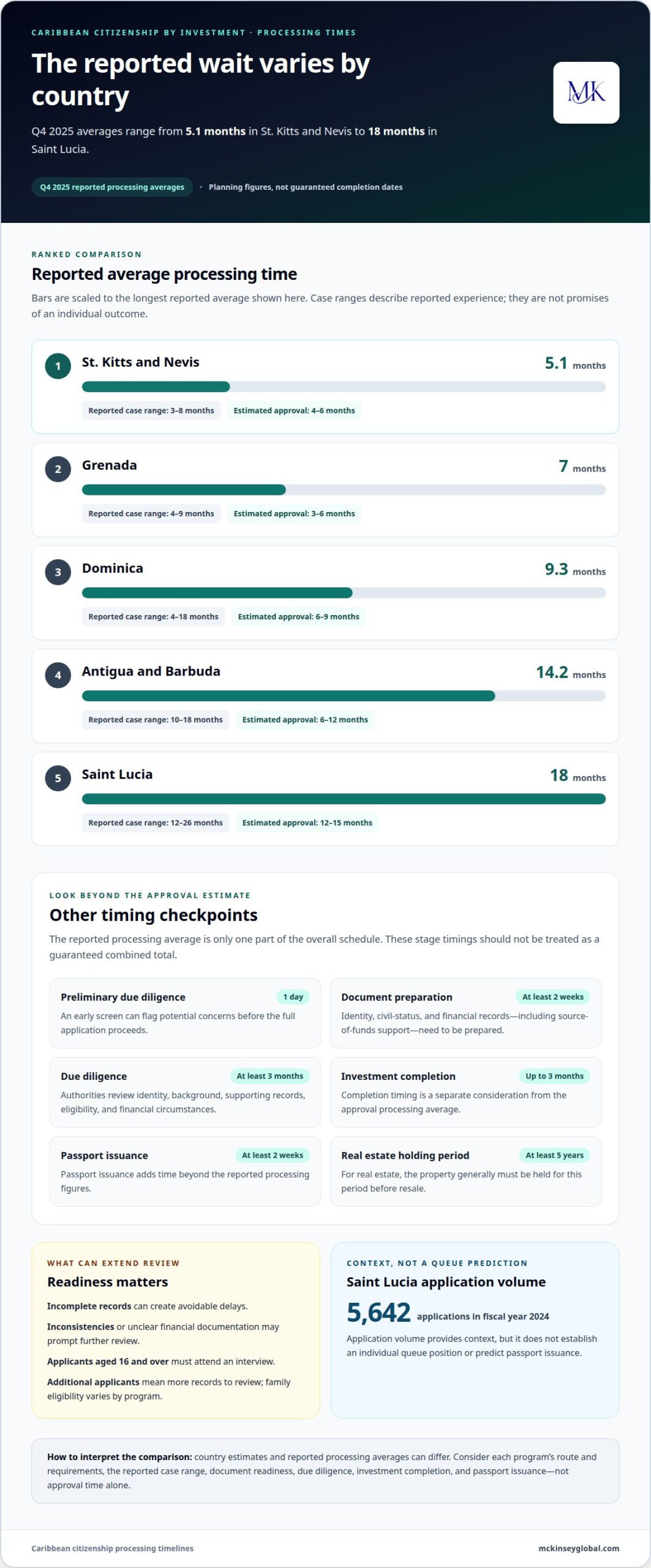
The fastest Caribbean option on paper is not always the fastest in practice: Q4 2025 reported average processing times were 5.1 months for St. Kitts and Nevis, 7 months for Grenada, 9.3 months for Dominica, 14.2 months for Antigua and Barbuda, and 18 months for Saint Lucia. A Caribbean citizenship application timeline can therefore differ substantially by country, and these averages provide a more useful comparison than a single regional estimate.
A published processing estimate does not cover the entire wait. An application also involves preparation, due diligence, approval, investment completion, and passport issuance, and the time spent at each stage affects the overall schedule.
This guide compares the five programs’ timelines, explains due diligence, and outlines the application stages. It also offers a framework for weighing processing time against each program’s requirements and structure.
Key Takeaways
- Compare each programme’s stated approval estimate with reported processing experience before weighing it against your priorities.
- Understand how identity, financial background and source-of-funds checks shape due diligence and application readiness.
- Map the process from document preparation through review, approval and passport issuance to plan each stage more clearly.
- Use the decision guide to weigh timing alongside programme requirements and the route that best fits your circumstances.
What is Caribbean Citizenship by Investment?
Caribbean citizenship by investment allows eligible applicants to obtain citizenship through an approved investment route. The five programs compared here are in St. Kitts and Nevis, Grenada, Dominica, Antigua and Barbuda, and Saint Lucia. Each nation sets its own routes and review process, so a regional estimate alone cannot predict an individual application’s processing time. A Caribbean citizenship application timeline is therefore best assessed country by country.
Reported Q4 2025 averages show a wide difference between programs. The table compares those averages with reported case ranges; these figures describe processing experience, not a guaranteed completion date.
| Program | Q4 2025 average | Reported case range |
|---|---|---|
| St. Kitts and Nevis | 5.1 months | 3-8 months |
| Grenada | 7 months | 4-9 months |
| Dominica | 9.3 months | 4-18 months |
| Antigua and Barbuda | 14.2 months | 10-18 months |
| Saint Lucia | 18 months | 12-26 months |
Choose by matching the program’s route and requirements to your priorities, then assess its reported processing range. Investment completion can take up to 3 months, while passport issuance takes at least 2 weeks after a Caribbean citizenship application. For real estate, applicants generally must hold the property for at least 5 years before resale; that holding period affects wealth planning beyond approval. A country-specific Caribbean citizenship application timeline should account for these stages, not approval alone.
There is no single minimum investment or government fee across the five countries. Applicable amounts vary by country, route, and applicant composition. The total cost depends on the case and is provided after a quote request. Factors include the selected route, the applicants included, and government charges.
Applications commonly require identity, civil-status, and financial records, including material supporting the source of funds. Document preparation takes at least 2 weeks; completeness helps limit avoidable processing delays and supports the mobility plan behind the application.
How long does citizenship processing take in St Kitts, Antigua, Dominica, Grenada and St Lucia?
Published country estimates can differ from reported processing averages, so use them as planning ranges, not guaranteed completion dates. A Caribbean citizenship application timeline should separate each program’s estimate from factors that may extend review.
St Kitts Processing Timeline
St. Kitts and Nevis is commonly estimated to take 4-6 months for approval. Separate Q4 2025 reporting placed its average at 5.1 months, illustrating how estimates and recorded cases can differ. Grenada’s estimated 3-6 months is shorter at the lower end, while Dominica’s 6-9 months extends beyond the St. Kitts range. These figures describe processing, not later passport issuance.
Antigua Processing Timeline
Antigua and Barbuda’s estimated processing time is 6-12 months, although Q4 2025 reported cases averaged longer. This distinction matters when planning an international move or real estate investment: an estimate is not a reliable date for completing every stage. The route selected, document readiness, and review requirements can affect how quickly an application advances.
Saint Lucia Timeline and Backlog
Saint Lucia’s estimated approval period is 12-15 months, placing it at the longer end of these program estimates. Q4 2025 reported an 18-month average, while Saint Lucia received 5,642 citizenship-by-investment applications in fiscal year 2024. Application volume provides context, but it does not establish an individual queue position or predict passport issuance. Include that distinction in your Caribbean citizenship application timeline planning.
Application Delays and Rejection Risks
Applicants aged 16 years and over must attend an interview. Incomplete records, inconsistencies, or unclear financial documentation can prompt further review; due diligence findings may also affect an application’s outcome. Family eligibility varies: Antigua and Grenada allow children up to age 30, while other relatives depend on each program’s rules. Additional applicants mean more records for review, which can affect the schedule.
A country-by-country review of Caribbean citizenship application options can help align the chosen route with your family and timing priorities.
Due diligence checks and rejection risks
Due diligence is a key stage in Caribbean citizenship by investment applications. Authorities assess applicants’ backgrounds, supporting records, and eligibility as part of their review.
Preliminary Due Diligence
A preliminary check can identify potential concerns before the full application proceeds. This early screen takes 1 day and differs from later government review, which examines the submitted application in greater depth. It gives the application team an opportunity to identify gaps or inconsistencies for resolution before they complicate the formal assessment. For families, the preliminary review can consider each included applicant’s information.
Background Screening
Background screening assesses whether the application presents a clear, consistent account of identity, personal history, and financial circumstances. For example, conflicting dates across records or an unclear explanation of a contribution may prompt further questions. Applicants can reduce avoidable delays by preparing coherent documents and explaining the origin of funds. Due diligence takes at least 3 months, making the quality and consistency of records material to the schedule.
The 2024 Memorandum of Agreement raised investment thresholds across the Caribbean region and committed signatories to harmonized due diligence. That regional framework makes screening a substantive part of assessment, rather than a formality that ends once an application is submitted.
Government Review
Before deciding, the government reviews the full application and screening results. Missing information, inconsistencies, or background findings that raise eligibility concerns can lead to further scrutiny or rejection. Choosing a contribution route does not bypass these checks: investment eligibility and due diligence are separate parts of the process. For Antigua and Barbuda and Grenada, pay close attention to both the selected route and each applicant’s records.
Saint Lucia offers expedited due diligence, but faster screening does not remove the government’s assessment. A faster review option is not a guaranteed decision or passport date. The sequence still matters: preliminary screening, complete submission, background assessment, and government review.
Caribbean citizenship application stages
The process typically includes preparation, submission, government review, investment completion, and passport issuance. Knowing these stages helps distinguish application processing from the time needed to meet investment conditions.
- Prepare documents: Applicants typically spend one to three months gathering records before an agent submits the application. Complete, consistent documents give the government a clearer basis for review.
- Submit through an agent: Caribbean citizenship-by-investment applications must be submitted through a licensed agent. Applicants do not need to travel to the Caribbean to submit them.
- Complete screening and interviews: Due diligence takes at least 3 months. Applicants aged 16 years and over must attend an interview, adding a formal assessment step to the process.
- Meet investment conditions: Fulfilling the investment conditions takes up to 3 months. This stage follows the program’s approved route and should be accounted for separately from government processing.
- Receive the passport: After the application and investment conditions are completed, passport issuance takes at least 2 weeks. This final administrative stage matters when planning global mobility.
Applicants should check the program’s interview and submission requirements before applying. Residency obligations depend on the program: Antigua and Barbuda requires new citizens to spend at least 5 days there during their first 5 years. That post-approval condition is distinct from application processing.
For St. Kitts and Nevis, mandatory biometric enrollment for citizenship-by-investment applicants was introduced in 2026. This is a separate procedural step from document preparation and government review, so applicants should account for applicable enrollment requirements when planning the process.
The key planning distinction is between review time, investment completion, and passport issuance; each is a separate stage, not one continuous government decision. To align the stages with your intended route, discuss your Caribbean citizenship application.
McKinsey Citizenship and Residency Solutions
McKinsey Citizenship and Residency Solutions helps applicants assess Caribbean citizenship options and understand how preparation, due diligence, government review, and investment completion shape the schedule. Its guidance can help you compare programs against your priorities and understand what each stage involves.
If you are considering Antigua and Barbuda Citizenship by Investment, St. Kitts and Nevis Citizenship, or Dominica, review the relevant requirements and organize your application around them. Greece Residency by Investment may suit applicants whose objectives point toward residency rather than Caribbean citizenship.
Turn to McKinsey Citizenship and Residency Solutions for structured guidance comparing routes and preparing for the process. Contact the firm to discuss your citizenship or residency objectives.
Plan Your Next Move With Clarity
Treat the Caribbean citizenship application timeline as one part of a broader decision, not a deadline on its own. Consider how your travel plans, family priorities, financial planning, and future residency goals fit together. A clear plan helps identify questions to resolve before moving forward.
Before proceeding, define your priorities: your preferred country, a suitable investment route, and the preparation needed for a complete application. This gives discussions a clear structure and keeps the decision focused on your objectives, rather than a single processing estimate.
McKinsey Citizenship and Residency Solutions can help you assess relevant citizenship and residency pathways in light of those priorities. If you are ready to discuss your next steps, contact McKinsey Citizenship and Residency Solutions. A considered conversation can help you move forward with a clearer plan.
Frequently Asked Questions
What Could Trigger a Rejection?
An application may be rejected if government review identifies eligibility concerns or adverse due diligence findings. Conflicting personal details across records, for example, may prompt further scrutiny, while unresolved concerns may affect the decision. In a family application, the information for each included person matters. Careful preparation helps present a consistent file, but cannot override a substantive issue identified during screening.
Which Caribbean countries offer citizenship by investment?
The five Caribbean countries discussed here with citizenship-by-investment programs are Antigua and Barbuda, Dominica, Grenada, Saint Lucia, and St. Kitts and Nevis. Their routes differ. Antigua and Barbuda offers a National Development Fund contribution, real estate, and business ownership; Dominica offers a government contribution and real estate. Start your comparison with each program’s eligible routes and applicant requirements.
How long does a Caribbean citizenship by investment application take in each country?
Published approval estimates are 4-6 months for St. Kitts and Nevis, 6-12 months for Antigua and Barbuda, 6-9 months for Dominica, 3-6 months for Grenada, and 12-15 months for Saint Lucia. These ranges allow an initial comparison, but they do not include every step after approval. Document readiness, screening, and investment completion also shape the full schedule.
What are the application steps and estimated timeline for Caribbean citizenship?
The process generally moves from document preparation to agent submission, due diligence, government review, investment completion, and passport issuance. Applicants typically spend one to three months gathering documents; due diligence takes at least 3 months. Investment conditions can take up to 3 months, and passport issuance takes at least 2 weeks. Treat these as separate stages when building a personal schedule.
How long do due diligence and background checks take?
Due diligence takes at least 3 months, while a preliminary due diligence check takes 1 day. The preliminary screen is an early assessment, not a substitute for the full background review and government decision. A practical planning approach is to assemble a consistent record set before submission, including documents for each applicant, so questions about the application can be addressed in context.
How do application timelines and costs compare across Caribbean citizenship programs?
Timelines range from Grenada’s 3-6-month estimate to Saint Lucia’s 12-15-month estimate; the other country-specific estimates fall between them. Costs cannot be compared through one universal figure because programs have different investment routes and applicant requirements. Assess the investment structure and applicable program charges for the chosen route and family composition, then weigh those factors against the expected processing schedule.