The passport with the broadest travel access is not automatically the right choice. Citizenship by investment may support greater mobility and long-term planning, with a second passport potentially providing visa-free access to 100-150 countries or more, depending on trade agreements. The best citizenship by investment advisory helps compare that potential with each country’s investment routes and requirements.
It’s understandable to focus first on travel access or the investment route that seems most straightforward. A sound comparison also considers what each route requires, how it fits your objectives and family circumstances, and which destinations matter most to you.
This guide explains why citizenship by investment may suit some investors, how donation, real estate, and other routes differ, and how to compare countries beyond headline travel-access figures. It offers a framework for weighing your options and understanding the factors that shape the overall commitment before choosing a path.
Key Takeaways
- Compare country options by the full investment route and application timeline, not by a headline minimum alone.
- Assess donation, real estate, fund, securities, and business routes against your liquidity preferences and investment objectives.
- Evaluate travel access against the destinations you actually need; passport access figures are only one part of the decision.
- Weigh family eligibility, physical-presence obligations, and long-term plans before narrowing your shortlist.
Why Citizenship by Investment?
Citizenship by investment can provide an additional nationality, but the right route depends on your objectives and eligibility. Compare each country’s investment requirements, application process, travel access, and ongoing obligations rather than treating a second passport as a single outcome.
Investment Costs and Processing Times
Minimums and timelines differ by country and route. St. Kitts and Nevis applications are listed at 3-4 months, while Dominica applications are listed at 6-9 months. Compare the investment itself separately from application costs and assess how document preparation and due diligence affect the process.
Due diligence examines an applicant’s identity, background, and source of funds. Prepare clear records showing where the investment funds came from and how they moved, so your application presents a consistent financial history.
Tax, Residency, and Reporting Obligations
Citizenship, tax residence, and physical residence are separate considerations. Before choosing a country, map where you live, earn income, hold assets, and file tax returns. These circumstances shape the tax and reporting rules relevant to you. An investment threshold alone does not determine your tax position or obligations. Compare a country’s residence conditions with your existing international commitments, and consider how a new nationality may affect reporting in other jurisdictions.
To assess an advisory firm, review its stated licensing and accreditation, the scope of its role, and its record handling applications for the specific country. Look for clear explanations of process stages, documentation, and fees, rather than relying on broad success claims.
Risks include fraudulent intermediaries, incomplete applications, refusal after screening, and program changes that affect eligibility or investment routes. Reduce exposure by following documented application steps, keeping accurate records, and reviewing each country’s current program rules before committing funds.
Donation, real estate, funds, securities, and business investments
Investment routes differ in how capital is committed, held, or recovered. Compare each country’s approved options and the obligations attached to them before choosing a route.
Investment Route Options
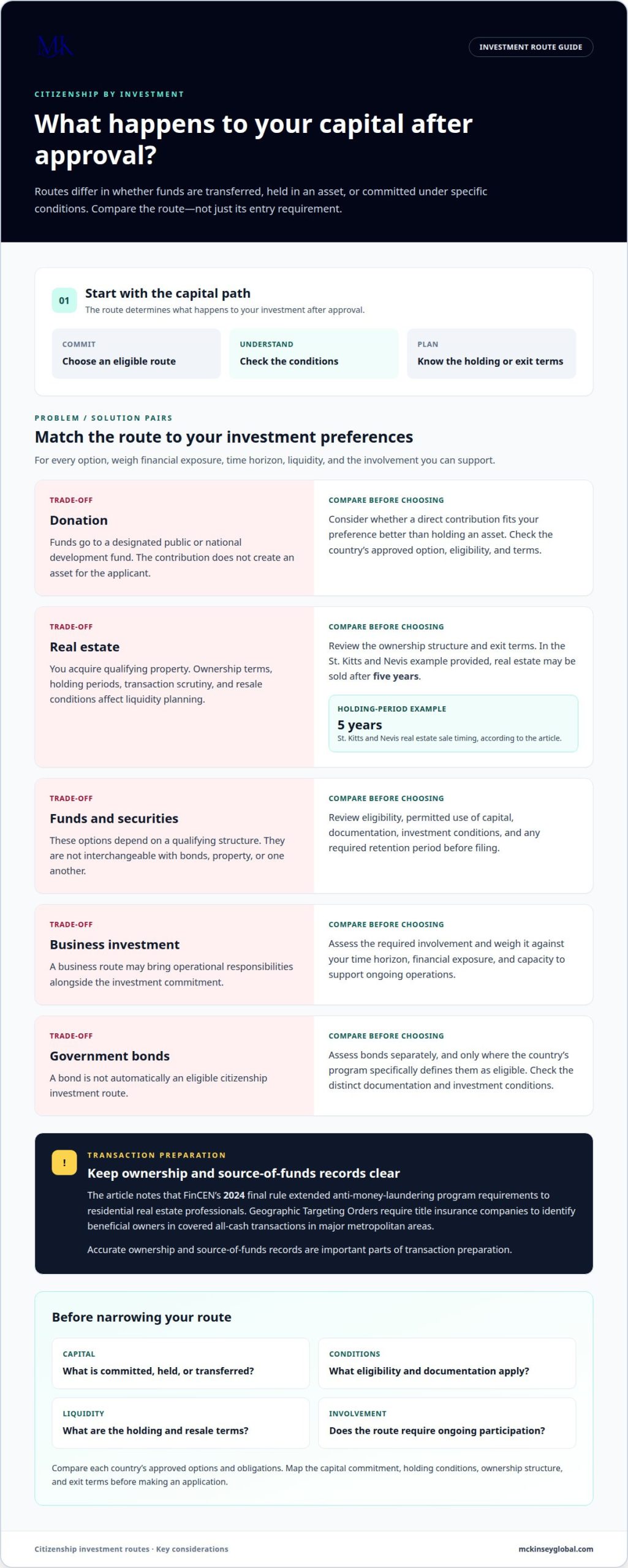
A donation transfers funds to a designated public or national development fund; it does not create an asset for the applicant. Real estate involves acquiring qualifying property, so assess ownership terms, holding periods, and resale conditions. Funds, securities, and business investments call for careful review of eligibility, permitted use of capital, and any required retention period. The route determines what happens to your investment after approval.
For example, St. Kitts and Nevis real estate may be sold after five years, according to the program fact provided. That holding period can shape liquidity planning. A business route may also involve operational responsibilities, while fund or securities options depend on their qualifying structure. Compare the route’s financial exposure with your intended time horizon and the degree of ongoing involvement you can support.
Donation and Government Bond Options
Caribbean programs include donation and real estate routes, but eligibility and terms vary by country. A donation may suit applicants who prefer a direct contribution over holding an asset; property may appeal to those seeking an investment they can later sell under program rules. Assess government bonds separately, and only when a country’s citizenship program specifically defines them as an eligible route.
For each route, map the capital commitment, holding conditions, ownership structure, and exit terms before filing an immigration application. Do not treat a government bond, fund, or security as interchangeable: each has distinct documentation and investment conditions. Real estate also brings transaction scrutiny. FinCEN’s 2024 final rule extended anti-money-laundering program requirements to residential real estate professionals; its Geographic Targeting Orders require title insurance companies to identify beneficial owners in covered all-cash transactions in major metropolitan areas. These requirements make accurate ownership and source-of-funds records important parts of transaction preparation.
Visa-free travel access
A passport’s value depends on the destinations you use, not just its headline access count. Compare entry rules for your regular business, family, and migration routes before weighing travel opportunities.
Published program figures differ: Antigua and Barbuda lists access to over 150 destinations, while Dominica lists 153 countries. St. Lucia lists 147 or more countries, and St. Kitts and Nevis lists 157 or more. These figures are not interchangeable; assess the specific destinations and entry conditions relevant to your plans.
Start with the destinations that matter to you. Then assess whether the passport offers visa-free entry, a visa on arrival, or another procedure for each one. Evaluate any passport against your actual itinerary rather than a general ranking. Travel access can change, so include current destination requirements in your planning.
For Americans, treat tax analysis and nationality disclosure as separate planning matters. U.S. visa applications, including DS-160 and DS-260, ask applicants to disclose all current and former nationalities. ESTA applications also require disclosure of all citizenships, including prior citizenships. Keep application answers consistent with your full nationality history.
Grenada citizenship may form part of a U.S. E-2 application pathway, but citizenship itself is not a U.S. visa. Consider that route separately from visa-free travel, and assess the application’s requirements and purpose rather than assuming a passport creates U.S. residence.
Golden visa programs provide residency, not immediate citizenship. Portugal’s program participants may apply for citizenship after 10 years, while Greece’s citizenship application may follow seven years of living in Greece. These routes involve residence timelines, so compare them with a direct citizenship program based on whether your objective is residency or nationality.
In 2024, the Court of Justice of the European Union issued a ruling questioning the EU portability of investment-only citizenship. That distinction matters: visa access, residency rights, and citizenship recognition are separate considerations. Include each in your comparison.
Choosing a citizenship-by-investment country
A sound shortlist starts with your intended outcome, not a ranking. Separate immediate citizenship objectives from residency plans, then compare eligibility, investment structure, travel needs, family inclusion, physical-presence conditions, and future obligations country by country. To identify the best citizenship by investment advisory for your case, look for a clear comparison of these factors rather than a recommendation based on one headline benefit.
Use a practical sequence. First, identify destinations where visa access would materially support your plans. Next, decide whether you need citizenship or residency, such as a European residency-by-investment route. Then assess each program’s investment structure, application requirements, due diligence, and ongoing conditions. A faster-seeming option is not automatically the best fit if its travel access or eligibility does not match your priorities.
Your family circumstances can also shape the decision. Review how each country defines eligible dependants, what evidence it requires, and whether family members follow the same application process. Consider physical-presence requirements alongside work, education, and travel commitments. These criteria can distinguish a practical route from one that looks attractive only on paper.
Distinguish direct citizenship programs from residency-by-investment programs. A golden visa creates a residency pathway; it is not immediate citizenship. In Europe, timelines and legal status differ by country, so consider whether you intend to live there or pursue a longer-term route. Program rules can change, making current eligibility and route conditions central to a careful comparison.
Finally, build a comparison table with your priorities, eligibility, investment route, presence requirements, family rules, travel destinations, and intended use. Mark each criterion essential or flexible to make trade-offs visible. The best citizenship by investment advisory should help you assess those trade-offs in the context of your objectives. To organize your country shortlist around these factors, discuss your investment objectives as a next step.
McKinsey Citizenship and Residency Solutions: Antigua and Barbuda Citizenship by Investment
McKinsey Citizenship and Residency Solutions helps investors assess Antigua and Barbuda Citizenship by Investment against their mobility and planning objectives. The firm also advises on St. Kitts and Nevis Citizenship and Dominica, while Greece Residency by Investment offers a residency route rather than direct citizenship.
Turn to the firm when you have narrowed your priorities and need to compare these pathways, understand the application process, and identify which option aligns with your circumstances. A focused discussion can clarify whether your goal is a second citizenship or residency, and which factors should guide your next steps.
To discuss your objectives, contact McKinsey Citizenship and Residency Solutions.
Make Your Next Move With Clarity
Your next step is to turn broad priorities into a considered decision: define the outcome you seek, identify the constraints you cannot compromise on, and compare the available pathways against both. The best citizenship by investment advisory should make those trade-offs clear, helping you proceed with a well-framed understanding of your objectives rather than relying on one headline benefit.
McKinsey Citizenship and Residency Solutions offers Antigua and Barbuda Citizenship by Investment, St. Kitts and Nevis Citizenship, and Greece Residency by Investment. These options provide a starting point for discussing whether your plans call for citizenship or residency, and which route merits closer consideration.
For a measured next step, contact McKinsey Citizenship and Residency Solutions to discuss your objectives and the pathways relevant to them. A clear decision begins with asking the right questions, and you can take that step with confidence.
Frequently Asked Questions
Does a Second Citizenship Require Passport Forfeiture?
No single rule applies across all countries. Whether you can retain an existing citizenship depends on the laws and procedures of the countries involved. Before applying, identify any nationality-retention rules affecting your current citizenship and the country offering the new one. Also consider disclosure requirements on visa or travel applications, which may ask for accurate information about current and former nationalities.
What is the best country to buy citizenship in?
There is no universally best country; the right choice depends on your priorities and eligibility. For example, an applicant focused on Caribbean mobility may compare Antigua and Barbuda, Dominica, St. Lucia, and St. Kitts and Nevis. Someone seeking European residency rather than immediate citizenship may need a different route. Rank destinations, investment structure, family needs, and future obligations before selecting a program.
What to Discover in This Guide?
This guide provides a framework for deciding whether an investment-based route fits your plans. Use it to distinguish citizenship from residency, compare investment structures, and assess how travel access relates to your intended destinations. It also highlights questions to resolve before applying, including family eligibility, source-of-funds documentation, residence expectations, and whether the route supports your longer-term objectives.
Who Can Apply?
Eligibility depends on the rules of the specific program and the applicant’s circumstances. Applicants generally need to meet that program’s due-diligence standards, document the origin of investment funds, and submit complete identity and financial records. Family members may qualify as dependants under program-specific conditions. For instance, some programs allow dependent children up to age 28-30 when they are in full-time education.
Who Can Obtain a Passport by Investment?
Eligible applicants may obtain citizenship through a qualifying investment route and then apply for the passport issued by that country. The passport is a travel document linked to citizenship, not a separate investment product. Applicants must meet the relevant program’s screening and documentation requirements. Approval of an investment application and issuance of a passport are distinct steps in the process.
Which citizenship-by-investment programs are currently available and what are their eligibility rules?
Citizenship-by-investment programs include routes in Antigua and Barbuda, Dominica, Grenada, St. Lucia, St. Kitts and Nevis, and Türkiye. Eligibility rules vary by country and investment route. Examine qualifying investment options, due diligence, source-of-funds evidence, family inclusion, and any physical-presence obligations. Residency programs, including Greece Residency by Investment and the Portugal Golden Visa, are distinct from direct citizenship pathways.