Citizenship by investment (CBI) is a route to citizenship through a qualifying investment under a country’s national program. Its reach extends beyond individual applicants: worldwide, an estimated 50,000 people, including applicants’ family members, obtain citizenship through investment programs annually. The available routes and eligibility rules vary by country.
It is understandable to focus first on the investment requirement, but choosing a Citizenship by investment (CBI) program also means considering processing time, family eligibility, and the differences between contribution and investment routes. A headline figure alone cannot show whether a program fits your priorities.
This guide explains how citizenship by investment works and compares application timelines, investment routes, family provisions, and estimated global uptake. Use these criteria to assess options systematically before deciding which ones merit closer attention.
Key Takeaways
- Compare programs by more than their investment route: processing time, eligibility rules, and your long-term priorities also shape the decision.
- Understand why application timelines differ and which stages can affect the overall process.
- Identify which family members may qualify and how citizenship may extend to future generations.
- Distinguish contribution-based options from real estate and other investment routes before assessing program fit.
- Use the global uptake estimate as context, then focus on the country-specific criteria that matter to your circumstances.
What is Citizenship by Investment?
Citizenship by investment (CBI) provides a route to nationality through a country’s legally defined investment program. More than 100 countries have legislation for residence or citizenship programs, while about 60 such programs are operating successfully.
Regional Citizenship Programs
The Caribbean has established programs in St. Kitts and Nevis, Dominica, Antigua and Barbuda, St. Lucia, and Grenada. Routes vary: Dominica offers a government donation or real estate investment, while Grenada offers a contribution to its National Transformation Fund or a real estate route. Outside the Caribbean, Egypt and São Tomé and Príncipe offer citizenship routes. Portugal and the UAE, by contrast, are associated with residency programs, not direct citizenship by investment.
Minimum investment requirements vary by jurisdiction and route. These figures are program thresholds, not a complete estimate of application expenses. Caribbean programs offer different contribution and investment routes, so compare each qualifying route and its conditions rather than treating the region as one uniform option.
| Program | Route or distinction | Minimum investment example |
|---|---|---|
| St. Kitts and Nevis | Four routes, including contribution, public benefit, and real estate | Varies by route |
| Dominica | Government donation or real estate | Varies by route |
| Antigua and Barbuda | Four routes, including development fund and approved real estate | Varies by route |
| St. Lucia | Contribution route | Varies by route |
| Grenada | National Transformation Fund or real estate |
Malta’s framework changed from its former investment program to citizenship by merit. The Government of Malta identifies Subsidiary Legislation S.L. 188.06, Legal Notice 159 of 2025, as part of that framework. Nauru’s Economic and Climate Resilience Citizenship Program began in 2024, adding an Oceania example; Egypt represents an African program.
Visa-Free Travel, Dual Citizenship, and Passport Strength
Passport access differs across Caribbean programs: the 2024-2025 snapshot lists St. Kitts and Nevis at 147 visa-free destinations, Antigua and Barbuda at 143, St. Lucia at 139, Dominica at 133, and Grenada at 137. These figures provide a travel-access comparison, not a single measure of passport strength. Dominica permits multiple citizenships through its program; rules for dual citizenship otherwise depend on the countries involved.
For Americans, the United States Congress introduced the EB-5 Reform and Integrity Act in March 2022. It concerns a U.S. investment immigration framework; a foreign country’s citizenship program has its own eligibility and application requirements.
Key risks include fraudulent intermediaries, changes to program rules, and possible loss of citizenship under a country’s laws. Reduce exposure by using the legally required application channel, reviewing current program rules, and understanding the consequences of inaccurate or incomplete disclosures before applying.
Application processing times
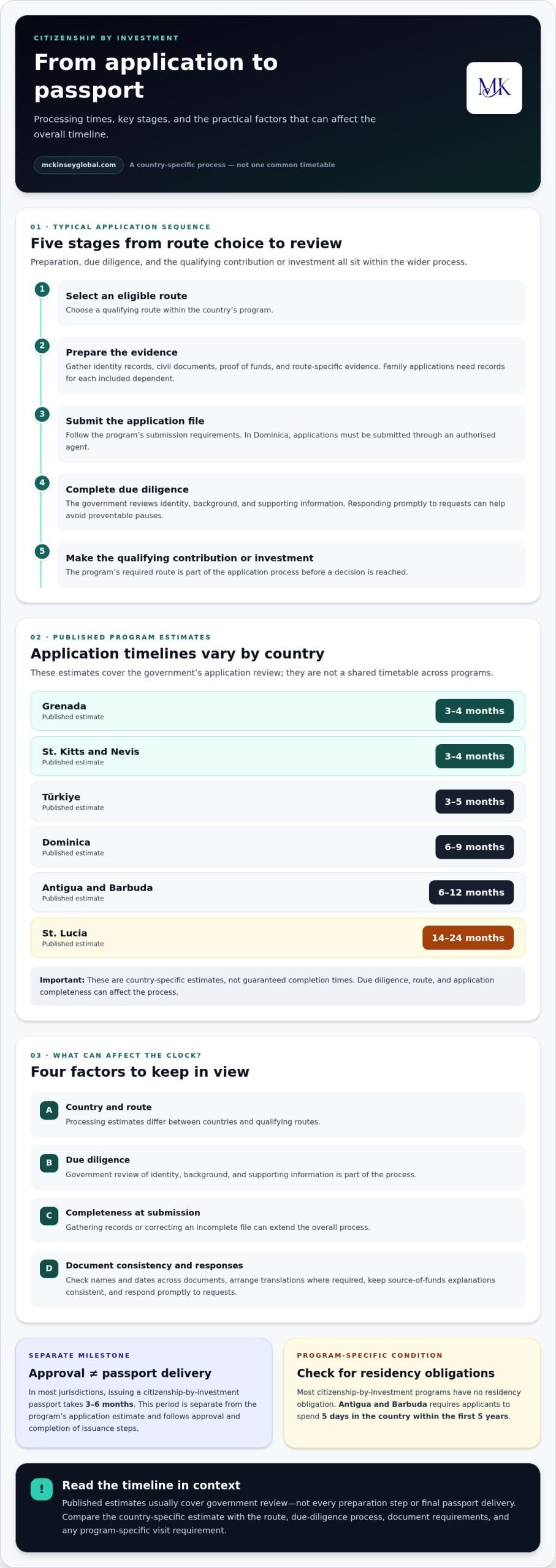
Processing time depends on the country, route, due diligence, and completeness of the application at submission. Published estimates usually cover the government’s review, not every preparation step or final passport delivery. Time spent gathering records or correcting an incomplete file can extend the overall process.
Published program estimates vary substantially. Grenada and St. Kitts and Nevis list three to four months; Türkiye lists three to five months. Dominica lists six to nine months, Antigua and Barbuda six to twelve months, and St. Lucia fourteen to twenty-four months. These are country-specific estimates, not a common timetable.
- Grenada: three to four months.
- St. Kitts and Nevis: three to four months.
- Türkiye: three to five months.
- Dominica: six to nine months.
- Antigua and Barbuda: six to twelve months.
- St. Lucia: fourteen to twenty-four months.
The process typically involves selecting an eligible route, preparing evidence, submitting the file, completing due diligence, and making the qualifying contribution or investment. The government reviews identity, background, and supporting information before reaching a decision. In Dominica, applications must be submitted through an authorised agent.
Thorough preparation can help the process proceed smoothly. Applicants typically gather identity records, civil documents, proof of funds, and route-specific evidence. Family applications require records for each included dependent. Check that names and dates match across documents, arrange translations where required, and keep source-of-funds explanations consistent. Respond promptly to requests to avoid preventable pauses.
Approval and passport delivery are separate milestones. In most jurisdictions, issuing a citizenship-by-investment passport takes three to six months, so distinguish that period from the program’s application estimate. Delivery follows approval and completion of the relevant issuance steps.
Most citizenship-by-investment programs have no residency obligation. Antigua and Barbuda requires applicants to spend five days in the country within the first five years. Any visit requirement is program-specific, not a universal condition before or after approval.
For tax planning, distinguish citizenship from tax residence. Consider where income arises, where you reside, and which national tax rules apply. A second passport alone does not determine your tax position. U.S. citizens and other applicants should consider their citizenship, residence, income, and applicable obligations.
For a route-specific preparation process, explore Antigua and Barbuda citizenship by investment and its application requirements.
Family eligibility and citizenship for future generations
Family applications may include relatives beyond the principal applicant, but qualifying relationships and age limits vary by country. Compare each program’s dependent rules with your family’s composition and long-term plans.
Eligible Family Members and Dependents
Some programs allow an applicant to include a spouse, children, and, in many cases, parents or grandparents. Dependent children may qualify up to age 28-30 when they’re in full-time education, while Antigua and Barbuda allows eligible children under 30. St. Kitts and Nevis lowered the qualifying age for a main applicant’s parent, or their spouse’s parent, to 55.
Eligible relatives may be included, but each person must meet the selected program’s requirements. Additional costs depend on the family members included and may arise from application, due diligence, and document-processing requirements. List the family members first, then compare each person with the program’s relationship, age, and dependency criteria.
Eligibility and Background Checks
Including relatives does not remove individual screening. Depending on the program and applicant, government assessments may examine identity, background, source of funds, and health information. Each dependent’s records should establish their relationship to the principal applicant and support their eligibility under the selected country’s rules.
Prepare civil documents, identity records, and financial evidence for the principal applicant and each relative. Keep names, dates, and relationship details consistent throughout the application. If a family member relies on education or financial dependency, include records that demonstrate the relevant circumstance. Clear documentation helps the government assess everyone in the file.
Citizenship for Future Generations
Family planning can extend beyond the initial application. Dominica citizenship obtained through its investment program is for life and can pass to future generations. This is different from adding an eligible child or parent to an application, which concerns relatives seeking citizenship alongside the principal applicant.
Before applying, consider how citizenship fits your future residence, education, and family plans. Citizenship and residency are distinct: acquiring nationality does not itself require a family to relocate. Most citizenship-by-investment programs have no residency obligation, while Antigua and Barbuda requires five days in the country within the first five years.
For a practical comparison, record each relative’s relationship, age, dependency status, and required evidence. Then compare how each country treats those details, including children approaching an age threshold and parents who may qualify as dependents. This helps distinguish immediate eligibility from potential citizenship by descent for future generations.
Investment routes
Citizenship programs offer different qualifying routes, from non-refundable contributions to approved real estate or public-benefit projects. Compare the structure, holding conditions, and eligibility requirements, not just the minimum threshold.
Donation Routes
A donation route involves making a qualifying contribution to a government fund or designated public purpose; it does not create a property asset for resale. Grenada’s National Transformation Fund is another contribution-based option. Before assessing whether a route fits, compare its qualifying terms and the purpose of the contribution.
A contribution is generally different from a bond or other investment: it is not an asset expected to be repaid. Assess bond-based options against the specific program terms, including any holding period and repayment conditions. Do not assume a bond and a donation have the same financial outcome.
Real Estate Routes
Real estate routes require investment in property or an approved development, rather than a direct contribution. Dominica’s real estate route lists a three-year holding period, while St. Kitts and Nevis lists seven years.
These conditions shape the investment horizon: consider how long your capital will be committed and what resale rules apply. A real estate route involves an asset, unlike a donation, but approval still depends on meeting the program requirements. Review the eligible project, holding period, and permitted ownership structure together.
Jurisdiction Options and Minimum Thresholds
Thresholds and qualifying routes vary by jurisdiction. These figures describe different program structures, not directly interchangeable investments.
Other examples show how routes vary. Dominica offers real estate investment or a government donation, while Antigua and Barbuda and St. Kitts and Nevis each offer four routes. St. Kitts and Nevis also offers a public-benefit investment option. A lower threshold alone does not establish which route is preferable.
Compare each opportunity using the same criteria: the qualifying contribution or asset, minimum holding period, route-specific conditions, and whether the investment can be recovered. Align those terms with your capital horizon and international travel or family objectives. This separates the route’s financial structure from the citizenship outcome and makes comparisons more practical.
Estimated global uptake of citizenship by investment
Worldwide, an estimated 50,000 people, including applicants’ family members, obtain citizenship through investment programs annually. This estimate places individual applications within a wider family context: it counts people, not only principal applicants. The figure describes annual uptake across programs, rather than the number of applications filed or one country’s share.
This distinction matters when interpreting the scale of the market. One application can include relatives, so the number of people receiving citizenship may exceed the number of principal applicants. The estimate describes citizenship obtained, not interest, enquiries, applications still under review, or residence permits. These are different measures and outcomes.
For prospective applicants, the global total provides context, not a forecast. It cannot establish how many people apply to a particular country, how quickly an individual application will proceed, or which route fits a family. Those questions depend on the jurisdiction, qualifying investment, eligibility rules, and completeness of the application.
Established and newer programs both contribute to the worldwide estimate, but their histories and routes differ. An aggregate cannot show how uptake is distributed between them. Start a comparison at the country level: identify the programs under consideration, then assess their requirements and family provisions individually.
Vanuatu is a country name readers may encounter in discussions of international citizenship options. The global estimate does not describe its individual uptake or explain how its program compares with others. Treat each jurisdiction as a separate decision rather than assuming a worldwide figure reflects a typical applicant’s experience.
For a useful comparison, separate the decision into three steps:
- Clarify whether the objective is citizenship or residency, since these are different outcomes.
- Compare qualifying routes and family eligibility within each country’s program.
- Assess the application timeline and requirements against your own circumstances.
This approach turns a broad global estimate into a practical starting point. It helps you avoid treating overall uptake as proof of program quality or personal suitability. An annual total, whether large or small, does not determine passport access, investment structure, or family eligibility. Assess those factors country by country.
To translate the comparison into a focused shortlist, assess citizenship and residency program options against your family structure, investment route, and international plans.
McKinsey Citizenship and Residency Solutions: Antigua and Barbuda Citizenship by Investment
McKinsey Citizenship and Residency Solutions helps investors assess and pursue Antigua and Barbuda Citizenship by Investment, aligning program requirements with their objectives, family structure, and preferred investment route. The firm also guides applicants considering St. Kitts and Nevis Citizenship, Dominica, or Greece Residency by Investment.
After comparing timelines, qualifying routes, and family eligibility, focused guidance can help you understand application requirements and organize the decision around your circumstances. If your priorities point toward Antigua and Barbuda, begin by assessing whether the program aligns with your goals and preparing for its application requirements.
For a considered discussion of your options, contact McKinsey Citizenship and Residency Solutions or visit mckinseyglobal.com.
Make Your Next Decision With Clarity
A Citizenship by Investment (CBI) decision is more than a choice of destination. It is a long-term commitment that should align with your mobility needs, family priorities, and financial strategy. Before proceeding, define what a successful outcome means to you and identify essential requirements, not just attractive features.
McKinsey Citizenship and Residency Solutions can help assess Antigua and Barbuda Citizenship by Investment, St. Kitts and Nevis Citizenship, and Greece Residency by Investment against your priorities. A focused discussion can turn broad research into a practical shortlist and clarify which questions matter most for your circumstances.
Take the next step when you are ready to explore your options: contact McKinsey Citizenship and Residency Solutions. A considered decision begins with clear priorities, and the right guidance can help you evaluate them with confidence.
Frequently Asked Questions
Who Can Take Part in the Program?
Adults who meet a country’s eligibility, due diligence, and investment requirements can apply as principal applicants. Applicants are generally expected to be at least 18 years old. Programs assess identity, background, and the origin of funds; family members can join only if they meet that program’s dependent criteria. Before selecting a route, map each applicant’s citizenship, family relationship, and supporting records against the country’s requirements.
Can you buy a passport in the Caribbean?
No. A passport is not purchased as a standalone document. An applicant applies for citizenship through a country’s lawful investment program and receives a passport after citizenship is granted. Caribbean programs use qualifying routes such as contributions or approved real estate investment. For example, Dominica offers a government donation or real estate route, and applications must be submitted through an authorised agent.
Does a Second Citizenship Require Passport Forfeiture?
Not necessarily. The answer depends on the laws of both countries involved. Dominica permits individuals to hold multiple citizenships through its investment program, but another country’s rules may differ. Before applying, find out whether your current nationality permits dual citizenship and whether acquiring another nationality triggers notification or other obligations. A passport documents nationality; it does not replace it.
How to Choose a Country of Second Citizenship?
Start by ranking your priorities, such as family inclusion, travel access, investment structure, and any physical-presence requirements. Compare them with each country’s program rules, application timeline, and route conditions. If you prefer an asset-based route, compare eligible real estate options and holding periods. If applying as a family, first assess dependent eligibility. Treat tax residence as a separate planning question.
What is CBI?
CBI means citizenship by investment: a country grants nationality to qualifying applicants who complete an approved investment route and pass the application review. Depending on the jurisdiction, the investment may be a contribution or approved real estate. CBI is a citizenship process, not simply a travel-document purchase. Each country sets its own rules, eligible family members, and qualifying routes.
Who Can Obtain a Passport by Investment?
A principal applicant may obtain a passport after qualifying for and receiving citizenship through an investment program. Applicants generally need to meet the program’s age, identity, background, and source-of-funds requirements. Eligible relatives may be included where the country permits dependent applications. Some programs allow children in full-time education to qualify into adulthood, subject to that country’s age and dependency rules.
What is citizenship by investment (CBI), and how does it differ from residency by investment?
Citizenship by investment grants nationality after an applicant completes a qualifying route and meets the country’s requirements. Residency by investment grants permission to live in a country under a residence status; it does not itself confer citizenship. Portugal’s Golden Visa and Greece’s residency program are residence routes, while programs such as Dominica’s offer a direct citizenship pathway.
Which countries currently offer citizenship by investment programs?
Citizenship-by-investment programs include Antigua and Barbuda, Dominica, Grenada, St. Kitts and Nevis, St. Lucia, Türkiye, Egypt, El Salvador, Nauru, and São Tomé and Príncipe. Their routes and eligibility rules differ, so check the specific country’s program rather than treating them as interchangeable. Malta’s current framework is citizenship by merit, not a standard priced investment program; Austria does not operate a standard priced program.