
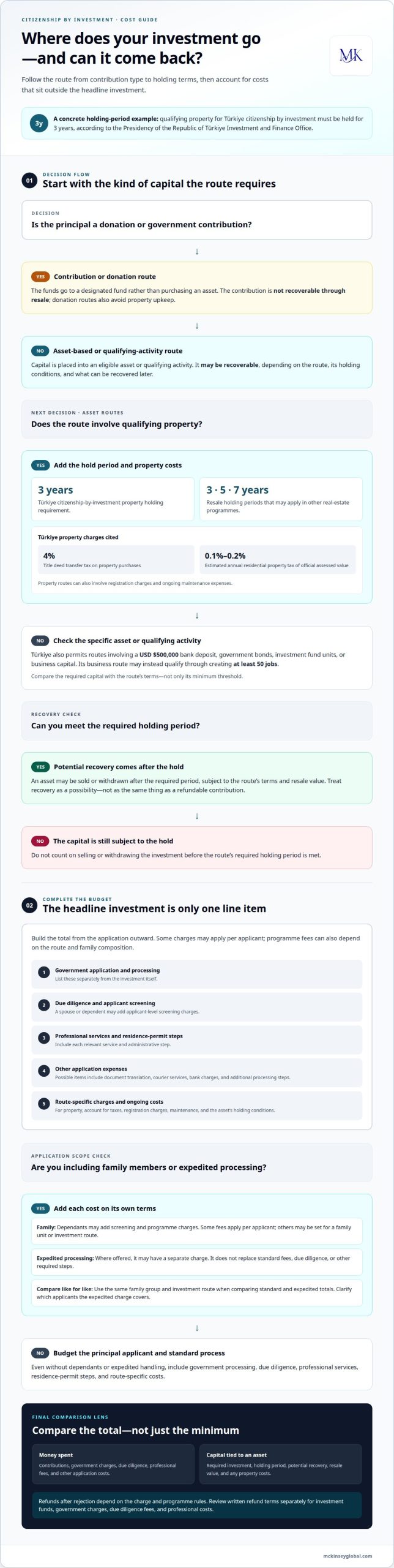
The headline investment is only part of the total: citizenship by investment hidden costs can include government processing, due diligence, family and professional fees, as well as expedited processing where available. Whether invested capital can be recovered depends on the route; contributions are different from assets that may be sold after a required holding period. For example, qualifying property in Türkiye must be held for 3 years, according to the Presidency of the Republic of Türkiye Investment and Finance Office.
It’s reasonable to focus on the minimum contribution when comparing programmes, but that figure alone does not show the full financial commitment or what may be recoverable later. A sound comparison considers the cash needed to complete an application and the conditions attached to any investment.
This article explains how government, residence, family, and expedited-processing charges affect the total cost, then compares contribution and asset-based routes in terms of capital recovery. You’ll also see which costs are generally spent rather than invested, and why holding requirements and resale value matter when planning your decision.
Key Takeaways
- Build a complete cost picture by accounting for government charges, due diligence, professional fees and other application expenses, not just the headline investment.
- Compare contribution routes with asset-based options to understand which funds are spent and which may be recoverable after the required holding period.
- Assess how family composition and processing choices can change the overall budget before selecting a programme.
- Use a like-for-like comparison of total costs, investment conditions and capital recovery prospects to narrow your options.
Residence permit and government application fees
Separate the investment from administrative charges before estimating the initial outlay. Government application and processing fees, due diligence, professional services, and residence-permit steps can appear as separate line items. Charges may apply per applicant, while programme fees can depend on the route and family composition.
Due diligence assesses each included applicant, so a spouse or dependent may add charges even when the main contribution stays unchanged. For example, a family application can have different total government fees from a single-applicant case. In Türkiye, the Presidency of the Republic of Türkiye Investment and Finance Office states that citizenship-by-investment property must be held for 3 years.
| Applicant or route | Fee basis to include |
|---|---|
| Main applicant | Government processing and individual due diligence |
| Spouse or dependent | Additional applicant-level screening and document processing |
| Property route | Application charges and the asset’s holding conditions |
Compare the total for every family member, and distinguish recoverable investment capital from fees that are spent.
If an application is rejected, refunds depend on the specific charge and programme rules. Review written refund terms for investment funds, government charges, due diligence fees, and professional costs as separate items.
For Americans, a second citizenship does not by itself settle US tax or reporting obligations. Those obligations depend on the person’s US tax status and relevant income, accounts, and assets.
After citizenship is granted, passport issuance, renewals, and replacement documents can bring further costs. The timing and charges depend on the document and issuing authority.
Unexpected costs may include document translation, courier services, bank charges, or additional processing steps. Fraud risks include misleading fee claims and unauthorised representation. Use a licensed agent or authorised representative when the programme requires one.
Comparing minimum contributions and total programme costs
A minimum contribution is only one part of the comparison: the route determines whether capital is donated or invested. Compare the amount, potential recovery, holding period, and any additional property costs.
Government Contributions and Donations
A donation or government contribution goes to a designated fund rather than purchasing an asset. It can make the initial outlay easier to compare, but donation capital is not an asset that can be resold.
Minimum Investment Thresholds
Investment thresholds apply to routes that place funds into eligible assets or qualifying activity. Türkiye also permits routes involving a USD $500,000 bank deposit, government bonds, investment fund units, or business capital; its business route may instead qualify through creating at least 50 jobs. Compare the required capital with the route’s terms, not just the minimum.
Holding Periods and Additional Charges
Holding periods affect when invested capital may be sold or withdrawn. The Presidency of the Republic of Türkiye Investment and Finance Office states that Turkish citizenship-by-investment property must be held for 3 years. Other real-estate programmes may require resale holding periods of 3, 5, or 7 years. Property routes can also bring taxes, registration charges, and ongoing maintenance expenses.
For a practical comparison, list each route’s contribution, asset threshold, holding period, and additional costs separately. Türkiye charges a 4% title deed transfer tax on property purchases, while estimated annual residential property tax is 0.1%-0.2% of official assessed value. Donation routes avoid property upkeep, but the contribution itself is not recoverable through resale. For further context, compare Caribbean programme routes against investment-based alternatives.
Family application and expedited processing costs
Family size can change the total substantially, because dependants may add screening and programme charges. Expedited processing is a separate budget item, not a replacement for standard application costs.
Single-Applicant and Family Costs
Compare totals for the same route and investment, then add the costs for each family member. These are example totals, not a universal family-pricing formula.
The difference between these illustrative totals shows why applicants should examine the fee structure rather than multiply one figure mechanically. Some charges apply to each applicant; others are set for a family unit or investment route. Prepare a comparison that lists the principal applicant, spouse, and each dependant separately. Check which family members qualify under the chosen programme and whether including them changes due diligence or government processing charges.
Expedited Processing Costs
A faster-processing option, where offered, may carry its own charge. Separate it from standard government fees, applicant screening, and professional costs in your budget.
Request a cost breakdown that identifies the expedited-processing charge and the applicants it covers. Compare it with the programme’s standard timeline and your family’s actual timing needs. Faster handling does not remove due diligence or other required steps, so keep those line items in the total. For a family with several applicants, clarify whether the charge applies to each case or to the application as a whole.
For a practical comparison, set the standard and expedited totals side by side using the same family group and investment route. This shows whether the additional charge suits your family’s timeline without obscuring the underlying cost of acquiring citizenship.
All-in citizenship by investment costs
The all-in figure is the amount needed to complete an application, not just the qualifying contribution. For an international comparison, include the investment programme’s government contribution, processing charges, due diligence, professional costs, and route-specific expenses. Assessing citizenship by investment hidden costs starts with every required payment, not just the headline amount.
These estimates combine the main investment with government fees, due diligence, and typical agent fees; they are not client service prices.
| Programme | All-in estimate, single applicant | Comparison point |
|---|---|---|
| Dominica | Contribution or approved real-estate route | |
| Antigua and Barbuda | Contribution or investment route | |
| Saint Lucia | Compare contribution and asset conditions | |
| St. Kitts and Nevis | Include programme and screening charges | |
| Türkiye | Property or other qualifying investment routes |
Use these estimates as a like-for-like starting point, then compare each total with the route’s actual requirements. A real-estate option may involve property-related processing, while a contribution route does not create an asset to sell. Professional fees and international document handling can also affect the amount needed before citizenship is granted. To identify citizenship by investment hidden costs, separate required expenses from capital that may later be recoverable.
For a decision-ready comparison, separate recoverable investment capital from spent charges, then account for family members and holding conditions. Request a programme cost comparison to assess the total against your preferred route and circumstances.
McKinsey Citizenship and Residency Solutions
McKinsey Citizenship and Residency Solutions helps investors assess citizenship and residency by investment options in light of their financial priorities and family circumstances. Its guidance helps clarify how programme contributions, government charges, due diligence, and potentially recoverable investments factor into the decision.
For applicants comparing routes, the firm supports Antigua and Barbuda Citizenship by Investment, St. Kitts and Nevis Citizenship, Greece Residency by Investment, and Dominica. Start by identifying whether citizenship or residency is your priority, then compare eligible routes by total costs, family requirements, and the terms for holding or recovering invested capital.
Contact McKinsey Citizenship and Residency Solutions to discuss how these considerations apply to your programme options.
Make the next decision with a clear capital strategy
Before choosing a route, decide what role the investment should play in your wider financial plan. A contribution may support an application without creating an asset to recover, while an investment route can tie up capital subject to holding conditions and future resale considerations. The practical question is not only what it takes to qualify, but whether the structure aligns with your priorities after citizenship or residency is granted.
Use this distinction to frame your next discussion: clarify your preferred outcome, identify which capital you hope to preserve, and consider how family circumstances shape the decision. Citizenship by investment hidden costs are easier to assess when you consider the budget and recovery strategy together. Individual outcomes depend on the selected programme and its terms.
Comparing relevant programme options against these priorities can help clarify which route may fit. Contact McKinsey Citizenship and Residency Solutions to discuss your next step. A considered comparison can put your decision on firmer strategic ground.
Frequently Asked Questions
Is It Possible To Recover Capital Invested In This Way?
Recovery may be possible when a route puts capital into an asset that can later be sold or redeemed. A government contribution or donation is generally not recoverable as investment capital. For property or bonds, distinguish eligibility rules from resale value: market conditions, transaction expenses, and programme holding terms affect the amount ultimately recovered.
What are the official government fees for citizenship by investment programs?
Government fees depend on the country, investment route, and people included in the application. Separate contribution requirements from application, processing, and passport-related charges: they are distinct budget items. For a useful comparison, request a country-specific breakdown showing which amounts go to the government, which apply per applicant, and which relate to the selected investment route.
What additional due diligence and background check fees apply to citizenship by investment?
Due diligence charges may apply to every applicant screened, including a spouse or eligible dependent. Some programmes set different charges by age, so a child’s fee may differ from an adult’s. Keep screening costs separate from government processing and professional fees, and include every family member named in the application when estimating the total.
What are the legal, agent, and application processing fees for citizenship by investment?
Legal, agent, and processing charges are separate parts of the application budget, and their structure depends on the programme and work involved. A clear breakdown distinguishes professional representation from government processing, document preparation, and any bank or courier expenses. This shows what each charge covers and prevents the quoted service scope from being mistaken for the complete programme cost.
Are there extra costs for spouses, children, parents, or other dependents?
Adding family members can change the total because each person may bring screening, document, and processing requirements. Eligibility also varies by programme and relationship, so a spouse, child, or parent may not be treated identically. Build your estimate around the actual family group, listing each dependant and their relationship before comparing programme totals or choosing an investment route.
How do total citizenship by investment costs compare across countries?
Compare countries by route, not by headline contribution alone. Donation-based and property-based options tie up capital differently, while government charges, due diligence, and professional expenses affect the final budget. For example, compare Dominica’s contribution route with property-based options in Antigua and Barbuda or Türkiye, then assess holding conditions and potential recovery alongside the total outlay.