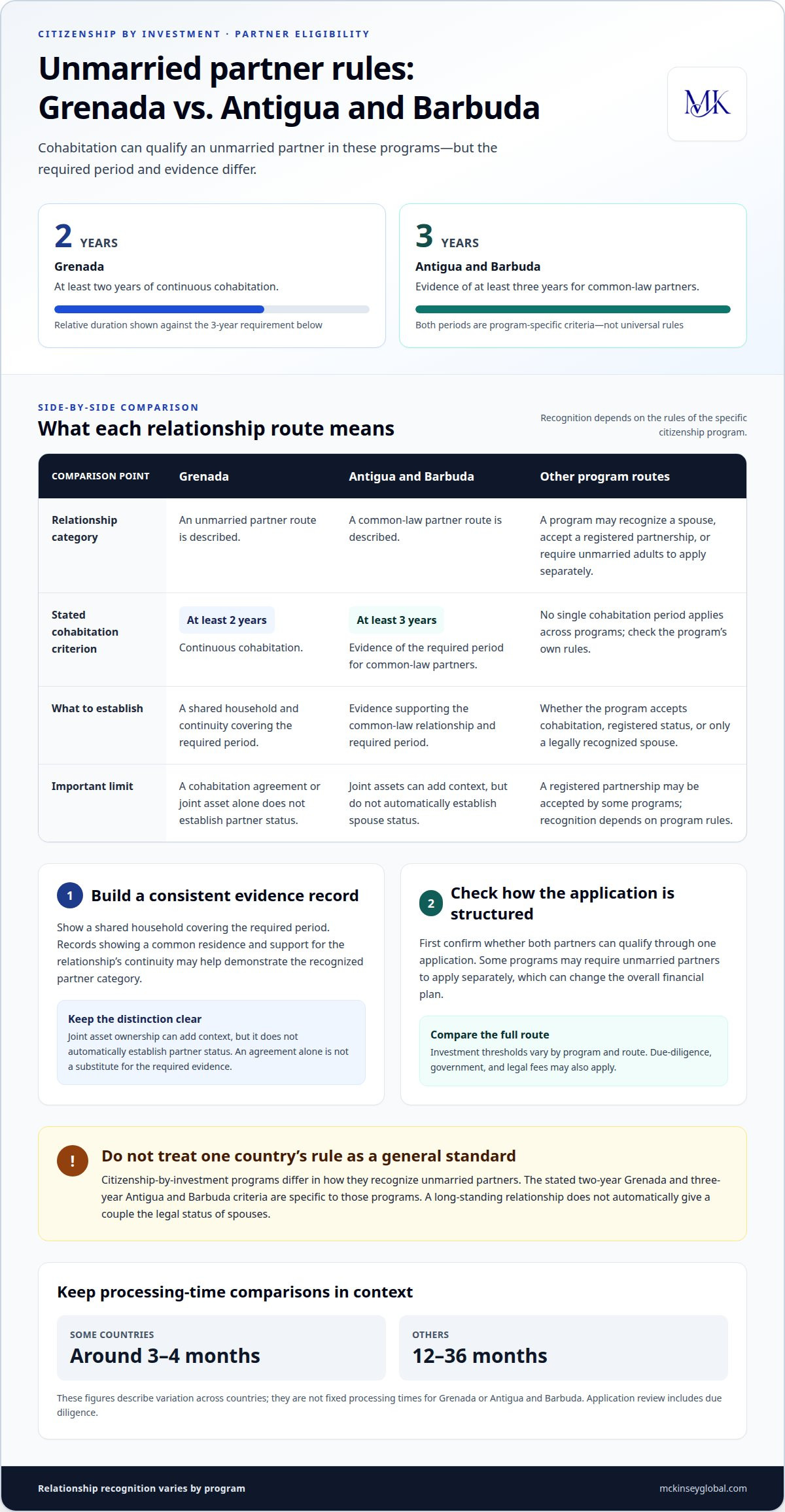
An unmarried partner may be included in some citizenship by investment applications, but living together does not automatically give a couple the legal status of spouses. Eligibility for citizenship by investment for unmarried partners depends on how each program recognizes the relationship. Grenada generally requires at least two years of continuous cohabitation, while Antigua and Barbuda requires evidence of at least three years for common-law partners.
A long-standing relationship may feel clear-cut, but each program applies its own eligibility criteria. One jurisdiction may recognize a registered partnership or civil union while another treats it differently. Some programs may require unmarried partners to apply separately.
This guide compares the main ways programs recognize relationships and explains how cohabitation evidence, civil-union status, and rules for same-sex partners can affect eligibility. To narrow your options, first identify the relationship category a program accepts, then assess whether your documents establish that status.
Key Takeaways
- Identify whether a program recognizes your relationship as a spouse, registered partner, or common-law partnership before assessing eligibility.
- Organize evidence that demonstrates a shared household and the continuity of your relationship; joint assets alone may not establish partner status.
- Distinguish marriage recognition from unmarried-partner recognition, including how rules may apply to same-sex couples.
- Compare civil unions and cohabitation agreements by the legal recognition they provide in the relevant jurisdiction, not by their name alone.
Citizenship by investment program options
Citizenship by investment programs differ in how they recognize unmarried partners. The key eligibility question is whether the program accepts cohabitation, a registered partnership, or only a legally recognized spouse.
Program Costs and Investment Thresholds
Investment thresholds vary by program and route, so the contribution amount alone does not reflect the full cost. Due-diligence, government, and legal fees may also apply. For unmarried partners, first establish whether both applicants can qualify through one application. Separate applications can change the overall financial plan.
Caribbean citizenship-by-investment programs include Antigua and Barbuda, Dominica, Grenada, St. Kitts and Nevis, and St. Lucia. Türkiye also has a citizenship-by-investment program. Compare each route’s investment structure and partner-recognition rules rather than choosing by threshold alone.
Programs Requiring Legal Marriage
A citizenship-by-investment program may recognize a spouse but not an unmarried partner. Some programs may accept a registered partnership, while others may require each adult in an unmarried couple to apply separately. The available facts do not establish that a specific program always requires legal marriage, so distinguish a spouse-only rule from one that accepts another documented status.
For example, Grenada generally requires at least two years of continuous cohabitation for unmarried partners. Antigua and Barbuda requires evidence of at least three years for common-law partners. These are specific relationship criteria, not universal rules.
| Option | Partner recognition | Relationship criterion |
|---|---|---|
| Grenada | Unmarried partner route | At least two years’ continuous cohabitation |
| Antigua and Barbuda | Common-law partner route | At least three years’ cohabitation evidence |
| Registered partnership | May be accepted by some programs | Recognition depends on program rules |
| Separate applications | May apply to unmarried couples | Each adult applies individually |
Match your documented relationship to the program’s eligibility category, then compare the investment route and additional fees.
Cohabitation requirements in Grenada and Antigua and Barbuda
Grenada and Antigua and Barbuda recognize qualifying unmarried relationships under specific cohabitation criteria. The shared household’s duration and continuity matter. An agreement or joint asset alone does not establish partner status.
Grenada generally requires at least two years of continuous cohabitation. Antigua and Barbuda requires evidence of at least three years for common-law partners. These are the two programs in this comparison with stated cohabitation rules for unmarried partners.
The relevant official criteria are those of the government-administered citizenship programs in Grenada and Antigua and Barbuda: at least two years of continuous cohabitation in Grenada, and evidence of at least three years in Antigua and Barbuda.
Build a consistent record of a shared household covering the required period. Examples may include documents showing a common residence and records supporting the relationship’s continuity. Joint asset ownership can add context, but it does not automatically establish spouse status. Since unmarried partners do not have a marriage certificate, the application must demonstrate the partner category the program recognizes.
Applications proceed through the relevant program’s submission and review stages, including due diligence. Some citizenship applications take around 3-4 months in some countries, while others take 12-36 months. Those figures describe variation across countries, not a fixed timetable for Grenada or Antigua and Barbuda. Citizenship applications also differ from residency-by-investment routes, which involve a residence permit rather than direct citizenship.
If a partner is refused, that partner may not receive citizenship through the application. If the relationship ends during processing, the basis for the couple’s eligibility may change, so disclose material changes through the application process. For an application requiring a spouse, a marriage certificate establishes the marriage, but it does not replace the distinct cohabitation evidence required for an unmarried partner.
Same-sex spouses and partner recognition
Citizenship-by-investment rules generally give a legally recognized spouse a clearer route than an unmarried partner. A spouse may qualify as a dependent when the program recognizes the marriage; an unmarried partner may need registered status or a separate application. This distinction concerns eligibility, not whether the relationship is same-sex.
Greece’s 2024 marriage equality law allows same-sex spouses married abroad to qualify directly. This recognition can support a spouse’s eligibility, while an unmarried partner must meet the relevant program’s separate relationship criteria. A marriage certificate is a key document for establishing that applicants are spouses.
Family categories may distinguish spouses from other dependents. Some citizenship programs allow dependent children and, in certain cases, dependent parents or grandparents. These relatives do not qualify through a spouse’s status alone; each must meet the program’s dependent criteria. Identify every family member under the correct category in the application.
Antigua and Barbuda allows a principal applicant to add a future spouse after citizenship through a post-approval addition route. This may matter when a couple marries after the principal applicant becomes a national. It is different from including a spouse in the initial application and does not create an automatic route for an unmarried partner.
If both partners are approved and granted citizenship, each holds citizenship individually under the destination country’s rules. One partner’s approval does not by itself confer citizenship on the other. The practical question is whether the spouse was included and approved or whether the second partner must qualify through a separate route.
A golden visa is a residence route, not necessarily a citizenship application, so its rules for dependents may differ. Before signing forms, classify the relationship accurately and distinguish a spouse, registered partner, and unmarried partner. That classification can affect the application, dependent children, and any later spouse addition.
Civil unions and notarized cohabitation agreements
A civil union, cohabitation agreement, and marriage certificate are distinct documents. Their immigration value depends on how the destination country recognizes each relationship category. A notarized agreement can record shared arrangements, but joint assets alone do not automatically establish spouse status in a citizenship application.
Portugal defines a de facto partnership as two people living together for more than two years in conditions comparable to marriage. This definition may help establish a relationship for relevant migration procedures, but it does not make every document equivalent to a marriage certificate. Portugal Golden Visa family rules and citizenship-by-investment rules are separate frameworks, so distinguish residence eligibility from citizenship eligibility.
Other countries illustrate why recognition must be assessed by jurisdiction. Greece has allowed same-sex couples to enter cohabitation agreements since 2015; those agreements can affect property relations, financial claims, and inheritance. Italy has treated civil unions as equivalent to marriage for immigration purposes since 2016. Cyprus has recognized civil unions, including same-sex civil unions, since 2015.
The United Arab Emirates made cohabitation lawful through its 2021 personal status reforms. That change concerns legality, not automatic recognition as a spouse in every international application. A legal agreement may document a relationship, yet a program can still apply its own dependent-partner criteria.
For an application, group evidence into three categories: civil-status documents, proof of shared residence, and records showing the relationship’s duration. Keep the original agreement and supporting documents together, and check that names and dates are consistent throughout the file. An agreement supports the record but does not replace formal status when a program requires it.
For guidance on how relationship documents relate to residence eligibility, discuss Portugal Golden Visa options.
McKinsey Citizenship and Residency Solutions
McKinsey Citizenship and Residency Solutions helps investors assess citizenship and residency pathways alongside family eligibility. For unmarried partners, the key step is matching the relationship’s legal documentation to the selected program’s dependent rules before preparing the application.
Relevant options include Antigua and Barbuda Citizenship by Investment, St. Kitts and Nevis Citizenship, Dominica, and Greece Residency by Investment. Each pathway has distinct eligibility criteria. Compare relationship recognition, application structure, and whether the goal is citizenship or residence.
Use this guidance when narrowing program options or considering how a civil union, cohabitation history, or later marriage may affect your plans. Contact McKinsey Citizenship and Residency Solutions to discuss your circumstances and potential pathway.
Make partner eligibility part of the decision
A sound plan for citizenship by investment for unmarried partners starts with the outcome you want, not simply the investment route. Decide whether both partners need citizenship, whether one partner’s residence is sufficient, and how you want family status documented over time. Those priorities help identify which program categories to consider.
Before moving forward, organize the decision around three points: the relationship status the program recognizes, the evidence supporting that status, and the outcome each partner seeks. This gives you a clearer basis for assessing the application structure and spotting issues that could affect either partner before documents are submitted.
Because partner recognition can influence eligibility and planning, tailored guidance can help you evaluate the available pathways against your circumstances. Contact McKinsey Citizenship and Residency Solutions to discuss your next steps and proceed with a more informed plan.
Frequently Asked Questions
Can I Include My Girlfriend or Boyfriend in My CBI Application?
Sometimes, but being in a relationship does not automatically make someone eligible as a dependent. Citizenship by investment for unmarried partners depends on whether the program recognizes the relationship and whether its conditions are met. Grenada generally requires at least two years of continuous cohabitation; Antigua and Barbuda requires evidence of at least three years. Other programs may accept registered partnerships or require separate applications.
What Is a Common-Law Partner in the Context of CBI?
A common-law partner is generally an unmarried person whose relationship is demonstrated through a continuous shared life rather than a marriage certificate. The precise legal meaning varies by program and country. For citizenship by investment, the program’s eligibility rules determine what duration and evidence count. Distinguish this status from a civil union or registered partnership, which may have separate legal recognition.
Which countries offer citizenship by investment programs?
Countries with citizenship-by-investment programs in 2026 include Antigua and Barbuda, Dominica, Egypt, Grenada, Jordan, Malta, Nauru, São Tomé and Príncipe, St. Kitts and Nevis, St. Lucia, and Türkiye. This identifies countries with programs, not a guarantee that every program accepts an unmarried partner. Family eligibility is a separate criterion, so compare relationship recognition as well as investment routes.
Can an unmarried partner be included as a dependent in citizenship by investment applications?
Yes, if the program recognizes the couple’s relationship and they meet its eligibility conditions. Citizenship by investment for unmarried partners may involve a registered partnership, a recognized cohabiting relationship, or separate applications, depending on the program. The principal applicant’s eligibility does not itself establish the partner’s dependent status. Identify the relevant relationship category before structuring the family application and preparing documents.
What proof of a genuine unmarried partnership do citizenship programs require?
Evidence should show a continuous shared household and a relationship that meets the program’s duration rule. Organize records across the relevant period to make the timeline clear, and ensure names and dates align across documents. A notarized cohabitation agreement or joint asset ownership may support the record, but neither automatically establishes spouse status. The program’s criteria determine which evidence is relevant.
What are the investment amounts, government fees, and partner-related costs?
Investment thresholds and fees vary by country, program, and route, so there is no single amount for an unmarried couple. Applications may also involve due-diligence, government, and legal fees. Partner-related costs depend on whether the partner joins one application, qualifies as a dependent, or applies separately. Assess the full application structure, not just the principal investment threshold.