
For the best citizenship by investment for visa-free travel to China, Dominica is a clear Caribbean option: Dominican citizens can enter mainland China visa-free for up to 30 days per entry. Dominica and China signed their mutual visa waiver agreement in November 2021. This access gives China-focused applicants a specific benefit to weigh alongside broader passport mobility.
Visa-free travel to China is only one factor in choosing a citizenship-by-investment route. The passport’s wider travel access, the application requirements and the possibility of policy changes all matter when assessing its long-term value.
This article compares Dominica with other relevant Caribbean options, explains how citizenship-by-investment applications generally proceed, and outlines the risks of relying on visa-free access. It offers a clearer basis for deciding whether China access or broader travel flexibility should carry more weight.
Key Takeaways
- Compare Caribbean passport options by China entry rights and broader travel access, rather than relying on a single passport-ranking figure.
- Factor residence obligations and application timelines into your decision, since requirements differ across programs.
- Assess how policy changes and scrutiny of investor citizenship schemes could affect visa-free access over time.
- Understand the main application stages and what can influence processing before choosing a route.
- Consider whether Dominica’s China access aligns with your travel plans, while weighing the limits that apply to visa-free visits.
Which Caribbean passports offer visa-free entry to China?
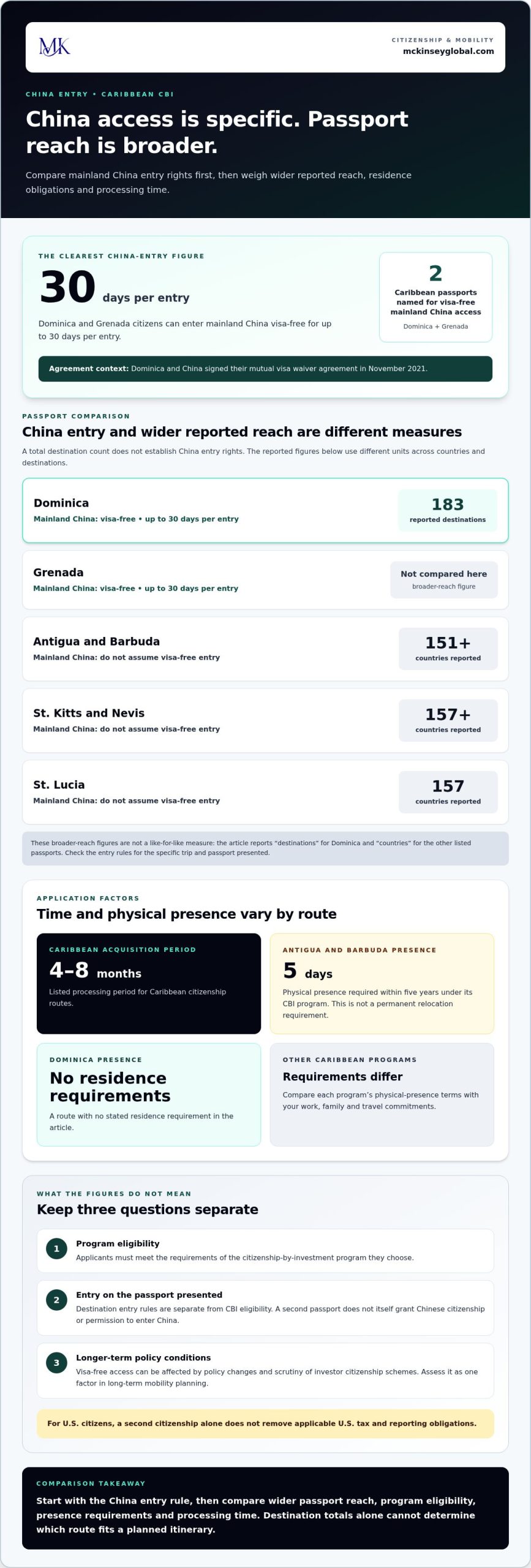
Dominica and Grenada citizens can enter mainland China visa-free for up to 30 days per entry. For investors comparing Caribbean passports, this specific access is distinct from wider destination totals.
Caribbean Citizenship-by-Investment Programs
Caribbean citizenship-by-investment programs include routes in Antigua and Barbuda, Dominica, Grenada, St. Kitts and Nevis, and St. Lucia. Each government grants its own citizenship, while the passport determines the holder’s travel access. For mainland China, Dominica and Grenada are the relevant choices discussed here. Do not assume other Caribbean programs provide the same access.
The best citizenship by investment for visa-free travel to China depends on whether China access outweighs your other priorities. China does not offer a golden visa or citizenship-by-investment program, so a Caribbean investment route cannot directly grant Chinese citizenship. U.S. citizens can obtain a second citizenship through investment. Their U.S. tax and reporting obligations remain subject to applicable U.S. rules; a second passport alone does not remove them.
Citizenship-by-investment eligibility and destination entry are separate questions. Applicants must meet the relevant program’s requirements, while travelers must qualify under the rules for the passport they present. An individual who does not meet a program’s eligibility conditions may be unable to use that route. The rules do not necessarily apply in the same way to every applicant.
Visa-Free Travel Figures by Program
Passport-wide destination totals offer context, but they do not establish entry rights to China. The comparison below distinguishes mainland China access from broader reported reach, noting that the figures use different units across countries and destinations.
| Passport | Mainland China access | Reported broader reach |
|---|---|---|
| Dominica | Visa-free, up to 30 days per entry | 183 destinations |
| Grenada | Visa-free, up to 30 days per entry | Not compared here |
| Antigua and Barbuda | Do not assume visa-free China entry | 151+ countries |
| St. Kitts and Nevis | Do not assume visa-free China entry | 157+ countries |
| St. Lucia | Do not assume visa-free China entry | 157 countries |
To find the best citizenship by investment for visa-free travel to China, compare the specific China entry rules first, then weigh wider destination access and program eligibility. A total destination count alone cannot show whether a passport suits your planned itinerary.
Why Citizenship by Investment?
Citizenship by investment can provide a second passport and additional destination-access options. Its practical value depends on your travel priorities, the program’s residence conditions, and the rules for each passport. A visa-free destination count alone does not show whether you meet those conditions or can enter China.
Residence obligations and processing periods are separate considerations. Caribbean citizenship routes are listed as taking four to eight months, while physical-presence requirements vary by country. Compare each program’s residence obligation with your ability to spend time there; do not assume all investment programs work in the same way.
Residence Requirements and Physical Presence
Antigua and Barbuda requires five days of physical presence within five years under its citizenship-by-investment program. This is a defined post-citizenship obligation, not a requirement to relocate permanently. Dominica’s program has no residence requirements, which may suit applicants seeking limited physical ties. These differences can affect how well a route fits your work, family and travel commitments.
Before choosing, separate three questions: how long an application may take, whether the program requires physical presence, and which destinations the resulting passport can access. The stated Caribbean acquisition period is four to eight months, but that does not replace checking each program’s residence terms. Citizenship may broaden mobility, but it does not automatically provide the right to live or work in every destination.
China Entry and Other Nationalities
Chinese nationals planning international travel should distinguish their current passport’s entry rules from any future passport’s access. Visa requirements depend on the destination and the passport presented; citizenship by investment does not itself grant permission to enter China. China’s unilateral visa-free policy for most eligible countries is scheduled to remain in effect through December 31, 2026, so its scope and end date matter when planning a trip.
Türkiye’s program illustrates why destination totals need careful interpretation. Turkish citizenship by investment lists visa-free access to over 110 destinations, but that figure alone does not establish visa-free entry to China. Applicants focused on China should assess China entry separately from Türkiye’s broader passport reach, and distinguish a visa waiver from transit arrangements.
Chinese passport holders considering travel to Türkiye should treat destination entry rules separately from citizenship-program requirements. A second citizenship does not automatically change the rules for travel on a Chinese passport. For any trip, identify the passport you will use, establish the applicable entry category, and then compare program residence commitments and processing.
For applicants weighing Antigua and Barbuda’s presence requirement against broader mobility priorities, citizenship planning considerations can help frame the comparison around travel patterns and residence commitments.
Visa-free access risks linked to investor citizenship schemes
Yes. Mainland China, Hong Kong, and Macau have distinct entry arrangements. Grenada and Dominica citizens may enter mainland China visa-free for up to 30 days per entry, and Hong Kong permits them stays of up to 90 days. Macau should be assessed separately rather than assumed to follow either arrangement.
A visa waiver is a policy benefit, not a permanent feature of a passport. The United Kingdom withdrew visa-free travel from Dominica, Honduras, Namibia, Timor-Leste and Vanuatu, citing abuse of citizenship schemes, including grants to people considered a risk. This illustrates how government decisions can change travel access beyond an investor’s control.
For Grenada and Dominica, the mainland-China allowance is up to 30 days per entry. It differs from Hong Kong’s separate 90-day visa-free stay for citizens of both countries. Travellers should distinguish the territory they plan to visit, the passport they will present, and the permitted purpose and duration of each stay. A single “China access” label can conceal materially different entry conditions.
Passport totals also require context. China ranks 117th of 199 on the La Vida Passport Value Index, while its passport offers access to 86 destinations without a prior visa. These figures describe different measures: a ranking compares passports, while destination access counts places. Neither establishes the economic value of a second citizenship or guarantees access to a particular destination.
São Tomé and Príncipe passport holders can obtain e-visa access to Qatar and the UAE. That is not visa-free entry and does not indicate access to mainland China. Nauruan passport holders have visa-free access to Hong Kong, Singapore and the UAE. These examples show why applicants should compare each destination’s entry category instead of treating all passport benefits as equivalent.
If you are considering Dominica, Grenada or St. Kitts and Nevis, assess policy exposure alongside current access. Government decisions, including responses to perceived risks in investment programs, can affect a passport’s travel permissions. Visa-free access is a planning factor, not an unconditional guarantee. The United States has its own entry rules; Caribbean citizenship does not itself establish a right to enter the country.
Before selecting a route, map your intended destinations individually: mainland China, Hong Kong, Macau and any onward countries. Record whether each requires visa-free entry, an e-visa or another authorization. This helps distinguish broad visa-free access from a passport that serves a specific travel objective.
What is the application process for these CBI programs?
A citizenship-by-investment application typically moves through preparation, submission, assessment, and a final citizenship stage. Each cbi program sets its own documents and procedures, so applicants should organize identity, financial, and family records around that program’s requirements. Processing time also varies: listed estimates range from around 3-4 months to 12-36 months, depending on the program.
Processing figures describe different routes and may use different milestones. Caribbean investment routes are listed as taking four to eight months. Dominica’s acquisition period is listed as at least 6 months, while St. Kitts and Nevis’s is at least 4 months. Investors can obtain St. Kitts and Nevis citizenship in as little as nine months. These figures should be read as program-specific estimates, not interchangeable promises.
For Dominica, the listed minimum acquisition period is 6+ months. For Grenada, no program-specific processing figure appears in the available article facts, so the general processing range cannot be treated as a Grenada estimate. Applicants should distinguish the time needed to prepare a complete application from government assessment and later passport issuance. Each stage can affect the date citizenship is obtained.
Typical Application Stages
- Select a route. Compare the program’s eligibility rules, residence conditions, and qualifying investment route, including whether approved real estate forms part of the option.
- Prepare records. Assemble identity documents, evidence of funds, and information for each included family member. Consistent details help avoid preventable gaps during review.
- Submit for assessment. The government reviews the application and supporting materials. Background checks and requests for further documents can influence the processing period.
- Complete the final requirements. Follow the program’s instructions after approval, then complete the steps required to obtain citizenship and travel documents.
Assess Antigua and Barbuda’s processing alongside its physical-presence condition: five days within five years. This illustrates why application timing is only one selection criterion. If you are comparing citizenship with residence options, distinguish citizenship from residency, and a passport from permission to live or work elsewhere.
A Schengen destination count, for example, is a travel-access measure; it does not explain how long a citizenship application takes. Türkiye’s citizenship-by-investment process is listed as taking 3-5 months, while another listed acquisition period for Türkiye is at least 8 months. The difference reinforces the need to identify the milestone each estimate describes before building travel or relocation plans around it.
For a practical comparison, record each program’s stated processing period, application stages and residence obligations in separate columns. This helps you compare Dominica, Grenada, Antigua and Barbuda, and other routes without treating different estimates as equivalent.
Dominica visa-free travel
Dominica offers a specific China advantage: Dominican citizens may enter mainland China visa-free for up to 30 days per entry. Dominica and China signed their mutual visa waiver agreement in November 2021. This bilateral arrangement is the central distinction for travellers comparing Caribbean passports around China access.
China’s separate unilateral visa-free policy covers eligible ordinary passport holders from most eligible countries through December 31, 2026. Do not assume that the unilateral policy and Dominica’s mutual waiver are interchangeable. The relevant basis depends on the passport presented and the applicable entry arrangement. For migration planning, that distinction matters: a policy window and a mutual agreement may have different terms.
How to assess Dominica’s destination access
Published access totals use different units. One listing gives Dominica 145+ countries, while another reports 183 destinations. Countries and destinations are not identical measures, so compare the stated entry rights for your planned trips rather than choosing solely by the larger total.
Compare entry requirements destination by destination. For a China visit, record the permitted stay, purpose of entry and passport you will use. Assess other priorities separately, such as access to the Schengen Area, whose entry terms cannot be inferred from China access. Visa-free access to one destination does not establish visa-free access to another.
Before travel, review the passport and itinerary details that can affect boarding and entry. Travellers to China generally need a passport valid for at least six months from entry. Visitors staying in a private home must register with the local Public Security Bureau within 24 hours of arrival. These practical requirements sit alongside the visa waiver; they do not replace it.
What the investment route does and does not provide
Dominica’s citizenship-by-investment program is a route to Dominican citizenship, not Chinese citizenship or a Chinese residence permit. A contribution or other qualifying investment relates to the citizenship application; it does not purchase a guaranteed visa waiver for every future trip. Assess the program’s eligibility and application requirements separately from destination entry rules.
The practical takeaway is straightforward: Dominica is a relevant option when visa-free mainland China entry for up to 30 days per entry is a priority. Its broader passport reach may matter for other travel, but totals alone do not replace checking each destination’s entry category. A planned trip through China, Hong Kong, or the Schengen Area should be assessed against each jurisdiction’s separate rules.
Explore Dominica citizenship options if you are evaluating this route against your travel and migration priorities.
McKinsey Citizenship and Residency Solutions: Antigua and Barbuda Citizenship by Investment
McKinsey Citizenship and Residency Solutions guides applicants considering Antigua and Barbuda Citizenship by Investment, Dominica or St. Kitts and Nevis Citizenship. If China access is your priority, compare each passport’s entry rules separately from its application requirements. Broader mobility goals and residence commitments may also shape your decision.
If you are weighing citizenship against a European residence route, Greece Residency by Investment is a distinct option. The right comparison depends on your intended destinations and whether you seek citizenship or residency. A structured review can help clarify which route aligns with your priorities.
Contact McKinsey Citizenship and Residency Solutions to discuss your citizenship-by-investment options.
Make Your Next Move With a Clear Travel Strategy
Choosing the best citizenship by investment for visa-free travel to China starts with your actual travel pattern, not a passport ranking alone. Consider which destinations matter most, how often you expect to travel, and whether citizenship or residency better supports your plans. This framework helps weigh mobility against application requirements and residence commitments.
McKinsey Citizenship and Residency Solutions offers Antigua and Barbuda Citizenship by Investment, St. Kitts and Nevis Citizenship, and Greece Residency by Investment. These options provide different pathways to assess against your priorities. Start by identifying the outcome you seek and the obligations you are prepared to meet.
For a considered discussion of your options, contact McKinsey Citizenship and Residency Solutions. A clear strategy can help you move forward with greater confidence.
Frequently Asked Questions
Who Can Obtain a Passport by Investment?
Applicants who meet a country’s citizenship-by-investment requirements may qualify for its passport. There is no single international eligibility standard: each government sets its own application, due-diligence, investment and documentation rules. Assess whether you can meet those requirements and provide complete, consistent records. A family member’s eligibility may depend on the program’s rules, so consider each person included in an application individually.
Are there European or Middle Eastern alternatives?
Yes. Greece Residency by Investment, the Portugal Golden Visa and United Arab Emirates Residency Solutions are residency routes, not direct citizenship-by-investment passports. They may suit people seeking residency rather than a second citizenship. Compare the status each route provides, its conditions and the destinations relevant to your plans. Residency and citizenship are distinct legal statuses, so a residence permit is not a passport or a citizenship benefit.
How do these programs compare?
Compare programs across four practical dimensions: whether they provide citizenship or residency, the destinations you expect to visit, physical-presence obligations, and application processing. Then assess each passport’s access destination by destination, since a broad travel count does not establish entry rights for a particular country. For example, a person prioritizing mainland China should weigh that entry arrangement separately from a route’s access to Europe or other business destinations.
Is it worth it for business professionals?
An additional nationality may be useful if it directly supports recurring travel, family mobility or business continuity. Start by listing your regular destinations, the passport you use for each trip and the entry permissions required. A second citizenship is less relevant if it does not improve access to places central to your work. Also consider application obligations and ongoing changes to travel policies before treating passport access as a long-term business asset.
Why did other CBI countries lose or lack China access?
Visa-free entry depends on China’s arrangements and policies; participation in a citizenship-by-investment program does not itself create access. China has mutual visa-exemption agreements for ordinary passport holders with 29 countries, while many other agreements cover diplomatic or official passports. The United Kingdom’s withdrawal of visa-free access from several countries was a separate decision by the UK, not a change to China’s rules.
Which citizenship-by-investment countries offer visa-free entry to mainland China?
Dominica and Grenada are the Caribbean citizenship-by-investment countries identified here for visa-free entry to mainland China. China and Dominica signed a mutual visa waiver agreement in November 2021; Grenadian and Dominican citizens may stay visa-free for the stated period per entry. Do not extend these entry arrangements to other Caribbean passports. Compare the passport’s China permission directly, rather than assuming nearby countries share the same agreement.
How many days can each qualifying passport holder stay in China visa-free?
Dominican and Grenadian citizens may stay in mainland China visa-free for up to 30 days per entry. That limit applies to each entry, not automatically to an entire year or to repeated stays without conditions. Plan the itinerary around the permitted stay, and distinguish mainland China from Hong Kong and Macau, which have separate entry arrangements. A passport’s mainland-China permission does not determine the rules for those other destinations.
What are China’s current visa-free entry rules and eligible travel purposes for these passports?
Dominican and Grenadian passport holders have visa-free entry to mainland China for up to 30 days per entry. China’s broader unilateral visa-free policy for most eligible countries is scheduled to remain in effect through December 31, 2026, but the listed facts do not establish that every passport or itinerary qualifies under it. Identify the passport presented and the applicable waiver before travel; do not assume mainland China rules also apply in Hong Kong or Macau.