What if the most demanding part of a citizenship application is not the investment itself, but clearly explaining how your wealth was built and where the funds came from? The citizenship by investment vetting process is a staged review of identity, personal and financial history, and proposed investment funds, not a single background check. For applicants with lawful but complex wealth, understanding what evidence may be requested can make preparation more manageable.
Requirements and review procedures differ by jurisdiction. An adviser’s preliminary assessment can help identify documentation gaps, but it is separate from official government due diligence and does not determine an application’s outcome. Good preparation means presenting accurate, consistent evidence and being ready to explain how key details fit together.
This guide covers typical vetting stages, records applicants may need to assemble, and how interviews or biometric checks may fit into a program where applicable. It also explains how to distinguish preparatory guidance from government review, why jurisdiction-specific requirements matter, and when qualified legal, tax, or financial advice may help with complex circumstances.
Key Takeaways
- Use the typical stages of the citizenship by investment vetting process as a planning framework, while treating each program’s current requirements as specific to that jurisdiction.
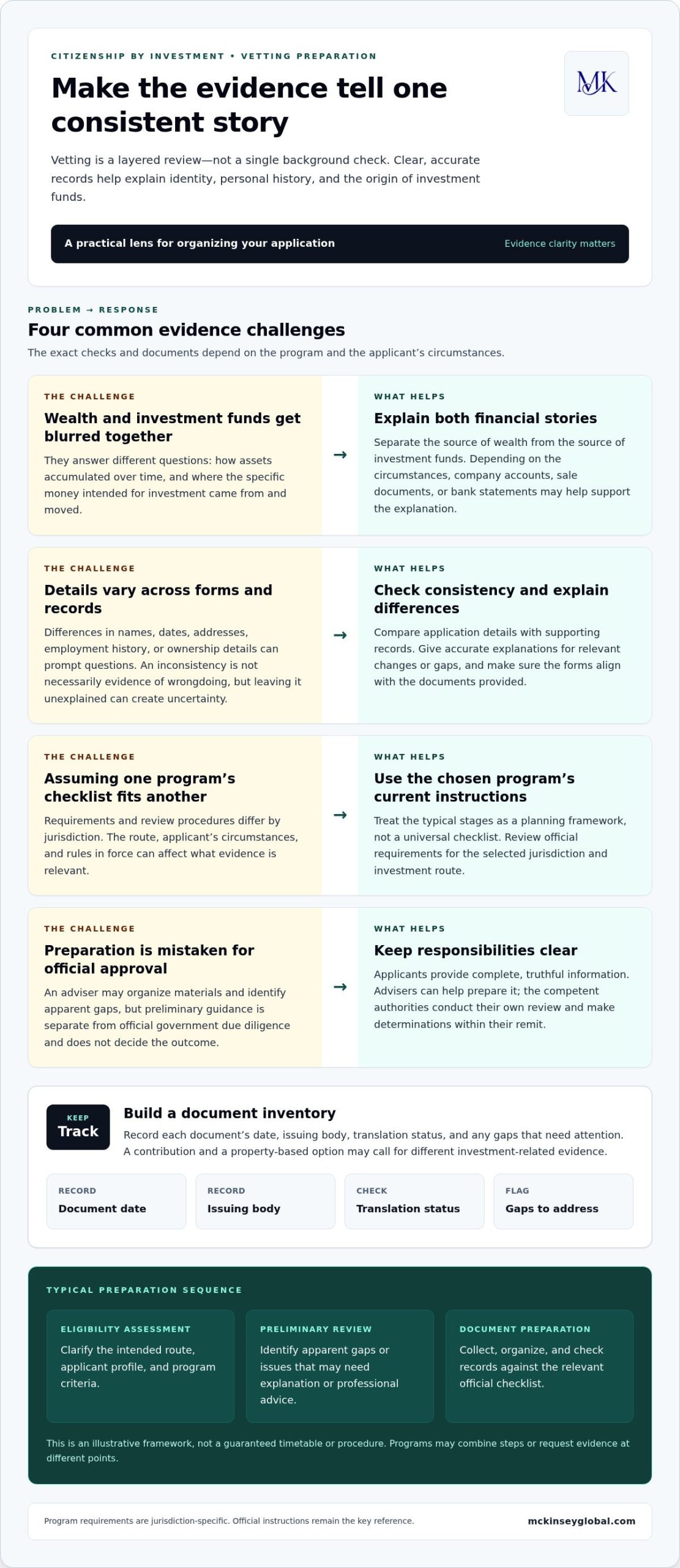
- Separate evidence of how your wealth was accumulated from records tracing the specific funds intended for investment.
- Build a document inventory that records dates, issuing bodies, translation status, and any gaps requiring attention.
- Prepare for interviews or biometric checks only where they form part of the applicable program’s official requirements.
- Use professional advisory support to organize evidence and identify gaps, while recognizing that government authorities conduct their own review and make the decision.
What the Citizenship by Investment Vetting Process Is Designed to Establish
Vetting is a layered assessment of an applicant’s identity, eligibility, integrity, and investment-related evidence under the rules of a particular program. Its purpose is to give the responsible authorities a basis for assessing whether the application, the people included, and the funds involved meet applicable requirements. There is no universal checklist: a requirement used in one jurisdiction should not be assumed to apply in another.
As a broad background resource, Immigrant investor programs describes investment-based immigration pathways and their due diligence dimension. For an individual application, the current program rules and official instructions are the key references. The scope of review can depend on the jurisdiction, route, applicant’s circumstances, and rules in force when the application is assessed.
What authorities may seek to verify
Authorities may verify identity details, declared family relationships, and whether each applicant meets relevant eligibility criteria. They may also compare information across forms and supporting records. Differences in names, dates, addresses, employment history, or ownership details can prompt questions. An inconsistency is not necessarily evidence of wrongdoing, but it should be explained accurately rather than left unresolved.
Financial evidence raises two related but distinct questions. Source of wealth concerns how an applicant accumulated assets over time; source of investment funds concerns the origin and movement of the specific money intended for the qualifying investment. Depending on the circumstances, company accounts, sale documents, or bank statements may help explain these matters. Integrity screening also varies by jurisdiction, so applicants should use the relevant official checklist instead of assuming every program conducts identical checks.
Who reviews an investment migration application
The applicant is responsible for providing complete, truthful information and supporting records. An authorized adviser can organize materials, identify apparent gaps, and prepare an application for submission, but this preliminary work is not official due diligence. A program unit may receive or assess an application, while designated government reviewers or authorities make determinations within their remit. The division of responsibilities varies by program.
Screening tools or database searches may support a review, but they do not replace an authority’s assessment of the full application or determine the outcome by themselves. An adviser cannot decide whether a government will approve an applicant. Keeping these roles distinct helps set realistic expectations: preparation can make evidence clearer and more consistent, while the competent authorities retain responsibility for their independent review and decision.
For applicants with complex but lawful financial histories, the goal is not to simplify the facts until they become incomplete. Instead, present a coherent, documented account, explain relevant changes or gaps, and make sure statements in the forms align with the records provided. The specific evidence and review standards still depend on the selected program’s current requirements.
How the Citizenship by Investment Vetting Process Typically Unfolds
The citizenship by investment vetting process can be viewed as a sequence of preparation and review stages, but this is an illustrative framework, not a guaranteed timetable or procedure. Programs may combine steps, use different terms, or request evidence at different points. Before proceeding, review the current official instructions for the chosen jurisdiction, including required forms, submission channels, and program-specific procedures.
From initial assessment to a prepared application
Preparation generally starts with an assessment of the applicant’s objectives, family circumstances, eligibility, and preferred investment route. An adviser can help identify apparent issues early, such as a mismatch between the proposed route and the applicant’s circumstances, or financial records that need further explanation. This is a preliminary review, not an official finding that the applicant qualifies.
Once a route is under consideration, the applicant and adviser can organize relevant records. Depending on the program and the people included, these may relate to identity, family relationships, financial history, and the proposed investment. The aim is to assemble evidence that is complete, consistent, and responsive to the official checklist. A document set prepared for one program should not be assumed to meet another program’s requirements.
The investment route also affects which records are relevant. A contribution and a property-based option, for example, may call for different investment-related evidence. A comparison of the citizenship by investment donation versus real estate strategy can help frame that choice before application materials are finalized.
A typical sequence may include:
- Eligibility assessment: clarify the intended route, applicant profile, and program criteria.
- Preliminary review: identify apparent gaps or issues that may need explanation or professional advice.
- Document preparation: collect, organize, and check records against current official instructions.
- Submission: file the application through the required channel and provide the requested materials.
Government review, follow-up, and outcome
After submission, the designated program unit or government authority assesses the application under the applicable framework. The review may include examination of the application and supporting evidence, along with any additional steps required by that jurisdiction. An adviser can help manage communications and organize responses, but the authority is responsible for its own review and decision.
Authorities may request follow-up information, though this is not necessarily part of every applicant’s experience. If a request arrives, identify each question, read the instructions carefully, and provide accurate supporting evidence in the required form and timeframe. A direct response to the points raised is more useful than unrelated material.
Approval or refusal, review stages, timing, and any procedural options depend on the program’s current official rules and the facts of the case. Treat general sequences or estimates as guidance, not promises. Jurisdiction-specific advisory support can help organize preparation around current requirements, while the official assessment and outcome remain with the relevant authorities.
What Vetting May Examine: Identity, Wealth, Funds, and Risk
Evidence is assessed in context, not simply counted. In the citizenship by investment vetting process, reviewers may examine who is applying, whether eligibility criteria appear to be met, how wealth was accumulated, and how the proposed investment funds reached the applicant or payment channel. The evidence requested and scope of screening depend on the program and its current rules.
Identity, family, and background information
Identity records may include passports or other identification, while civil documents can establish relevant family relationships. Where requested, residence history and other background details help complete the applicant’s profile. Check names, dates, addresses, and family details across forms and supporting records. If a name changed or a date differs between documents, record the reason and prepare appropriate supporting evidence instead of silently changing information.
Translations should be complete and prepared in the format required by the program. Political exposure, sanctions, adverse media, or other integrity matters may also be reviewed, but these are possible, jurisdiction-dependent screening areas, not a universal checklist. Beneficial-ownership information may be relevant when a company or other entity is connected to assets or investment funds.
| Evidence category | What it may help establish | Common consistency checks |
|---|---|---|
| Identity and civil records | Identity, family relationships, and relevant personal history | Names, dates, addresses, and relationship details across forms and records |
| Residence and background information | Where the applicant has lived and information relevant to program criteria | Residence dates and addresses against declarations and supporting evidence |
| Source-of-wealth records | How the applicant accumulated assets over time | Whether income, ownership, or asset-sale details align across records |
| Investment-fund records | The origin and movement of the specific funds intended for investment | Whether account statements, transfers, and transaction documents trace the same funds |
| Entity and ownership records | Relevant company interests or beneficial ownership | Declared ownership, accounts, and related financial records |
Source of wealth and source of investment funds
Source of wealth describes how assets were built over time; source of investment funds traces the particular money intended for the qualifying investment. For example, a business owner might document wealth through company income and audited accounts, then trace the investment funds through a dividend, bank transfers, and account statements. Other lawful origins may include employment income, inheritance, or proceeds from an asset sale.
Potential supporting records include contracts, tax records, bank statements, company accounts, and documents relating to an inheritance or sale. Relevant materials depend on the facts and official requirements; no single wealth origin or document set guarantees acceptance. A clear, documented financial trail helps reviewers connect how wealth was built to the specific funds proposed for investment. If the trail includes several accounts, entities, or transactions, a concise chronology can help reviewers follow the links between records.
How Applicants Can Prepare for Citizenship by Investment Vetting
Good preparation is not about assembling the largest possible file. It is about making each relevant record easy to understand and verify. Requirements differ by program, so use the current official checklist to determine which documents are required, how they must be prepared, and whether translations or certifications are specified. An organized file can help identify gaps before submission, but it cannot replace the authority’s assessment.
Build a consistent evidence file
Start with separate folders for identity, family, residence, wealth history, investment funds, and the proposed investment. For each item, record its date, issuing body, language, translation status, and whether it is an original or a copy. This inventory makes it easier to compare records and spot documents that may need updating or explanation.
Compare names, dates, addresses, account references, and transaction descriptions across forms and supporting evidence. If a bank transfer is described differently in two records, note the discrepancy and establish the accurate explanation before filing. If historical evidence is unavailable, record what is missing, why it cannot be obtained, and what alternative evidence may explain the relevant facts. Do not make an account appear simpler by omitting material information.
A practical readiness check:
- Match every requested item against the current official checklist.
- Record each document’s date, issuer, translation status, and any validity period stated in the instructions.
- Reconcile key names, dates, addresses, and financial references across the file.
- List missing or unavailable records and prepare a factual explanation.
- Confirm sensitive documents are shared only through appropriate, secure channels.
Address complexity and protect confidentiality
Business ownership, assets held in multiple jurisdictions, and transfers through several accounts may require a clearer documentary trail. A short chronology can connect events, such as a business distribution, a transfer between personal accounts, and the investment payment. Link each explanation to relevant records, and distinguish confirmed facts from estimates or details that need further verification.
Keep sensitive records in access-controlled storage and use secure channels when sharing them with an authorized adviser or through the official process. Avoid sending identity or financial documents through informal channels, and keep a record of what was shared and when. Preparation should be specific to the selected program. Applicants considering Antigua and Barbuda, for example, should align their file with that program’s current instructions and relevant investment option, rather than relying on a checklist prepared for another jurisdiction.
For a complex financial history, qualified advisory support can help organize evidence, identify gaps, and align preparation with the chosen program’s requirements. To discuss preparation for an investment-based application, request application advisory support.
How Professional Advisory Support Fits the Vetting Process
Professional guidance can add structure to an application involving several applicants, financial records, and program-specific requirements. An adviser helps coordinate preparation; designated government authorities conduct their own assessment and decide the outcome. This distinction is central to realistic expectations about the citizenship by investment vetting process: careful preparation can reduce avoidable uncertainty, but it cannot guarantee approval or control the official review.
What an investment migration adviser can contribute
An investment migration adviser can help assess potential pathways against an applicant’s stated objectives, coordinate application materials, and organize supporting records around the relevant program’s requirements. During preparation, the adviser may flag apparent inconsistencies, missing explanations, or documents that appear to need clarification before submission. This helps build a more coherent application file. Legal and tax questions should be addressed by appropriately qualified professionals where they arise.
The value is often practical. For example, an adviser may help arrange financial records in a clear sequence so an applicant’s explanation of a transaction can be followed through supporting documents. An adviser can also help distinguish a preparation issue, such as a missing record, from a question that calls for specialist legal, tax, or financial advice. Neither an adviser’s review nor a screening tool substitutes for the government authority’s independent judgment.
Moving forward with a clear, jurisdiction-specific plan
Start by clarifying your objectives, identifying the program you are considering, and making an initial inventory of relevant records. Then review that program’s current eligibility criteria, official document instructions, and investment route. This sequence keeps preparation focused and helps identify where further explanation or professional advice may be needed.
Rules, responsible authorities, evidence requirements, and review practices can change over time. A checklist or process description prepared for another jurisdiction, or at an earlier date, may not reflect current instructions. Revisit official guidance during preparation, and treat an adviser’s preliminary assessment as help with organizing the application, not confirmation of eligibility or a prediction of the government’s decision.
A measured next-step plan can include:
- Write down the applicant’s objectives and the questions the chosen pathway must answer.
- Organize available records and note gaps or details that need clarification.
- Review the current official requirements for the relevant jurisdiction and route.
- Seek qualified legal, tax, or financial advice where the circumstances call for it.
For applicants who would value structured, jurisdiction-specific preparation, discuss investment migration application guidance as a considered next step.
Plan Your Next Step with Clarity
A well-prepared application starts with clear objectives and a program that aligns with them. Before assembling a final submission, consider whether your records present a consistent account of your circumstances and whether the chosen pathway reflects your longer-term priorities. The citizenship by investment vetting process is specific to each program, so a considered plan can help you approach requirements with greater confidence while recognizing that the relevant authorities make their own decisions.
McKinsey Citizenship and Residency Solutions provides end-to-end guidance for investment-based citizenship and residency applications across Caribbean, European, and Middle Eastern jurisdictions. This jurisdiction-specific support can help structure your preparation and identify questions that may need further attention.
When you are ready to explore your options, Discuss your investment migration objectives with our advisory team.
Frequently Asked Questions
How long does the citizenship by investment vetting process take?
There is no single reliable duration for the citizenship by investment vetting process across all programs. The schedule depends on program procedures, document readiness, applicant circumstances, and any follow-up. Separate the time needed to obtain and prepare records from the authority’s review period; these are different parts of the process. Use current official guidance for the chosen jurisdiction, and do not treat an adviser’s preparation estimate as a government timeline.
Can an application be refused after an adviser’s pre-screening?
Yes. An adviser’s pre-screening is a preparation exercise, not an approval or a binding government view. The responsible authority assesses the application independently under the applicable rules and may consider evidence or information that was not part of the preliminary review. If an adviser identifies a concern, ask what documents or explanations could help address it, while recognizing that the outcome remains uncertain until the authority decides.
Are family members also subject to citizenship by investment vetting?
Family members included in an application may need to provide information and supporting records, depending on their relationship to the principal applicant, their age, and the program’s rules. A family relationship or dependent status, for example, may need separate evidence rather than being inferred from the principal applicant’s file. Use the current official checklist to identify who must provide which information, and check that each person’s details are consistent.
What happens if an applicant has a politically exposed person connection?
A politically exposed person connection does not by itself establish wrongdoing or decide an application. Depending on the program and its procedures, it may prompt questions about the relationship, relevant roles, or associated financial activity. Disclose information accurately when requested and provide supporting context. Do not assume that a connection will automatically result in approval or refusal; only the responsible authority can assess its relevance.
Can lawful but complex wealth cause questions during vetting?
Yes. Lawful wealth may still require further explanation if its history involves several companies, accounts, or jurisdictions. A reviewer may need to understand, for example, how a business distribution relates to a later transfer and the funds designated for investment. Explain those connections clearly and use the program’s current instructions to guide the supporting evidence. Do not omit a relevant transaction because its explanation is complicated.
Is the citizenship by investment vetting process confidential?
How application information is handled depends on the jurisdiction’s laws and program procedures, so confidentiality practices are not identical everywhere. Before sharing sensitive records, understand the submission channel and how information may be collected, stored, or shared within the process. Keep a record of documents provided and use appropriate secure channels. Do not assume application information can never be disclosed under applicable rules.
Can an applicant correct an error after submitting an application?
Possibly, but the procedure depends on the responsible authority and the application’s stage. If you discover an error, identify what is incorrect, gather relevant supporting evidence, and use the official channel to ask how to submit a correction or clarification. Avoid sending inconsistent versions through informal routes. Program rules determine whether additional information can be accepted and what steps apply, so follow the official instructions for the specific case.