Citizenship by investment is not free: applicants must make a qualifying investment or contribution. The best countries for economic citizenship depend on more than the investment route. Eligibility, residence expectations, and processing requirements also shape the decision.
It’s understandable to look first for a low-cost, fast option, but citizenship is a significant legal and financial decision, and a short processing estimate does not make every program suitable. Some investment-based applications may take around 3-4 months, while others may take 12-36 months.
This comparison explains how Caribbean citizenship programs differ, what to consider when weighing investment routes, and why citizenship at no cost is not a realistic expectation through these programs. You’ll also see how processing timelines can vary and which factors may help you identify an option aligned with your priorities.
Key Takeaways
- Citizenship by investment is not a free route; compare the qualifying investment and route requirements before weighing an option.
- Visa-free access differs by citizenship, so consider destination access alongside your wider mobility priorities.
- Processing estimates vary considerably between programs; understand what each timeline covers before using it to plan.
- Use the comparison to narrow Caribbean options according to investment route, travel access, residence expectations and your personal priorities.
Why Citizenship by Investment?
Citizenship by investment provides a route to nationality, while residency programs generally grant permission to live in a country first. Compare the legal outcome, qualifying investment or contribution, fees, and any later naturalization requirements.
Investment Minimums and Program Contributions
Citizenship-by-investment programs use different qualifying routes, including government contributions and approved investments. Requirements depend on the country and selected route, rather than a single threshold that applies across countries.
Compare the qualifying investment or contribution with other costs, such as government application and due-diligence fees. A lower qualifying contribution does not necessarily mean a lower total outlay, so review the full fee structure before comparing programs.
Citizenship Compared With Residency
Citizenship by investment is a route to nationality through an eligible investment. Residency by investment grants residence; citizenship generally requires a separate naturalization process and compliance with the country’s rules.
For Greece, applicants for citizenship must have legally resided there for at least 7 years before applying. This differs from a direct citizenship route: a Greek residence-by-investment option is not immediate citizenship, and the qualifying residence period matters to long-term planning.
Country Options and Government Fees
Country-specific routes differ in their qualifying investment, government charges, and intended legal outcome. Antigua and Barbuda, Dominica, and St. Kitts and Nevis offer citizenship-by-investment pathways; Greece and Portugal offer residence routes that may lead to a later citizenship application.
Government fees are separate from the qualifying investment, so compare all cost categories, not just the contribution. Due diligence includes confirming the official route, understanding who receives payments, and reviewing written fee terms. Treat claims of guaranteed approval or unexplained payment requests as warning signs.
| Option | Route | Key comparison |
|---|---|---|
| Dominica | Citizenship by investment | Direct citizenship route |
| Antigua and Barbuda | Citizenship by investment | Direct citizenship route |
| Greece | Residency by investment | At least 7 years of legal residence before citizenship application |
| Portugal | Golden Visa residence route | Citizenship application may follow 10 years, with minimum stay requirements |
Start by deciding whether you want a direct route to nationality or residence followed by naturalization.
Tax Implications and U.S. Reporting
Tax consequences depend on tax residence, income sources, and the rules that apply to each person; a new citizenship alone does not settle the matter. U.S. citizens should consider U.S. tax and reporting obligations separately from any investment-program application.
To manage risk, review eligibility, payment terms, and due-diligence procedures before proceeding. Claims that citizenship removes existing obligations or guarantees approval are warning signs, not a substitute for assessing the applicable rules.
Are There Any Countries Offering Citizenship for Free?
There is no free route to citizenship by investment: applicants must meet a qualifying contribution or investment requirement. A sound comparison starts with the full application obligations, not claims of cost-free nationality. Treat promises of citizenship without a qualifying route as a warning sign, especially when payment terms are unclear.
Travel access is one factor applicants consider, but it varies by national passport. Antigua and Barbuda lists visa-free access to over 150 destinations. St. Kitts and Nevis lists access to 157+ countries, while Dominica lists 145+ and Saint Lucia lists 147+. These figures provide a useful comparison, not a guarantee of entry to every destination.
A second passport may broaden travel options, but visa-free access does not mean unrestricted entry or permission to live and work abroad. Identify your most frequent destinations, then compare each passport’s access with your travel priorities. The best countries for economic citizenship depend on your intended travel and family circumstances.
Program benefits depend on the route and household application rules. Antigua and Barbuda offers citizenship by investment, while Greece offers residency by investment, a different legal outcome. If applying with a spouse, compare how each program handles family applications and what costs or documents apply to each person.
Real estate is a qualifying route in some programs, but owning property and obtaining citizenship are not interchangeable. The property must qualify under the program, and applicants must meet its other requirements. Compare the minimum investment, contribution structure, government fees, and travel access rather than choosing by a single headline benefit.
For a considered next step, review the relevant citizenship and residency options against your travel priorities, family needs, and preferred legal status.
Application processing times
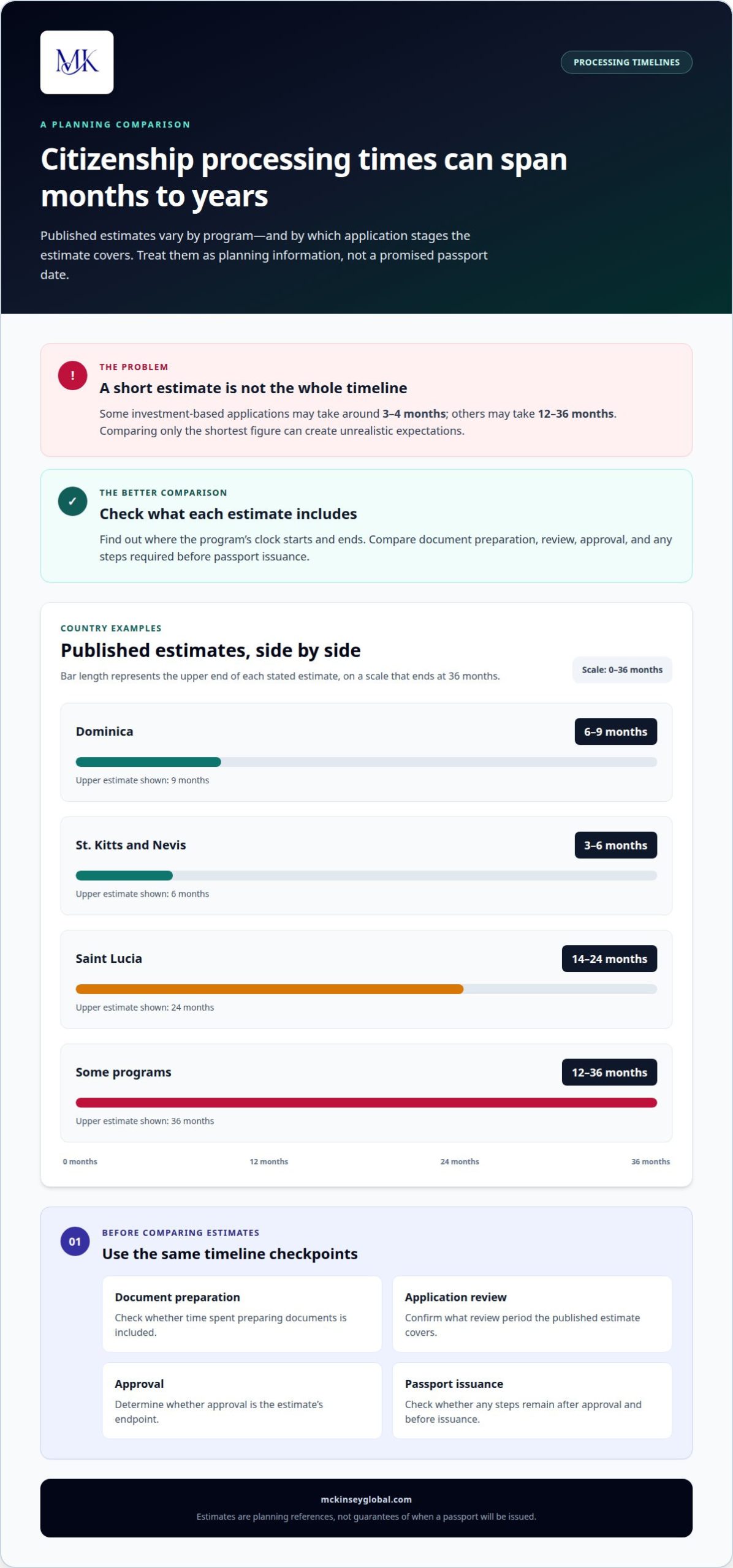
Processing estimates differ by country and by what each program counts as the start and end of an application. Some citizenship by investment programs take around 3-4 months, while others may take 12-36 months. These ranges make the application process a planning factor, not a reliable promise of when a passport will be issued.
Country examples show the variation. Dominica lists a processing time of 6-9 months, while St. Kitts and Nevis applications take three to six months. Saint Lucia lists 14-24 months. Compare each estimate on the same basis, including document preparation, review, approval, and any steps required before passport issuance.
When assessing a program, separate the qualifying investment, government charges, and application-related expenses. For timing, identify which stages an estimate covers. An investment figure is not the full cost, and a processing estimate may not represent the complete timeline from application to passport.
Applicants generally submit identity, family, and financial documents, then undergo program review and due diligence. Government fees may include application and due-diligence charges, separate from the qualifying investment. Approval follows the program’s assessment; passport issuance comes afterward. Required documents and charges depend on the country and route.
Family eligibility varies by program. A spouse, children, parents, or other dependents may qualify under some routes, with each person’s relationship and documents assessed under the program’s rules.
Most Caribbean citizenship-by-investment applicants are not required to relocate or live in the country after receiving citizenship. Antigua and Barbuda requires new citizens under its investment program to spend at least 5 days in the country within their first 5 years of citizenship. These are post-approval obligations, distinct from any steps during application review.
When comparing timing, look at the published range, the stages it covers, and any residence obligations. This helps distinguish an approval estimate from the full time needed to complete an application and receive a passport.
Caribbean citizenship programs
Caribbean programs deserve comparison by route, government requirements, family eligibility, and post-approval obligations. Antigua and Barbuda, Dominica, St. Kitts and Nevis, and Saint Lucia each administer a distinct citizenship program. The best fit depends on how its qualifying contribution and rules align with your priorities.
Investment routes are not identical. Antigua and Barbuda includes a University of the West Indies Fund option and a government-approved real-estate option. St. Kitts and Nevis also has a real-estate route. Compare the permitted investment type, holding conditions, and government charges: a property route and a fund contribution have different practical implications.
Travel access is another point of comparison, but passport rankings alone do not show the full benefit. Visa-free access varies among Caribbean passports, and destination entry rules still apply. Map your regular destinations against each passport’s access, then consider whether the program supports your broader global mobility plans.
Residence obligations also differ. Most Caribbean citizenship-by-investment applicants are not required to relocate or live in the country after citizenship. Antigua and Barbuda requires new citizens to spend at least 5 days in the country within their first 5 years of citizenship. Include that obligation in your planning.
For family applications, review how each government defines eligible dependents, such as a spouse, children, or parents. Account for every family member and the documents needed to establish eligibility. Dual citizenship is a separate consideration: acquiring another nationality does not, by itself, determine whether you can retain your existing one.
A practical decision sequence is to select an investment route, compare travel access, review residence and family rules, then assess the application requirements. This keeps a headline benefit from outweighing a condition that matters to your circumstances. For a focused comparison, explore Caribbean citizenship pathways alongside your family and mobility priorities.
McKinsey Citizenship and Residency Solutions
McKinsey Citizenship and Residency Solutions helps investors assess citizenship and residency pathways against their priorities. Its guidance can help clarify whether a citizenship route or a residence-first option better fits your objectives, family circumstances, and preferred timeline.
Available pathways include Antigua and Barbuda Citizenship by Investment, St. Kitts and Nevis Citizenship, Dominica, and Greece Residency by Investment. These options differ in legal outcome and application requirements, so the next step is to identify which route aligns with your goals and review its relevant criteria.
To compare these pathways with guidance tailored to your priorities, contact McKinsey Citizenship and Residency Solutions.
Turn Your Comparison Into a Clear Next Step
Choosing among the best countries for economic citizenship means deciding which legal outcome and future you want to plan for. Define your priorities first: direct citizenship or residence first, family arrangements, and the destinations most relevant to your mobility. A structured comparison can then focus your attention on programs that fit, rather than on a single headline feature.
McKinsey Citizenship and Residency Solutions can help assess pathways including Antigua and Barbuda Citizenship by Investment, St. Kitts and Nevis Citizenship, and Greece Residency by Investment. The right route depends on your priorities and circumstances. Start a conversation to clarify the questions that matter most to your decision.
Contact McKinsey Citizenship and Residency Solutions to discuss your options and take a considered next step toward your international plans.
Frequently Asked Questions
Does a Second Citizenship Require Passport Forfeiture?
No. Obtaining a second citizenship does not automatically require you to surrender your existing passport. Citizenship and passport possession are related but distinct: nationality is a legal status, while a passport is a travel document issued by a state. Whether you may retain both nationalities depends on the laws governing your existing and new citizenships. Review those rules before applying, especially if renunciation could affect your rights or obligations.
What are the second and dual citizenship?
Second citizenship means holding citizenship in an additional country alongside your original nationality. Dual citizenship describes the resulting status when two countries recognize someone as a citizen at the same time. For example, someone who acquires citizenship through a qualifying investment may hold two nationalities if their original country permits it. The terms are often used interchangeably, but the laws of both countries determine the person’s legal position.
What are the ways to obtain a second citizenship?
Common routes include citizenship by descent, naturalization after qualifying residence, marriage where a country’s law provides that pathway, and citizenship by investment. Each has different eligibility criteria and evidence requirements. An ancestry applicant may need to document family relationships; an investor must meet the selected program’s requirements. Compare the legal route, residence obligations, and application evidence before deciding what fits your circumstances.
Who Can Obtain a Passport by Investment?
Applicants who meet a country’s citizenship-by-investment eligibility requirements may apply for citizenship and, after approval, a passport. Programs assess applications against their rules, including identity documentation and due-diligence procedures. Family members may qualify for inclusion where the program permits it. Investment capacity alone does not determine eligibility: applicants must also satisfy applicable screening and documentation requirements.
Which countries currently offer citizenship by investment or economic citizenship?
Examples of countries with citizenship-by-investment routes include Antigua and Barbuda, Dominica, St. Kitts and Nevis, Saint Lucia, Türkiye, Jordan, Sierra Leone, and Egypt. Program structures differ, and not every investment route grants citizenship directly. Distinguish citizenship programs from residence-by-investment options, such as Greece’s, which grant residence rather than immediate nationality. The country that fits depends on your intended legal status and application priorities.
What are the minimum investment amounts and fees for each country’s citizenship program?
Minimum investment requirements and government charges vary by country and route, so no single amount applies across programs. Some routes use a government contribution; others involve qualifying real estate or another approved investment. Compare the investment requirement separately from application, due-diligence, and other government fees. Antigua and Barbuda and St. Kitts and Nevis, for example, have different qualifying routes and fee structures.