Agreement matters more than persuasion. Many citizenship by investment programmes allow a spouse and eligible dependents to be included, although the rules differ by country. If you’re considering convincing a spouse to explore citizenship by investment, start with the shared reasons for considering it, such as travel flexibility, family eligibility and long-term planning, then discuss the trade-offs that matter to you both.
It’s reasonable to approach the decision carefully: it can affect family members, finances and future plans. This article explains why families consider citizenship by investment, how spouse and dependant eligibility can vary, and how to discuss priorities and concerns together. Focusing on practical implications rather than pressure can help you make an informed decision about whether to explore a programme.
Key Takeaways
- Assess whether family members may qualify for inclusion, since eligibility depends on the programme and each dependant’s circumstances.
- Clarify which family priorities matter most, including mobility, long-term planning and dependent children’s eligibility.
- Discuss the decision as a shared evaluation of benefits, responsibilities and concerns, rather than as a case to win.
- Explore relevant options with McKinsey Citizenship and Residency Solutions, including programmes in Antigua and Barbuda, St. Kitts and Nevis, Dominica and Greece.
Can I include family members?
Some citizenship programmes allow a spouse and qualifying dependants on one application, but eligibility varies by country. Compare which family members qualify, what contributions and application requirements apply, and which benefits extend to each approved person.
Eligible Family Members
Eligible family members are relatives who meet a programme’s relationship and dependency criteria; their inclusion can shape the application’s scope. Spouses and dependent children are commonly considered, while some programmes also include dependent parents, grandparents or, in limited cases, siblings. According to the Antigua and Barbuda Citizenship by Investment Unit, children under 30 may be included. The same Unit lists financially dependent parents over 55 as eligible family members.
Family Citizenship and Passport Benefits
When a family member is included and approved, that person receives the citizenship and passport benefits available to the main applicant. This can give the household a shared status rather than leaving relatives with different immigration positions. Before applying, clarify which relatives qualify and how approval fits your family’s plans for travel, residence and long-term mobility.
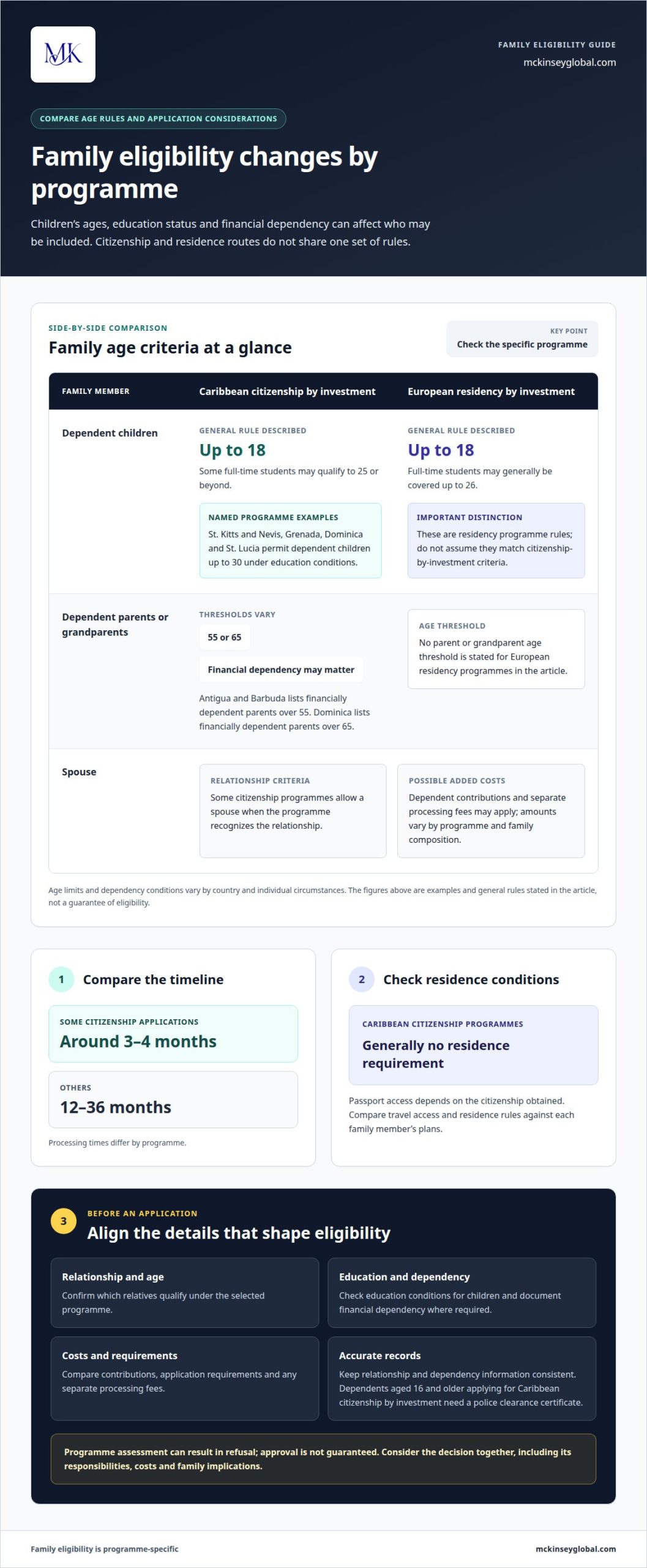
Caribbean family rules differ by programme: children are typically dependents up to 18, with some full-time students qualifying to 25 or beyond. Dependent parents or grandparents may qualify from 55 or 65, depending on the programme; Dominica, for example, lists financially dependent parents over 65. European residency-by-investment programmes generally include children to 18, or to 26 for full-time students.
A spouse can generally be included in a citizenship-by-investment application if the selected programme recognizes the relationship. Additional costs can include higher contributions for dependents and separate processing fees; the amount and contribution route vary by programme and family composition.
For a U.S. citizen, tax, inheritance and dual-citizenship implications depend on the relevant jurisdictions and personal circumstances. Citizenship and a passport alone do not determine the outcome. Assess each issue separately before applying.
U.S. reporting obligations and renunciation are separate considerations from obtaining another citizenship. Applying for citizenship elsewhere does not determine reporting obligations or whether renunciation is appropriate for an individual.
Countries named among current citizenship-by-investment programmes include Antigua and Barbuda, Dominica, Grenada, St. Kitts and Nevis, St. Lucia and Türkiye. Immigration routes and family eligibility differ across them.
Risks include an ineligible dependant, incomplete information or refusal after programme assessment. No approval is guaranteed. Provide accurate records and understand the programme’s investment route and application requirements before proceeding.
Why Citizenship by Investment?
Citizenship by investment is a route to citizenship through a qualifying investment and an application to the relevant country. The process generally involves selecting a programme, submitting applicant information and supporting documents, meeting its investment requirements, and awaiting a decision.
For families, dependent children’s eligibility can shape the choice. St. Kitts and Nevis, Grenada, Dominica and St. Lucia permit dependent children up to age 30 under education conditions. The precise conditions vary, so a child’s age, education and dependency status matter when preparing the application.
Age thresholds are not interchangeable across citizenship and residence programmes. European residency and golden visa programmes generally cover dependent children up to age 18, or up to age 26 for full-time students. A family considering a country should distinguish citizenship from residence: the status sought determines which programme rules apply.
Citizenship derived by children is a separate concept from including them in a parent’s application. In the United States, a child under 18 may automatically derive U.S. citizenship when at least one parent is a U.S. citizen and certain residency requirements are met. That rule concerns U.S. citizenship, not automatic citizenship under another country’s investment programme.
U.S. E-2 treaty-investor classification may be available to an investor’s spouse or child as well as the investor. An E-2 classification is an immigration status, not citizenship; the spouse may work anywhere without employer sponsorship. This can be relevant to families whose plans involve the United States, but it does not replace assessing the citizenship programme’s own family criteria.
Families should consider how each child’s age and education status relate to the chosen programme’s rules. Separate citizenship goals from residence plans and U.S. visa considerations, too. These distinctions help spouses discuss the outcome they want instead of assuming one programme gives every family member the same status or rights.
Including a spouse and dependents in a citizenship application
Some citizenship-by-investment programmes allow a main applicant to include a spouse and dependent children; others may accept dependent parents or grandparents. Criteria vary by country, and relationships, ages and financial dependency can affect eligibility.
Processing times and residence conditions also differ. Some citizenship applications take around 3-4 months, while others take 12-36 months. Caribbean citizenship programmes generally have no residence requirement. Passport access depends on the citizenship obtained, so compare the travel access and residence rules relevant to each family member’s plans.
Document preparation should reflect each dependant’s status. Keep relationship and dependency records consistent across the application, and document financial dependency where parents or grandparents are included. Dependents aged 16 and older applying for Caribbean citizenship by investment need a police clearance certificate. For Antigua and Barbuda, approved applicants and dependents aged 16 or older must attend virtual interviews.
Eligibility, due diligence and source-of-funds assessment form part of the application review. Provide accurate information and records that explain your circumstances and the origin of investment funds. Missing or inconsistent details can complicate assessment; the programme’s criteria determine which evidence is relevant.
Through an authorized agent, the process generally involves choosing a programme, reviewing family eligibility, assembling supporting records, submitting the application and completing any required assessment steps. Documents vary with the programme and family composition, while police clearance applies to Caribbean dependents aged 16 and older. An agent can coordinate the application materials and submission process.
Before deciding together, compare processing time, passport access and residence obligations as separate factors. A faster process may not match your family’s travel or residence plans. Discussing the distinctions helps you assess what an application would mean for your household instead of relying on a single headline benefit.
How to discuss citizenship by investment with a spouse
Approach convincing your spouse to consider citizenship by investment as a shared decision, not a case one partner has to win. Start with the family outcome you hope to achieve, then invite your spouse to identify priorities and reservations. One partner might value travel flexibility while the other prioritises financial exposure or future residence. Both concerns deserve consideration.
Structure the conversation around decisions you can assess together:
- Define the goal. Distinguish citizenship from a residence permit, and describe what status the family seeks. A country’s government sets its own programme criteria.
- Identify who may qualify. Consider each family member’s eligibility and how inclusion could affect the application. A dependent child’s age or education status may matter under programme rules.
- Discuss responsibilities. Review the required contribution, documentation and due diligence process. Explain how records, such as a certificate establishing a family relationship, may support an application.
- Agree on open questions. Separate programme criteria from assumptions, and note what needs professional explanation before making a commitment.
Use specific examples rather than broad promises. If your spouse is concerned about a child’s eligibility, review the programme’s age and dependency rules. If the concern is permanence, distinguish citizenship from residence rights in another country. A passport alone does not determine where your family can live or work.
Discussing citizenship by investment with your spouse should leave room for both partners to assess whether the family can meet the application requirements. You do not need to resolve every issue in one conversation. Agree on a next step, such as reviewing the relevant programme criteria together, then revisit the decision once you both understand the implications.
A constructive discussion can extend across several conversations, giving practical and personal concerns equal weight. For guidance on family eligibility and programme requirements, discuss citizenship options for your family.
McKinsey Citizenship and Residency Solutions
McKinsey Citizenship and Residency Solutions guides families assessing citizenship or residency by investment and whether a programme fits their shared priorities. If you and your spouse are weighing family eligibility, application requirements and the differences between citizenship and residency, tailored guidance can help you assess the options.
Options include citizenship programmes in Antigua and Barbuda, St. Kitts and Nevis, and Dominica, as well as Greece Residency by Investment. The right option depends on your family’s objectives, the relatives you hope to include and the applicable programme criteria. Discussing these factors helps both spouses understand the available routes and their requirements.
To discuss your family’s priorities and potential programme options, contact McKinsey Citizenship and Residency Solutions.
Make the Next Decision Together
A productive conversation does not need to end with an immediate commitment. Agree on what you both need to understand before deciding, then use the next discussion to assess priorities, eligibility and implications together. This collaborative approach to discussing citizenship by investment with your spouse gives each partner space to raise concerns, consider the information and decide whether to proceed.
For families ready to explore options, McKinsey Citizenship and Residency Solutions offers Antigua and Barbuda Citizenship by Investment, St. Kitts and Nevis Citizenship, and Greece Residency by Investment. These can be starting points for discussing which route aligns with your family’s objectives and circumstances.
When you are ready to discuss your priorities and potential next steps, contact McKinsey Citizenship and Residency Solutions. A clear, considered conversation can help you and your spouse move forward with greater confidence.
Frequently Asked Questions
Can parents be added as dependents?
Some programmes allow parents to be included if they meet the programme’s dependency requirements. The relationship alone may not establish eligibility; financial dependency and supporting records can also matter. When considering an application with a parent, distinguish the parent’s age from the evidence needed to demonstrate dependency. The applicable programme rules determine whether they qualify.
Do dependent rules differ by country?
Dependant rules vary by country and programme, including which relatives qualify and the conditions they must meet. Eligibility under one citizenship route does not automatically establish eligibility under another country’s residency programme. Compare relationship criteria, dependency conditions and required evidence for each route, especially if adult children or parents are part of your plans.
How long does it take?
Processing time varies by programme and application circumstances, so there is no single timeline for every family. Document completeness, due diligence, interview scheduling and government review can all affect the process. Families including several dependants should plan to gather consistent records for each applicant, rather than treating the main applicant’s file as the whole submission.
What are the minimum investment amounts and total fees for citizenship by investment?
Investment requirements and application-related costs depend on the country, programme route and family composition. Assess the applicable requirements for the specific application rather than assuming one amount applies to every family. No universal figure covers every programme and family situation.
How can spouses discuss and evaluate citizenship by investment together?
Set aside time to identify each spouse’s priorities, concerns and decision criteria before choosing a programme. One partner might outline the hoped-for family outcome while the other raises questions about eligibility, obligations or long-term plans. Review the same programme information together and agree on what needs clarification. The objective is a joint decision, not persuading one partner to accept a predetermined choice.
What are the eligibility, due diligence, and source-of-funds requirements?
Eligibility depends on the programme and each family member’s relationship, age and dependency status. Due diligence and source-of-funds assessment are part of the review. Provide accurate, consistent records that explain applicants’ circumstances and the origin of investment funds.