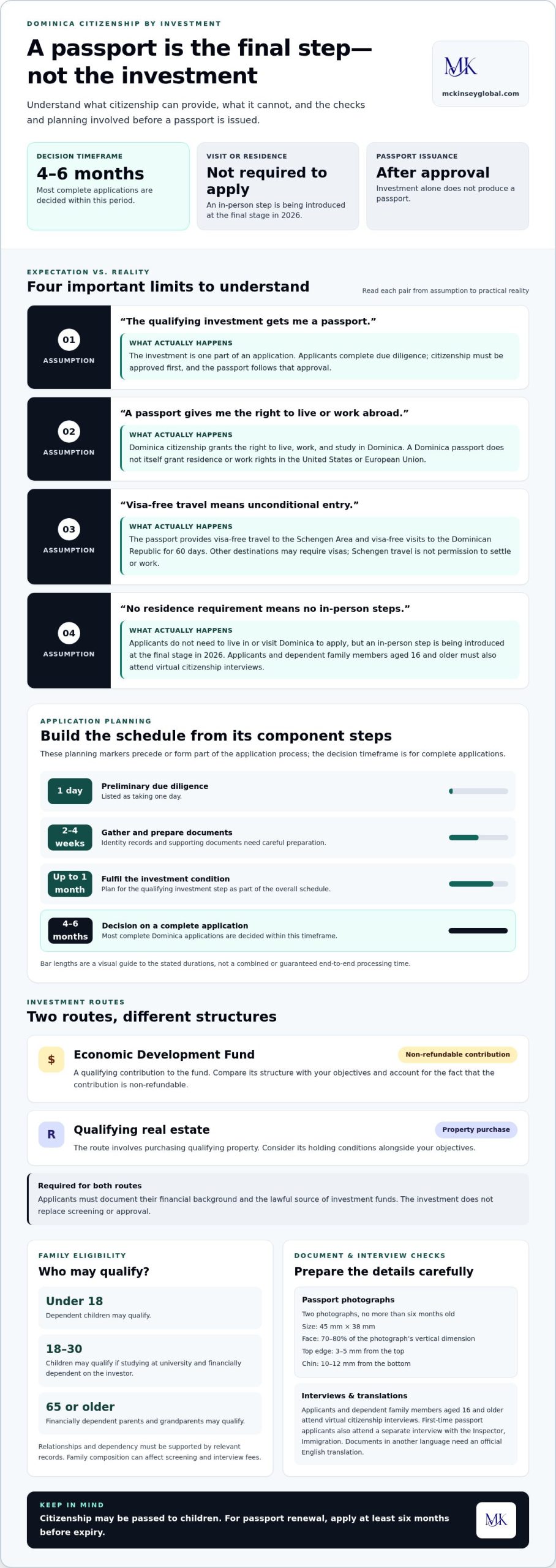
A Dominica passport is not obtained simply by making an investment. Applicants must first complete the country’s citizenship-by-investment process. Most complete applications are decided within four to six months, and applicants are not required to visit or reside in Dominica. The passport is issued after citizenship is approved.
The appeal of a second citizenship is understandable, particularly when international mobility and long-term planning matter. Yet the value of a Dominica passport depends on more than travel access. The application process, due diligence, family eligibility, and the limits of what citizenship can resolve all deserve careful consideration.
This guide explains how Dominica citizenship by investment works, what to expect from the processing timeline, and where the passport’s benefits have limits. It also examines the risks and limitations of a Dominica passport, helping you assess the option in light of your circumstances rather than treating a passport as a guarantee of access, residence, or other outcomes.
Key Takeaways
- Prepare identity documents and passport photographs carefully, since formatting and supporting records are part of a complete application.
- Compare the available investment routes and assess how family eligibility may affect your application structure.
- Build a realistic schedule around document preparation, due diligence and completion of the investment requirement.
- Evaluate travel access alongside practical limits, including the fact that a passport does not remove every visa or entry condition.
What is the Dominica Citizenship by Investment Program?
Dominica citizenship by investment is a path to citizenship through an approved investment and application process. Citizenship may lead to a national passport, but it does not grant residence or work rights abroad.
Passport photographs are recent identification images that must meet application specifications. Submit two photographs, no more than six months old, measuring 45mm x 38mm. For Dominica passport photographs, the face must occupy 70-80 percent of the photograph’s vertical dimension. Position it 3mm to 5mm from the top edge, with the chin 10mm to 12mm from the bottom. Documents in another language need an official English translation.
Residency and Physical Presence
Physical presence requirements determine whether applicants must visit or live in Dominica. Applicants are not required to reside in the country or visit to apply. However, an in-person step is being introduced at the final stage in 2026. The application therefore does not require residence, although applicants should account for this final-stage requirement when planning.
Citizenship Interview Requirements
A citizenship interview is a screening conversation about an applicant’s background and application. Applicants and dependent family members aged 16 and older must attend virtual interviews. Questions may cover business activities and how investment funds were generated. First-time passport applicants must also attend an interview with the Inspector, Immigration. This is a separate interview from the citizenship screening.
Visa Destinations and Passport Strength
Visa destinations are countries where entry rules determine whether advance permission is needed. A Dominica passport provides visa-free travel to the Schengen Area and visa-free visits to the Dominican Republic for 60 days; other destinations may require visas. Its comparative strength depends on the destinations and entry categories assessed, so it should not be treated as automatically stronger than other Caribbean passports.
A Dominica passport does not, by itself, give holders the right to live or work in the United States or European Union. Schengen visa-free travel is not permission to settle or take employment. For renewal, apply at least six months before expiry.
Citizenship by investment program overview
Dominica citizenship by investment is a path to citizenship through an approved investment and application process. Applicants complete due diligence before citizenship is granted, and can then apply for a Dominica passport.
Citizenship by Investment Routes
An investment route is the qualifying contribution or purchase used in an application. Dominica offers an Economic Development Fund contribution and a qualifying real estate option.
The fund contribution is non-refundable, while the real estate route involves purchasing qualifying property. Both require applicants to document their financial background and the lawful source of investment funds. Before applying, compare each route’s structure and holding conditions with your objectives. The investment is one part of the process; it does not replace screening or approval. A Dominica passport follows citizenship approval, not the investment alone.
Citizenship Rights and Dual Citizenship
Citizenship rights are the legal privileges attached to being a national of Dominica. Citizens may live, work, and study there, and Dominica permits dual citizenship.
Applicants are not required to reside in Dominica to obtain citizenship. This can suit people who cannot relocate, but citizenship does not itself grant residence or work rights in other countries. A Dominica passport provides travel-document benefits, while citizenship rights within Dominica remain distinct from entry rules abroad. Consider both when assessing how citizenship fits your global plans.
Citizenship Transmission to Children
Citizenship transmission means passing citizenship to future generations by descent. Dominican citizenship may be passed to children, extending its potential relevance beyond the main applicant.
Eligible dependent children may be included in an application. Children under 18 may qualify; those aged 18 to 30 may qualify when studying at university and financially dependent on the investor. Financially dependent parents and grandparents aged 65 or older may also qualify. Each family member’s relationship and dependency must be supported by relevant records.
Citizenship Costs and Fees
Program costs combine the qualifying investment with application-related charges. The total depends on the chosen route, applicant profile, and eligible dependents; pricing is provided after a quote request.
Cost categories include due diligence, interviews, application processing, and naturalization certificate fees. These charges are separate from the investment itself. Family composition affects which screening and interview fees apply, so identify the applicant group before calculating the full commitment. This distinction helps applicants assess the investment route and related obligations together.
Citizenship-by-investment processing timeline
The timeline covers citizenship approval and the later passport stage. Most complete applications are decided within four to six months.
Standard and Emergency Processing Times
Standard processing is the period used to assess a complete citizenship application. Most complete Dominica applications are decided within four to six months, while preparation and investment steps also take time.
Preliminary due diligence is listed as taking one day. Gathering and preparing documents is listed as taking 2-4 weeks, and fulfilling the investment condition can take up to one month. These steps form part of planning, rather than a replacement for the main assessment period. Prepare early, especially where records must be collected across jurisdictions.
Due Diligence and Processing Time
Due diligence is the screening process used to assess applicants and their supporting information. The main due-diligence stage is listed as taking 3-6 months, making it a substantial part of the application timeline.
Applicants should organize passports, birth certificates, relevant marriage certificates, and police clearance certificates for relevant jurisdictions. They may also be asked to explain their business activities and how investment funds were generated during a remote interview. Clear, consistent records help address review requirements; missing or difficult-to-reconcile information can lead to further examination. The Economic Development Fund supports national economic development and diversification, but choosing that route does not remove applicant screening.
Passport Processing Times
Passport processing is the period between submitting a passport application and receiving the travel document. Normal passport processing in Dominica takes two weeks; emergency processing can take two to three working days.
These passport processing times are separate from citizenship approval. Applicants must first obtain citizenship before applying for a passport, so the two-week period does not represent the full investment-to-travel timeline. Family applications also involve records for each eligible member, including children, and any required interview steps. Treat the citizenship decision, investment completion, and passport issuance as distinct stages when planning travel.
Risks and limitations of a Dominica passport
A passport provides travel access, not unrestricted entry or settlement rights. As of 30 March 2026, Dominican passport holders had visa-free, visa-on-arrival, or eTA access to 145 countries and territories; other destinations require advance visa permission. Entry rules can also depend on trip purpose and duration, so visa-free arrival should not be treated as permission to live or work abroad.
Travel access is only one measure of practical value. It does not establish a global ranking or guarantee the same access as other Caribbean passports. Before relying on a destination for a business trip, confirm the applicable visa category and permitted activities. A passport also does not replace the original documents needed for an application, such as a birth certificate, or an official English translation where required.
Citizenship by investment involves extensive background screening. Applicants must explain the source of their wealth and investment funds, disclose relevant personal and business history, and provide police clearances for relevant jurisdictions. A previous visa refusal by a country with which Dominica has a visa-free travel agreement creates a specific eligibility issue: the applicant must successfully obtain that country’s visa before applying. Incomplete or inconsistent records can complicate assessment.
Investment choices also carry constraints. Qualifying real estate can generally be sold after three years, or after five years when resold to another citizenship applicant. That holding period can affect liquidity and exit planning. Applicants using this route should assess the investment commitment separately from the value of citizenship, rather than assuming they can resell immediately.
Finally, a passport’s validity does not remove renewal planning. Dominican passports are valid for 10 years, and renewal guidance recommends applying at least six months before expiry. Map travel dates against expiry and destination rules, and retain copies of key civil records. To discuss application considerations and route suitability, review your Dominica citizenship options.
McKinsey Citizenship and Residency Solutions: Antigua and Barbuda Citizenship by Investment
McKinsey Citizenship and Residency Solutions helps investors assess citizenship and residency routes against their objectives, family circumstances, and mobility plans. If Dominica’s travel access or investment structure does not align with your priorities, a structured comparison can clarify which alternative may merit consideration.
The firm provides guidance on Antigua and Barbuda Citizenship by Investment, Greece Residency by Investment, and Dominica. The appropriate route depends on factors such as intended travel, family eligibility, investment preferences, and whether citizenship or residency better fits your plans. Tailored guidance can be useful before you commit to an application or when comparing routes across jurisdictions.
For a discussion of your circumstances, contact McKinsey Citizenship and Residency Solutions or visit mckinseyglobal.com.
Make Your Next Citizenship Decision Deliberately
Before choosing a second citizenship, define what it needs to support: family planning, international mobility, or a long-term connection to another country. Then weigh those priorities against your existing citizenship, travel patterns, and willingness to complete a detailed application. This makes the decision more strategic than focusing on a passport alone.
A Dominica passport may form part of that plan, while another route may better match your objectives. McKinsey Citizenship and Residency Solutions offers Antigua and Barbuda Citizenship by Investment, St. Kitts and Nevis Citizenship, and Greece Residency by Investment. Comparing these options against your circumstances can clarify the next step without treating any one route as universally suitable.
When you are ready to discuss your priorities and application pathway, contact McKinsey Citizenship and Residency Solutions. A considered conversation can help you move forward with greater clarity and purpose.
Frequently Asked Questions
How Do I Apply for a Passport?
First obtain Dominican citizenship, then submit a passport application with the required supporting documents. Prepare your birth certificate and any relevant marriage certificate, along with two recent passport photographs. First-time applicants must attend an interview with the Inspector, Immigration. The declaration signature in Section 7 must be notarised or witnessed by a notary public or an authorised person at the Dominica High Commission.
How Long Does the Process Usually Take?
Most complete citizenship-by-investment applications are decided within four to six months. Passport issuance is a separate stage, with normal processing taking two weeks. Document preparation is listed as taking 2-4 weeks, while the main due-diligence stage is listed as taking 3-6 months. Plan travel only after allowing for both citizenship approval and the later passport application.
How to Get a Dominica Passport?
To obtain a Dominica passport through investment, an adult applicant must first qualify for citizenship. Select an eligible investment route, prepare the application and supporting records, complete due diligence, and attend the required interview. After citizenship is granted, submit the passport application and arrange any required first-time interview. The passport is the final document in this sequence, not the initial investment approval.
Who Can Be Included in an Application?
A qualifying application can include a spouse and eligible dependent relatives, subject to their relationship and dependency status. Dependent children under 18 may qualify; children aged 18 to 30 may qualify when studying at university and financially dependent on the main applicant. Financially dependent parents and grandparents aged 65 or older may also be included. Each family member must provide supporting identity and civil records.
What are the requirements to get a Dominica passport?
Applicants must first qualify for citizenship and provide identity, civil-status, and background documents. Common records include passports, birth certificates, relevant marriage certificates, and police clearances for relevant jurisdictions. Documents in another language need an official English translation. Applicants and dependent family members aged 16 and older must attend virtual citizenship interviews. A previous visa refusal may also affect eligibility if it involved a country with a visa-free agreement.
How can you obtain Dominica citizenship by investment, and what are the steps?
Begin by choosing between the Economic Development Fund contribution and qualifying real estate route. Prepare identity, family, financial-source, and police-clearance documents, then submit the application for screening. Applicants may be interviewed about their background, business activities, and the origins of investment funds. After due diligence, fulfil the investment condition and complete the required oath process. Once citizenship is granted, apply separately for a passport.