
Ensuring application confidentiality means limiting each person’s access to the documents and data they need, rather than treating an application as one shared file. Role-based permissions can distinguish at least three roles: unprivileged users, privileged users, and administrators. Access to one document should not automatically open others stored in the same application.
That principle is straightforward, but effective protection also depends on how information is collected, handled, and explained. Privacy concerns a person’s access to or control over their personal space and information; confidentiality concerns how data about that person is protected after collection. Consent documents clarify what information is gathered, how it may be used, and where confidentiality has limits.
This article explains how segregated permissions, secure document handling, and clear consent practices work together. It outlines practical safeguards for application data and distinguishes privacy protections from confidentiality measures, helping you assess whether arrangements suit the information and people involved.
Key Takeaways
- Structure permissions around roles and individual documents so access stays limited to what each person needs.
- Use consent documents to explain how information is handled and where confidentiality has limits.
- Distinguish privacy, which concerns people, from confidentiality, which concerns data about them.
- Consider how authentication, encryption, and ongoing security practices can strengthen protection for sensitive application data.
Segregated document access and user permissions
Ensuring application confidentiality requires permissions tailored to each person’s role and task. Document-level restrictions also prevent access to unrelated records.
Role-Based Permissions
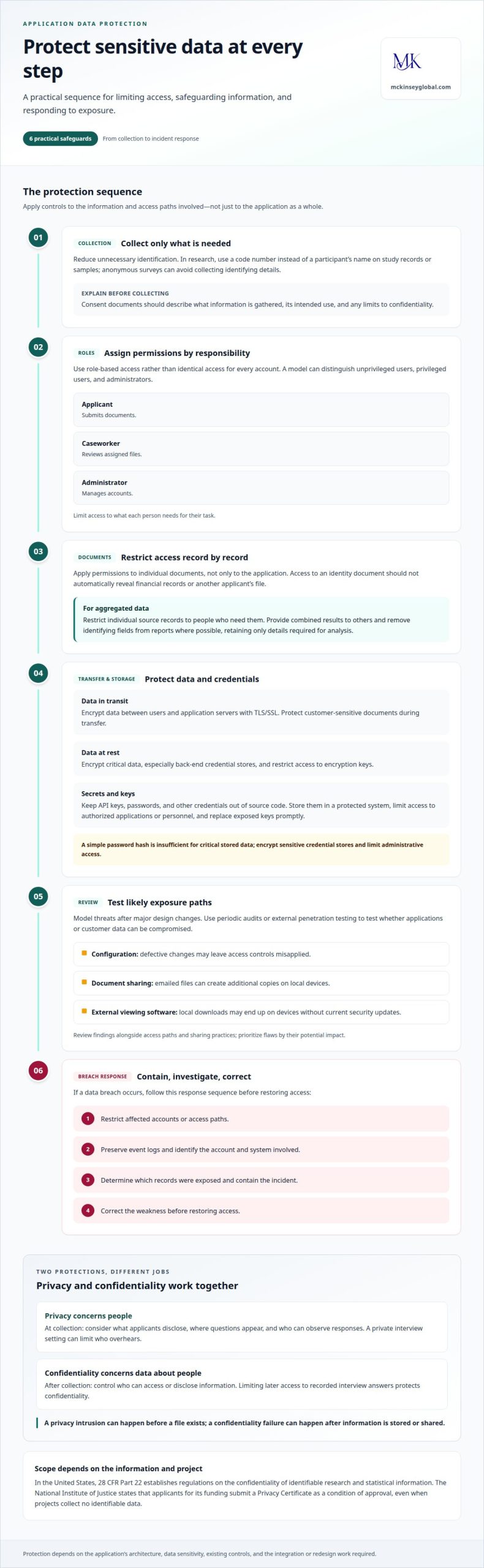
Role-based access control assigns permissions according to defined responsibilities, rather than giving every account identical access. A model can separate unprivileged users, privileged users, and administrators. For example, an applicant submits documents, a caseworker reviews assigned files, and an administrator manages accounts. This structure limits unnecessary exposure and clarifies who may view or change each record.
Apply permissions to individual documents, not just to the application. Access to an identity document should not automatically reveal financial records or another applicant’s file. For aggregated data, restrict individual source records to people who need them and provide combined results to others. Remove identifying fields from reports where possible, retaining only details required for analysis.
Implementation costs depend on the application’s architecture, data sensitivity, existing controls, and the integration or redesign work required. Assessing these factors helps define the effort involved without assuming one control can secure every system.
Encrypt data in transit with TLS/SSL between users and application servers. Encrypt critical data at rest, especially back-end credential stores. Protect customer-sensitive documents during transfer and storage, and restrict access to encryption keys.
Managing Secrets and Credentials
Secure secrets management keeps API keys, passwords, and other credentials out of source code and limits their use. Store credentials in a protected system, grant access only to authorized applications or personnel, and replace exposed keys promptly. A simple password hash is insufficient for critical stored data; encrypt sensitive credential stores and limit administrative access. These measures support a deliberate approach to ensuring application confidentiality.
After a data breach, restrict affected accounts or access paths, preserve event logs, and identify the account and system involved. Determine which records were exposed, contain the incident, and correct the weakness before restoring access.
Privacy and confidentiality in applications and consent documents
Consent documents explain how information is collected, stored, and handled; application controls govern who can access it.
Privacy Rules for Application Data
U.S. privacy requirements depend on the data and its purpose; the cited rule has a defined research scope. According to the National Archives and Records Administration, in the United States, 28 CFR Part 22 establishes regulations on the confidentiality of identifiable research and statistical information. The National Institute of Justice states that applicants for its funding submit a Privacy Certificate as a condition of approval, even when projects collect no identifiable data. These distinctions matter: consent language and stored records should reflect the project and information involved.
Protecting Sensitive Application Data
Protect sensitive application data by reducing unnecessary identification and explaining handling practices before collecting information. In research, a code number can replace a participant’s name on study records or samples, while anonymous surveys can avoid collecting identifying details. Consent documents should describe the information gathered, its intended use, and any limits to confidentiality. If documents are shared, true redaction removes sensitive information instead of merely covering it visually.
Vulnerabilities That Expose Confidential Information
Application vulnerabilities are weaknesses that can expose stored records or credentials to unauthorized access. Defective configuration changes, for example, may leave access controls misapplied, while emailing documents can create additional copies on local devices. External viewing software may also result in local downloads on devices without current security updates. Threats can arise from design decisions, code flaws, or data flows, each creating a different path to confidential information.
Assessing Confidentiality Risks
Risk assessment examines how application design, configuration, and data handling could expose identifiable information. Developers can model threats after major design changes, then use periodic audits or external penetration testing to test whether applications or customer data can be compromised. Review findings alongside access paths and document-sharing practices, and prioritize flaws by their potential impact. For residency applicants, UAE Residency Solutions provide a relevant route to consider.
Distinguishing privacy from confidentiality
The University of Utah IRB distinguishes privacy from confidentiality. Privacy concerns people; confidentiality concerns data about people. Privacy asks whether the setting and method respect a person’s reasonable expectations. Confidentiality asks how collected information is protected from improper access or disclosure. These protections work together but address different points in an information process.
Consider an application interview held in a private setting. Limiting who can overhear supports privacy; controlling later access to recorded answers supports confidentiality. A privacy intrusion can occur before anyone creates a file, while a confidentiality failure can occur after information is stored or shared. This distinction helps teams identify whether risk arises during collection or later handling.
At collection, assess what applicants disclose, where questions appear, and who can observe responses. Check whether a shared screen reveals personal details to someone nearby. At the record stage, assess links between identifying details and documents, reports, or correspondence. Then examine whether later use matches the purpose explained to the person.
Consent supports informed participation, but it does not secure a document or prevent every disclosure. Explain intended uses and relevant confidentiality limits clearly. Describe possible disclosures involving reportable diseases or abusive situations. Also address a stated intent to harm oneself or others. Align collection practices, participant explanations, and handling controls.
The University of Utah IRB advises researchers to assume it expects the highest protection level. That expectation applies to the most vulnerable populations in a study. Evaluate both dimensions separately: reduce unnecessary intrusion, then protect collected records. Decide whether an interview question is necessary, then ask whether its answer must remain identifiable during analysis. Documenting these decisions clarifies distinct privacy and confidentiality risks.
Researchers can also protect privacy by allowing participants to submit surveys and questionnaires anonymously. University of Utah investigators should review study design to avoid or minimize intrusion where participants have a reasonable expectation of privacy. In the described IoT data-cloaking context, k-anonymity means that each record is indistinguishable from at least k − 1 other records.
In the United States, 34 U.S.C. § 10231a provides statutory protection for private information in NIJ research studies. When a project will not collect personally identifiable information, its NIJ Privacy Certificate should state that fact and briefly describe the project. Log events appropriately so incident responders can identify which account was used and which system it came from.
What are best practices for protecting sensitive application data?
Protect sensitive application data with layered controls, from secure access to tested configurations. For an application holding identity documents, each safeguard should address a specific exposure path.
Require strong authentication by default, using single sign-on and multifactor authentication where appropriate. Configure TLS/SSL to protect communications between users and application servers. Encrypt critical data at rest, especially back-end credential stores; a simple password hash alone is insufficient. Developers should also protect customer-sensitive documents during transfer and storage, making intercepted traffic or exposed files harder to read.
A web application firewall can block attacks while developers remediate vulnerable code. Where available, virtual patching can help cover vulnerabilities between patch deployments. Pair these measures with a vulnerability management program that identifies flaws, assesses their significance, and prioritizes remediation. For example, a flaw exposing uploaded documents should be triaged according to the files’ sensitivity and reach.
Review configuration changes through a controlled process, since a defective infrastructure update can cause service outages or weaken protections. Use change management, then automate configuration tests to alert operations when defective changes appear. Threat modeling is also appropriate after a major application design change: map data flows, identify possible misuse, and reassess controls before release.
Application controls can check data completeness and reveal when an upstream control has failed. For example, a missing required field in a submitted record may indicate that a validation step did not work as intended. DDoS mitigation services designed to block attacks at the network edge address a different risk: service disruption. No single control covers every threat; authentication, testing, monitoring, and remediation should work together.
If your international plans also involve residency, explore UAE residency solutions as a separate consideration.
Make TLS/SSL the default for communications between users and web application servers, rather than relying on it only for selected routes. This keeps transport protection in place consistently as users move through the application.
Encryption choices also deserve review: in 2022, cryptographic primitives providing 80 bits of security or less could be efficiently broken within months using modern computers. Avoid relying on primitives at or below that threshold when protecting sensitive application data.
McKinsey Citizenship and Residency Solutions
McKinsey Citizenship and Residency Solutions guides global investors through citizenship and residency by investment pathways. Organized application documents and careful handling support a well-prepared submission. The firm can help you understand options such as Antigua and Barbuda Citizenship by Investment, Caribbean Citizenship programs, Greece Residency by Investment, and Dominica.
Consider this support when assessing an investment-based application and seeking guidance on the relevant program and application process. Clear expectations about required documents and their use can help you handle sensitive personal information carefully, alongside the privacy and confidentiality safeguards discussed above.
For guidance on citizenship or residency by investment options, contact McKinsey Citizenship and Residency Solutions.
Carry Confidentiality Into Your Next Application
For teams handling sensitive applications, ensuring application confidentiality means making deliberate decisions about who can access information and how it is handled. Build those decisions into the application’s design, rather than leaving them to a final administrative step. Clear responsibilities can help teams maintain consistent practices as records move between people and systems.
When planning an investment-based citizenship or residency application, apply the same care to your document process. Understand which information is required, how it will be handled, and what questions to resolve before proceeding. A considered approach gives you a clearer basis for deciding whether a program aligns with your priorities.
You can explore citizenship and residency by investment options as part of your planning. Discuss your application plans and take a considered next step with confidence.
Frequently Asked Questions
How can authentication and authorization prevent unauthorized access to applications?
Authentication verifies who is signing in; authorization determines what that verified account can do. For example, after a caseworker signs in, the application should check each request against their approved permissions, rather than relying on a hidden screen or button. Denying access by default and removing permissions when responsibilities change helps prevent outdated accounts from retaining access to sensitive application functions.
What are the costs of implementing application security and data protection controls?
Implementation costs depend on the application’s architecture, data sensitivity, existing controls, and the integration or redesign work required.