A second passport is most useful when you arrange it before you need to leave. The right time to consider escaping political instability with a second passport is while you can still travel, gather the required records, and assess eligibility without crisis-driven pressure. It can create another mobility option, but it is not an immediate evacuation plan.
Planning ahead matters: instability can affect personal safety and your practical ability to travel or apply for another citizenship. Waiting until restrictions or disruption are in place may narrow your choices. Applying too early without understanding your goals, however, can lead to a poor fit.
This article explains how to assess timing, how political instability and passport mobility factor into the decision, and how age, eligibility, and citizenship-by-investment programs may shape your options. It also distinguishes a second passport from residency, helping you assess which route best supports your need for flexibility and long-term planning.
Key Takeaways
- Consider a second passport before travel restrictions or urgent circumstances limit your ability to prepare an application.
- Compare citizenship with residency by asking whether your priority is a new nationality or a lawful option to live abroad.
- Caribbean investment programs differ in eligibility, qualifying routes, and application requirements, so assess how each fits your circumstances.
- Age can affect migration eligibility, but the rules vary by country and program; identify the criteria that apply to your intended route.
- Reduce scam risk by checking program details through official government channels and reviewing the application process before making commitments.
Caribbean citizenship-by-investment programs
Caribbean investment programs offer one route to citizenship; ancestry and naturalization may provide alternatives. The right pathway depends on eligibility, family records, mobility priorities, and the destination country’s rules.
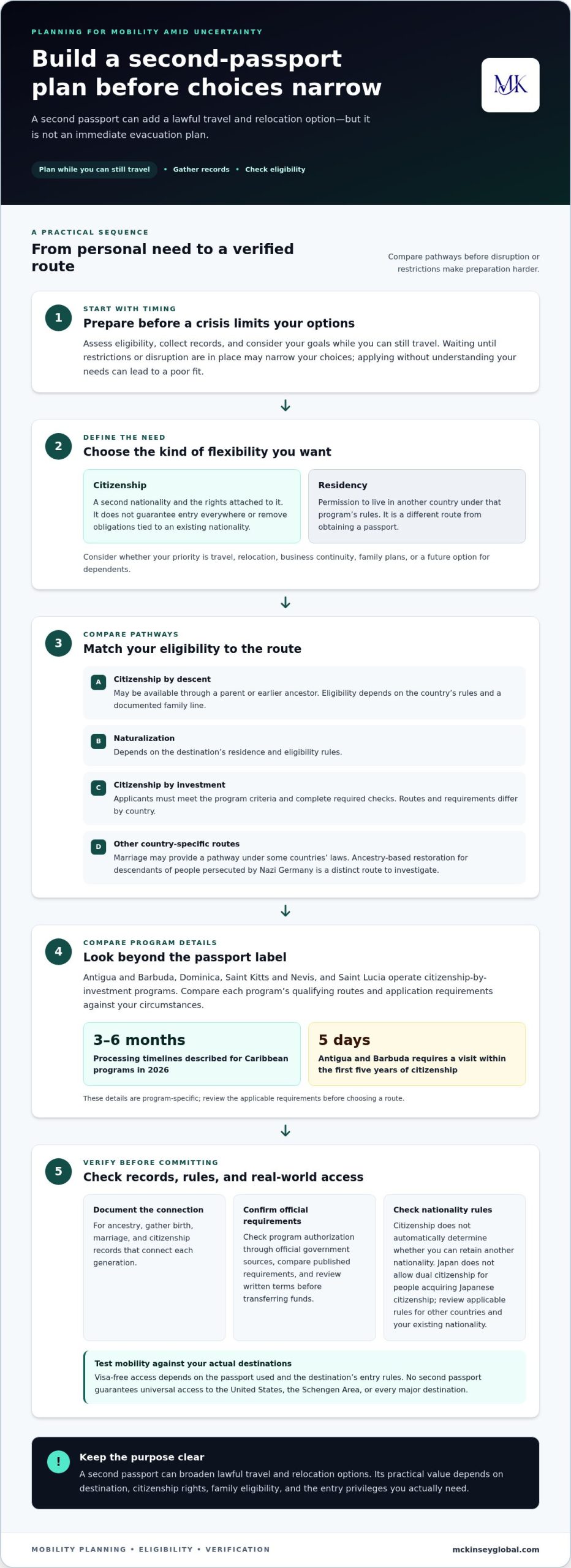
Antigua and Barbuda, Dominica, Saint Kitts and Nevis, and Saint Lucia operate citizenship-by-investment programs. Their qualifying routes and application requirements differ, so compare the structure of each program before deciding where to apply. Caribbean programs are described as having processing timelines of 3 to 6 months in 2026. Antigua and Barbuda also requires a five-day visit within the first five years of citizenship.
Citizenship by descent may be available if a parent or earlier ancestor held citizenship, but eligibility depends on the country’s rules and a documented family line. Gather birth, marriage, and citizenship records connecting each generation. For descendants of people persecuted by Nazi Germany, ancestry-based restoration may be a distinct route to investigate. It is separate from investment-based citizenship.
Passport Options in Selected Countries
Singapore, South Korea, Japan, and Switzerland each have their own citizenship pathways and passport rules. These differences matter because gaining citizenship does not automatically determine whether you can retain another nationality. Japan does not allow dual citizenship for people acquiring Japanese citizenship. For Singapore, South Korea, and Switzerland, review the applicable rules alongside those of your existing nationality before pursuing a route.
Visa-Free Access to Major Destinations
Visa-free access depends on the passport you use and the destination’s entry rules. No second passport should be treated as universal access to the United States, the Schengen Area, or every major destination. Compare each passport with your actual travel priorities, including business and family destinations. A passport’s value rests on specific entry privileges, not its label or the country’s reputation.
Eligibility Rules and Program Verification
Ancestry applications rely on a documented family connection; naturalization depends on the destination’s residence and eligibility rules. Marriage may create a pathway under some countries’ laws, while investment applicants must meet program criteria and complete required checks. To reduce scam risk, verify a program’s authorization through official government sources, compare its published requirements, and review the written terms before transferring funds.
Attitudes toward dual citizenship are increasingly part of American mobility planning. A Harris Poll found that 66% of US Gen Z and millennial respondents considered dual citizenship an aspirational goal. That interest does not determine eligibility, but it can prompt families to compare descent, investment, and residency pathways before circumstances make planning more difficult.
A second passport as a backup amid political or economic instability
A second passport can provide another lawful travel and relocation route if conditions change at home. Its practical value depends on the destination, the rights attached to citizenship, and whether your family can qualify.
Political and Economic Reasons for Seeking Another Passport
Political or economic uncertainty can prompt people to seek greater freedom of movement, access to another country, or continuity for family plans. Additional citizenship may broaden your options, but it does not remove obligations tied to an existing nationality or guarantee entry everywhere. Assess the countries you may need to reach, your family’s cultural and practical ties, and the type of disruption you are planning for.
Applications have risen amid changing political concerns. Data gathered by Al Jazeera from legal outfits facilitating citizenship by descent indicated that US applications may have grown by 500% since 2023. Industry reports also highlighted a significant rise in US applications for second citizenship or residency over recent years. These figures reflect interest in different routes, not a single explanation or a guarantee of eligibility.
Economic planning matters, too. A second citizenship or residency option may support business continuity, family relocation, or access to another place to live. Before choosing a route, distinguish immediate mobility from longer-term planning: a passport establishes citizenship, while residency provides permission to live in a country under its program rules.
Migration Pathways and Risk Concerns
Migration pathways connect personal goals with a country’s admission criteria; comparing them helps reveal trade-offs before you apply. Industry estimates cited by Al Jazeera put global second-passport applications at roughly 10,000 in the past few years, including about 4,000 from Americans. Global mobility advisors noted that Americans frequently outnumber people of other nationalities when securing alternative residences or additional citizenships.
Demographic patterns also shape decisions. Before recent US elections, the majority of surveyed American millionaires were actively exploring options abroad, according to industry data. This example shows why an international plan may reflect economic interests as well as political concerns; it does not mean every applicant shares the same priorities. Clarify whether your principal need is a second nationality, residence, or a future option for dependents.
Risk assessment should include the stability of the destination, the legal terms of the pathway, and the consequences of holding more than one nationality. Compare program rules with your existing citizenship obligations, and consider whether family members qualify independently or as dependents. Avoid making a decision solely from headlines or application trends. For a structured comparison of citizenship and residency pathways, focus on how each route aligns with your mobility goals and long-term plans.
Political instability and loss of passport mobility
Political instability can affect personal security and the ability to travel abroad. Passport mobility also depends on destination entry rules, diplomatic relations, and border controls. For families considering escaping political instability with a second passport, the practical question is whether another nationality could preserve access to destinations that matter. This is a planning option, not a guarantee of entry or protection from events.
Venezuela illustrates how passport mobility can change over time. The Venezuelan passport ranked 28th in the world in 2015, then fell to 40th over the following 10 years. A ranking does not determine an individual’s right to leave, but it can indicate shifts in international access. Compare the countries you may need to reach rather than treating a passport ranking as a complete measure of travel freedom.
European access also varies by nationality. The Schengen Area described in the research comprises 26 countries, and citizens of 62 nationalities do not need a visa to enter it. By contrast, more than 49 percent of Nigerian applicants for a Schengen visa are rejected. These figures show why escaping political instability with a second passport requires attention to particular destinations and entry rules, not broad assumptions about mobility.
Australia’s pandemic controls provide another example of restrictions affecting movement. During some lockdowns, residents of Australian capital cities could not travel more than 5 kilometers from home. In 2020, Australia did not allow people holding valid legal working visas to enter. Returning Australian citizens faced mandatory 14-day hotel quarantine, which was often self-funded.
These examples distinguish citizenship from immediate permission to travel. A second passport gives you another nationality to present when seeking entry, but each destination sets its own rules. It does not guarantee admission, remove screening, or automatically give you the right to live abroad. Compare relevant routes with your likely travel needs, family circumstances, and longer-term immigration plans.
For someone in the United States, political concerns may prompt contingency planning before a crisis develops. Start by identifying the destinations that matter, then assess their entry conditions and whether citizenship or residency is relevant. Residency can provide permission to live in a country under its program rules, but it does not confer citizenship. This distinction matters if your goal is another passport rather than a place to reside.
Mobility rules can change while an application is underway. Review the entry requirements for your intended travel and distinguish long-term citizenship benefits from immediate access. A practical comparison should cover eligibility, family inclusion, and ongoing obligations. This helps clarify whether an additional nationality addresses the specific mobility risk you are planning for, rather than simply adding another document to your portfolio.
Age limits and migration eligibility
Age can affect eligibility differently across citizenship and residency pathways. Before applying, identify whether the destination’s government sets age criteria for the principal applicant, dependents, or both. An age limit for direct residency does not automatically establish a limit for citizenship by investment, ancestry, or another route.
Australia provides a clear example of an age-related restriction. Applicants over 45 are generally ineligible for direct residency there, barring unique circumstances. This rule concerns a specific migration pathway, not every country’s programs. Compare the relevant route’s criteria before treating age as either a barrier or a reason to delay.
Citizenship and residency lead to different outcomes. A citizenship application seeks nationality and a passport; a residency pathway concerns permission to live in a country under its rules. For example, when evaluating the United Arab Emirates, distinguish a residency solution from citizenship. The pathway’s purpose determines which eligibility criteria matter most.
Family composition can change the application analysis. List everyone who may apply with the principal applicant, including a spouse and children, then identify the requirements for each category. A dependent’s age may be assessed separately from the main applicant’s. Confirm how the program defines eligible family members and what evidence supports each relationship.
Timing matters when a route has an age threshold or requires a period of residence. Compare your current age with the applicable criteria, then map the steps required before submitting an application. If eligibility depends on residence, consider whether you can meet that condition in practice. Do not assume that gaining residency immediately confers citizenship.
Age alone does not determine whether you can obtain a second passport. Ancestry routes depend on documented family connections; naturalization depends on a country’s requirements; investment routes have their own eligibility standards. For each option, separate mandatory criteria from personal preferences, such as desired destinations, family inclusion, and ability to relocate.
A 77-year-old New York resident was seeking a secondary passport in Antigua with his wife and daughter. This example shows why age should prompt a route-specific assessment, rather than an automatic conclusion that applying is no longer possible. It does not establish that every applicant of the same age qualifies.
Before choosing a pathway, compare applicant ages, family members, residence commitments, and required records. Assess each item against the applicable program criteria. This focused review helps distinguish a genuine eligibility constraint from an assumption and clarifies whether citizenship or residency better fits your plans.
How can applicants verify a citizenship program and avoid immigration scams?
Start with the government authority responsible for the program, not an advertisement or social media post. Find its official program materials and compare the eligibility criteria, application stages, required documents, and payment process. If an intermediary describes a different route, ask for the exact program name and compare each claim with the government’s published information.
Next, establish what the service promises. Citizenship, residency, and a passport are distinct outcomes; an application for residency does not itself grant citizenship. Treat claims of guaranteed approval, instant citizenship, or special access beyond official rules as warning signs. A legitimate process includes an assessment, document review, a government decision, and clear disclosure of the applicant’s responsibilities.
Check the intermediary’s role before sharing sensitive records or funds. Confirm whether the relevant government identifies authorized representatives or provides a way to verify their status. Match the representative’s legal name and business details against those records. If a representative will not identify the program authority, gives inconsistent information, or pressures you to act immediately, pause and reassess.
Review every written document before signing. The agreement should identify the service, scope of work, payment stages, refund terms, and responsibilities on both sides. Compare its wording with official program requirements. Keep applications, receipts, correspondence, and identity documents in secure storage. For example, clarify a payment request that names neither a recipient nor a program stage before proceeding.
Scrutinize claims about passport mobility as carefully as claims about eligibility. No passport provides unrestricted entry to every country, and approval depends on the applicable process. Ask which citizenship route is under consideration, then compare its stated requirements with your circumstances, including family members and source documents. Do not rely on a passport ranking or verbal promise as proof of your individual outcome.
Applicants considering Antigua and Barbuda Citizenship by Investment or St. Kitts and Nevis Citizenship should assess each program’s requirements and application process separately. A sound comparison explains which route is under consideration and what the applicant must provide. It does not confuse citizenship with residency or suggest that investment alone secures approval.
Before committing, organize your questions around three points: the official program, the intermediary’s role, and the written terms. This makes inconsistencies easier to identify and gives you a clear record of what was represented. To discuss Caribbean citizenship program options, request guidance on the route that aligns with your eligibility and objectives.
McKinsey Citizenship and Residency Solutions: Antigua and Barbuda Citizenship by Investment
McKinsey Citizenship and Residency Solutions guides applicants considering Antigua and Barbuda Citizenship by Investment, helping them assess whether the route aligns with their mobility and family priorities. Turn to the firm once you have clarified your objectives and want guidance comparing program requirements with your circumstances.
For applicants weighing alternatives, the firm also assists with St. Kitts and Nevis Citizenship, Dominica, and Greece Residency by Investment. These routes have different outcomes: citizenship and residency are not interchangeable, and the right option depends on your eligibility and long-term plans. A focused discussion can help you understand which pathway merits consideration and what its application involves.
To discuss your options, contact McKinsey Citizenship and Residency Solutions or visit mckinseyglobal.com.
Make Your Mobility Plan Deliberate
A plan for escaping political instability with a second passport should begin with a clear personal threshold: what circumstances would prompt you to relocate, and which destinations would remain practical for your family? Defining that threshold now can help you assess options calmly instead of deciding under pressure.
Before moving forward, turn your priorities into a written decision framework. Consider each family member’s role, the records you can assemble, how you intend to use a second status, and the difference between citizenship and residency. This makes your next conversation more focused and helps you compare pathways against the same objectives.
McKinsey Citizenship and Residency Solutions offers Antigua and Barbuda Citizenship by Investment, St. Kitts and Nevis Citizenship, and Greece Residency by Investment. If you are ready to discuss how a pathway may align with your plans, contact McKinsey Citizenship and Residency Solutions.
Thoughtful preparation can give your family a clearer basis for its next decision.
Frequently Asked Questions
When Is the Right Time to Apply?
Apply when you can make a considered decision and gather the records your chosen route requires, rather than waiting for a crisis to dictate the timing. First, identify the event that would prompt relocation; then review document availability, family readiness, and application requirements. For example, if your family needs to document several generations of ancestry, locating those records early can help establish whether descent is a viable route.
How Do You Choose the Right Program for Your Situation?
Choose a program by matching its legal outcome and obligations to your actual objective. Create a comparison that records whether the route grants citizenship or residency, how it treats dependents, what residence commitments apply, and which travel destinations matter to you. Then consider dual-nationality implications and your ability to meet the program’s requirements. A route that suits a frequent traveler may not fit someone planning to relocate with children.
How do you buy a citizenship?
You do not buy citizenship directly from a private seller; you apply through a country’s lawful citizenship process. For an investment route, the applicant submits required information and completes the qualifying steps set by the government. The authority assesses the application and decides whether to grant citizenship. Treat offers of a passport without government review as a warning sign, and distinguish the private service provider’s role from the government’s decision.
What Does a Second Passport Actually Protect You From?
A second passport may give you another nationality and another basis for seeking entry to destinations where that passport provides relevant access. It does not guarantee admission, prevent political events, or remove your obligations under another country’s laws. If you are concerned about travel disruption, identify the specific destinations and border rules that matter instead of assuming another passport offers universal access or personal protection.
What are passport-for-investment schemes?
Passport-for-investment schemes are citizenship programs in which an eligible applicant follows a government-defined investment route and may receive citizenship after meeting the requirements. The term should not suggest an automatic exchange of money for a passport. Applications undergo official review, and applicants must meet program criteria. Distinguish these schemes from residency-by-investment routes, which grant residency rather than citizenship.
What are the main reasons that people want second passports?
People may seek another passport to expand travel options, create a relocation pathway, support family plans, or pursue opportunities connected to another country. Some investigate citizenship by descent because of family history; others consider investment routes. Your motivation affects the route: someone seeking a place to live may prioritize residence rights, while a traveler may focus first on destination access and nationality rules.
Will the demand for second passports continue to rise?
Political uncertainty, economic conditions, travel access, and changes to national programs can shape demand. These factors may influence whether people explore another citizenship or residency, but they do not establish a certain future trend. For an individual, application volume matters less than the route’s eligibility rules and suitability. A sound plan should remain useful even if public interest shifts or program requirements change.
Which countries offer citizenship by investment or other second-passport programs?
Citizenship-by-investment options include programs in Antigua and Barbuda, Dominica, St. Kitts and Nevis, and St. Lucia. Türkiye also offers citizenship by investment. Other routes include citizenship by descent or naturalization, subject to each country’s laws. Greece, Portugal, the United Arab Emirates, and Latvia offer residency pathways that can support relocation planning, but are not passports or citizenship.