A persuasive proposal is not proof of an agent’s authority or of the figures quoted. To understand how to verify a citizenship by investment agent, confirm the agent’s identity and programme-specific authorisation, then compare the required investment and payment instructions with the government’s current requirements. Treat any promise of guaranteed approval as a warning sign.
Before committing, ask for clear figures and a precise explanation of the agent’s role. This guide explains how to check an agent’s identity, authority and approval claims, and how to distinguish the qualifying investment from other charges. It also shows how to compare a written breakdown with programme requirements, so you can see what each amount covers and who receives it.
Key Takeaways
- Match the agent’s legal name and contact details to their stated business role, so you can spot inconsistencies before proceeding.
- Check the programme’s official agent register and recheck authorisation before payment, since an agent’s status can change.
- Separate the qualifying investment from government charges and professional service fees when reviewing a written quotation.
- Distinguish authority to submit an application from authority to decide it, and treat approval promises accordingly.
Checking investment figures against government requirements
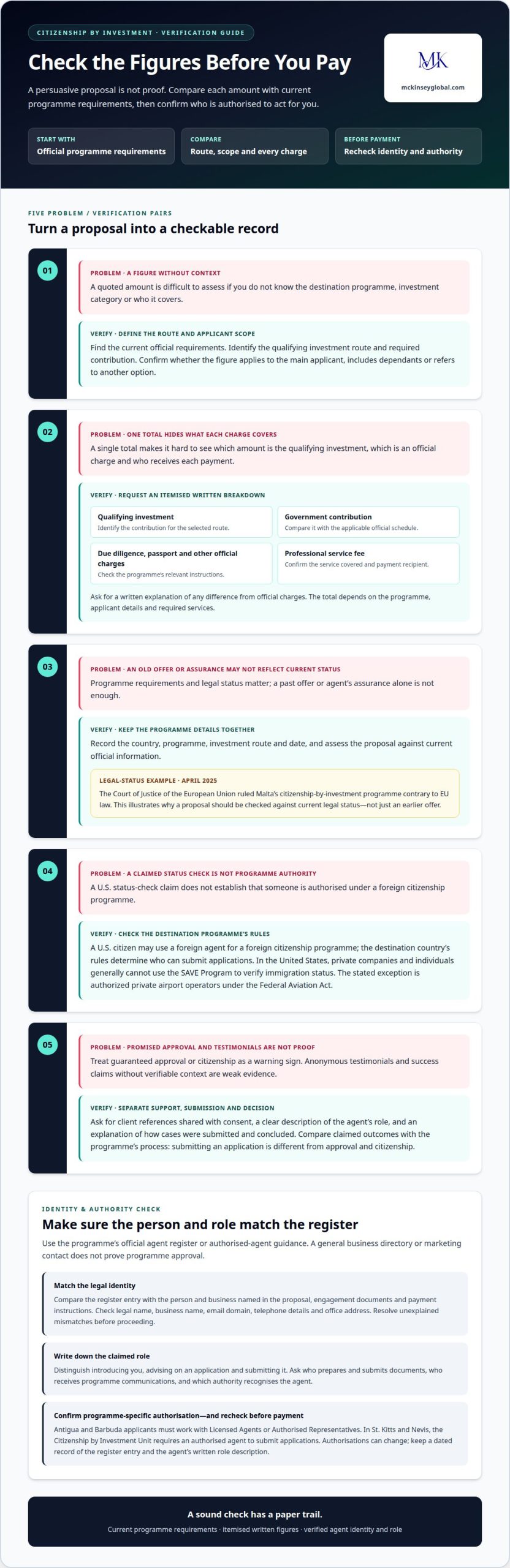
- Begin with the destination programme’s current official requirements, not an agent’s summary. Identify the qualifying investment route and its required contribution, then compare the proposal with that route. Check whether the figure applies to the main applicant, includes dependants or refers to a different option. Without the programme and investment category, a figure is difficult to assess.
- Compare each amount with the relevant government schedule, and record what it covers. In April 2025, the Court of Justice of the European Union ruled Malta’s citizenship-by-investment programme contrary to EU law. This illustrates why a proposal should be assessed against the programme’s current legal status, not simply a past offer or an agent’s assurance. Keep the country, programme, route, and date together in your notes.
- Before paying, request an itemised written breakdown that separates the qualifying investment from the agent’s professional fee, government contribution, due diligence, passport and other official charges. Compare official charges with the programme’s applicable instructions, and ask for a written explanation of any difference. The total depends on the case and is provided after a quote request; factors include the programme, applicant details and required services.
- A U.S. citizen may use a foreign agent for a foreign citizenship programme; the destination country’s rules determine who can submit applications. In the United States, private companies and individuals generally cannot use the SAVE Program to verify immigration status. The exception is authorized private airport operators under the Federal Aviation Act. A claimed U.S. status check is not proof of authority under a citizenship programme.
- Treat references and past outcomes as supporting information, not proof of future approval. Ask for client references shared with consent, a clear description of the agent’s role, and an explanation of how cases were submitted and concluded. Compare claimed outcomes with the programme’s process, distinguishing application submission from approval and citizenship. Anonymous testimonials and success claims without verifiable context are weak evidence.
Matching an agent’s legal identity, contact details and role
Use official programme records to establish who is authorised to act for you. Compare that authority with the identity and role stated in your correspondence.
-
Verify official agent licensing
Find the programme’s official agent register and search the agent’s full legal name. Check that the listed status and role apply to the programme you are considering, not a different destination. Antigua and Barbuda applicants must work with Licensed Agents or Authorised Representatives. In St. Kitts and Nevis, the Citizenship by Investment Unit requires an authorised agent to submit applications. A marketing contact may not be the authorised submitting agent.
-
Match the agent’s identity and contact details
Compare the register entry with the person and business named in the proposal, engagement documents and payment instructions. Check that the legal name, business name, email domain, telephone details and office address are consistent. If someone communicates for a firm, establish their stated role and connection to the registered entity. Resolve unexplained name changes or mismatched details before proceeding.
- Write down the exact role the agent claims to perform: introducing you, advising on an application or submitting it. These roles are different. Request the proposed scope in writing, including who prepares and submits documents and who receives programme communications. For example, do not treat a contact who arranges an introduction as the official submitting agent unless the programme recognises that role.
- Check that the named agent remains authorised for the selected programme before payment; authorisations can change. Keep a dated record of the register entry and the agent’s written role description. If the application involves several representatives, identify each party’s function and legal identity. Programme-specific application guidance can help clarify the steps involved in a citizenship application.
Related verification procedures can involve separate government records and document duties. Nebraska broker-dealers and investment advisers must submit the completed attestation form and supporting documentation to the Department for individuals identified as qualified legal aliens. As of March 2026, the Verification Information System supporting the U.S. SAVE Program contained over 100 million records. These facts describe verification systems, not agent authorisation.
Understanding agent authority and approval guarantees
Confirm the agent’s authority for the specific programme, then distinguish application support from decision-making power. Take these steps before signing or transferring funds.
-
Locate the authorized-agent registry
Visit the official citizenship programme authority’s website and find its agent register or authorised-agent guidance. Search the agent’s legal name and the programme country, then check the listed role and status. In St. Kitts and Nevis, the Citizenship by Investment Unit requires an authorised agent to submit applications. A general business directory does not prove programme approval.
-
Ask about the agent’s authority
Request a written description of the agent’s role: will they advise, prepare documents or submit the application? Ask which programme authority recognises them and who handles official correspondence. In St. Kitts and Nevis, the authorised agent submits the application, while the government process determines the decision. The answers should make clear whether the person is an intermediary or the authorised submitting agent.
-
Recognize scam warning signs and approval promises
Treat promises of guaranteed citizenship or approval as a warning sign. In Dominica, authorised agents submit applications, but they do not decide them and cannot guarantee approval. Be cautious if someone pressures you to transfer funds quickly, will not identify the legal recipient or claims authority without a verifiable programme role. Compare every claim with the programme’s official process.
-
Review the contract and protect your money
Before signing, make sure the agreement identifies the parties, services, deliverables, charges, payment schedule and terms for ending the engagement. Confirm in writing which sums go to the agent and which go to a government or other legal recipient. Independently verify programme payment instructions and identify each payment’s legal recipient. Keep the signed contract, invoices and payment records together.
Timing is another reason to be wary of promises. Dominica’s official programme guidance gives a non-guaranteed guide of three to six months for complete applications. In St Kitts and Nevis, the process includes approval in principle, followed by the qualifying investment and a citizenship certificate. These are process details, not a substitute for checking current official instructions.
Nebraska will terminate those registrations on January 1, 2027, if firms do not submit supplements or provide required information by the appropriate deadline. Separately, USCIS deployed an updated version of the SAVE Program on May 22, 2025, allowing state and local authorities to submit Social Security Numbers to help verify immigration status. These references concern different systems; do not treat them as evidence of an agent’s citizenship-program authority.
How can I verify that a citizenship by investment agent is officially licensed?
Use the destination programme’s official information to confirm the agent’s role. Match the authorisation to the specific country and application route.
- Start with the citizenship programme’s official authority and find its agent register or published agent requirements. Search the agent’s legal name, then compare the listed role with the service offered. A general business listing or professional profile does not establish programme authorisation. Record the programme and role shown to distinguish submission authority from marketing or referral work.
- For Grenada, check the Investment Migration Agency Grenada’s approved-agent information. Applications are submitted through approved agents, including Local Agents or International Marketing Agents. The process uses international marketing agents working with local agents, so identify the specific party responsible for your application. An intermediary’s involvement does not, by itself, make that intermediary the authorised submitting agent.
- For Saint Lucia, compare the agent’s role with the programme’s requirements for Licensed Authorised and Marketing Agents. For Antigua and Barbuda, applicants must work with Licensed Agents or Authorised Representatives. These titles are specific to each programme. Match the exact designation to your destination instead of relying on a similar title used elsewhere.
- Recheck the agent’s authorisation before payment, since authorisations can change. Confirm that the name and role still match the official programme information, and keep a dated record. A register entry establishes the agent’s listed status, but does not by itself demonstrate service quality, investment safety or suitability for your family.
- Resolve any discrepancy through the programme authority’s official contact channels before proceeding. Ask which listed agent will submit the application and whether the named representative acts through another approved agent. Keep the response with your application records. For help aligning a programme route with your plans, discuss citizenship programme options as a next step.
McKinsey Citizenship and Residency Solutions
McKinsey Citizenship and Residency Solutions helps investors assess citizenship and residency by investment pathways and understand the application process. After reviewing an agent’s identity, authority, and quoted figures, you may want guidance applying those checks to a specific programme and your circumstances.
McKinsey Citizenship and Residency Solutions supports options including Antigua and Barbuda Citizenship by Investment, St. Kitts and Nevis Citizenship, Greece Residency by Investment and Dominica. Its guidance can help you clarify the programme route, understand the agent’s role and consider the next steps in the process. This is a practical next step when you are moving from general checks to evaluating an application pathway.
For guidance on programme options and the application process, contact McKinsey Citizenship and Residency Solutions.
Make your next decision with a clear process
Once you know how to verify a citizenship by investment agent, apply the same care when deciding whether a programme fits your broader plans. Consider how the application pathway aligns with your family’s priorities, mobility needs and long-term intentions. A sound decision involves more than choosing an agent: understand the commitment and process you are choosing to pursue.
McKinsey Citizenship and Residency Solutions can help you consider programme pathways and understand the steps involved in an application. If you are ready to discuss your circumstances and next steps, contact McKinsey Citizenship and Residency Solutions. A considered conversation can help you move forward with greater clarity.
Frequently Asked Questions
How do I verify an agent’s company registration, address, and professional credentials?
Search the company’s legal name in the official corporate registry for its jurisdiction, then compare its registration details and registered address with the proposal and contract. Check that correspondence uses consistent business details, and clarify any difference between a registered office and the agent’s working address. Verify professional credentials with the issuing body, and check programme-specific authorisation separately. Company registration alone does not establish authority to submit citizenship applications.