The most familiar route through the latvia investment residency program may no longer be available to new applicants. Since September 15, 2026, Latvia has closed its real estate and bank-deposit investment options to new applications, shifting the focus toward business investment and a newly introduced fund route that is not yet operational.
It is reasonable to ask which options remain viable and what a Latvian residence permit actually provides. The distinction matters: temporary residence is not permanent residence or citizenship, and Schengen travel permission does not grant unrestricted rights to live or work across the European Union.
This guide explains the current investment routes, their eligibility requirements and practical differences, and the due diligence to consider before choosing one. It also clarifies how residence, physical presence, renewal, and longer-term status fit together, so you can assess a route against your objectives rather than assume an investment alone determines the outcome. Structured program evaluation and application guidance can help you understand your obligations and organize the evidence required.
Key Takeaways
- The latvia investment residency program has shifted away from real estate and bank deposits. Understand which investment routes are currently relevant before planning an application.
- Compare business investment options by company criteria, qualifying investment, and ongoing obligations. Distinguish them from the fund route, which is not yet operational.
- Assess the permit for what it grants: Latvian temporary residence and limited Schengen travel, not automatic permanent residence, citizenship, or unrestricted EU work rights.
- Prepare for a compliant application by organizing identity, investment, source-of-funds, and supporting records. Latvian authorities make the final decision.
- Use a structured review of your objectives, route fit, investment due diligence, and evidence readiness to shape a practical Latvia residency strategy.
What Is Latvia’s Investment Residency Program, and What Does It Grant?
The latvia investment residency program is a framework through which eligible non-EU investors may seek a Latvian temporary residence permit by meeting the requirements of a qualifying investment route. The current framework reflects Latvia’s Immigration Law, including changes effective September 15, 2026. A residence permit allows its holder to reside in Latvia under specified conditions; it is not permanent residence, citizenship, or a Latvian passport.
Definition: Latvian investment residence is a temporary immigration status granted to an eligible investor under applicable Latvian law, not a grant of Latvian or EU citizenship. Eligibility, permitted activities, renewal conditions, and related obligations depend on the selected route and the rules in force when an application is assessed.
Who may consider Latvian investment residence?
Residence planning may be relevant to investors seeking a base in Latvia, developing European business interests, or diversifying where they live and operate. Family considerations can also shape the assessment: the program allows an eligible main applicant to include a spouse and dependent children. These objectives do not establish eligibility or assure approval. They help frame whether Latvia’s current routes and obligations align with an investor’s circumstances.
What residence in Latvia does, and does not, mean
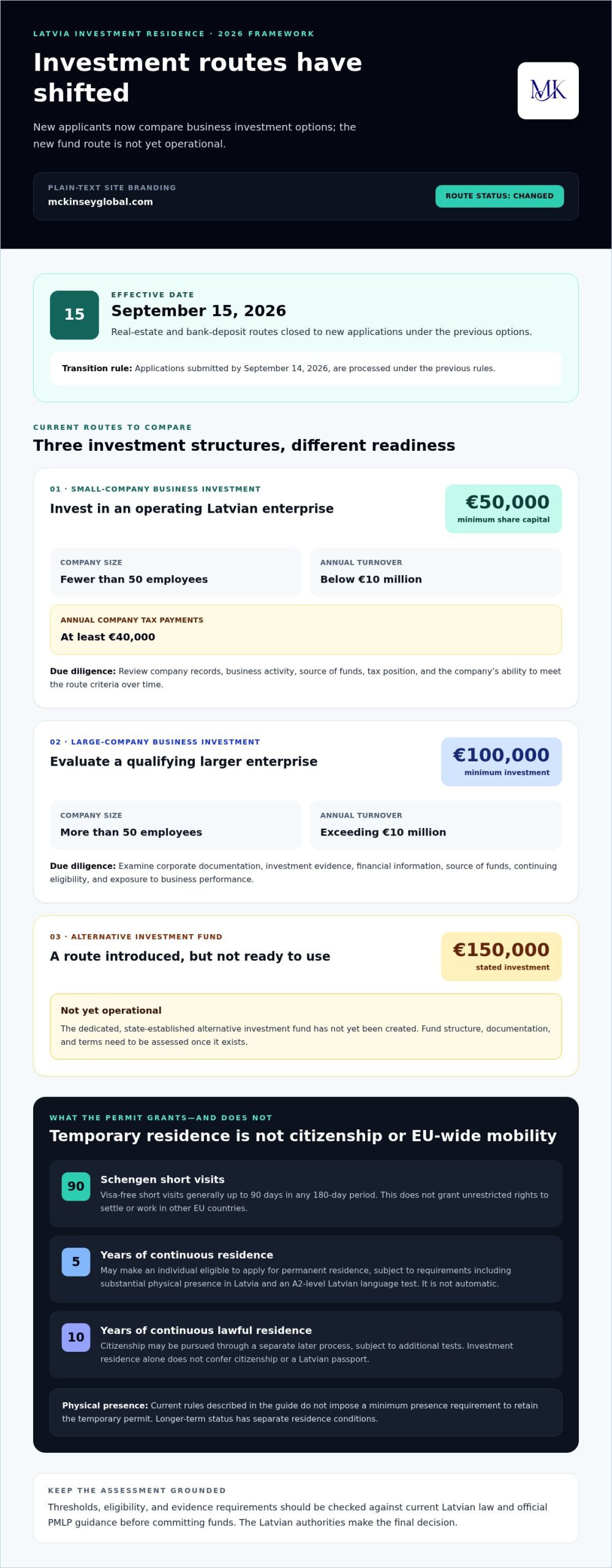
A temporary residence permit differs from permanent residence and citizenship. After five years of continuous residence, an individual may be eligible to apply for permanent residence, subject to requirements that include substantial physical presence in Latvia and an A2-level Latvian language test. Citizenship is a separate, later process that may be pursued after ten years of continuous lawful residence, subject to additional tests. Neither status is automatic, and investment residence does not itself confer a Latvian passport. Citizenship by descent is also a distinct legal route, assessed on ancestry rather than an investor residence permit.
A Latvian residence permit can support visa-free short visits within the Schengen Area, generally up to 90 days in any 180-day period. It does not grant the right to settle or work without restriction in other EU countries. Residence rights in Latvia and permission to work elsewhere are separate matters. Nor does holding a Latvian permit alone settle an individual’s tax position. Tax residence is assessed separately, and time spent in Latvia is one relevant consideration.
For the permit itself, the current rules do not impose a minimum physical-presence requirement to retain residence, although longer-term status has its own residence conditions. Distinguish the immediate permission you seek from the presence, language, and compliance requirements that may apply later.
Which Latvia Investment Residency Routes Should Investors Compare?
Route selection changed materially on September 15, 2026. Under the current framework described in this guide, new applicants can compare business investment routes, while real-estate and bank-deposit applications are no longer accepted under the previous options. A state-established alternative investment fund route has been introduced, but it is not yet operational because the dedicated fund has not been created. Applications submitted by September 14, 2026, are processed under the previous rules.
The current latvia investment residency program therefore calls for a comparison of both investment structure and implementation status. The figures below reflect the rules described for 2026. Have thresholds, eligibility, and evidence requirements checked against current Latvian law and official PMLP guidance before committing funds.
| Route | Investment form | Core diligence | Continuing considerations | Potential investor fit |
|---|---|---|---|---|
| Small-company business investment | At least €50,000 in share capital; the company must have fewer than 50 employees and annual turnover below €10 million. | Review company records, business activity, source of funds, and the stated requirement for at least €40,000 in annual company tax payments. | Assess the company’s ongoing activity, tax position, and ability to meet the route’s criteria. | Investors prepared to assess and support an operating Latvian enterprise. |
| Large-company business investment | At least €100,000 in a company with more than 50 employees and turnover exceeding €10 million. | Examine corporate documentation, investment evidence, financial information, and source of funds. | Consider the company’s continuing eligibility and the investor’s exposure to business performance. | Investors evaluating a qualifying larger enterprise. |
| Alternative investment fund | €150,000 in a state-established alternative investment fund; the route is not yet operational. | Assess the fund structure and investment documentation once the dedicated fund exists. | Confirm route requirements and fund terms before making an investment. | Investors considering a fund structure, subject to operational readiness. |
| Real estate or bank deposit | Previous options, including the €250,000 real-estate and €280,000 bank-deposit routes. | Not available for new applications under the rules effective September 15, 2026. | Applications submitted by September 14, 2026, follow the previous rules. | Relevant only to applicants within the stated transition period. |
A one-time €10,000 state payment applies to the current investment routes described in the 2026 guidance. Treat this separately from the investment itself, and verify the applicable payment and submission requirements for the chosen route before transferring funds.
Company investment: assess the enterprise and continuing obligations
Business investment requires more than proof that capital has been committed. Due diligence should connect the investment to the company’s share-capital records, corporate documents, financial position, and evidence showing the lawful source of funds. For the small-company route, the stated annual tax-payment condition makes the company’s capacity to sustain qualifying operations especially important. An investment and supporting file do not guarantee a residence decision.
Real estate and financial-institution routes: compare the underlying risks
Real-estate and credit-institution investment should not be treated as current options for new applications under the rules effective September 15, 2026. For cases submitted by the transition deadline, eligibility under the former rules is distinct from the commercial merits of a property or deposit. Property title, valuation, liquidity, and market exposure remain separate due-diligence questions; none determines immigration approval on its own.
A structured review of route fit, company or fund records, and investment-source evidence can help identify gaps before you commit capital. Latvia residency route assessment can form part of that planning process.
Does Latvian Investment Residence Lead to EU Citizenship or Full Mobility?
No. Investment residence is not an immediate citizenship route. A temporary residence permit grants a defined immigration status in Latvia, while permanent residence and citizenship require separate applications and qualification under the rules in force at the time. Latvian citizenship can confer EU citizenship, but an investment or residence permit alone does not.
Latvian investment residence does not automatically grant permanent residence, Latvian or EU citizenship, a Latvian passport, or unrestricted rights to live and work throughout the EU. These distinctions matter when assessing what the latvia investment residency program can provide: residence in Latvia, not automatic progression to broader status.
Temporary residence, permanent residence, and citizenship are different statuses
A temporary residence permit authorizes residence in Latvia subject to its terms. Permanent residence is a separate status. An applicant may become eligible to apply after five years of continuous residence, including physical presence for at least four of those five years and an A2-level Latvian language test. Meeting a time threshold alone does not guarantee approval.
Citizenship is a further legal process. It may be pursued after ten years of continuous lawful residence, subject to language, history, and constitutional knowledge tests. Investment does not replace these requirements, and citizenship by descent is a distinct route based on ancestry rather than investor status.
Schengen access, work rights, and tax residence require separate analysis
A valid Latvian residence permit allows short visits within the Schengen Area, generally up to 90 days in any 180-day period, subject to applicable travel rules and valid documents. This is travel permission, not authorization to establish residence or take employment in another EU country. A Latvian permit’s rights should not be treated as equivalent to those of an EU citizen.
Tax status is also separate from immigration status. A person who spends fewer than 183 days a year in Latvia is generally not considered a Latvian tax resident; however, the day count alone is not a complete tax assessment. Relevant facts and applicable rules may affect the outcome.
Plan around the status you need now and the criteria you may need to satisfy later. Retaining a temporary permit and qualifying for permanent residence involve different considerations. Language, physical presence, lawful residence, and other applicable conditions can shape the longer-term assessment.
How to Prepare a Latvia Investment Residency Application
A well-prepared application begins with route fit, not document collection alone. The latvia investment residency program has route-specific eligibility and evidence requirements, so organize the process around the investment structure, the applicant’s circumstances, and current Latvian authority instructions. Advisory support can help assess eligibility, structure the file, and coordinate preparation; the competent Latvian authorities decide whether to grant a permit.
Establish eligibility and document the investment trail
Use this preparation sequence to identify gaps before submission:
- 1. Define the objective and assess route fit. Match the applicant’s residence goals and circumstances to a route currently available under Latvian law. Check the applicable criteria and investment conditions before committing funds.
- 2. Assemble identity and civil-status records. Organize passports and relevant records for the main applicant and any included family members, using the categories and formats required for the specific application.
- 3. Document the investment. Gather evidence showing the investment’s structure, ownership, transfer, and relationship to the qualifying business or fund route. Corporate or fund records should support the route-specific eligibility assessment.
- 4. Trace the source of funds. Prepare a coherent record of how the capital was obtained and transferred, supported by financial and other relevant records. Ensure the investment trail aligns across documents.
- 5. Validate document formalities. Check current official instructions for translation, certification, legalization, document validity, and submission format. Requirements can differ by document and applicant circumstances, so avoid relying on a generic checklist.
Plan submission, decision-making, and ongoing compliance
Before filing, review the application as a complete record. Confirm that names, dates, ownership details, and financial evidence are consistent, and identify any missing explanations. Submission and follow-up may involve responding to requests or providing additional records. Processing time depends on the case and authority workload; preparation or advisory guidance cannot guarantee a decision or a specific timeframe.
After approval, maintain a compliance calendar. Record permit expiry and renewal dates, track any investment-retention conditions, and keep evidence of continuing eligibility. Changes such as a family-status update, a change in the investment, or other material personal circumstances may affect what must be reported or documented. Check the applicable rules rather than assuming the original file covers later events.
For structured support with route assessment, evidence organization, and application management, explore Golden Visa advisory guidance as part of your planning.
Build a Latvia Residency Strategy with Structured Advisory Support
A sound Latvia residency strategy links the desired outcome to a route that is currently available, an investment the applicant understands, and evidence that can withstand review. The latvia investment residency program should be assessed as both an immigration process and an investment decision; qualifying on one dimension does not remove the need to examine the other.
McKinsey Citizenship and Residency Solutions advises investors on Latvia planning through program evaluation and application management. This support can bring structure to route comparison, document preparation, and procedural coordination, while Latvian authorities retain responsibility for eligibility assessments and permit decisions. Advisory work can improve clarity and readiness, but it cannot guarantee approval.
Match the route to your objectives and risk profile
Begin by defining the purpose of residence, such as a family base, participation in a Latvian business, or a broader geographic strategy. Then compare potential routes across four dimensions:
- Investment structure: Identify what capital is committed to and how the investment is documented.
- Liquidity and commercial exposure: Consider how readily the investment can be exited and what financial or operational risks it carries.
- Involvement: Determine whether the route requires an active relationship with a company or another investment structure.
- Immigration criteria: Assess eligibility, supporting evidence, permit conditions, and renewal obligations under current Latvian requirements.
Keep commercial due diligence distinct from the immigration assessment. A business may appear commercially attractive without meeting permit criteria. Conversely, meeting a stated investment threshold does not establish that an investment suits the applicant’s financial objectives. Base recommendations on current official requirements, and record assumptions and unresolved evidence gaps clearly.
Take the next step with a documented plan
Before proceeding, prepare a concise planning record that captures the applicant’s objectives, the route under consideration, the basis for route fit, and the documents needed to support the case. Add practical milestones for investment verification, application preparation, submission, permit expiry, renewal, and any continuing conditions. This creates a working plan rather than an assumption that residence follows automatically from investment.
With structured guidance, investors can assess the route, organize application evidence, and plan for ongoing responsibilities with greater procedural clarity. To discuss your objectives and develop a tailored Latvia residency strategy, Discuss your Latvia residency strategy.
Turn Your Latvia Residency Goals into a Clear Plan
The latvia investment residency program is best approached as a carefully assessed investment and immigration decision, not a shortcut to citizenship. The right route depends on your objectives, investment profile, eligibility, and readiness to document the application. A temporary permit also carries distinct rights and obligations from permanent residence or citizenship, so understanding those limits is essential to sound planning.
McKinsey Citizenship and Residency Solutions provides investment-migration advisory for Latvia and other international jurisdictions, including structured program evaluation and end-to-end application guidance and management. This support can help organize route assessment, evidence preparation, and procedural steps; the decision remains with the Latvian authorities.
Begin with a clear account of what you want residence to achieve, then assess the current requirements and responsibilities against that objective. To discuss your circumstances and plan a considered next step, Discuss your Latvia residency strategy. Informed preparation can help you move forward with greater clarity.
Frequently Asked Questions
What is Latvia’s investment residency program?
Latvia’s investment residency program allows eligible non-EU investors to apply for a temporary residence permit by meeting the requirements of a qualifying investment route under Latvian law. The permit provides residence rights in Latvia subject to its conditions; it is not permanent residence or citizenship. Eligibility, family-member provisions, and ongoing obligations depend on the route and the rules applicable when the application is assessed.
Which investments qualify for Latvian residence in 2026?
For new applications, the 2026 routes described are business investment and a state-established alternative investment fund route, which is not yet operational. Business investment starts at €50,000 for a qualifying small company, subject to company criteria and an annual tax-payment requirement, or €100,000 for a qualifying larger company. The fund route is €150,000. Real estate and bank deposits are no longer available to new applicants under rules effective September 15, 2026.
Does Latvian investment residency lead to citizenship?
No. Investment residence grants a temporary status, not citizenship, and progression is not automatic. After five years of continuous residence, an applicant may be able to apply for permanent residence, subject to criteria that include significant physical presence and an A2-level Latvian language test. Latvian citizenship is a separate process and may be pursued after ten years of continuous lawful residence, subject to additional requirements and tests.
Can a Latvian residence permit let me live and work anywhere in the EU?
No. A Latvian residence permit authorizes residence in Latvia under its conditions; it does not provide unrestricted permission to live or work in other EU countries. Permit holders can generally make short visa-free visits within the Schengen Area for up to 90 days in any 180-day period, subject to applicable rules. Travel rights are distinct from residence and employment authorization, which must be assessed under the relevant country’s requirements.
How long does a Latvia investment residency application take?
The standard processing time is 30 days, with an expedited 10-day review available for an additional government fee of €280. These are processing options, not guaranteed decision dates; case complexity, document completeness, and authority procedures can affect timing. Some estimates indicate a broader range of one to three months. Build flexibility into planning and treat any estimate as subject to the application and official processing.
What documents are required for Latvian investment residency?
Requirements depend on the investment route and applicant circumstances. Common document categories include identity records, civil-status documents where relevant, evidence of the qualifying investment, company or fund records, and documents showing the lawful source and transfer of funds. Family applications may require supporting records for included relatives. Translation, certification, legalization, validity periods, and submission format must follow current official instructions, so a route-specific checklist is essential.
Does a Latvia residence permit make me a Latvian tax resident?
No, holding a residence permit alone does not automatically establish Latvian tax residence. An individual who spends fewer than 183 days a year in Latvia is generally not considered a Latvian tax resident. However, this threshold is not a complete personal tax assessment; the relevant facts and applicable rules matter. Review tax status separately from immigration eligibility and residence-permit conditions.