A Portuguese residence card has no single renewal or absence rule for every holder. A residence permit allows a foreign national to live in Portugal under a specific immigration category, and its renewal conditions depend on that category. For permanent residence, applicants must have held a temporary residence permit for at least five years, according to Imprensa Nacional-Casa da Moeda (INCM).
Maintaining residency status in Portugal means understanding the requirements for your specific route, rather than relying on one rule for all residents. This guide explains what a residence permit is, when Portuguese-language requirements may apply, and how renewal periods and time abroad vary by permit category. It also distinguishes temporary from permanent residence to help you identify the conditions that apply to your status and plan for renewal.
Key Takeaways
- Identify whether your status is temporary or permanent, since each follows a different renewal framework.
- Find out when Portuguese-language requirements may affect a permanent-residence application.
- Match your permit category to its renewal and time-in-country conditions before planning extended travel.
- Understand how absence rules can differ for Golden Visa, entrepreneur, and employment permit holders.
What is a Portugal residence permit?
A Portugal residence permit allows a foreign national to live in Portugal under a specific immigration category. Its validity, renewal conditions, and route to permanent residence depend on the holder’s status.
Permanent Residence Eligibility
Permanent residence is available after a qualifying period of legal residence in Portugal. Eligible residents can move beyond temporary permits, but their qualifying residence history remains central to the application.
A foreign national must have held a temporary residence permit for at least five years to qualify, according to Imprensa Nacional-Casa da Moeda (INCM). This period concerns legal residence, not simply time spent in Portugal as a visitor. Temporary absences may affect how the period is counted: qualifying residence generally excludes absences of up to six consecutive months per year.
The type of permit also matters. Work, study, and family reunification are distinct immigration categories, and their income and residence conditions may differ. EU, EEA, and Swiss citizens follow a separate registration framework and can apply for a Permanent Residency Certificate after five years.
Renewal and Citizenship Eligibility
Permanent residence and citizenship are different outcomes, although both involve a residence history. Keep this distinction in mind when deciding whether to renew a residence document or pursue another status.
Portuguese permanent residence is issued indefinitely, but the residence card has separate renewal requirements. A permanent residence card must be renewed every five years. For EU, EEA, and Swiss citizens, the Permanent Residency Certificate is valid for ten years and must be renewed at an AIMA office.
Citizenship eligibility also refers to five years of holding a valid residence permit. Completing this period does not make permanent residence and citizenship interchangeable: each is a distinct legal status. The relevant authorities assess each application under its own criteria, so a qualifying residence record remains important for either route.
Portuguese language requirement
A Portuguese-language requirement may apply when a foreign resident seeks permanent status. This is separate from the physical-presence rules for temporary permits. Language preparation, residence history, and migration status concern different parts of an application.
Applicants may wish to consider whether language preparation is relevant to their permanent-residency application. This requirement gives applicants a defined course commitment to account for when planning to apply for permanent residence. It is not the same as a general expectation to speak Portuguese in daily life: the stated condition concerns completing course hours. D7 and D8 residence rules, by contrast, focus on time spent in the country.
The Withdrawal Agreement provides rights for people who moved to Portugal before 1 January 2021 and have lived there legally since, as well as their family members. For a residence card under this agreement, the relevant evidence needs to support those underlying facts: the person’s move to Portugal before that date and lawful residence since then. A family member’s application also turns on their connection to someone protected by the agreement. These criteria differ from a language-course requirement.
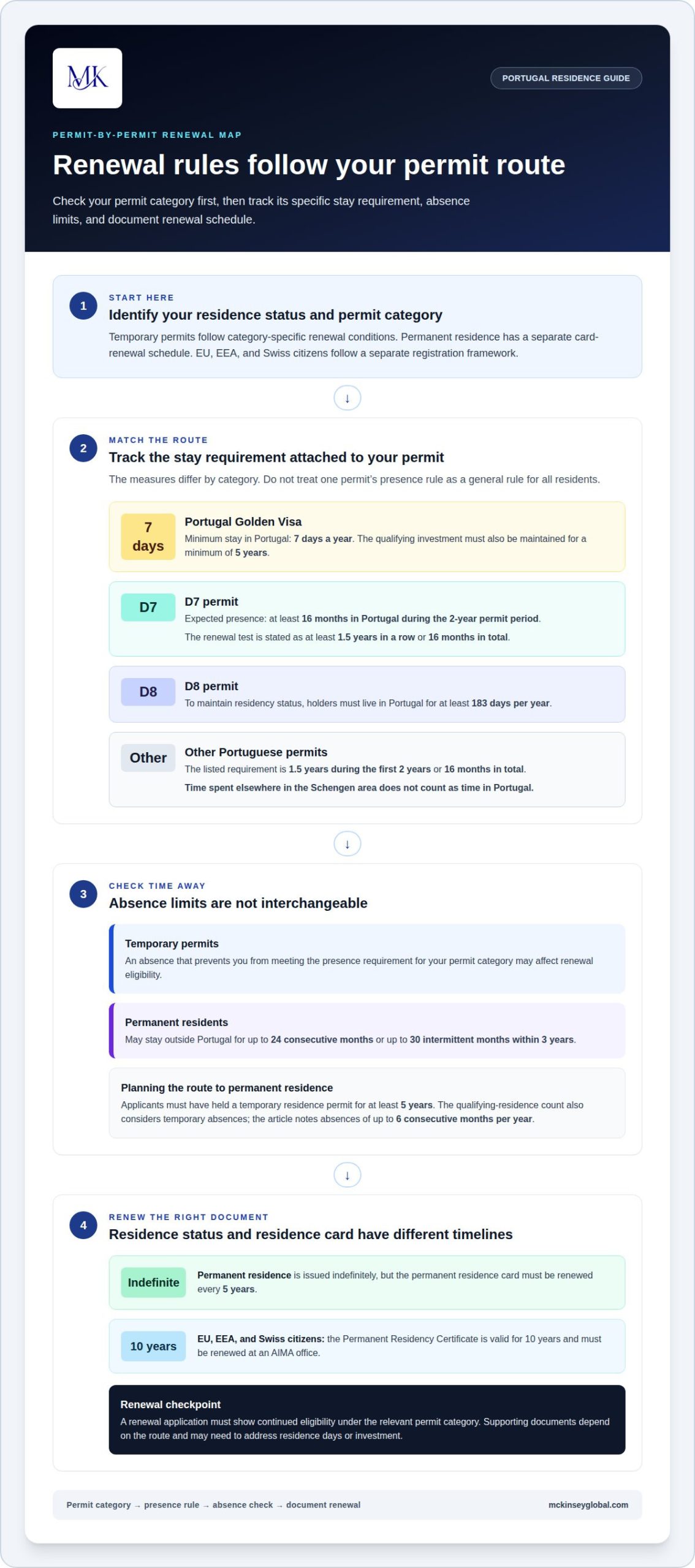
D7 permit holders are expected to spend at least 16 months in Portugal during the two-year period for which the permit is granted. Applicants relying on passive income should consider this residence commitment alongside their financial arrangements. Time away for travel can affect whether the expected presence is met.
D8 permit holders face a different presence condition: they must live in Portugal for at least 183 days per year to maintain residency status. This is an annual threshold, unlike the D7 requirement, which is measured across its two-year permit period. Distinguishing those periods helps foreign residents plan travel and understand which obligations apply to their own permit. Language-course completion, Withdrawal Agreement evidence, and permit-specific residence days should not be treated as interchangeable requirements.
Residence requirements for renewing different Portuguese permits
Renewal and absence conditions vary between temporary and permanent permits. The Portugal Golden Visa, for example, has a different annual stay requirement from other temporary permits.
Permit-Specific Renewal Requirements
Permit-specific renewal requirements are the conditions attached to each category; they matter because one permit’s residence pattern may not satisfy another’s. Other Portuguese permits are listed with a requirement of 1.5 years during the first 2 years or 16 months in total. D7 permit holders have a related renewal test: at least 1.5 years in a row or 16 months in total. Time spent elsewhere in the Schengen area does not count as time in Portugal.
Investment Status and Golden Visa Renewals
Golden Visa renewal ties continued residence status to both the qualifying investment and a minimum stay. Holders must spend 7 days a year in Portugal, and the investment must be maintained for a minimum of 5 years. This route can suit people whose plans involve limited time in Portugal, but meeting the investment condition alone does not replace the annual stay requirement. Keep both obligations in view during each renewal period.
Absences and Renewal Risks
Absence limits define how much time a permit holder can spend outside Portugal without undermining residence conditions. For temporary permits, an absence that prevents meeting the applicable presence requirement can affect renewal eligibility. Permanent residents may stay outside Portugal for up to 24 consecutive months or up to 30 intermittent months within three years. These are distinct limits; do not treat either as a general allowance for every permit.
Renewal Documents and Personal Changes
A renewal application must show continued eligibility under the relevant permit category. The supporting documents depend on the route and may need to address residence days, investment status, or the original basis for the permit. The applicable renewal process determines the fee; there is no single document list or fee for all categories.
Changes to employment, income, or address can affect the evidence relevant to eligibility, especially when a permit depends on work or financial circumstances. Before renewal, consider how the change relates to the permit’s original basis. Children and other family members may have separate residence documents, so do not assume their status renews automatically with the principal holder’s.
Absence limits for entrepreneur and employment permit holders
Portugal does not have one annual day-count requirement for every residence permit. The required presence depends on the permit category, so the rule for an entrepreneur may differ from the rule for an employee.
Entrepreneur permit holders should check the stay conditions attached to their permit to maintain residency status. Other Portuguese permits are listed with a requirement of 1.5 years during the first 2 years or 16 months in total. These periods show why nationals applying under different routes should assess their own permit terms before planning extended travel.
Employment permit holders fall under the residence requirements applicable to their permit category; the listed general requirement is 1.5 years during the first 2 years or 16 months in total. By contrast, presence requirements may also vary for highly qualified activity routes. A passport identifies the holder’s nationality, but the permit category determines the relevant presence test.
Investment-based residence has its own measure: Portugal Golden Visa holders must spend 7 days a year in the country. Special situations also follow distinct frameworks. EU, EEA, and Swiss nationals seeking a Permanent Residency Certificate apply to AIMA after five years, before their Registration Certificate expires. Study and scientific-research residence permits are listed as valid for 1 year, but their duration alone does not establish an absence allowance.
Temporary absences may be accepted if they last less than six months per year or up to 12 months. That general rule should not be mistaken for permission to disregard a permit’s specific stay requirement; an absence that prevents the holder from meeting that condition can put renewal eligibility at risk. For any category, align travel plans with the applicable residence period and preserve a clear record of time spent living in Portugal.
For a tailored view of how investment-based residence fits your plans, review residence planning options.
McKinsey Citizenship and Residency Solutions: Portugal Golden Visa
McKinsey Citizenship and Residency Solutions advises individuals considering the Portugal Golden Visa as an investment-based route to residence. This route may suit plans that require a different presence pattern from permits based on employment or personal income, provided the Golden Visa’s investment and stay conditions are met.
The right route depends on your objectives, eligibility, and ability to meet the requirements over time. McKinsey Citizenship and Residency Solutions can help assess whether the Portugal Golden Visa fits your residence plans and guide you through the program. If your priorities extend beyond Portugal, the firm also offers Greece Residency by Investment and citizenship programs in Antigua and Barbuda and St. Kitts and Nevis.
Contact McKinsey Citizenship and Residency Solutions to discuss your Portugal Golden Visa plans.
Plan Your Next Residence Decision With Care
Align your Portuguese residence status with how you intend to live, work, and travel. Consider whether your current permit still suits those plans and whether an investment-based route merits consideration as part of your longer-term strategy. A clear understanding of your priorities can make discussions about maintaining residency status in Portugal more focused and productive.
McKinsey Citizenship and Residency Solutions can discuss how the Portugal Golden Visa may fit your objectives and explain its relevance to your residence plans. The right course depends on your circumstances and the requirements of your chosen route. Start with a conversation focused on your goals.
Discuss your Portugal residence plans with McKinsey Citizenship and Residency Solutions, and take the next step with clarity.
Frequently Asked Questions
Can an entrepreneur moving to Portugal include his partner and child in their application?
An entrepreneur’s partner and child may be able to obtain residence through family reunification, but they are not automatically included in the entrepreneur’s permit. Maintaining residency status in Portugal for the principal applicant does not by itself establish the family members’ status. For example, a D2 entrepreneur’s family members need to qualify under the applicable family reunification basis rather than assume the principal permit covers them.
How long is PR valid in Portugal?
Permanent residence is issued indefinitely, but the physical residence card still needs renewal. Portugal’s permanent residence card must be renewed every five years. EU, EEA, and Swiss citizens use a Permanent Residency Certificate instead; it is valid for ten years and must be renewed at an AIMA office. Distinguishing the ongoing status from the expiring document helps clarify the renewal obligation.
What are the requirements for maintaining a Portuguese residence permit?
The requirements for maintaining residency status in Portugal depend on your permit category and its renewal conditions. You must continue meeting the basis of your route, such as its residence-presence requirement or, for an investment route, its investment conditions. If your circumstances change from employment to another basis, do not assume the original permit remains suitable. The requirements for your category determine what you need to maintain for renewal.
What are the residency requirements for Portugal’s D7, D8, and Golden Visa permits?
The D7 and D8 routes use different measures of physical presence. D7 holders are expected to spend at least 16 months in Portugal during the two-year permit period; D8 holders must live there for at least 183 days per year. Golden Visa holders must spend 7 days a year in Portugal. These are category-specific requirements, so time spent elsewhere in the Schengen area does not replace Portuguese residence days.
What are the consequences of overstaying or failing to meet Portuguese residency conditions?
Failing to meet a permit’s conditions can put renewal eligibility at risk and may affect your ability to rely on that residence history for a later application. For example, if you fall short of the required presence, do not assume that meeting an investment condition alone resolves the shortfall. The outcome depends on the permit and the condition breached; requirements are not interchangeable across categories.
How can Portuguese residence status lead to permanent residence or citizenship, and what are the timelines?
Both routes involve a five-year residence history, but they are separate applications with distinct criteria. A foreign national may apply for permanent residence after holding a temporary residence permit for at least five years. Portuguese citizenship applicants are described as needing five years with a valid residence permit. For permanent-residence applications in 2026, the stated language condition is completion of a 150-hour Portuguese course.