A second passport is not a single solution to every cross-border concern. A plan B passport strategy means assessing another citizenship as a source of additional travel and residence options, while weighing the investment route, tax implications, and security priorities that shape the decision.
It’s reasonable to seek greater flexibility, but a passport alone doesn’t determine where you owe tax or guarantee access to every destination. Citizenship, residence, and tax status are separate considerations, and the rules depend on the countries involved.
This guide explains what a Plan B passport can mean, how investment-based citizenship compares with residency routes, and how taxes, personal security, and travel mobility affect your options. You’ll also learn what to consider when deciding whether a second citizenship supports your longer-term plans.
Key Takeaways
- Distinguish citizenship by investment from residency routes, then assess which status aligns with your long-term plans.
- Build a realistic budget by considering the investment route and associated application costs, alongside the time involved.
- Assess tax consequences separately from passport choice; a second citizenship does not automatically change your tax position at home.
- Compare travel access and personal resilience against your family’s priorities, since mobility benefits vary by passport.
Citizenship by investment
Citizenship by investment is one route to a second nationality, alongside descent, naturalization, and marriage. Each route has distinct eligibility criteria, timelines, and implications for mobility and dual citizenship.
Routes to Citizenship
Citizenship by investment grants nationality through a qualifying contribution or investment, subject to government eligibility and review. Citizenship by descent relies on qualifying family ancestry; naturalization generally follows residence and other national requirements. Marriage may offer a route under a country’s rules, but it does not automatically grant citizenship everywhere. The route matters because it determines the evidence, financial commitment, and connection to the country applicants must establish.
For a U.S. citizen, ancestry may offer an alternative to investment, while naturalization involves meeting the destination country’s residence rules. A plan B passport strategy should distinguish citizenship from residency: a residence permit may support migration plans without granting a second nationality.
Eligibility and Citizenship Costs
Eligibility can depend on the route, the applicant’s records, and the destination country’s screening requirements. Investment applications involve a qualifying financial commitment and application-related expenses; costs depend on the country, route, and family circumstances. A case-specific quote request establishes pricing. Before pursuing dual citizenship, assess whether both countries permit it and whether either requires you to renounce your original citizenship. These rules can affect whether an additional nationality is practical.
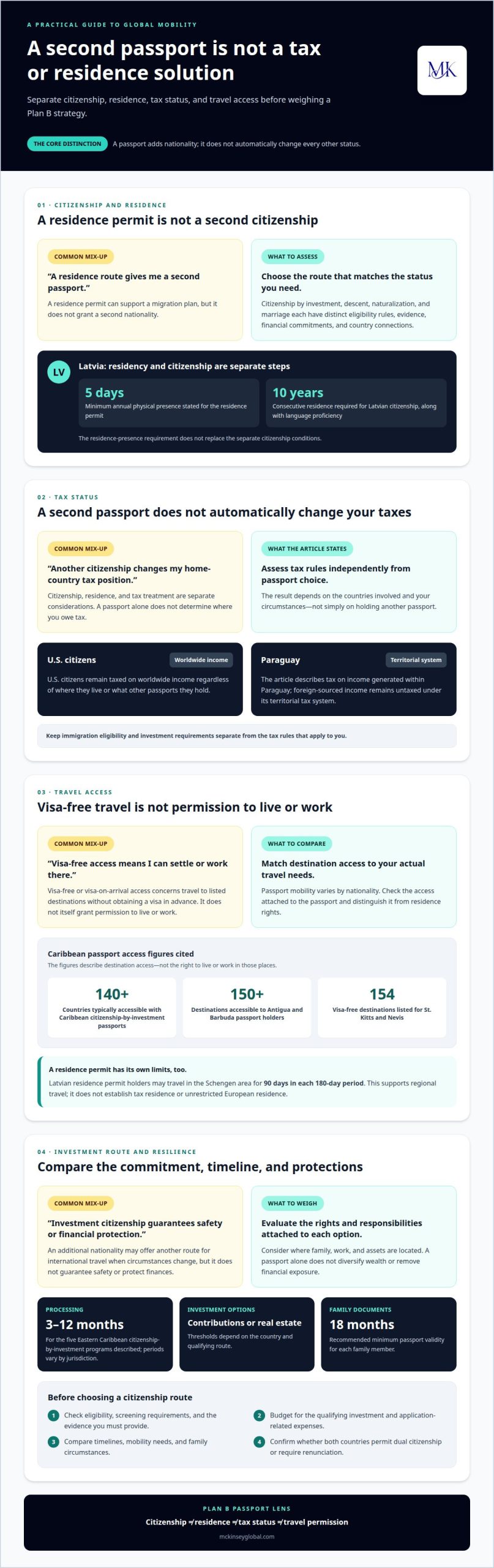
Latvia illustrates the difference between residency and citizenship. Latvian citizenship requires ten consecutive years of residence and language proficiency. Latvia’s residence permit has a stated minimum physical-presence requirement of five days annually, but that requirement does not replace the separate citizenship conditions. Distinguish the timeline for maintaining residency from the longer naturalization pathway.
A U.S. citizen who retains U.S. citizenship can apply for a U.S. passport through the standard application process after acquiring another citizenship. The second nationality does not itself issue a U.S. passport or determine the applicant’s tax position. In Latvia, for example, residence status and citizenship remain distinct steps, each with its own criteria.
Does a second passport affect my taxes at home?
A second passport does not, by itself, change a U.S. citizen’s tax obligations. U.S. citizens remain taxed on worldwide income regardless of where they live or what other passports they hold. Paraguay, by contrast, taxes income generated within the country; foreign-sourced income remains untaxed under its territorial tax system. Citizenship, residence, and tax treatment are separate parts of a global mobility plan.
Caribbean citizenship-by-investment programs combine qualifying investments with application review, and processing periods vary by jurisdiction. The five Eastern Caribbean programs described offer citizenship in three to twelve months. Investment thresholds depend on the country and qualifying route; options include contributions and real estate investment. Compare the required commitment, processing period, and travel purpose rather than treating a Caribbean passport as a tax solution.
Latvia’s business-investment residence route offers a European residency option, not citizenship by investment. Latvian residence permit holders may travel in the Schengen area for 90 days in each 180-day period. That access can support regional travel, but it does not establish tax residence or provide unrestricted European residence. Assess the permit’s investment conditions separately from your home-country tax position.
Paraguay launched its Investor Pass in April 2026, adding another investment route to consider. The country’s territorial tax system may be relevant to foreign-sourced income, while the Investor Pass itself concerns an immigration pathway. A sound assessment separates the program’s eligibility and investment requirements from tax rules. Political stability, travel needs, and the period you expect to spend in each country also shape the value of the freedom sought.
For a structured comparison of residency and citizenship investment routes, consider how each option aligns with your mobility and tax priorities.
Security, financial resilience, and travel mobility
A second nationality can add another legal status and travel document to a global plan. Its practical value depends on destination access, residence rights, and the protections each government provides.
Security and Financial Resilience
A second passport may provide an additional route for international travel when circumstances change, but it does not guarantee safety or financial protection. Its value depends on the rights attached to that nationality and the countries where you need access. For resilience, distinguish citizenship from a residence permit: a permit authorizes residence under its conditions, while citizenship establishes a separate nationality.
For family planning, keep each family member’s passport valid for at least 18 months. This recommendation gives families a practical document-management benchmark, not a substitute for entry requirements. A plan B passport strategy should also consider where assets, work, and family commitments are located, since a passport alone does not diversify wealth or remove financial exposure.
Travel Mobility and Visa-Free Access
Visa-free or visa-on-arrival access describes the ability to travel to listed destinations without obtaining a visa in advance; it does not itself grant permission to live or work there. Caribbean citizenship-by-investment passports typically provide access to 140 or more countries. Antigua and Barbuda passport holders have access to over 150 destinations, while St. Kitts and Nevis lists 154 visa-free destinations.
Those figures illustrate why passport nationality can affect travel planning, but access depends on the destination and entry conditions. Austrian citizenship, for example, allows holders to reside and work anywhere in the European Union or Switzerland, and provides visa-free or visa-on-arrival access to around 190 destinations. This combines mobility with residence and work rights, rather than travel freedom alone.
Compare the destinations you actually visit, not just a passport’s headline total. A United States traveler may prioritize different routes than a family that travels regularly in Europe. Visa-free access can simplify short visits, while a separate residence right matters for longer stays. This distinction helps clarify which citizenship or permit supports your plans.
Before travel, review passport validity and the entry conditions for each destination. The 18-month validity benchmark can help coordinate family documents, while visa access remains specific to each passport and destination. A government’s entry rules determine how nationality translates into practical travel rights.
What is a Plan B passport?
A Plan B passport is a second passport obtained through another citizenship, offering an additional nationality alongside a person’s primary citizenship. It can create different travel opportunities, but a residency permit is not citizenship and does not itself provide a second passport.
The route affects the required investment, eligibility assessment, and processing period. Citizenship by investment programs may involve a qualifying contribution or real estate; citizenship by descent, naturalization, and marriage follow separate rules. Costs depend on the route, property or contribution requirements, due diligence, processing, and family applications; a case-specific quote request determines the price.
Processing times vary by country and method, from a few months to several years. Caribbean citizenship programs take six months or more, while some European citizenship programs take more than a year. These are broad distinctions, not a shared timetable: the country, application route, and review process all influence when citizenship and a passport may be obtained.
For U.S. readers, the Visa and Passport Security Program is a separate legal subject, not an investment program. Its establishing provision was enacted as part of Pub. L. 108-458 on Dec. 17, 2004, and is codified at 22 U.S.C. § 4807. That identifier concerns the U.S. program; it should not be confused with another country’s citizenship process or passport rights.
Begin program selection with the rights you seek: travel access, residency opportunities, or another citizenship. Then compare the qualifying route, required documents, expected processing period, and whether dual citizenship suits your circumstances. Passport validity and citizenship status are distinct; questions about revocation concern legal rules, not simply an investment decision. This distinction clarifies what the passport provides and what it does not.
For a tailored review of citizenship and residency options, outline your objectives and preferred route.
McKinsey Citizenship and Residency Solutions
McKinsey Citizenship and Residency Solutions helps investors assess citizenship and residency by investment routes against their mobility priorities, family needs, and long-term plans. Its options include various global citizenship pathways and residency by investment programs designed for international clients.
This guidance is useful when you have clarified whether you seek another citizenship or a residence permit, but need to assess which available route aligns with that objective. The distinction matters: residency and citizenship confer different statuses, while eligibility, investment structure, and application requirements vary by country.
To discuss your objectives and relevant pathways, contact McKinsey Citizenship and Residency Solutions.
Make your next decision with a clear purpose
A sound plan B passport strategy starts with the outcome you need, not a passport ranking. Decide whether your priority is another citizenship, a residence option, or better access for specific travel and family needs. Then assess how the route fits your tax position, financial commitments, and long-term plans.
McKinsey Citizenship and Residency Solutions offers Antigua and Barbuda Citizenship by Investment, St. Kitts and Nevis Citizenship, and Greece Residency by Investment. These distinct pathways provide a starting point for considering whether citizenship or residency better matches your objectives. The next step is to discuss your priorities and identify which route merits further consideration.
Contact McKinsey Citizenship and Residency Solutions to discuss your objectives and potential pathway. A considered decision can turn broad mobility goals into a practical plan, with each choice aligned to what matters most to you.
Frequently Asked Questions
Can Americans hold two passports?
Yes. Americans can hold dual citizenship, and the U.S. Supreme Court settled the legality of dual citizenship for Americans in 1967. A second passport is associated with an additional nationality, rather than being a travel document obtained independently of citizenship. The practical consideration is whether the other country permits dual citizenship and how its rules apply to your existing nationality.
Can everyone get a second passport?
No. Eligibility depends on the citizenship route and the country’s requirements. Investment applications involve eligibility reviews, descent requires a qualifying family connection, and naturalization depends on the destination’s rules. Marriage does not automatically grant citizenship. If one pathway does not fit your circumstances, another may have different criteria, but no route is automatic or universally available.
Do my future children get citizenship?
Dual citizenship can be permanent and passed to a person’s children. This can make a second nationality relevant to family planning beyond the original applicant. Keep the concepts distinct: citizenship is the legal status, while a passport is a travel document. A child’s inherited nationality and the process for obtaining a passport are related, but they are not the same thing.
How long does it take?
It depends on the country and route: acquiring another citizenship can take from a few months to several years. Caribbean citizenship programs take six months or more, while some European citizenship programs take more than a year. Application review and the selected pathway affect the timetable. Residency and citizenship are separate statuses, so a residence permit does not itself complete a citizenship process.
How much does a real-world Plan B cost?
There is no single total because the budget depends on the route and family circumstances. Account for the qualifying investment, application-related expenses, due diligence, and processing; the type of investment also matters. These costs are separate from the broader financial planning involved in maintaining another residence or nationality. The price depends on the case and is provided after a quote request.
How much does it cost to obtain a second passport?
The amount depends on how citizenship is obtained, the destination’s requirements, and who is included in the application. An ancestry-based route and an investment pathway involve different cost components, while a passport document follows citizenship. For investment-based options, consider the qualifying investment alongside application, due-diligence, and processing costs. The price depends on the case and is provided after a quote request.