
What if a Portugal Golden Visa changes your right to live in Portugal but not your tax status? That distinction is central to the Portugal golden visa tax implications for US citizens: the permit alone doesn’t make you a Portuguese tax resident, while US citizenship generally keeps your worldwide income within the scope of US tax rules.
It’s understandable to worry about being taxed twice or missing a foreign-account reporting requirement when two systems apply. Start by separating immigration residence from tax residence. Then assess how your days in Portugal, living arrangements, income, and investments affect your position.
This 2026 guide explains Portugal’s tax-residency tests, US citizens’ continuing tax obligations abroad, and how treaty provisions, tax credits, and exclusions may relate to double taxation. It also covers reporting considerations such as FBAR and Form 8938, as well as the potential US tax complexity of Portuguese investment funds. Use it to identify which questions need individual tax advice and coordinate that review with a Portugal Golden Visa residency strategy.
Key Takeaways
- Separate Golden Visa immigration status from Portuguese tax residence; assess travel patterns and living arrangements independently.
- Understand the Portugal golden visa tax implications for US citizens by reviewing US filing obligations alongside Portugal’s rules for residents and non-residents.
- Treat treaty provisions, foreign tax credits, and exclusions as distinct coordination mechanisms, not automatic exemptions from tax or filing.
- Before investing or relocating, organize your residence timeline, income sources, asset and account ownership, and relevant filing records for individual review.
- Coordinate your immigration strategy with a separate cross-border tax review so residency objectives, investment structures, and reporting obligations are considered together.
Does a Portugal Golden Visa Make a US Citizen a Portuguese Tax Resident?
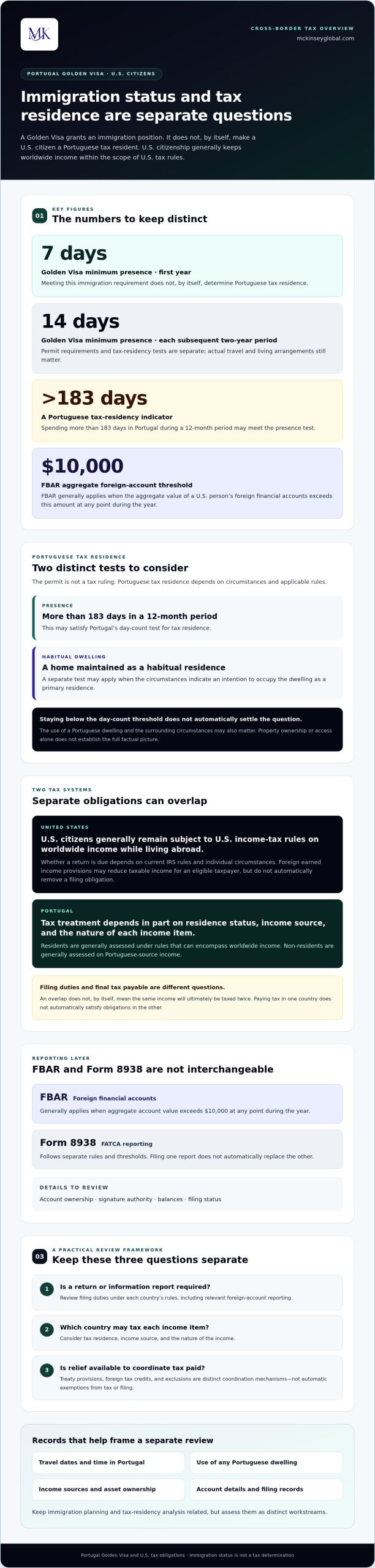
No. A residence permit and tax residence are separate legal questions. Portugal’s Golden Visa is an immigration pathway that can grant eligible investors residence rights; it is not a tax ruling. Holding the permit alone does not make a US citizen a Portuguese tax resident.
Immigration residence determines a person’s permission to reside in Portugal; tax residence depends on the person’s circumstances and the applicable tax rules. That distinction is central to the Portugal golden visa tax implications for US citizens. The permit may shape an immigration plan, but tax status must be assessed separately using facts such as time spent in Portugal and whether a home there is maintained as a habitual residence.
What does Portugal Golden Visa status establish?
The Golden Visa is a residence-by-investment route, with eligibility tied to a qualifying investment or contribution under the program’s current rules. It establishes an immigration position, not whether Portugal treats the holder as resident for tax purposes. Approval of an investment for immigration purposes also doesn’t determine how that investment, its income, or other assets will be taxed. Those questions require separate assessment.
Permit holders have a minimum physical-presence obligation: seven days in the first year and 14 days in each subsequent two-year period. Meeting that immigration requirement doesn’t, by itself, settle tax residence. Consider both sets of rules, especially if your actual travel or living arrangements go beyond the minimum needed to maintain the permit.
When might Portugal treat someone as tax resident?
Portugal’s tax-residency tests look beyond visa possession. A person may be treated as tax resident if they spend more than 183 days in Portugal during a 12-month period. A separate test may apply when someone maintains a habitual dwelling in Portugal in circumstances indicating an intention to occupy it as a primary residence.
These are distinct indicators, not a single day-count rule. Staying below 183 days doesn’t automatically resolve the question if your dwelling and circumstances could meet the habitual-residence test. Conversely, owning or having access to a property doesn’t, on its own, establish the full factual picture; the nature and use of the dwelling matter.
For example, an investor who limits visits to the Golden Visa’s minimum stay should still consider whether they have established a home in Portugal that indicates an intention to live there as their primary residence. Someone spending more than 183 days may meet the presence test even if they initially intended to use the permit for occasional visits. The outcome depends on the applicable rules and individual facts, so neither the permit nor a travel-day target is a definitive tax determination.
For practical planning, keep a clear record of travel dates and consider how you use any Portuguese dwelling. These details help frame a separate tax-residency review before a move or investment decision. The immigration application and its requirements remain a related but distinct workstream.
How US Citizenship and Portuguese Tax Residence Create Separate Obligations
A US citizen who becomes a Portuguese tax resident may have obligations in both countries because each system applies its own rules. US citizenship can keep US tax filing in scope while Portuguese tax residence can bring income within Portugal’s tax system. This overlap doesn’t, by itself, mean the same income will ultimately be taxed twice. Filing duties and final tax payable are separate questions.
To understand the Portugal golden visa tax implications for US citizens, identify three issues separately: whether a return or information report is required, which country may tax a particular item of income, and whether relief is available to coordinate tax paid. A filing requirement doesn’t prove that tax is owed, and paying tax in one country doesn’t automatically satisfy obligations in the other.
What continuing US obligations should citizens consider?
US citizens generally remain subject to US income-tax rules on worldwide income while living abroad. Whether a return is due depends on current IRS rules and the person’s circumstances. Foreign earned income provisions may reduce taxable income for an eligible taxpayer, but they don’t automatically remove the obligation to file or apply in the same way to every type of income.
Foreign-account reporting is a separate compliance layer. FBAR generally applies when the aggregate value of a US person’s foreign financial accounts exceeds $10,000 at any point during the year. FATCA reporting, including Form 8938 where applicable, follows separate rules and thresholds. Filing one report doesn’t automatically replace the other. A review should account for account ownership, signature authority, balances, and filing status.
Which Portuguese income and residence questions matter?
Portugal’s treatment depends in part on whether someone is tax resident and on the source and nature of their income. Residents are generally assessed under rules that can encompass worldwide income, while non-residents are generally assessed on Portuguese-source income. The specific result depends on domestic law and the details of each income item.
Employment compensation, investment returns, pension income, and rental income each merit separate consideration. For example, working remotely from Portugal may raise different sourcing questions from receiving rent from Portuguese property or distributions from an investment. The label attached to an income stream isn’t enough to determine its treatment; the relevant facts and rules matter.
Where both countries may tax income, coordination mechanisms can matter. The IRS Foreign Tax Credit may help eligible taxpayers address foreign income taxes, but it is distinct from an exclusion and doesn’t automatically eliminate filing requirements or Portuguese tax. Treaty provisions also require analysis in context.
To keep the workstreams aligned, document your expected residence pattern, income categories, and financial accounts before implementation. A Portugal Golden Visa strategy can be considered alongside a separate cross-border tax review, without treating immigration advice as a tax determination.
Can the US-Portugal Tax Treaty and Foreign Tax Credits Prevent Double Taxation?
Potentially, but neither the US-Portugal tax treaty nor a foreign tax credit provides an automatic exemption from tax or filing. The treaty provides rules for coordinating certain cross-border tax questions. US citizens remain subject to the treaty’s saving clause, which generally preserves the US right to tax its citizens as if the treaty did not apply. The result must be considered by income type and under the relevant provisions.
A foreign tax credit is different from an exclusion. A credit may offset eligible US tax by reference to qualifying foreign income taxes, subject to applicable limits and rules. An exclusion may remove qualifying income from US taxable income under specific conditions. Treaty provisions can address matters such as taxing rights or relief, but their effect depends on the provision and the taxpayer’s circumstances. None of these mechanisms, on its own, cancels required returns or disclosures.
How should readers understand treaty relief and foreign tax credits?
Start with the income item, not a general assumption that treaty relief applies. Employment earnings, pension income, rental receipts, and investment returns can raise different questions about source, timing, and which country may tax them. Credit eligibility and limits may also depend on how income and taxes are classified under the applicable rules. Review the current treaty text, relevant competent-authority guidance, and the rules in force for the tax year.
| Issue | Possible coordination mechanism | Questions requiring professional analysis |
|---|---|---|
| Income taxed in both countries | Foreign tax credit or relevant treaty provision | What is the income’s source and character, and when was tax paid? |
| Income potentially eligible for an exclusion | US foreign-income exclusion, if the requirements are met | Does the income qualify, and how does the choice interact with credits? |
| Conflicting claims to taxing rights | Applicable treaty rules, subject to the saving clause | Which treaty article applies, and does it provide relief for this taxpayer? |
The table is a planning framework, not a determination. For example, a tax credit may not match the amount of foreign tax paid dollar for dollar if income category, timing, or limitation rules affect the calculation. That distinction is central to the Portugal golden visa tax implications for US citizens: outcomes depend on income type, sourcing, timing, residence facts, and the individual’s full filing position.
Why are foreign accounts and investment structures separate issues?
Tax on income and reporting ownership of foreign accounts or assets are separate obligations. FBAR and FATCA reporting have different tests; satisfying one doesn’t necessarily satisfy the other. Account ownership, joint ownership, signature authority, and asset classification can each affect the reporting analysis, even if an account produced little or no income.
Investment structure also deserves particular attention. Portuguese Golden Visa investment funds are generally treated as passive foreign investment companies under US tax rules, potentially bringing Form 8621 reporting and complex tax treatment into consideration. Fund documents, ownership records, distributions, and transaction dates help establish the facts for an individual review. Immigration investment eligibility and US tax classification are separate analyses, so coordinate them before implementation.
What Should US Citizens Review Before Moving or Investing Under the Golden Visa?
Before committing to a residence plan or investment, assemble a factual record for both immigration and tax workstreams. A clear sequence helps identify decisions that affect the Golden Visa application, potential tax residence, and annual reporting, without treating one review as a substitute for the other.
Which facts should be assembled before changing residence?
Begin with a timeline, then map your income and assets against it. Keep supporting records together, including travel dates, residence documents, account statements, and investment materials. This groundwork helps distinguish established facts from questions that need case-specific analysis.
- Set out the residence timeline. Record intended move dates, planned visits to Portugal, time spent in other countries, and significant US ties. Note where you expect to maintain a home and how you will use it. Family circumstances, work arrangements, and changes during the year may also affect the overall facts.
- Inventory income by type and source. List employment compensation, business income, pensions, rental receipts, and investment income. For each item, note who pays it, where the work or asset is located, when income is received, and which records support its source. Don’t assume income with the same label receives identical treatment.
- Map accounts, entities, and ownership. Prepare a list of foreign bank and investment accounts, business interests, and other relevant financial arrangements. Identify legal and beneficial owners, joint holders, and anyone with authority over an account. This is an inventory for review, not an assumption that every item has the same reporting treatment.
- Organize investment documents. Retain subscription materials, fund or company documentation, transaction confirmations, distribution records, and statements showing ownership. Immigration eligibility and the investment’s tax classification are separate questions; organized documents help the relevant reviewers assess each accurately.
- Build two calendars. Track immigration milestones and permit-related obligations separately from tax-year boundaries, return due dates, and information-reporting deadlines. Dates can depend on your circumstances and the rules in force, so use the applicable calendar rather than relying on a general checklist.
How should the Golden Visa and tax workstreams be coordinated?
Use the immigration review to clarify your residence objective, qualifying route, application sequence, and permit-related requirements. Use a separate cross-border tax review to assess residence facts, income treatment, account and asset disclosures, and filing responsibilities. If a proposed move or investment changes the underlying facts, revisit both calendars before acting.
This coordinated approach is especially useful when the application timeline and a potential change in living arrangements fall in different tax years. Keep a dated record of decisions and supporting documents so later filings can be assessed against what actually happened, not only what was initially planned.
For the Portugal golden visa tax implications for US citizens, careful sequencing keeps immigration decisions connected to, but distinct from, individual tax analysis. To structure the investment-migration process, review your Portugal Golden Visa strategy alongside a separate assessment of your cross-border tax position.
How to Align a Portugal Golden Visa Strategy With Cross-Border Tax Planning
A coordinated plan treats immigration eligibility and tax position as connected questions governed by different rules. The goal is not to assume a particular tax result, but to make key choices in a deliberate order and document the relevant facts and responsibilities before implementation.
For the Portugal golden visa tax implications for US citizens, a practical sequence is:
- Define the immigration objective. Clarify whether your priority is a residence option, a planned move, or another long-term goal, then assess how the Golden Visa route and application steps align with it.
- Map residence facts. Set out expected travel, possible relocation dates, home arrangements, and personal ties in Portugal and the United States. These facts inform a separate tax-residency review; the permit itself doesn’t determine tax status.
- Describe the income and investment profile. Identify employment, business, pension, rental, and investment income, along with the proposed investment structure and ownership. This gives tax professionals context to assess source, classification, and relevant documentation.
- Review reporting responsibilities. Organize account, asset, and entity information, then identify which US and Portuguese filing or disclosure questions need individual analysis. Consider reporting duties independently from whether tax is ultimately payable.
- Coordinate implementation and timing. Align application milestones and investment decisions with travel plans, potential relocation, tax years, and filing calendars. Revisit the analysis if actual circumstances depart from the original plan.
What can an investment-migration adviser contribute?
An investment-migration adviser can help evaluate the Portugal Golden Visa pathway, structure the residency-planning process, and manage application steps. This work can place immigration milestones and investment decisions on a broader planning calendar, making it easier to see when decisions need to be made and what information to assemble. It does not determine tax residence or replace tax advice.
What should a coordinated cross-border plan deliver?
A useful plan should leave you with three distinct records: the basis for immigration eligibility, the facts for a separate tax-residency analysis, and a list of potential reporting obligations. It should also set out key dates for investment, travel, relocation, and tax years, while identifying unresolved questions for individual review by qualified tax professionals.
For example, a planned move that changes the expected number of days in Portugal could affect the facts used for tax analysis without changing the immigration eligibility criteria. Recording that change and sharing it with the relevant advisers helps keep the workstreams aligned. This is not a one-time checklist; it is a planning framework that should reflect what actually happens.
McKinsey Citizenship and Residency Solutions provides Portugal Golden Visa advisory focused on residency strategy and application support. For tax outcomes, a separate cross-border tax review is needed. If you are ready to structure the immigration workstream, explore Portugal Golden Visa advisory.
Make Your Portugal Plans With Clarity
Turn a broad relocation or investment objective into a sequence of decisions, directing each question to the right specialist. Before acting, identify what remains unresolved about your immigration route, expected living arrangements, income, and reporting position. This preparation can help keep decisions aligned as your plans develop, without assuming that a residency permit determines a tax outcome.
The Portugal golden visa tax implications for US citizens are individual, so consider your immigration strategy alongside a separate cross-border tax review. McKinsey Citizenship and Residency Solutions advises on investment-based residency, including the Portugal Golden Visa, and supports investment-migration planning across Europe, the Caribbean, and the Middle East. Tax preparation and tax advice are distinct disciplines.
When you are ready to shape your residency workstream, explore Portugal Golden Visa advisory.
Frequently Asked Questions
Does a Portugal Golden Visa automatically make a US citizen a Portuguese tax resident?
No. A Golden Visa does not itself determine Portuguese tax residence; the person’s conduct and circumstances are assessed under the applicable rules. For example, an investor who initially plans brief visits may need a fresh review if they later establish a home or spend substantially more time in Portugal. Keep travel and housing records, and reassess the position when plans change rather than relying on the visa category.
Do US citizens still have to file US tax returns after moving to Portugal?
Generally, yes, if they meet the filing requirements under current US rules. US citizens abroad remain subject to US taxation on worldwide income, though whether a return is required depends on factors such as income, filing status, and age. A person with wages, self-employment income, or investment income should assess each item against the relevant filing rules. Living overseas alone doesn’t determine whether a return is due.
Can a US citizen be a tax resident of both Portugal and the United States?
Yes. Portugal may treat someone as resident under its domestic rules while the United States continues to tax that person as a citizen. These are separate bases for tax obligations, so overlapping status is possible. Treaty rules may help address certain conflicts, but they don’t necessarily remove US filing duties. A useful review should distinguish domestic tax residence, treaty residence for relevant purposes, and citizenship-based US obligations.
Does the US-Portugal tax treaty eliminate double taxation for Golden Visa holders?
No, it does not guarantee that a Golden Visa holder will owe tax in only one country. The treaty provides coordination rules, but its application depends on the income category and relevant provisions; the US saving clause also preserves the US right to tax citizens in many circumstances. Foreign tax credits may offer relief when requirements are met, but credit limits and income classification matter. Filing obligations can remain even when relief applies.
Does the Foreign Earned Income Exclusion remove the requirement to file a US tax return?
No. The Foreign Earned Income Exclusion may reduce US taxable income for qualifying foreign earned income, but it does not automatically remove a filing requirement. Eligibility depends on the taxpayer’s circumstances and the applicable tests, and the exclusion generally concerns earned income rather than every type of receipt. Interest, dividends, pensions, or rental income require their own analysis. Check filing duties separately from whether an exclusion may be available.
Do US citizens with Portuguese bank accounts need to file FBAR or FATCA reports?
Possibly. FBAR generally applies when the aggregate value of foreign financial accounts exceeds $10,000 at any point during the year. FATCA reporting, including Form 8938 where required, follows separate thresholds and asset definitions, so filing one report does not necessarily satisfy the other. Review account ownership, joint accounts, signature authority, and balances. A bank account can create a disclosure question even if it generated little or no taxable income.
Can a US citizen use Portugal’s NHR or successor tax regime in 2026?
The original Non-Habitual Resident regime closed to new applicants on January 1, 2024, although people who already hold NHR status may retain its benefits for their applicable term. Portugal’s successor, IFICI, is narrower and generally targets qualifying work in areas such as research, technology, and innovation. It is not a like-for-like option for most retirees or general remote workers. Eligibility and tax treatment require individual review under current rules.