European residence by investment can create a route to living and studying in the country that grants the permit, with options in Greece, Portugal, Latvia and Italy in 2026. For families considering residency by investment for access to European education, the key distinction is that residence in one country does not automatically provide the same education rights across Europe. Schengen travel and education access are separate considerations.
It is understandable to focus first on the investment route and the ability to travel across borders. But a child’s education options also depend on where the family plans to live, the permit’s family-inclusion rules, and the school or university system they want to access. For example, holders of Greek residence by investment can access Greece’s education system on the same basis as EU residents.
This guide compares relevant residence-by-investment options, explains how Schengen travel differs from citizenship rights, and outlines what European residence may mean for children’s schooling and university plans. It also sets out questions families should consider when choosing a country, so the decision reflects both the immigration route and the education outcome they seek.
Key Takeaways
- A residence permit from a Schengen member state allows travel across the area for up to 90 days within any 180-day period; it does not grant the right to live or study in every member country.
- Compare residence options by investment route, family eligibility, renewal conditions and the country where your child intends to study.
- Greece, Portugal, Italy and other countries have distinct residence and citizenship pathways, with eligibility periods and requirements that vary by country.
- Residence can support access to the host country’s education system, but school and university options depend on the country and the child’s circumstances.
- Use the comparison and decision guide to identify which options best align with your family’s education plans and long-term goals.
Does residence by investment give access to Europe’s Schengen Area?
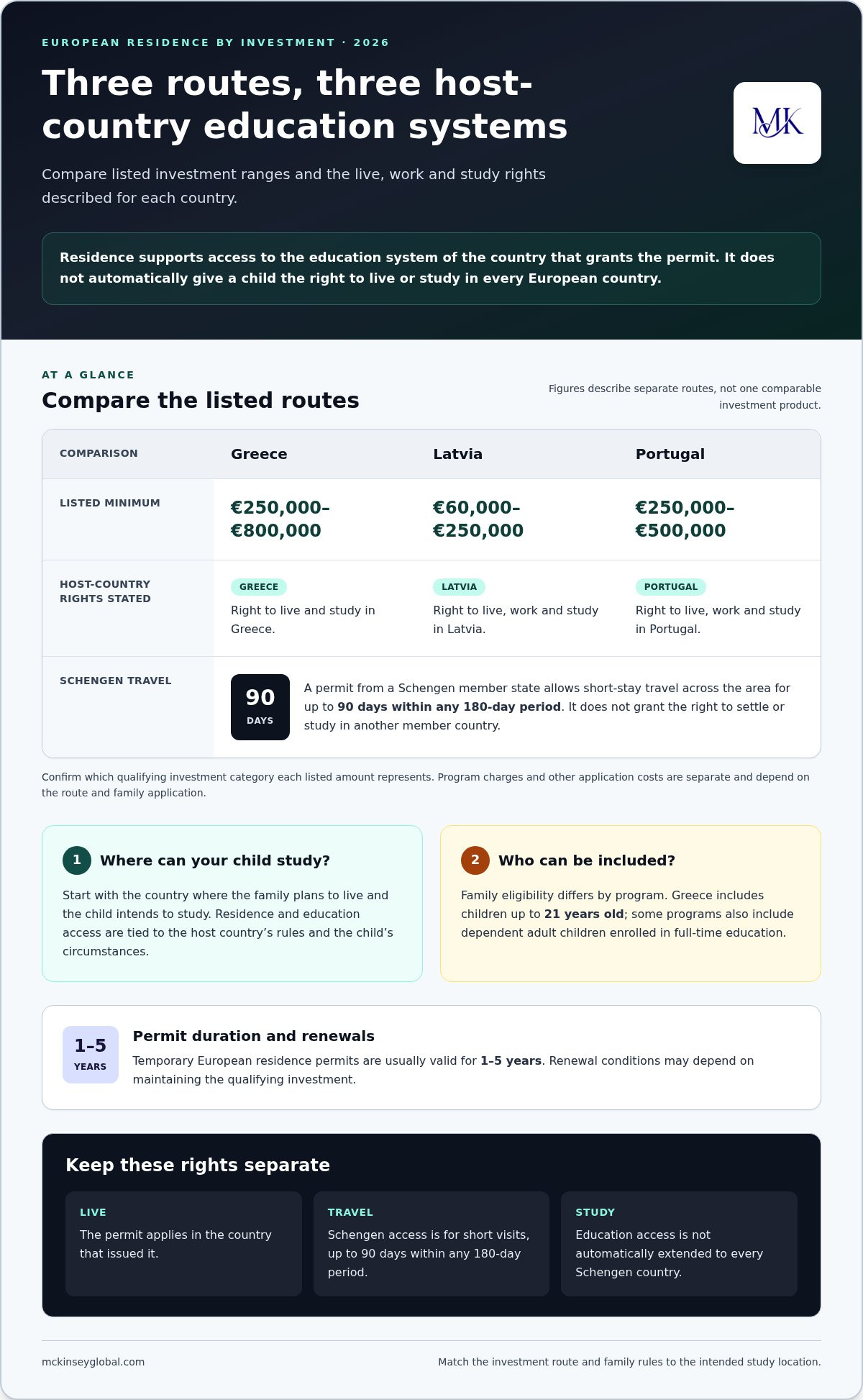
Yes. A residence permit issued by a Schengen member state allows visa-free travel across the area for up to 90 days within any 180-day period. European residence-by-investment programs provide access to 29 Schengen countries for short visits, not unrestricted residence or study in every country.
The main risks are confusing travel rights with permission to live elsewhere, overlooking family eligibility, and relying on a route that has closed. Spain’s Residence by Investment Program concluded on 4 April 2025; Ireland’s concluded on 10 December 2023, and the Netherlands’ on 1 March 2024.
Program charges and other application costs are separate; their amounts depend on the route and family application.
For families, obtaining a permit should be assessed against the child’s intended school location, the spouse’s residence rights, and the program’s rules for dependent children. Greece includes children up to 21 years old. Some programs also extend family eligibility to dependent adult children enrolled in full-time education. A child’s inclusion does not itself grant study rights in another country.
Permits and investment conditions also differ. Temporary European residence permits are usually valid for 1-5 years, and renewal conditions may depend on maintaining the qualifying investment. Before comparing routes, separate three questions: where the family may live, where it may travel, and where children may study.
| Option | Listed minimum | Education and travel consideration |
|---|---|---|
| Greece | €250,000 to €800,000 | Right to live and study in Greece; Schengen short-stay travel |
| Latvia | €60,000 to €250,000 | Right to live, work, and study in Latvia; Schengen short-stay travel |
| Portugal | €250,000 to €500,000 | Right to live, work, and study in Portugal; Schengen short-stay travel |
These figures describe separate routes, not a single comparable investment product. Confirm which qualifying investment category each amount represents.
Choose a route by matching its permitted investment and family rules to the country where your children will study. Schengen travel does not in itself provide education access.
Can residence by investment lead to citizenship?
Yes, residence can lead to citizenship, but a residence permit is not citizenship. Each government sets its own naturalization rules and qualifying residence period. This distinction matters for families planning education, work, and long-term rights. Residence generally applies in the country that issued the permit; citizenship can provide broader rights under that country’s laws.
Portugal’s Golden Visa allows holders to live, study, and conduct business in Portugal. The program provides eligibility to apply for Portuguese citizenship after five years and requires an average minimum stay of seven days annually. These are separate milestones: residence does not itself confer citizenship. Applicants must meet the applicable naturalization requirements when they apply.
The route determines the investment structure; a residence permit does not automatically establish rights in another European country.
Other countries have different naturalization timelines. Greece offers citizenship eligibility after seven years of residence, while Italy offers eligibility after ten years. Cyprus permanent residents may apply for citizenship through naturalization after residing there for at least seven years. Hungary, Greece, and Bulgaria have no minimum physical-presence requirement for their residence-by-investment programs, but this does not replace citizenship criteria.
For students, permission to study and permission to work after graduation are separate questions. Portugal’s listed residence routes include study rights, while post-graduation employment depends on the person’s status and the country’s work rules. Employer sponsorship is a separate employment pathway. An investment residence permit should not be treated as automatic sponsorship or an unrestricted right to work across Europe.
Schengen travel is also distinct from residence and citizenship. A residence permit issued by a Schengen member state allows visa-free travel across the Schengen Area for up to 90 days within any 180-day period. That travel allowance does not authorize a resident to settle, study, or take employment in another member state.
To assess a pathway, compare these three stages:
- Residence: identify the country where the permit grants live-and-study rights.
- Naturalization: compare that country’s residence period and application requirements.
- After graduation: assess the separate work status required for employment or employer sponsorship.
Families considering a Portuguese route should compare the Golden Visa’s residence conditions with their planned study location and long-term citizenship timeline.
Which countries offer residence by investment programs in 2026?
Greece, Portugal, Italy, and Hungary offer distinct investment-based residence routes in 2026. For a family application, an initial investor residence permit application requires four recent passport photos, a valid passport with a national visa, and private health insurance, according to the Ministry of Migration and Asylum; applicants then follow the chosen country’s filing process.
Greece Investment Thresholds
Greece’s qualifying routes vary by property type and location. The application process usually takes approximately 4-6 months, and permits are issued for 5 years, renewable while the investment is maintained.
Portugal Investment Thresholds
Portugal uses several investment categories rather than one property threshold. Its fund route requires at least €500,000, with at least 60% of a qualifying fund’s capital invested in Portuguese companies. Applicants should compare qualifying activity and holding conditions, not just the capital required.
Qualifying Investment Types and Timelines
Greece’s routes focus on qualifying property, while Portugal includes investment funds, cultural or scientific contributions, and HQA investment. The processing figures apply to different routes: Greek applications usually take approximately 4-6 months, while Portugal’s HQA processing is listed at 3-6 months. These timelines help compare routes, but do not indicate identical application requirements or approval stages.
These options distinguish Italy by investment type, including business and bond capital, rather than a single property threshold. Hungary is also relevant to the 2026 comparison, but the investment threshold depends on its qualifying route; no amount should be inferred from another country’s program.
Residence duration also differs by program. Greek permits last 5 years and may be renewed while the investment is maintained. Greece and Hungary have no minimum physical presence requirement for their investment residence programs. Cyprus, by comparison, requires holders to make one visit every two years; this is a separate condition, not an investment threshold.
Family members should be included in the comparison from the outset. Greece’s Golden Visa includes children up to 21 years old, while some programs extend eligibility to dependent adult children in full-time education. Compare each program’s eligible family relationships, investment category, permit duration, and application timeline before selecting a route.
Portugal Golden Visa eligibility and citizenship pathway
Portugal’s Golden Visa links qualifying investment with Portuguese residence, study, and business rights. Permanent residence and citizenship each involve separate eligibility milestones.
Children’s Education with EU Citizenship
Children of European Union citizens can access education in any EU country. This broader access differs from a Portuguese residence permit, which grants rights in Portugal, not automatic EU-wide residence. Parents planning a child’s education should distinguish citizenship-based access from residence-based study rights. School placement, healthcare access, and other services depend on the country and the family’s status there.
Permanent Residence Pathways
Portugal’s Golden Visa is listed as leading to permanent residence after 5 years. The same program provides eligibility to apply for Portuguese citizenship after 5 years, but permanent residence and citizenship remain distinct legal statuses. Fund applicants should also account for the investment condition: qualifying fund investments generally must be maintained for at least 6 years to preserve residency status. This holding period extends beyond the listed five-year milestones.
Residency Versus Citizenship by Investment
Portugal’s Golden Visa is a residence-by-investment route, not immediate citizenship by investment. It gives qualifying holders the right to live, study, and conduct business in Portugal; citizenship requires a separate application after the stated eligibility period. A Portuguese citizen’s child can access education in any EU country, while a residence permit does not itself create that EU-wide citizenship right.
Applicants can compare Portugal’s investment options by route. The fund route also has its own investment-maintenance condition, so families should consider the capital commitment alongside their residence plans.
Presence requirements are another practical factor for families. Portugal’s Golden Visa requires an average minimum stay of 7 days annually. That permits a different pattern of residence from programs requiring a family to establish day-to-day life in the host country. Applicants should align this requirement with school attendance, parents’ work arrangements, and the child’s intended place of study.
Malta offers a separate education comparison, not an extension of Portuguese residence rights. Families comparing Malta’s residency and citizenship pathway with Portugal should distinguish education costs from immigration status: residence, permanent residence, and citizenship are distinct outcomes, each with its own eligibility process.
Education access for children with European residence
A European residence permit can support a child’s education in the country that issued it, but it does not automatically provide study rights throughout the Schengen Area. The practical question is where the family will live and which country’s schools or universities the child plans to attend.
Greece is a specific example: holders of residence by investment can access the Greek education system on the same basis as EU residents. This access applies in Greece, not every Schengen member state. Travel rights and education access are separate, so families should plan around the school’s location rather than assume free movement provides enrollment rights.
Tuition comparisons also need to distinguish local access from international student fees. These figures apply to different student categories and countries, so they are not interchangeable estimates.
European residence may reduce university fees by 70%-100%, but the relevant fee category depends on the country and the student’s status. For example, the Portuguese and Italian ranges differ in both amount and stated basis. Families should compare the child’s actual residence category with the institution’s tuition classification before making education budgets.
Family eligibility can shape the education pathway. Greece’s Golden Visa family inclusion covers children up to 21 years old. Portugal’s program can include financially dependent children up to age 26 when they are enrolled in education. Some programs also extend eligibility to dependent adult children in full-time education. These rules determine whether a child can be included as a family member; they do not themselves guarantee admission to a particular school.
For practical planning, align three decisions before applying: the child’s intended study country, the permit’s family-inclusion rules, and the institution’s admission process. Processing time matters because residence and school applications may follow separate timetables. According to the Ministry of Migration and Asylum, the initial investor residence permit application requires four recent passport photos, a valid passport with a national visa, and private health insurance.
For families considering Greece, explore a Greece residence pathway alongside the child’s intended education plan.
McKinsey Citizenship and Residency Solutions: Antigua and Barbuda Citizenship by Investment
McKinsey Citizenship and Residency Solutions helps investors assess citizenship and residence pathways against their family’s priorities. For European residence, Greece Residency by Investment is an option to compare. For citizenship, families can consider Antigua and Barbuda Citizenship by Investment, St. Kitts and Nevis Citizenship, and Dominica. These pathways serve different goals: Caribbean citizenship is not a substitute for European residence or education rights.
Before choosing a route, consider the intended country of residence, your children’s study plans, and whether citizenship or residence is the primary goal. Contact McKinsey Citizenship and Residency Solutions to discuss the options.
Make the Next Decision with Your Family’s Priorities in View
Start by defining what your family needs the status to achieve: a place to study, a longer-term home, or citizenship as a separate objective. This distinction keeps residency by investment for access to European education focused on the child’s intended destination, rather than on a permit alone. Consider how each pathway fits your family’s plans, including whether European residence or citizenship elsewhere is the priority.
McKinsey Citizenship and Residency Solutions offers Greece Residency by Investment for families considering a European residence pathway, alongside Antigua and Barbuda Citizenship by Investment and St. Kitts and Nevis Citizenship for those assessing citizenship options. These offerings address different objectives, so begin by identifying the outcome your family seeks.
To discuss which pathway may align with your plans, contact McKinsey Citizenship and Residency Solutions. A considered next step can help your family move forward with greater clarity.
Frequently Asked Questions
Can my family be included in a residency by investment application?
Yes, some residence-by-investment programs allow eligible family members to apply with the main applicant. The qualifying relationships and age limits depend on the country and route. Greece includes children up to 21 years old, while Portugal’s program can include financially dependent children up to age 26 when enrolled in education. Prepare a family plan around each person’s relationship, dependency status, and intended place of residence.
What Is a Golden Visa?
A Golden Visa is a residence pathway linked to a qualifying investment, not citizenship granted directly. Portugal’s Golden Visa, for example, provides residence rights in Portugal through eligible investment routes. Holders remain residents unless and until they separately qualify for and obtain citizenship. The permit’s rights follow the issuing country’s rules, so the term does not mean unrestricted residence throughout Europe.
Are there any language requirements to get residency by investment?
There is no single language requirement for every European residence-by-investment route. Criteria depend on the country, permit category, and whether the application is for residence or later naturalization. Families comparing Greece and Portugal, for example, should distinguish the initial residence application from a later citizenship application. Language ability can also matter in practice for school communication, public services, and daily life.
Can I work or start a business in the country where I gain Residency?
Work and business rights depend on the specific residence permit; investment residence does not create a universal European work authorization. Portugal’s Golden Visa allows holders to conduct business in Portugal, while Latvia’s program lists the right to live and work there. Before planning employment, distinguish permission to work in the issuing country from Schengen travel, which does not itself grant employment rights.
Do I need to live in the country to maintain my residency by investment status?
Physical-presence conditions vary by program and should be considered separately from requirements to maintain the investment. Portugal’s Golden Visa requires an average minimum stay of 7 days annually. Greece, Hungary, and Bulgaria have no minimum physical presence requirement for their residence-by-investment programs. A family should also account for renewal conditions and practical commitments, such as children’s school attendance in the chosen country.
Residence permit or work permit or visa?
A visa generally authorizes entry for a defined purpose or period, while a residence permit authorizes a person to reside in the issuing country under its conditions. Work authorization may be separate from permission to reside. For example, a Latvian residence route that grants work rights differs from Schengen travel permission, which allows short visits but does not authorize employment elsewhere.
Which European countries offer residency by investment programs?
Options identified in this guide include Greece, Portugal, Latvia, Italy, Cyprus, Hungary, and Bulgaria, with qualifying routes and conditions differing by country. Spain’s Residence by Investment Program concluded on 4 April 2025; Ireland’s ended on 10 December 2023, and the Netherlands’ on 1 March 2024. Compare current program status, investment category, family eligibility, and residence conditions rather than relying on older program lists.
Which European residency-by-investment permits provide access to public schools or universities?
Greece is a specific example: holders of residence by investment can access its education system on the same basis as EU residents. Portugal’s Golden Visa grants the right to study in Portugal. These rights apply in the issuing country, not automatically across the Schengen Area. Families considering residency by investment for access to European education should compare the child’s intended study country with the permit’s territorial scope.