Residency by investment can provide legal residence through a qualifying investment, but it does not automatically grant citizenship. Each country sets its own rules, investment routes, and conditions. The distinction matters: a residence permit and a passport confer different rights and follow separate pathways.
For Portuguese applicants, the right option depends on more than the investment route. Time spent in the country, eligibility for permanent residence or citizenship, and the purpose of the move all shape the decision. This guide compares how programs address those factors, explains how residence may lead to citizenship, and outlines routes relevant to Portuguese applicants.
A program that suits someone seeking a second residence may not fit someone focused on a future citizenship pathway. Compare practical differences, including stay requirements and the stages between investment and longer-term status, against your own objectives.
Key Takeaways
- Compare investment routes by eligibility, capital structure, and processing time, rather than treating residence permits as interchangeable.
- Assess the required time in-country alongside travel rights to see whether a program fits your routine.
- Distinguish initial residence from permanent status and citizenship, then consider the conditions and timeline between each stage.
- For Portuguese applicants, weigh the available routes against your income, investment objectives, and long-term plans before selecting a program.
What is residence by investment?
Residency by investment is a legal route to residence through a qualifying investment under a country’s rules. Programs differ in eligible investments, application stages, family provisions, and the rights attached to residence.
Investment Thresholds and Processing Times
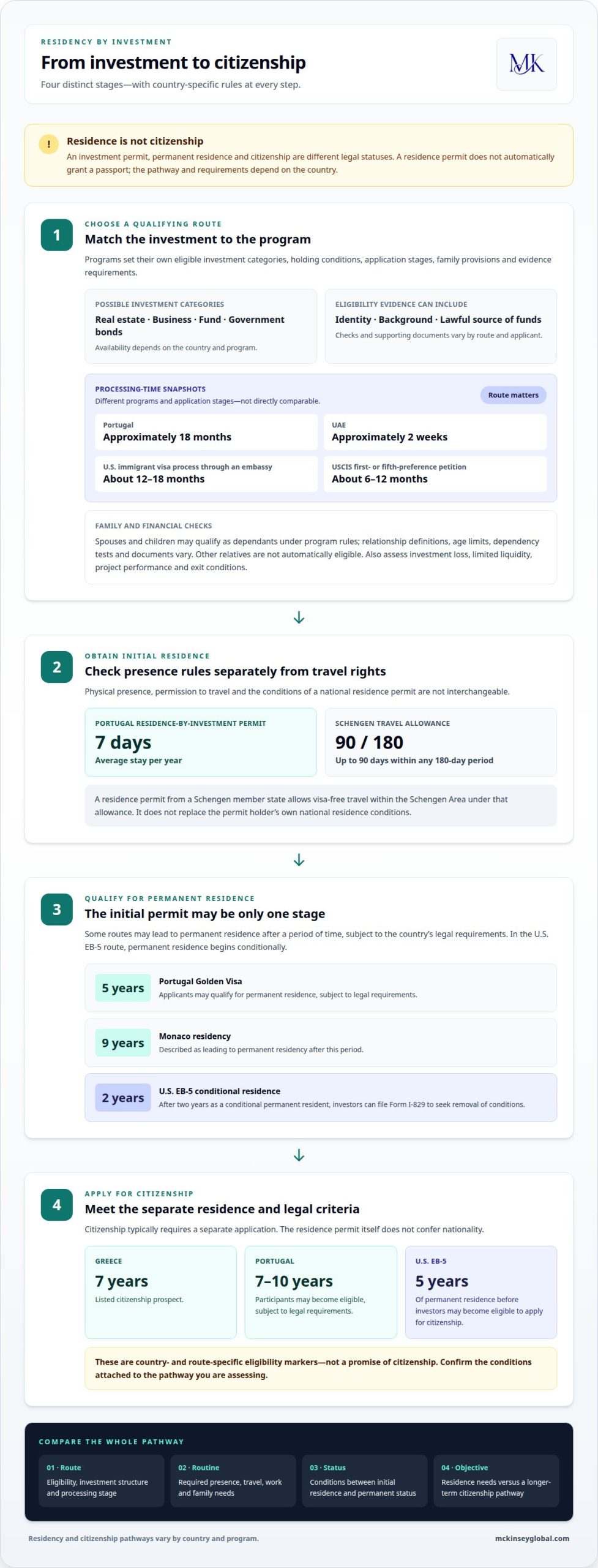
Investment minimums and timelines vary by route. Portugal’s listed processing time is approximately 18 months; the UAE’s is approximately two weeks. These figures describe different programs and are not directly comparable: investment type and application process also matter.
For a U.S. EB-5 application, Form I-526 starts the petition process. Applicants may need to complete additional steps for consular immigrant visa processing after a petition is approved. The U.S. immigrant visa process through an embassy takes about 12-18 months. USCIS normally approves a first- or fifth-preference immigrant petition in about 6-12 months.
| Option | Investment criterion | Listed processing time |
|---|---|---|
| Latvia | Not listed here | |
| Greece | Approximately four months | |
| Portugal | Route-dependent | Approximately 18 months |
| UAE | Route-dependent | Approximately two weeks |
Choose by matching the investment structure and timeline to your objectives, not by speed alone.
Family Members on an Application
Spouses and children may be included when program rules recognize them as eligible dependants. Permitted relationships, age limits, dependency criteria, and supporting documents vary by country. Other relatives are not automatically eligible; inclusion depends on each program’s definitions and evidence requirements. Assess family eligibility alongside the main applicant’s investment route, since an individual pathway may not suit the whole household.
Which countries offer programs in 2026? Examples include Portugal, Greece, Latvia, the UAE, Türkiye, the United States, New Zealand, and Hong Kong. More than 20 programs were active worldwide in 2026.
Risks include investment loss, limited liquidity, project underperformance, and misrepresentation by fraudulent promoters. Before committing funds, examine the project’s business model, investment terms, governance, and exit conditions. A promised residence outcome does not remove the commercial risks of the underlying investment.
Minimum-stay requirements
Physical presence is separate from the investment itself. Compare required days in-country with your travel rights, work plans, and family routines before choosing a program.
Portugal’s residence-by-investment permit holders must stay an average of seven days per year. A residence permit from a Schengen member state also allows visa-free travel within the Schengen Area for up to 90 days within any 180-day period. That travel allowance does not replace the permit holder’s own national residence conditions.
What investments can qualify? Depending on the country and program, eligible routes may involve real estate, a business, a fund, or government bonds. Each program sets the permitted category, holding conditions, and evidence required. Distinguish investment eligibility from minimum-stay rules.
Eligibility checks can include identity and background screening, a clear criminal record, and evidence that investment funds come from lawful sources. Prepare a documented account of how the capital was obtained and transferred. Required evidence depends on the route and your circumstances.
U.S. E-2 eligibility depends on treaty-country nationality and an investment in a U.S. business. The E-2 visa is described as renewable indefinitely.
By contrast, the U.S. first-preference route has no minimum investment or required employee count. The foreign company must have operated for over a year, while the foreign and U.S. companies need at least 50% common ownership. A sponsoring U.S. company normally has five U.S. workers.
EB-5 adds an employment obligation: according to U.S. Citizenship and Immigration Services, the investor must create full-time employment for at least ten U.S. workers within two years after approval of permanent residence. Greece’s Golden Visa and other routes should be assessed separately, since their residence and investment criteria differ. Select the program by weighing lawful source-of-funds evidence, presence obligations, and business commitments together.
Permanent residence and citizenship pathways
An investment permit, permanent residence, and citizenship are distinct legal statuses. The route between them depends on the country’s residence rules and your eligibility.
Investment Visa Routes to Permanent Residence
Some programs provide a route toward permanent residence rather than granting it immediately. Portugal’s Golden Visa applicants may qualify for permanent residence after five years, subject to legal requirements. Monaco residency is described as leading to permanent residency after nine years. These examples show why it is important to distinguish the initial permit from the status you ultimately seek.
For U.S. EB-5 investors, permanent residence begins conditionally; applicants can file Form I-829 after two years as conditional permanent residents to seek removal of conditions.
Residence-to-Citizenship Pathways
Citizenship typically requires a separate application after you meet the country’s residence and legal criteria. Greece lists a citizenship prospect after seven years, while participants in Portugal’s program may become eligible after seven to ten years. Portugal Golden Visa holders may apply for citizenship after meeting legal requirements; the residence permit itself does not confer nationality.
According to U.S. Citizenship and Immigration Services, EB-5 investors may become eligible to apply for U.S. citizenship after five years of permanent residence. Eligibility is a step toward applying, not citizenship automatically.
Hybrid Residence-Citizenship Programs
A hybrid model combines a residence route with a longer-term citizenship pathway, but its investment structure can differ from residence-only programs. Mauritius, for example, requires an investor to buy luxury residential property in a specified development or make a ten-year investment in selected businesses. The government’s program terms therefore shape both the qualifying investment and the route to status.
Taxes, travel access, and quality of life also differ by country. Cyprus describes a non-dom regime exempting qualifying income from Special Defence Contribution for 17 years, while Greece lists a fixed annual tax of €100,000 on foreign-sourced income; Schengen residence permits allow travel within the area for up to 90 days in any 180-day period. For daily life, weigh those provisions alongside the destination and the residence conditions.
Portuguese eligibility and investment routes
For applicants considering Portugal, residency by investment is one route among several. The right pathway depends on the qualifying basis, required documentation, and whether your objective is residence, business activity, or longer-term status.
Portugal’s Golden Visa, also known as the ARI residence permit, gives holders the right to reside in Portugal and travel within the Schengen Area. These are route-specific entry points, not a single threshold for every applicant. The qualifying investment category determines which amount and evidence apply.
Applicants should distinguish the Golden Visa from income-based options. These pathways have different eligibility criteria and bases, so compare them with your financial profile and intended activity before choosing a route.
A clear criminal record is listed as a general requirement for residency by investment programs for 2026. Applicants should organize identity records, investment or income evidence, and supporting documents before lodging an application. Include a spouse, children, and other family members in household planning, while assessing each person under the applicable eligibility criteria.
Physical presence and future status also shape the decision. Portugal’s investment permit holders must stay an average of seven days per year. Golden Visa applicants may qualify for permanent residence after five years, while citizenship eligibility depends on meeting legal requirements. The permit supports travel within the Schengen Area but does not itself grant residence in every member state.
For a Portugal-focused investment route, review the Portugal Golden Visa pathway alongside income-based alternatives. Compare the investment basis, evidence, family needs, annual presence, and long-term objectives to determine whether residency by investment aligns with your plans.
McKinsey Citizenship and Residency Solutions: Antigua and Barbuda Citizenship by Investment
McKinsey Citizenship and Residency Solutions advises on citizenship and residence pathways, including Antigua and Barbuda Citizenship by Investment. This route may suit people seeking citizenship through investment. Greece Residency by Investment is a separate option for those whose priority is residence. Start by comparing the status you want with each program’s requirements.
The firm also offers alternative Caribbean citizenship and European residence pathways. These provide additional options to consider alongside Antigua and Barbuda, while Greece remains a primary residence alternative. The right comparison depends on your objectives, eligibility, and preferred destination, since programs do not all lead to the same status.
If you are assessing these pathways, you are welcome to contact McKinsey Citizenship and Residency Solutions to discuss your options.
Set a Clear Direction for Your Next Move
Start by defining what a successful outcome means for you and your family. Is your priority a second residence, a future citizenship pathway, or greater flexibility across borders? For Portuguese applicants, separating these objectives can clarify which requirements deserve close attention, from eligible investment categories to physical presence and future status.
Residency by investment is a significant personal and financial decision, so set your priorities before selecting a route. Consider where you intend to live, how often you can be present, which family members need to be included, and whether citizenship is a long-term goal. This creates a practical framework for comparison, rather than making the investment threshold the sole deciding factor.
McKinsey Citizenship and Residency Solutions works with investment-based citizenship and residence pathways. To discuss how your objectives align with available options, contact McKinsey Citizenship and Residency Solutions. A considered first conversation can help you approach your next decision with greater clarity and confidence.
Frequently Asked Questions
Common Mistakes: Why Applications Get Rejected?
Applications can be refused if evidence is incomplete, inconsistent, or fails to meet the selected route’s criteria. Before filing, reconcile names and dates across identity, financial, and civil documents; document the lawful source of funds; and include records for every family member named. A clear criminal record is a general requirement cited for these programs. Disclose relevant history accurately and ensure application details match supporting evidence.
Do I need to live in the country to maintain my residence permit?
Not always. Physical-presence conditions vary by program and may differ from the rules for renewal or future status. Before applying, compare your planned absences with the permit conditions and any later permanent-residence or citizenship requirements. Keep travel records and track time spent in the country. Do not assume a valid residence permit removes separate presence obligations for a future application.
What Taxes Do Residents Have to Pay?
Tax obligations depend on tax residence, income, and applicable rules, not solely on holding an immigration permit. Relevant factors can include where you live and where your income arises. For example, if you retain foreign income while relocating, assess how both the source country and destination treat it. Include a separate tax review in relocation planning, since immigration approval does not determine tax treatment.
What is residency by investment and how does it differ from citizenship by investment?
Residency by investment provides a route to a residence permit through a qualifying investment, while citizenship by investment seeks nationality under a separate framework. A residence permit may authorize you to live in a country without making you a citizen. Compare the rights, renewal conditions, family eligibility, and future status attached to each route to clarify whether your priority is residence or citizenship.
What are the minimum investment amounts and fees for each residency by investment program?
Minimums differ by country and route, while application and government charges are separate from the qualifying investment. A sound comparison identifies the eligible asset or investment structure, any holding conditions, and the charges at each stage. Keep investment capital and other costs in separate budget lines to compare the total financial commitment without treating every program’s threshold as equivalent.
How long does application processing take, and what are the steps to apply?
Processing time varies by country, route, document readiness, and government review stages. Applications generally proceed through route selection, eligibility assessment, preparation of identity and source-of-funds evidence, filing, review, and follow-up before a decision. Prepare a checklist for the main applicant and dependants, retain copies of submitted records, and respond promptly to requests. Treat approval and completion of any investment steps as separate milestones.