While many view global mobility as an unavoidable expense, the most disciplined investors recognize that a well-structured acquisition can transform a regulatory requirement into a resilient capital hedge. Selecting the Antigua citizenship by investment real estate option allows you to secure a powerful second passport while maintaining a deeded asset in a premier Caribbean jurisdiction. You likely understand the inherent value of a Tier 1 passport; however, concerns regarding property liquidity and the complexity of government-approved projects often create hesitation.
This 2026 investor’s guide provides a meticulous analysis of the current regulatory landscape, including the verified $300,000 minimum investment threshold and the total cost of ownership. We will examine the strategic alignment of property acquisition with long-term wealth protection; specifically, we detail the path to resale after the mandatory five-year holding period and the mitigation of hidden administrative fees. From evaluating rental yields to ensuring adherence to the latest OECS harmonization standards, this briefing offers the clarity required to navigate the Antigua and Barbuda Citizenship by Investment Unit protocols with total confidence.
Key Takeaways
- Evaluate the strategic shift from non-refundable donations to the Antigua citizenship by investment real estate option, which serves as a recoverable capital asset held for a minimum of five years.
- Navigate the 2026 financial landscape with precision, including the $300,000 minimum investment threshold and comprehensive government processing fees for families of four.
- Identify high-yield, government-approved developments through a disciplined selection process that prioritizes project completion and long-term asset liquidity.
- Streamline the acquisition protocol by understanding the critical sequence from signing the Purchase and Sale Agreement to the final issuance of citizenship.
- Mitigate investment risks by leveraging independent advisory to distinguish between high-potential Caribbean projects and non-compliant or sub-par developments.
Understanding the Real Estate Pathway to Antiguan Citizenship
The Antigua citizenship by investment real estate option represents a structured capital allocation into the nation’s high-end hospitality and residential sectors. Unlike the non-refundable contribution to the National Development Fund, this pathway involves the acquisition of a deeded asset within a project specifically sanctioned by the government. This distinction is critical; investors don’t simply purchase any property on the open market. Only developments that have undergone rigorous vetting by the Citizenship by Investment Unit (CIU) qualify for the program. This regulatory oversight ensures that the capital supports projects of strategic national importance while providing investors with a tangible, recoverable asset.
The Legal Basis of Investment Migration in Antigua
The framework for this pathway is rooted in the Citizenship by Investment Act of 2013, which expanded the traditional scope of Antiguan and Barbudan nationality law to include economic contributions. By 2026, this legislation has been further refined through regional harmonization efforts among OECS nations. These updates established a unified price floor and enhanced due diligence protocols to maintain the integrity of the Caribbean’s migration industry. The CIU acts as the primary gatekeeper, managing the application process and monitoring project compliance to protect the interests of the state and the investor. It’s the CIU’s responsibility to verify that every project maintains its "approved" status through regular audits and construction progress reports.
Approved Projects: From Luxury Resorts to Private Villas
The "Approved Project" designation is a status granted only to developments that meet specific financial and operational criteria. These projects typically fall into two categories: fractional ownership and whole ownership. Fractional ownership provides a cost-effective entry point where investors hold a deeded share of a luxury resort or hotel suite. Whole ownership involves the acquisition of a standalone villa or condominium, offering greater control over the asset and potential personal use.
Selecting the right project requires a disciplined evaluation of the developer’s track record and the project’s current completion status. While the general real estate market fluctuates based on local demand, properties within the Antigua citizenship by investment real estate option framework are governed by a distinct secondary market. This market is shaped by the mandatory five-year holding period and the unique requirements of future citizenship applicants. It’s essential for any investor to prioritize capital preservation by choosing projects with high liquidity and proven management. This strategic approach ensures that the asset remains viable for resale once the holding period expires.
Financial Thresholds and Regulatory Requirements for 2026
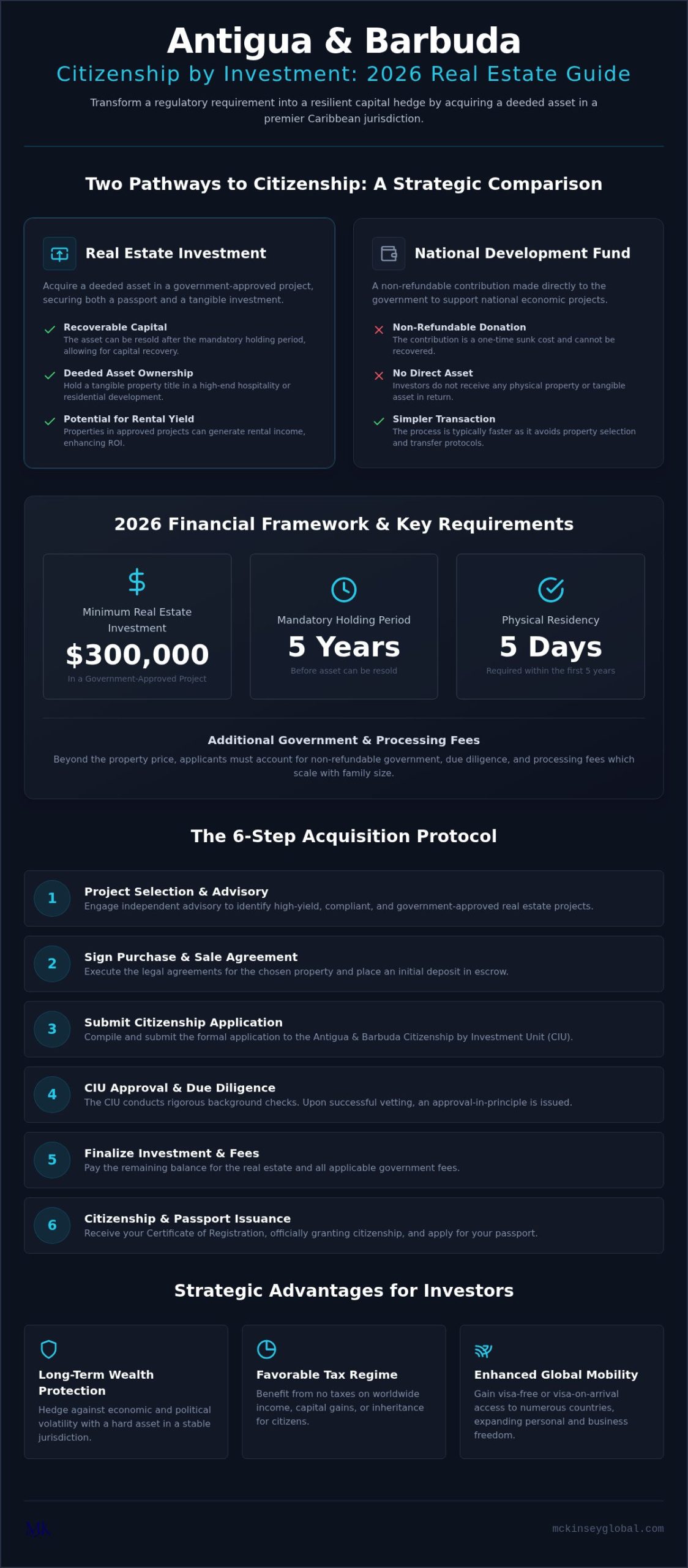
The financial structure of the Antigua citizenship by investment real estate option is defined by a rigorous set of thresholds designed to attract high-net-worth individuals while ensuring national economic stability. In 2026, the minimum investment for a government-approved property stands at $300,000. This capital must remain committed for a mandatory holding period of five years, after which the asset may be liquidated on the secondary market. Non-resident owners should also consider the broader fiscal environment; Antigua maintains a highly favorable tax regime with no taxes on worldwide income, capital gains, or inheritance for its citizens.
Minimum Capital Outlay for Real Estate Acquisition
The acquisition of property requires a minimum capital injection of $300,000 into a project vetted by the state. This entry point applies whether the applicant is a single individual or a family unit, though the accompanying administrative costs will scale accordingly. Unlike the donation route, this investment is recoverable. Investors must maintain ownership for at least five years to remain compliant with the program’s regulations. It’s also necessary to fulfill a minimal physical residency requirement of five days within the first five years of holding the passport.
The Schedule of Government and Administrative Fees
Beyond the property purchase price, several government-mandated fees apply to the application process. These costs are non-refundable and are paid directly to the Official Antigua Citizenship by Investment Unit to cover the administrative burden of file processing and passport issuance. The fees are structured as follows:
- Processing Fees: $10,000 for a single applicant; $20,000 for a family of up to four.
- Additional Dependents: $10,000 for each person beyond the initial family of four.
- Passport Fees: Standard fees apply per person for the physical document issuance.
For those seeking tailored guidance on these capital requirements, engaging with a disciplined investment migration advisor ensures that all financial disclosures meet the CIU’s exacting standards.
Vetting and Due Diligence: The Multi-Tiered Security Check
The integrity of the program is upheld through an exhaustive due diligence process. Each applicant undergoes a background check performed by independent international agencies to ensure compliance with global security standards. The fees for this vetting are structured as follows: $8,500 for the main applicant, $5,000 for a spouse, $2,000 for dependents aged 12 to 17, and $4,000 for those aged 18 or older. These checks are non-negotiable and represent the final hurdle before the CIU grants approval in principle for the Antigua citizenship by investment real estate option.
Strategic Analysis: Real Estate Investment vs. National Development Fund
Choosing between a non-refundable contribution and the Antigua citizenship by investment real estate option is a fundamental decision that defines an investor’s long-term financial exposure. While the National Development Fund (NDF) offers a lower initial capital requirement, it represents a total loss of principal. In contrast, the real estate pathway functions as a capital preservation tool, allowing the investor to maintain a deeded interest in a tangible asset. This choice requires a disciplined evaluation of one’s liquidity needs and risk tolerance. Strategic investors often view the property route not as an expense, but as a temporary capital allocation into a premium Caribbean asset class.
The Economics of the Donation Option (NDF)
The NDF remains the most straightforward route for those prioritizing speed and simplicity over capital recovery. For a family of four, the $230,000 contribution is significantly lower than the total outlay required for property. However, this payment is a sunk cost with zero potential for financial return. It’s often the preferred choice for applicants who view citizenship as a pure utility rather than an investment vehicle. The application process for the NDF is generally less complex; it avoids the legal intricacies of title transfers and property management agreements that accompany physical asset ownership.
The Case for Capital Preservation via Property
For the strategic investor, the real estate option offers a more sophisticated risk-mitigation profile. By committing $300,000 into a government-approved project, the applicant secures a recoverable asset that can generate annual rental yields between 2% and 5%. A recent Forbes analysis of the Antigua CBI program highlights how these property-backed acquisitions serve as a ticket to global mobility while keeping capital within the investor’s control. Ownership structures vary. Fractional ownership offers a lower-maintenance entry into luxury resorts. Full title grants complete authority over a private villa. Full title acquisitions often provide higher long-term appreciation potential but require more rigorous oversight of maintenance and administrative fees.
Exit Strategies: Reselling Your Investment After Five Years
The primary advantage of the real estate pathway is the ability to liquidate the asset after the five-year holding period. Successful liquidation depends on the project’s inherent market value and the robustness of the secondary market. Properties located in prime coastal areas with established management teams tend to hold their value more effectively. It’s vital to select a project with a clear resale protocol. The ability to sell to a future CBI applicant can significantly enhance liquidity. This exit strategy effectively transforms the "cost" of citizenship into a temporary capital allocation, provided the investor conducts thorough due diligence on project-specific risks.
The Acquisition Protocol: From Project Selection to Passport Issuance
The acquisition of the Antigua citizenship by investment real estate option follows a methodical, five-stage protocol designed to ensure both legal compliance and capital security. This journey begins with the selection of a government-approved development and concludes with the formal issuance of the passport. Each phase is characterized by specific regulatory milestones that must be reached before the subsequent step can proceed. The process is designed to be completed remotely, though the underlying investment requires a disciplined approach to documentation and financial transparency.
- Step 1: Selection of a government-approved development and signing of the Purchase and Sale Agreement (PSA).
- Step 2: Submission of the citizenship application through a licensed agent, including payment of initial due diligence fees.
- Step 3: Receipt of ‘Approval in Principle’ from the CIU following a successful background check.
- Step 4: Completion of the property investment and payment of the remaining government processing fees.
- Step 5: Taking the Oath of Allegiance and receiving the Certificate of Registration and physical passport.
Navigating the Purchase and Sale Agreement
The Purchase and Sale Agreement (PSA) is the foundational legal instrument in this process. It’s not a standard property contract; it must align strictly with the CIU’s requirements for investment migration. The PSA defines the specific asset being acquired, whether fractional or whole title, and establishes the developer’s obligations regarding project completion and future maintenance. It’s the primary document used to verify the legitimacy of the investment during the initial application phase, ensuring the property qualifies for the Antigua citizenship by investment real estate option.
Escrow Requirements and Financial Compliance
To protect the investor’s capital, the program utilizes regulated escrow accounts for the transfer of funds. Capital is generally held by a licensed escrow agent and is only released to the developer once the CIU has issued an ‘Approval in Principle’. This mechanism ensures that the bulk of the $300,000 investment is only committed after the applicant has cleared the mandatory due diligence checks. It provides a layer of institutional security that distinguishes the Antiguan program from less regulated international property markets.
Timeline Expectations for 2026 Applications
For 2026 applications, the expected timeline from submission to passport issuance is between three and six months. This period is divided into the initial 60 to 90 days for due diligence and a final 30 to 60 days for investment completion and document processing. Engaging an expert citizenship consultant is the most effective way to maintain this schedule, as it minimizes the risk of administrative queries or documentation errors that could lead to significant delays in the issuance of the Certificate of Registration.
Mitigating Risk in Caribbean Real Estate Acquisitions
Navigating the Antigua citizenship by investment real estate option requires a level of scrutiny that extends beyond the official CIU approval status. While the government vets projects for legal compliance, this designation doesn’t guarantee commercial viability or adherence to construction timelines. Investors must distinguish between projects with established management and those that exist only as conceptual renderings. A disciplined approach to project selection is the only way to ensure that the underlying asset remains a viable capital hedge rather than a frozen liability.
Due Diligence Beyond the Government Requirements
Government approval serves as the minimum threshold for participation, not a seal of financial performance. A meticulous investor evaluates the developer’s historical performance, capital structure, and the current state of physical construction. Monitoring specific milestones for off-plan properties is essential to safeguard your principal. If a project stalls, your capital is at risk, even if the citizenship remains intact. Independent audits and site visits provide the clarity needed to identify high-yield opportunities while avoiding developments with structural or financial instabilities.
Portfolio Diversification Through Global Residency
Strategic mobility isn’t limited to a single jurisdiction. A deeded asset in Antigua can complement a broader portfolio that might include St. Kitts and Nevis Citizenship or residency solutions in the United Arab Emirates. By viewing the Antigua citizenship by investment real estate option as one component of a global residency strategy, investors mitigate jurisdictional risk and enhance their long-term wealth protection. This diversified approach ensures that your family’s mobility and assets are protected across multiple regions, providing a robust shield against local economic shifts.
Engaging Professional Advisory for Strategic Mobility
McKinsey Citizenship and Residency Solutions acts as a meticulous gatekeeper in this complex landscape. With over five years of experience in Caribbean CBI protocols, the firm provides independent advisory that prioritizes capital security over project-specific incentives. We evaluate developments through the lens of institutional risk management, ensuring that your investment aligns with your broader financial objectives. This professional oversight minimizes uncertainty and provides a clear path to asset recovery at the end of the mandatory five-year period. Our commitment to procedural integrity ensures that every step of your acquisition is handled with the discretion and precision that high-stakes investments demand.
Securing Your Global Legacy through Strategic Asset Acquisition
When evaluating the landscape of global mobility, selecting the Antigua citizenship by investment real estate option represents a sophisticated maneuver for the disciplined investor. By transitioning from a non-refundable contribution to a deeded capital asset, you effectively align your global mobility goals with long-term wealth protection and risk mitigation. To ensure a successful acquisition in 2026, you must maintain meticulous adherence to the $300,000 investment threshold while conducting a rigorous evaluation of project-specific liquidity and developer track records.
Our boutique advisory brings over five years of investment migration experience to your portfolio, offering the expert guidance necessary to navigate complex CIU protocols with total confidence. We operate as a steady guide through complex international landscapes, prioritizing compliance and discretion at every stage of the process. To begin your journey toward enhanced global mobility and capital preservation, Schedule a Private Consultation with Our Senior Strategists today. We look forward to helping you secure a stable and prosperous international future.
Frequently Asked Questions
What is the minimum investment for the Antigua real estate option in 2026?
The minimum capital requirement is $300,000 for a government-approved project. This threshold was established through a regional agreement among OECS nations to harmonize pricing and ensure the program’s long-term integrity. This investment allows for the acquisition of a deeded asset, providing a recoverable alternative to the non-refundable donation pathways while supporting the nation’s high-end hospitality sector.
Can I sell my Antiguan property after receiving citizenship?
Yes, you may liquidate the asset after a mandatory holding period of five years. Once this period expires, the property can be sold to a new citizenship applicant or on the general market without affecting your status. This exit strategy allows investors to recover their initial capital while retaining the lifelong benefits of their second passport and the associated global mobility.
Are there hidden costs associated with maintaining the investment property?
Investors should account for recurring expenses such as property management fees, insurance, and annual maintenance costs. These fees vary significantly depending on whether you choose fractional or whole ownership. It’s essential to review the developer’s management agreement meticulously to understand the total cost of ownership beyond the initial acquisition price and avoid unforeseen administrative liabilities.
How long does the application process take for the real estate pathway?
The standard processing time is estimated to be between three and six months from the date of submission. This timeline includes the rigorous due diligence checks performed by independent agencies and the final "Approval in Principle" issued by the CIU. Delays are usually avoided by ensuring all documentation is precise and compliant upon the initial filing through a licensed agent.
Do I need to live in Antigua to maintain my citizenship?
There is no permanent residency requirement, though you must visit the country for at least five days within the first five years of becoming a citizen. This visit is usually scheduled to coincide with the formal oath of allegiance or a personal vacation. Beyond this minimal requirement, you are free to live and work anywhere in the world without impacting your citizenship status.
Can my family be included in the real estate citizenship application?
The Antigua citizenship by investment real estate option supports the inclusion of a spouse, children under 31, and dependent parents over 55. Unmarried siblings of the main applicant or spouse may also be eligible for inclusion. Each additional dependent increases the government processing and due diligence fees but doesn’t raise the required minimum property investment threshold.
What happens if the approved project is not completed on time?
Construction risk is mitigated through the use of regulated escrow accounts where funds are released only upon the developer reaching specific milestones. If a project stalls, the investor’s capital is protected by these established legal frameworks. It’s critical to partner with a disciplined advisor who can vet developers’ historical performance and current project liquidity to minimize such risks.
Is the real estate option better than the University of the West Indies (UWI) fund?
The choice depends on your financial profile and family size. The UWI fund is a non-refundable contribution of $260,000 for families of six or more, making it cost-effective for large groups. However, the real estate option remains superior for those seeking a recoverable asset with the potential for annual rental income and long-term capital appreciation over the five-year period.