
Saint Lucia’s passport has an international profile, though rankings offer only one way to assess it. But a global position alone doesn’t show whether this passport would expand your own travel options. St Lucia passport strength is best assessed against the destinations you visit and the access your current passport already provides.
That comparison matters: visa-free access, visa-on-arrival access and entry that requires advance approval are not equivalent. Saint Lucia passport holders have visa-free or visa-on-arrival access to 147 destinations, while 111 destinations are fully visa-free.
This article explains what the figures say about St Lucia passport strength, how the passport compares with other Caribbean citizenship-by-investment passports, and how to assess it alongside your current passport. Destination access is only one part of the decision: your travel patterns and the entry rules for the countries important to you help determine whether a second passport offers practical value.
Key Takeaways
- Interpret travel access by entry type, distinguishing visa-free travel from visa-on-arrival, eTA and eVisa requirements.
- Compare Caribbean investment passports across both destination access and the features that matter to your plans.
- Assess whether a Saint Lucia passport adds practical value by comparing its access with the passport you already hold.
- Check the rules for major destinations carefully: access to the UK and Schengen differs from entry to the United States and Canada.
What is the reputation of Saint Lucia Passport?
Saint Lucia ranks 31st, with 80.8 points in a freedom-of-travel ranking. St Lucia passport strength is reflected in this position, but the ranking alone cannot show whether the passport suits your travel needs.
Destination Access Categories
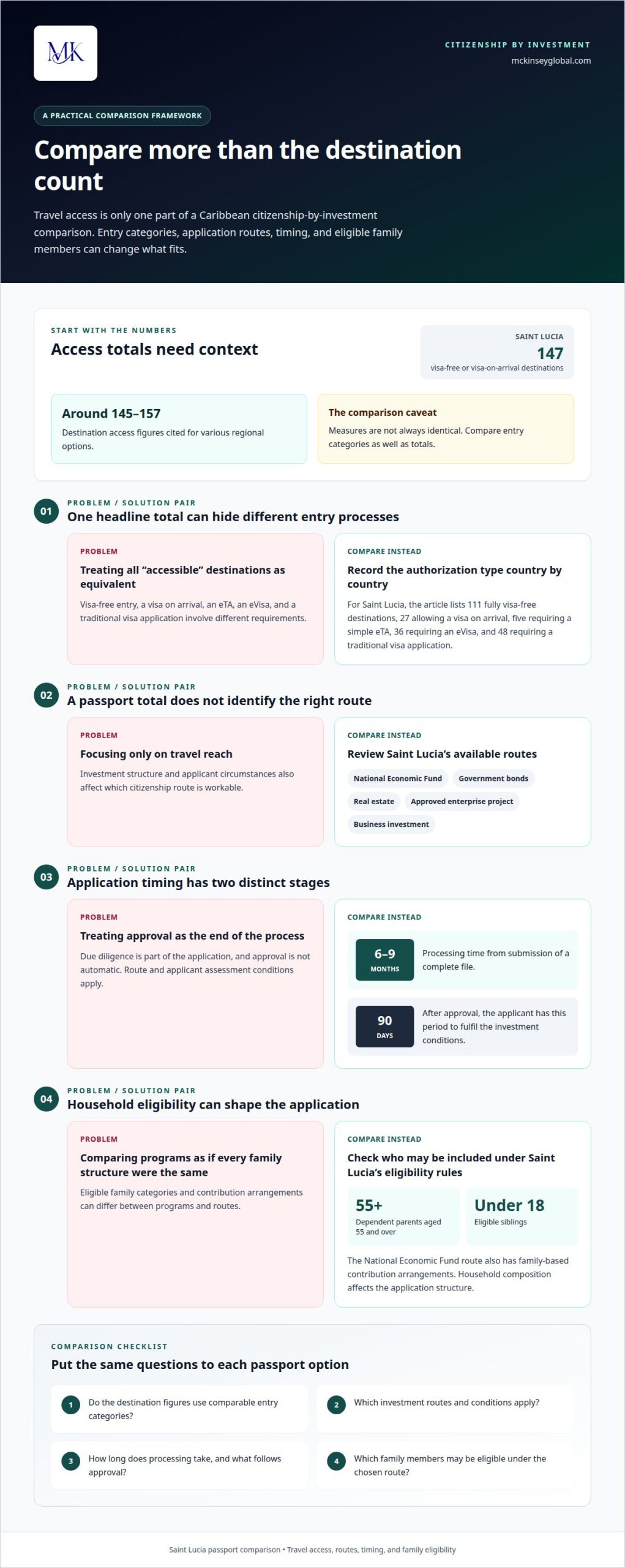
Destination access categories describe the entry authorization required for travel. One measure of St Lucia passport strength is the range of entry types available: holders have visa-free or visa-on-arrival access to 147 destinations. This includes 111 destinations with fully visa-free entry, 27 allowing a visa on arrival, and five requiring a simple electronic travel authorization. Another 36 destinations require an eVisa, while 48 require a traditional visa application. The categories clarify what a destination-access total means in practice.
Schengen Access and Suspension Risk
Schengen access allows Saint Lucia citizens to visit participating European countries without a visa for short stays. They may stay for up to 90 days in any 180-day period. A reported date for potential EU action concerning visa-free access is 1 June 2028. No EU suspension decision or confirmed date exists, so that reported date should not be read as a suspension taking effect. The Schengen allowance remains limited to short stays.
Dual Citizenship and Personal Implications
Dual citizenship means holding Saint Lucian citizenship alongside another nationality. Whether you can retain both depends on the laws governing each nationality. Citizenship and tax residence are separate considerations: holding a Saint Lucia passport alone does not establish tax residence. Your residence and income inform your tax obligations. Under Saint Lucia’s Citizenship by Investment Act, there is no minimum physical-presence requirement to acquire or retain citizenship.
For United States travel, Saint Lucia citizens should check the applicable visa requirements and conditions before travelling. This is visa-required travel, not visa-free access.
Comparison with other Caribbean citizenship-by-investment passports
Citizenship by investment is a legal route to citizenship linked to an approved investment. When comparing programs, consider travel access, available routes, and family eligibility, not just the investment structure.
Saint Lucia offers routes involving the National Economic Fund, government bonds, real estate, an approved enterprise project, or business investment. Across the region, the figures differ: various regional options provide access to around 145 to 157 destinations globally. These measures are not always identical, so compare entry categories as well as totals when evaluating St Lucia passport strength.
Application eligibility and steps depend on the selected Saint Lucia route and the applicant’s assessment. Processing takes six to nine months from a complete file; after approval, an applicant has 90 days to fulfil the investment conditions.
Due diligence is part of the application process, and approval is not automatic. Applicants must meet the applicable assessment and route conditions. Passport access also remains subject to each destination’s entry rules.
Saint Lucia’s family eligibility includes dependent parents aged 55 and over, and siblings under 18. The National Economic Fund route also has family-based contribution arrangements, so household composition affects the application structure. The eligible family categories can distinguish programs as meaningfully as destination access.
For a Saint Lucia passport, the cost depends on the selected route and the applicant’s circumstances; pricing is provided after a quote request through McKinsey Citizenship and Residency Solutions. Route selection and family composition are relevant cost factors. Processing takes six to nine months from submission of a complete file.
For a practical comparison, list the destinations you visit most and compare their entry rules across passports. Then assess which investment route and eligible family members fit your circumstances. This helps distinguish headline travel access from the conditions that shape a workable citizenship application.
Comparing a Saint Lucia passport with an existing passport
A passport comparison measures how each nationality affects entry to the countries you actually visit. For a useful assessment, compare your current passport with a Saint Lucia passport for the same destinations, travel dates, and entry categories, rather than relying on rankings alone.
Start with a short list of priority destinations, such as the United States, Canada, the United Kingdom, and Schengen countries. For each, record whether your existing passport permits visa-free entry, requires a visa, or uses another authorization. Then make the same comparison for Saint Lucia. Its citizens need a visa for the United States and Canada, while short visits to Schengen countries can be visa-free for up to 90 days in any 180-day period.
- United States: Record whether each passport requires a visitor visa. Saint Lucia citizens can obtain a B-1/B-2 visa, so this is not visa-free access.
- Canada: Compare the applicable visa requirement for both nationalities; Saint Lucia economic citizens still need a Canadian visa.
- Schengen: Compare short-stay access and the 90-days-in-180-days limit against your current passport’s rules.
Next, distinguish entry permission from convenience. Visa on arrival involves a different process from visa-free entry, while an eVisa requires an application in advance. A destination count can hide these differences, so note the authorization and preparation required for each country. This approach helps you see whether a second passport adds access or simply provides another travel document.
Finally, consider where you live and how your government treats dual citizenship. Citizenship and tax residence are separate matters: a Saint Lucia passport alone does not determine where you owe tax. Compare the legal requirements for your existing nationality and actual residence, then weigh the practical value of added access against your travel patterns. A destination-by-destination matrix makes overlaps and gaps visible before you assess citizenship by investment.
Can Saint Lucia passport holders travel to the United States, Canada, the UK, and Schengen countries visa-free?
Visa-free travel means entering a destination without obtaining a visa before the trip. Saint Lucia passport holders can travel visa-free to the United Kingdom and Schengen countries, but not to the United States or Canada. A strong destination-access total does not mean every major destination is visa-free.
United States: Saint Lucia citizens need a visa for travel to the United States. They can obtain a B-1/B-2 visitor visa valid for 10 years. The stated stay allowance with that visa is up to 180 days a year. A valid passport alone does not provide visa-free entry, so include the visa requirement when comparing travel documents.
Canada: Saint Lucia economic citizens who hold its passport still need a Canadian visa. This differs from destinations where Saint Lucia passport holders can enter visa-free or obtain authorization on arrival. In a travel comparison, record Canada separately rather than counting access as visa-free.
United Kingdom: Saint Lucia citizens can stay in the UK for up to 180 days, according to the stated travel information. The UK is separate from the Schengen Area, so its allowance should not be combined with Schengen entry. Treat each destination’s stay period as its own limit.
Schengen countries: Saint Lucia citizens may visit for up to 90 days in any 180-day period without a visa. This applies to short stays, and the period is not a separate 90-day allowance for every Schengen country. The same limit matters whether a trip includes one member country or several.
For a practical assessment, list these four destinations and mark each as visa-free or visa-required. Then note the applicable stay period and any visa requirement, especially the United States B-1/B-2 visa and Canada visa. This provides a more useful view than a passport ranking alone. Discuss Saint Lucia citizenship options in light of your travel priorities.
McKinsey Citizenship and Residency Solutions: St Lucia
McKinsey Citizenship and Residency Solutions helps applicants assess St Lucia citizenship against their travel priorities, family circumstances, and preferred investment route. This can be a useful next step when destination access is only one part of the decision or you want to understand how an application fits your broader plans.
If you are comparing jurisdictions, relevant alternatives include Antigua and Barbuda Citizenship by Investment, St. Kitts and Nevis Citizenship, and Greece Residency by Investment. Each option has distinct eligibility criteria and benefits, so compare them against your objectives rather than passport rankings alone. McKinsey Citizenship and Residency Solutions advises on these programs and St Lucia, helping you consider the available routes and their fit with your circumstances.
Contact McKinsey Citizenship and Residency Solutions to discuss your St Lucia citizenship objectives.
Make your next citizenship decision purpose-led
The value of a second passport depends on how well it supports your future plans, not simply its ranking. Use your priority destinations, family considerations, and intended travel patterns to define what meaningful additional access would look like. This makes assessing St Lucia passport strength personal and practical rather than abstract.
If your priorities extend beyond Saint Lucia, McKinsey Citizenship and Residency Solutions can also guide applicants considering Antigua and Barbuda Citizenship by Investment, St. Kitts and Nevis Citizenship, or Greece Residency by Investment. The useful comparison is the one that aligns with your circumstances and objectives; another route may suit you better if your needs differ.
When you are ready to consider the next step, contact McKinsey Citizenship and Residency Solutions to discuss your priorities. A clear understanding of what you need from a second citizenship can help you move forward with greater purpose.
Frequently Asked Questions
Is the St Lucia passport good for business travel?
A Saint Lucia passport can support business travel where its entry access suits your itinerary. For example, short business visits to Schengen countries may fall within the visa-free short-stay allowance, while travel to the United States requires a visitor visa. Before planning meetings, distinguish permission to enter from permission to work: visitor status does not itself establish work authorization.
How strong is the Saint Lucia passport in 2026, and what passport ranking does it have?
In 2026, Saint Lucia ranks 31st in a freedom-of-travel passport ranking, with a score of 80.8 points. That position gives a broad indication of international mobility, not a guarantee of entry to any specific country. For a practical assessment, consider the destinations you regularly visit and the entry conditions that apply to your circumstances, rather than relying on rank alone.
How many countries can Saint Lucia passport holders visit visa-free or with visa on arrival?
Saint Lucia passport holders have visa-free or visa-on-arrival access to 147 destinations. The combined figure includes different entry arrangements, so it does not mean every destination allows entry without preparation. For a specific trip, identify whether the destination requires no prior visa, grants a visa on arrival, or requires electronic or traditional visa approval before departure.
Which countries require a visa for Saint Lucia citizens?
The United States and Canada require visas for Saint Lucia citizens; neither is visa-free under the rules described here. A traditional visa application is also required for 48 destinations overall, although requirements depend on the destination and can change. For business or personal travel, identify the destination’s current entry category before finalizing travel arrangements, and distinguish visa requirements from passport validity requirements.
How does the Saint Lucia passport compare with other Caribbean passports?
Compare passports by your priority destinations and the type of entry permitted, rather than treating rankings as directly interchangeable. Saint Lucia, St. Kitts and Nevis, Antigua and Barbuda, and Dominica each offer a distinct mobility profile. A useful comparison records access for the countries you visit, the application route, and eligible family members. This shows whether a second citizenship fills a practical gap in your current travel options.
How can foreign nationals obtain Saint Lucia citizenship by investment, and what are the current minimum costs?
Foreign nationals apply through an available investment route, submit a complete application, and undergo due diligence. After approval, they must fulfil the investment conditions. The price depends on the case and is provided after a quote request; cost factors include the selected route and the applicant’s family composition. A complete application typically takes six to nine months to process.