In an era defined by rapid geopolitical shifts, a single passport is no longer a tool for travel; it’s a point of failure. As global dynamics evolve, the ability to move freely across borders has transformed from a luxury into a fundamental requirement for risk mitigation. You’re likely aware that passport volatility and sudden visa requirement changes can jeopardize both business operations and personal security. This is why sophisticated investors view citizenship by investment for global mobility not merely as a travel document, but as a critical strategic asset.
This 2026 analysis explores how elite investment migration programs serve as a disciplined hedge against sovereign risk and a catalyst for seamless international access. You’ll discover the specific mechanisms that allow these programs to provide long-term stability in an unpredictable world. We’ll provide a detailed evaluation of the most reliable pathways, including the Caribbean options in Antigua and Barbuda or St. Kitts and Nevis, alongside European residency solutions. By examining the alignment of regulatory frameworks, this report offers the clarity needed to secure a definitive “Plan B” for your family’s future.
Key Takeaways
- Understand why global mobility has transitioned from a travel convenience to a rigorous strategy for sovereign risk mitigation.
- Evaluate the fundamental differences between residency and citizenship by investment for global mobility to secure permanent settlement rights that temporary permits can’t provide.
- Identify the specific metrics used to evaluate high-performance programs, utilizing the Antigua and Barbuda benchmark for stability and efficiency.
- Examine the rigorous four-tier due diligence process and the heightened compliance standards that protect the integrity of reputable jurisdictions.
- Discover the McKinsey advisory methodology for aligning complex family requirements with the most secure international investment pathways.
The Strategic Evolution of Global Mobility in 2026
Within the current geopolitical environment, the traditional concept of a passport has undergone a fundamental transformation. For high-net-worth individuals, global mobility is no longer defined merely by the convenience of visa-free travel; it’s now recognized as the capacity to bypass systemic geopolitical restrictions on short notice. Relying on a single citizenship is increasingly viewed as a single point of failure within a comprehensive wealth strategy. Risk is rarely static. If a jurisdiction experiences sudden regulatory shifts or diplomatic isolation, an individual’s ability to protect assets and ensure business continuity is immediately compromised. This is why sophisticated investors view citizenship by investment for global mobility as a critical pillar of their long-term risk management strategy.
Mobility as a Risk Management Asset
Sudden shifts in visa policies can disrupt global commerce without warning, often leaving executives unable to attend critical negotiations or manage international interests. By utilizing citizenship by investment for global mobility, investors secure a form of permanent insurance against local instability. This strategic acquisition ensures that family security and professional obligations remain uncoupled from the volatility of any single nation’s foreign policy. There is a clear correlation between high mobility scores and economic resilience. Jurisdictions with robust international treaties provide their citizens with a layer of protection that functions as a hedge against sovereign risk, ensuring they’re never restricted by the limitations of a single administrative regime.
The 2026 Landscape of Investment Migration
The 2026 investment landscape is characterized by the rise of mobility-first investors who prioritize jurisdictional flexibility above all else. While residency programs offer significant benefits, they’re often subject to the changing whims of immigration authorities and don’t provide the absolute security of a passport. Consequently, many strategists are supplementing traditional residency with citizenship acquisitions to ensure an irrevocable right of entry and settlement. In this context, Economic Citizenship is a sophisticated financial instrument that provides a non-correlated hedge against geopolitical uncertainty while simultaneously expanding an investor’s global operational footprint. This methodology allows for the alignment of complex variables, including tax residency, family relocation, and capital preservation, within a single, disciplined framework that prioritizes long-term stability.
Structural Comparison: Citizenship vs. Residency for Mobility
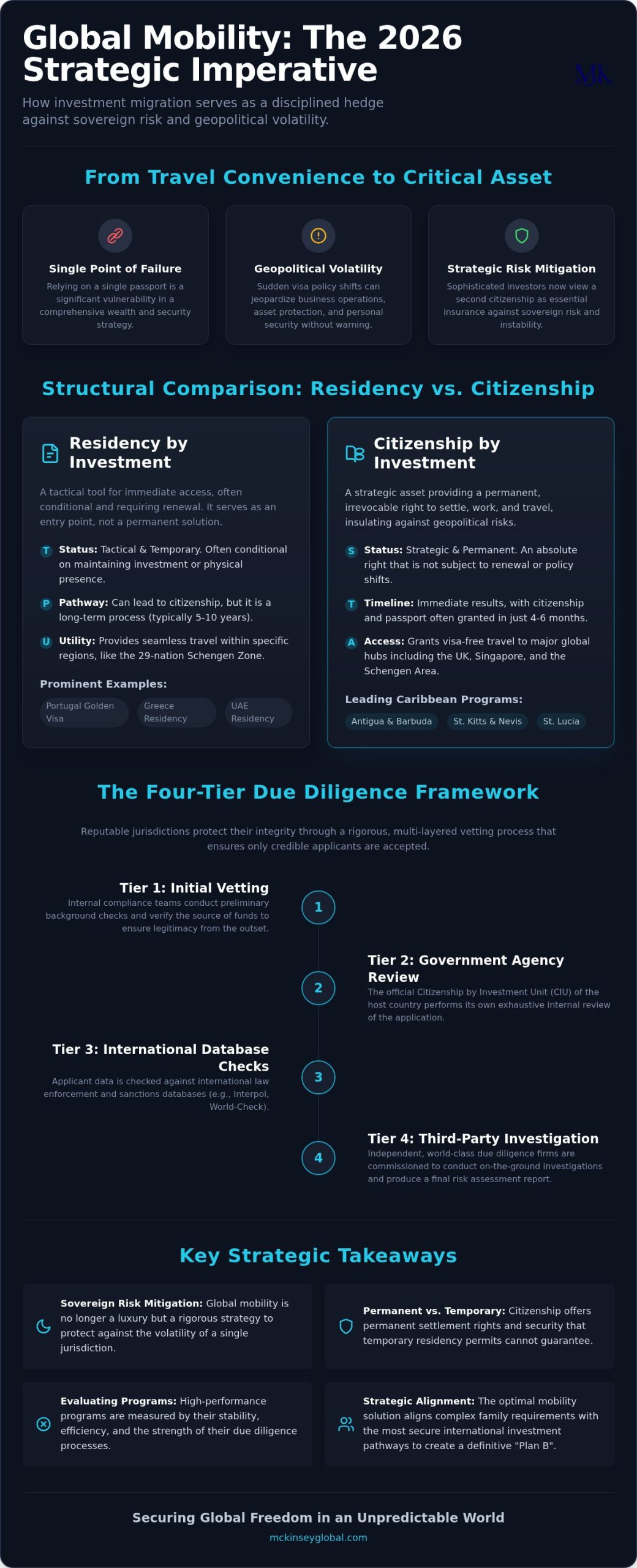
Understanding the structural differences between residency and citizenship is essential for any disciplined wealth strategy. While residency permits offer travel privileges, citizenship provides the absolute right to settle, work, and remain indefinitely. Residency is often a temporary status that must be renewed, making it a tactical tool rather than a permanent solution. For many high-net-worth individuals, the choice depends on whether they require immediate travel access or a long-term path to European integration. When evaluating citizenship by investment for global mobility, one must distinguish between the tactical advantages of a residency permit and the strategic permanence of a second passport.
The Utility of European Residency
Programs such as the Portugal Golden Visa or Greece Residency by Investment function as tactical entry points into the Schengen Zone. These permits allow for seamless travel across 29 European nations without the need for additional visas. However, residency is often conditional upon maintaining the investment or meeting specific physical presence requirements. While it offers a pathway to potential EU citizenship, this is a long-term strategic play typically spanning five to ten years. For those focused on Middle Eastern markets, United Arab Emirates Residency Solutions provide a similar tactical advantage within a rapidly growing economic hub, offering a stable environment for business operations and family life.
The Power of Caribbean Citizenship
In contrast, Caribbean programs offer immediate results. Jurisdictions like Antigua and Barbuda, St. Kitts and Nevis, and St. Lucia provide full citizenship, often within four to six months. This speed makes them superior assets for those facing urgent geopolitical risks or sudden visa requirement changes. These passports grant visa-free access to major global hubs, including the United Kingdom, Singapore, and the Schengen Area. When you choose citizenship by investment for global mobility through these jurisdictions, you’re acquiring a permanent asset that’s passed down through generations. This ensures your family’s security remains uncoupled from your primary nation’s regulatory environment, providing a definitive hedge against sovereign risk.
Ultimately, Caribbean programs prioritize speed and immediate mobility, while European residency prioritizes lifestyle and long-term integration. A meticulous advisor will help you determine which structure aligns with your specific capital preservation and family relocation goals. Whether you require the instant access of a Caribbean passport or the strategic foothold of a European Golden Visa, the decision should be based on a thorough evaluation of your specific mobility requirements and the regulatory stability of the host jurisdiction.
Evaluating High-Performance Programs for 2026
To navigate the 2026 investment migration market, a structured framework is required to assess program viability. This evaluation focuses on three critical variables: the mobility score, processing speed, and reputational stability of the host nation. Citizenship by investment for global mobility is only a viable hedge if the jurisdiction maintains rigorous international standards and avoids the scrutiny of global regulatory bodies. St. Kitts and Nevis continues to be regarded as the platinum standard for program integrity, reflecting its history as the world’s oldest investment migration pathway and its recent implementation of enhanced vetting protocols. Conversely, the Portugal Golden Visa remains the primary gateway for those seeking a foothold in the European Union, offering a disciplined path toward full citizenship for those who don’t require immediate passport issuance.
Caribbean Excellence: Speed and Access
For mobile entrepreneurs requiring rapid jurisdictional flexibility, St. Lucia and Dominica offer significant advantages in terms of processing efficiency and global hub access. The 2024-2025 Caribbean pricing harmonizations, formalized through a regional Memorandum of Agreement, have stabilized the market by establishing uniform minimum investment thresholds and standardized due diligence procedures. These changes ensure that 2026 investors are entering a transparent and highly regulated environment. Within this context, the “Antigua Advantage” is defined as a strategically optimized pathway that provides the most cost-efficient structure for large family applications, allowing for the inclusion of numerous dependents under a single, simplified investment framework. This makes Antigua and Barbuda a primary benchmark for families seeking to align wealth preservation with comprehensive relocation security.
The European and Middle Eastern Hubs
Alternative jurisdictions provide specialized benefits that complement a global mobility strategy. Greece Residency by Investment offers the strategic value of permanent, visa-free access to the 29 nations within the Schengen Area, functioning as a vital asset for those with frequent European business interests. Türkiye Citizenship by Investment serves as a unique bridge between Eastern and Western markets, providing high-stakes investors with access to a G20 economy and a strategic geographical base. Meanwhile, UAE Residency Solutions have positioned Dubai as a preeminent mobility hub for the global elite, offering a sophisticated regulatory environment that prioritizes privacy and capital growth. Each of these high-performance programs requires careful evaluation to ensure the specific jurisdictional benefits align with your family’s unique security and mobility goals.
Compliance and the Due Diligence Framework
In 2026, vetting compliance is the primary mechanism through which investment migration programs maintain their international standing. Jurisdictions are aggressively tightening their standards to preserve visa-free treaties and satisfy global regulatory bodies. When you pursue citizenship by investment for global mobility, you’re undergoing a rigorous evaluation of professional integrity and financial transparency. This heightened scrutiny isn’t an obstacle; it’s a protection. It ensures that the community you’re joining consists of high-integrity individuals, which in turn secures the long-term value of your second passport.
Reputable jurisdictions now utilize a multi-layered vetting structure to minimize risk:
- Initial internal screening by the authorized advisory firm to identify potential red flags.
- Comprehensive background checks conducted by specialized government units.
- Investigative reports from independent, third-party intelligence agencies with global reach.
- Final vetting by international law enforcement networks to ensure absolute security.
These tiers are supported by robust Anti-Money Laundering (AML) and Know Your Customer (KYC) protocols. These frameworks are designed to confirm the legitimate origin of all investment capital and verify the identity of every applicant. Transparency is the only way to protect your status from future legal challenges or shifts in international policy. Without these safeguards, a second citizenship remains vulnerable to external geopolitical pressures.
Navigating the Application Management Process
Meticulous documentation is the foundation of a successful application. Procedural integrity requires that every financial record and personal document is verified to the highest standard. Even small inconsistencies can trigger a refusal, making the role of a professional advisory firm essential. We act as a gatekeeper, ensuring that your submission is flawless before it reaches government officials. For a detailed breakdown of these requirements, consult our resource on Vetting Standards in Caribbean Citizenship Programs.
Privacy vs. Compliance in a Transparent World
Managing a global footprint requires navigating a complex web of international reporting standards. The implementation of the Common Reporting Standard (CRS) has created a world where financial transparency is mandatory for high-net-worth individuals. Your choice of a second citizenship must account for these global tax and legal frameworks to avoid unintended regulatory exposure. McKinsey Citizenship and Residency Solutions views compliance as a critical trust factor when facilitating citizenship by investment for global mobility. We guide you through the alignment of your mobility goals with these evolving standards. To ensure your strategy is both secure and compliant, speak with our compliance specialists today.
Implementing a Global Mobility Strategy with McKinsey
Moving from the evaluation of programs to the execution of a citizenship by investment for global mobility strategy requires a partner who understands the nuances of regulatory adherence. At McKinsey, our advisory methodology is built on a foundation of meticulous gatekeeping. We don’t just facilitate applications; we align jurisdictional benefits with the specific long-term goals of your family and wealth preservation strategy. This process begins with a comprehensive risk assessment, ensuring that the chosen pathway provides a robust hedge against the sovereign risks discussed in previous sections. By analyzing variables such as tax residency, educational access for dependents, and capital transferability, we ensure that your investment serves as a multifaceted tool for stability.
The McKinsey Advisory Advantage
Choosing a boutique advisory firm provides a level of discretion and specialized expertise that generalist consultancies often fail to provide. We focus exclusively on investment-based immigration pathways, which allows us to maintain a deep, technical understanding of the regulatory frameworks in jurisdictions ranging from the Caribbean to the United Arab Emirates. Our firm operates with a steadfast commitment to procedural integrity and strategic foresight, ensuring that every application is managed with the precision required for high-stakes international migration. This expertise extends far beyond the initial approval phase. We provide ongoing support for renewal management and the inclusion of new family members, ensuring that your mobility asset remains a permanent and secure component of your global footprint.
Next Steps for the Global Investor
For those ready to initiate their 2026 application cycle, the process begins with a private consultation to match your profile with the most suitable jurisdiction. While Caribbean programs like Antigua and Barbuda or St. Kitts and Nevis typically reach approval within four to six months, European residency pathways such as the Portugal Golden Visa require a more extended strategic horizon. Early initiation is essential to navigate the tightening compliance standards and ensure your documentation meets the rigorous 4-tier due diligence requirements now standard in reputable jurisdictions. To begin this process, you may schedule a strategic briefing with McKinsey Citizenship and Residency Solutions to discuss your specific requirements in a confidential environment. Our role is to minimize uncertainty and provide a clear, disciplined path toward your global mobility objectives, ensuring your family’s future is secured through a meticulously vetted second citizenship.
Securing Your Jurisdictional Future in an Unpredictable Era
The transition toward 2026 requires a shift from viewing a passport as a travel document to recognizing it as a critical pillar of sovereign risk mitigation. This analysis has demonstrated that the strategic implementation of citizenship by investment for global mobility ensures that your personal and professional interests remain independent of any single nation’s volatility. Whether you prioritize the immediate security of an Antigua or St. Kitts and Nevis passport, or the long-term integration offered by an EU Golden Visa, the choice must be guided by a commitment to meticulous vetting and procedural integrity. With over five years of specialized investment migration expertise, our firm serves as a disciplined gatekeeper in this complex landscape.
We invite you to secure your strategic mobility with a confidential McKinsey consultation. By aligning your family’s relocation goals with the most stable regulatory frameworks, you can ensure that your global operational footprint remains unencumbered. It’s time to transform your “Plan B” into a definitive, long-term asset that provides the security and flexibility your wealth demands.
Frequently Asked Questions
Is citizenship by investment for global mobility legal and recognized internationally?
Yes, these programs are established through formal national legislation and are fully recognized under international law. Reputable jurisdictions such as St. Kitts and Nevis or Antigua and Barbuda have created government-approved pathways that allow for the acquisition of citizenship through qualifying investments. Provided the host nation maintains its treaty obligations and adheres to global vetting standards, the resulting travel documents are accepted at international borders worldwide.
How long does it typically take to acquire a second citizenship for mobility?
Processing timelines vary by jurisdiction, though Caribbean programs generally conclude within four to six months. Programs in St. Lucia and Dominica are characterized by their administrative efficiency, while European residency pathways, such as the Portugal Golden Visa, require a multi-year commitment before citizenship eligibility is reached. It’s essential to account for the initial documentation phase, which requires meticulous preparation to avoid any procedural delays.
Can I include my family in a citizenship by investment application?
Most investment migration programs allow for the inclusion of a spouse and dependent children within a single application. Certain jurisdictions, notably Antigua and Barbuda, provide structured pathways that are specifically optimized for larger family units, occasionally including dependent parents or siblings. This ensures that the strategic benefits of citizenship by investment for global mobility extend to the entire family, providing a comprehensive hedge against future uncertainty.
What is the most cost-effective program for a family of four in 2026?
Antigua and Barbuda is frequently recognized as the most cost-effective benchmark for a family of four due to its specialized contribution structure. While the regional pricing harmonizations of 2024 and 2025 have standardized minimum thresholds across the Caribbean, Antigua’s specific provisions for dependents often result in a lower total capital requirement. This makes it a primary choice for families seeking to align wealth preservation with global access.
Do I need to reside in the country to maintain my second citizenship?
Most Caribbean citizenship programs don’t require physical residency to maintain your status. Antigua and Barbuda requires a minimal stay of five days during the first five years of citizenship, while St. Kitts and Nevis has no residency requirement at all. In contrast, European residency programs typically require periodic visits to maintain the permit and eventually qualify for naturalization, making Caribbean options more suitable for those requiring immediate mobility without relocation.
How does a second citizenship impact my tax obligations?
Acquiring a second citizenship doesn’t automatically alter your tax residency, which is generally determined by your physical domicile and local laws. However, it provides the jurisdictional flexibility to relocate to a more favorable environment if your strategy requires it. Investors should coordinate with a qualified tax advisor to ensure their citizenship by investment for global mobility strategy remains compliant with international reporting standards and their specific wealth goals.
What happens if a program changes its requirements after I’ve applied?
Legislative changes are rarely applied retroactively to applications that have already been formally submitted and acknowledged by the government. However, programs do update their due diligence and compliance standards to maintain their international standing. Maintaining a relationship with a professional advisor ensures you’re informed of any regulatory shifts that might affect your application’s progress or the long-term integrity of your acquired status.