
Turkey citizenship through real estate investment requires a qualifying purchase of at least USD 400,000. The property must also carry a no-sale annotation for three years, so the purchase price is only one part of the eligibility test. Understanding these conditions is central to assessing whether a property can support an application.
Investors often focus on the investment threshold, but eligibility also depends on the property structure and how the investment is documented and maintained. This article explains which property types may qualify, how multiple or under-construction properties are treated, and what alternative investment routes are available.
It also covers the three-year holding obligation, the programme’s legal framework, and the circumstances in which citizenship obtained through investment may be revoked. The aim is to help you assess this route before making a substantial commitment.
Key Takeaways
- Assess whether a single property, several properties, or an eligible under-construction purchase fits the programme’s property criteria.
- Understand the land registry requirements and how the property purchase connects to the citizenship application.
- Compare the real estate route with other investment pathways available under Türkiye’s citizenship programme.
- Learn why accurate documentation and compliance matter, including how fraudulent activity can lead to citizenship revocation.
What Type of Property Qualifies for Turkish Citizenship?
Property eligibility depends on value, title registration, and compliance with the programme’s holding rules. Location and ownership structure also affect whether a purchase qualifies.
Qualifying Property and Valuation
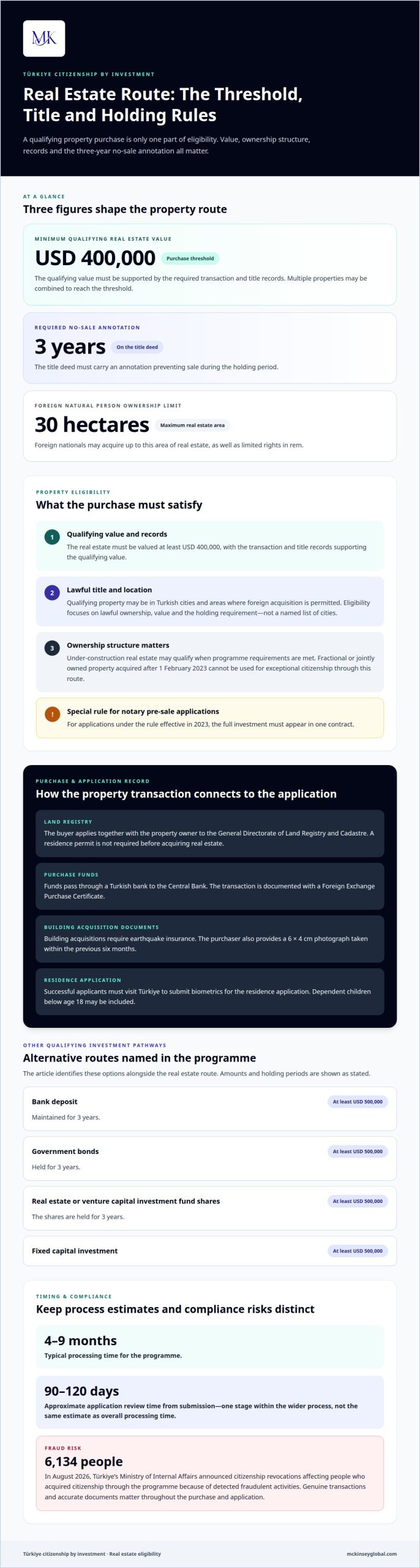
A qualifying purchase is real estate valued at least USD 400,000, supported by the required transaction and title records. This threshold matters because the property’s qualifying value, rather than its description alone, determines whether it can count toward the investment. Multiple properties may be combined to reach the threshold. For notary pre-sale applications under the rule effective in 2023, the full investment must appear in one contract.
Foreign nationals do not need a residence permit before acquiring real estate in Türkiye. The buyer applies to the General Directorate of Land Registry and Cadastre together with the property owner. A foreign natural person may acquire up to 30 hectares of real estate and limited rights in rem. The transaction therefore involves both a qualifying investment and compliance with foreign ownership limits.
Under-construction real estate may qualify when it meets programme requirements; its development stage alone does not exclude it. Fractional or jointly owned property acquired after 1 February 2023 cannot be used for exceptional citizenship through this route. These distinctions make the ownership structure and supporting document important, not just the purchase price.
Holding Period and Eligible Locations
The title deed must carry a no-sale annotation for three years. Eligibility is not limited to a named list of cities: qualifying real estate may be located in Turkish cities and areas where foreign acquisition is permitted. Focus on lawful ownership, qualifying value, and the required holding period rather than treating a particular city as a separate citizenship criterion.
Citizenship applications can include dependent children below age 18. Other investment routes include government bonds worth at least USD 500,000, held for three years. A real estate applicant may also qualify for a US E-2 Investor Visa after being domiciled in Türkiye for three years, but Turkish citizenship alone does not grant that visa or US residence rights.
What is the Turkish Citizenship by Investment Programme?
Türkiye’s programme allows eligible foreign investors to seek citizenship through approved investments. Article 12 of Law No. 5901 provides for this route, subject to a decision by the President of the Republic of Türkiye.
Purchase and Application Steps
The process links an eligible investment to land registry records and a citizenship application. For a property purchase, the buyer and owner apply together to the General Directorate of Land Registry and Cadastre. Building acquisitions require earthquake insurance, and the purchaser provides a photograph taken within the previous six months, sized 6×4 cm. Purchase funds pass through a Turkish bank to the Central Bank and are documented with a Foreign Exchange Purchase Certificate.
Applicant Eligibility and Family Inclusion
A foreign investor may apply through the property route or other qualifying investment categories. These include a bank deposit of at least USD 500,000, maintained for three years, or fixed capital investment of at least USD 500,000. Real estate investment fund or venture capital investment fund shares may also qualify at the same threshold, with a three-year holding period. An application may include dependent children below age 18.
Residence Permit and Application Processing
The investment-based residence permit referenced for citizenship eligibility appears in subparagraph (j) of the first paragraph of Article 31 of Law No. 6458. Successful applicants must visit Türkiye to submit biometrics for the residence application. The programme’s typical processing time is 4-9 months; application review takes approximately 90-120 days from submission. These are distinct stages within the wider procedure, rather than interchangeable estimates.
Fraud presents a material risk: in August 2026, Türkiye’s Ministry of Internal Affairs announced citizenship revocations affecting 6,134 people who acquired citizenship through the programme because of detected fraudulent activities. That action underscores why genuine transactions and accurate documents matter throughout the purchase and application.
For guidance on the Türkiye citizenship by investment route, consider how the property, transaction records and application requirements fit together.
Turkish citizenship through real estate investment
Türkiye’s investment program offers citizenship through property and several alternative investment routes. Compared with programs elsewhere, its defining feature is the combination of a real estate route and other qualifying investments, rather than one universal pathway.
Tax Residency and Tax Considerations
Turkish tax residency depends on physical presence, so citizenship and tax status are distinct considerations. The stated threshold is 183 days per year for avoiding Turkish tax obligations on foreign income. Investors should therefore consider where they live, not citizenship alone, when assessing potential tax exposure.
Gift and inheritance taxes are separate from investment eligibility and tax residency. The programme information does not establish specific gift or inheritance tax rates, so do not infer them from citizenship status. For planning, distinguish acquiring Turkish citizenship from the tax treatment of assets transferred during your lifetime or inherited later.
The real estate route is not the programme’s only option. Other qualifying investments include bank deposits, government bonds, real estate investment funds, venture capital investment funds and fixed capital investments, generally at a minimum of USD 500,000, held for three years. A private pension contribution may also qualify when it reaches USD 500,000 and remains in the system for at least three years. Contributions are made in Turkish lira, equivalent to the required USD amount.
Turkish Passport Travel Access
A Turkish passport provides visa-free or visa-on-arrival access to over 110 destinations. That access can support travel planning, although entry conditions remain destination-specific and may change. A Turkish passport is valid for 10 years for people aged 18 and older, and for up to 5 years for people under 18.
These travel arrangements are one outcome to weigh alongside investment eligibility and residence plans. The programme launched in January 2017, and citizenship through investment is subject to a decision by the President of the Republic of Türkiye. Passport access does not itself determine tax residency, inheritance treatment or eligibility under another country’s immigration rules.
How long must an investor hold Turkish real estate to qualify for citizenship?
Applicants must maintain the qualifying real estate investment for at least three years. The title deed must carry a no-sale annotation for the same period. This holding commitment is part of eligibility, not simply a post-application preference.
The annotation records the restriction on selling the property during the required period. Selling before that period ends would conflict with the no-sale commitment attached to the qualifying investment. The property’s role in the citizenship application therefore extends beyond purchase and valuation: ownership must continue to meet the programme’s retention condition.
Keep the investment period distinct from application processing. Türkiye’s citizenship application review is approximately 90-120 days from submission, while the real estate holding requirement lasts three years. Completing application review does not itself shorten that investment obligation. Planning should account for both stages, since they serve different purposes in the process.
The three-year period also matters when comparing property with other investment routes. Bank deposits, government bonds, real estate investment fund shares, venture capital fund shares, and qualifying private pension contributions each have their own three-year maintenance requirements. The qualifying asset differs, but retention remains central to each route. For property applicants, the title deed annotation documents that commitment.
Before proceeding, consider whether the required ownership period fits your plans for the asset. A property you intend to sell early may not suit a route requiring three years of retention. This is an important distinction between buying real estate to meet citizenship eligibility and purchasing property without that programme condition.
For guidance on the application and investment requirements, discuss Türkiye citizenship by investment with the advisory team.
McKinsey Citizenship and Residency Solutions: Antigua and Barbuda Citizenship by Investment
McKinsey Citizenship and Residency Solutions guides individuals considering citizenship and residency by investment, including Antigua and Barbuda Citizenship by Investment. If Türkiye’s property route does not align with your objectives, the firm can help you explore this alternative alongside options like Greece Residency by Investment or Dominica.
The right pathway depends on your priorities, programme requirements, and wider plans. A discussion can clarify which available option merits closer consideration, without assuming that one programme suits every applicant.
Contact McKinsey Citizenship and Residency Solutions to discuss your investment citizenship or residency objectives.
Set Your Investment Decision in Context
Before committing to a property, consider how the investment fits your plans for residence, family mobility, and asset ownership. The question is not only whether a purchase can support an application, but also whether the property and required holding period suit your intended use of capital.
A structured review of your objectives can clarify which questions to address first, from ownership arrangements to citizenship’s role in your long-term plans. This keeps the turkey citizenship real estate investment decision grounded in programme requirements and personal priorities.
For a broader discussion of citizenship and residency pathways, connect with McKinsey Citizenship and Residency Solutions. A considered next step can bring greater clarity to your options and help you proceed with confidence.
Frequently Asked Questions
What is the minimum real estate investment required for Turkish citizenship in 2026?
The minimum qualifying real estate investment is USD 400,000. The relevant amount must be supported by the property valuation and transaction documentation used for the application. For example, an investor considering several properties should assess whether their combined qualifying value reaches the threshold and whether their ownership structure is eligible. The investment must also meet the programme’s retention conditions.
What property types qualify for Turkish citizenship by investment?
Qualifying real estate may include completed or under-construction property, provided it meets the programme’s requirements. Multiple properties may count toward the investment value. However, fractional or jointly owned property acquired after 1 February 2023 cannot be used for exceptional citizenship through this route. The property’s development status alone does not determine eligibility; qualifying value, ownership, and the required title registration also matter.
What are the property valuation and title deed requirements for Turkish citizenship?
The qualifying property value must reach at least USD 400,000, and the title deed must carry a no-sale annotation for three years. The purchase funds are converted or sold through a Turkish bank to the Central Bank, with a Foreign Exchange Purchase Certificate documenting the exchange. These records connect the valuation and payment trail to the registered property, helping establish that the investment meets the programme conditions.
Can family members be included in a Turkish citizenship by investment application?
Yes. An applicant may include dependent children below the age of 18 in a Turkish citizenship-by-investment application. For a family with children of different ages, the age condition applies to each dependent child included. Family inclusion is separate from the property’s eligibility: the investment must satisfy its own value, ownership, and holding requirements while the application identifies the eligible family members.
What are the steps and processing time for Turkish citizenship through real estate investment?
The process links the property transaction to land registry documentation, the required investment records, a residence application, and the citizenship submission. Applicants must visit Türkiye to provide biometrics for the residence application. The typical programme processing time is 4-9 months, while citizenship application review is approximately 90-120 days from submission. These timeframes describe different points in the process, not a single guaranteed completion date.
What taxes, fees, and legal costs apply to buying property for Turkish citizenship in Turkey?
Tax exposure and transaction costs depend on the purchase and the investor’s circumstances; no single total applies to every acquisition. Tax residency depends on physical presence, while the treatment of foreign income is a separate consideration from the property purchase. The real estate investment threshold does not represent total transaction expenses, so assess purchase-related charges, tax treatment, and professional costs separately.