
If you’re asking “what happens if my CBI application is rejected,” the next step depends on the jurisdiction, the reasons stated in the decision, and the procedures available under that country’s rules. A refusal is not automatically the end of every possible route, but there is no universal process for challenging or replacing a rejected application.
It is understandable to be concerned about why the application was refused, how much time has been spent, and what may happen to fees or investment funds. A refusal may also affect future applications, where previous decisions may need to be disclosed. Depending on the program, clarification, reconsideration, an appeal, or a new application may be possible. None should be assumed without checking the applicable rules.
This 2026 guide explains how to read a refusal, identify procedural options, and make a measured decision about next steps. It also covers common areas of concern and shows how to review the decision and supporting documents before pursuing another application.
Key Takeaways
- Separate a formal refusal from a withdrawal or a request for more information. Each status can have different consequences.
- Compare the decision with the application record to identify possible issues, such as incomplete or inconsistent documents, without assuming a particular ground applies.
- Assess clarification, reconsideration, appeal, and reapplication separately. Check each route’s purpose, decision-maker, and program rules.
- Keep the refusal notice, note relevant dates, and build a timeline that distinguishes documented facts from assumptions.
- Use a program-specific review to organize unanswered questions and assess whether the concern relates to evidence or broader eligibility.
What happens if your CBI application is rejected?
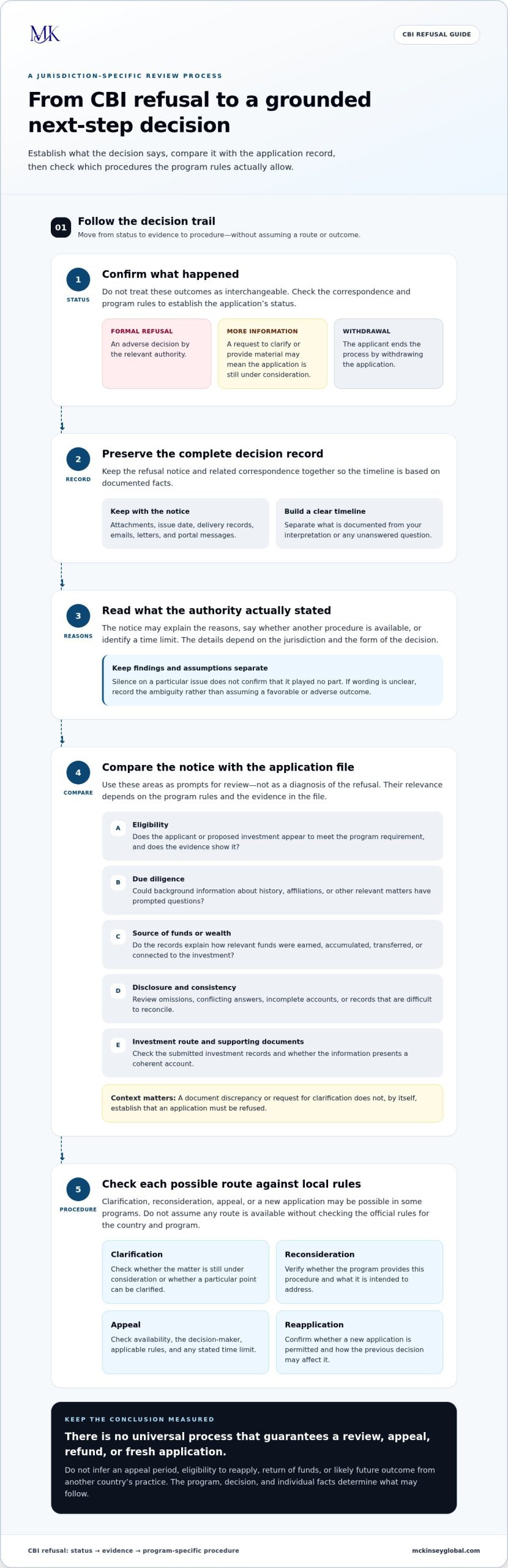
If your citizenship-by-investment application is refused, the consequences and available procedures depend on the program, the decision itself, and the rules governing that route. There is no universal process that guarantees a review, appeal, refund, or fresh application. To answer “what happens if my CBI application is rejected,” first establish the decision’s status and read the reasons given.
A refusal differs from withdrawing an application or receiving a request for more information. A request to clarify a document or provide missing material may mean the application is still under consideration. Withdrawal ends the process by the applicant’s action, while refusal is an adverse decision by the relevant authority. Do not treat these statuses as interchangeable. The correspondence and program rules should clarify which applies.
What a refusal decision may tell you
The decision notice is the starting point for understanding what happened and what may follow. Depending on the jurisdiction and the form of the decision, it may state the reasons for refusal, say whether the matter is closed or subject to another procedure, and identify a review route or time limit. Reasons may be limited, so silence on a particular issue does not confirm that it played no part.
Keep the complete notice, including attachments, the date it was issued, and records showing when and how it was delivered. Store related emails, letters, and portal messages with it. These records help establish the timeline and distinguish a final refusal from a pending application or a request for more evidence.
Separate what the authority expressly states from your own interpretation. A request for updated financial records, for example, is not necessarily a refusal. Conversely, a written decision refusing the application is not simply an invitation to submit more documents. If the wording is unclear, record the ambiguity rather than assuming a favorable or adverse outcome.
Why the country and application route matter
Citizenship-by-investment authorities operate under jurisdiction-specific laws and administrative procedures. The general overview of Citizenship by Investment programs can help explain how these routes differ, but it cannot establish the rights or deadlines attached to a particular decision. Check those against the official rules for the country and program involved.
The investment route, the applicant’s circumstances, and whether family members were included may all affect how a decision is framed and which procedural questions arise. A decision concerning one applicant may not automatically determine the position of every family member named in the application. Read the notice and program rules together, noting whose application was refused and whether the decision addresses each person.
Do not assume an appeal period, eligibility to reapply, return of funds, or likely outcome on a later application based on another country’s practice. First establish the decision’s status, then identify the official procedure and any time limits that apply in that jurisdiction.
Why can a citizenship-by-investment application be refused?
A refusal can arise from different issues. The reason in one case should not be treated as a rule for every applicant or program. Possible areas of concern include eligibility, due diligence, source-of-funds evidence, accuracy of disclosures, and compliance with the selected investment route. Refusal grounds and their consequences depend on the program authority and the facts of the individual application.
These categories are prompts for reviewing the decision, not findings about your case. Compare the notice with the program requirements and the information submitted. Incomplete or inconsistent records may lead the authority to request clarification. Depending on the rules and circumstances, they may also contribute to an adverse decision. A document issue alone does not establish that an application must be refused.
Documentation, eligibility, and due-diligence concerns
An application may contain records created at different times by different institutions. Identity documents, family details, financial records, and investment documents should present a coherent account. Differing name spellings, unexplained changes in an address history, or financial figures that are difficult to reconcile may prompt questions. Assess each discrepancy in context rather than treating it as conclusive on its own.
- Eligibility: The applicant or proposed investment may not appear to meet a program requirement, or the submitted evidence may not clearly demonstrate that it does.
- Due diligence: Background checks may raise questions about an applicant’s history, affiliations, or other information relevant under the program’s criteria.
- Source of funds or wealth: The records may not sufficiently explain how the relevant funds were earned, accumulated, transferred, or connected to the investment.
- Disclosure and consistency: An omission, conflicting answer, or incomplete account of relevant circumstances may affect the authority’s assessment.
These are illustrative categories, not a diagnosis of a particular refusal. Their relevance and significance depend on the governing rules and the evidence in the file.
How to read the authority’s stated reasons
Start with what the written notice actually says. Separate its express findings from assumptions, informal explanations, or conclusions drawn from events during processing. If the authority refers to a discrepancy, identify the specific record and response at issue. If it cites an eligibility concern, note the requirement it names. This helps pinpoint unanswered questions without overstating the decision.
Build a timeline that links the application materials, requests for clarification, your responses, and the decision date. Match each stated reason to the relevant documents, and record gaps without trying to fill them through speculation. If the notice involves sensitive allegations, legal issues, or reputational concerns, handle the matter confidentially and seek a careful, case-specific review before responding or making further disclosures.
If you’re asking “what happens if my CBI application is rejected,” understanding the stated ground is an essential step before weighing procedural options. Investment migration application guidance can help organize the decision record and distinguish an evidence concern from a broader eligibility question without presuming a particular outcome.
Appeal, review, or reapplication: which routes may be available?
After a refusal, several procedural routes may be worth examining, but they are not interchangeable and may not all be available. The appropriate option depends on the decision’s status, the authority’s rules, and the issue identified. Before acting, confirm each route’s purpose, who decides it, what it can consider, and any filing requirements or deadline in the official rules for that jurisdiction.
- Clarification: This may be relevant if the notice is unclear or the authority has requested more information. Establish whether the application remains open and which office can receive a response.
- Reconsideration: Where the rules provide for it, this may ask the original authority or another designated official to revisit a decision. Check whether it can address new evidence, an alleged factual error, or only specified matters.
- Appeal or formal review: This may allow a reviewable decision to be examined for disputed findings or procedural errors. Confirm who has jurisdiction, whether the particular refusal is eligible, and what issues the process can consider.
- New application: This is a separate submission, not necessarily a way to reverse the original refusal. Confirm whether reapplication is permitted, what needs to change, and how the earlier decision must be disclosed.
A route may be unavailable, time-limited, or unsuitable for the decision. “Appeal,” “review,” and “reconsideration” can have distinct meanings under a program’s rules. Use the procedure specified by the relevant authority rather than assuming one process applies across countries.
When a review or appeal may be relevant
A review or appeal may be relevant where the rules allow a challenge and the applicant can identify an issue that the process can examine, such as an alleged procedural error or a disputed finding. This does not mean the authority will change its decision. Before choosing this route, check the official jurisdiction rules for eligibility, filing format, supporting material, deadline, and scope of review.
When a fresh application may be considered
Reapplication may depend on the refusal grounds, program rules, and whether circumstances or evidence have materially changed. Addressing a document gap is different from resubmitting the same case unchanged. Neither approach guarantees approval or reverses the earlier decision. If considering another investment route, assess how a donation-versus-real-estate strategy relates to that program’s requirements and your circumstances.
When assessing what happens if my CBI application is rejected, compare possible routes with the written reasons and official procedure, then document why a particular next step is appropriate. An investment migration adviser can help organize this assessment and map the options without presuming an outcome. Structured application guidance can support a reasoned review of the decision record.
What should you do immediately after a CBI refusal?
After receiving a refusal, secure the record, establish the relevant dates, and verify the procedures that may apply before choosing a response. Let the decision notice and governing program rules guide your next step. Do not rely on assumptions about appeal rights, deadlines, or the treatment of payments based on another program’s process.
Build a complete record before deciding
Keep the original notice and all attachments, then assemble the application materials and correspondence in one secure file. A complete record makes it easier to distinguish the authority’s stated reasons from your interpretation and identify which documents may matter to a possible next step.
- Preserve the decision: Save the notice in its original form, record its issue and delivery dates, and retain the email or portal record through which it arrived.
- Gather the application file: Collect forms, supporting evidence, submission confirmations, correspondence, and every request for more information, together with the responses sent.
- Record key dates: Create a timeline of submissions, authority communications, responses, and the decision. Keep copies of the records as submitted, and do not alter originals while organizing them.
- Map each stated reason: For every ground expressly identified in the notice, note the relevant passage and related documents. Mark missing information or discrepancies as questions, not proven explanations.
- Verify the procedure: Review official program rules promptly for any filing deadline, review right, response requirement, and stated treatment of payments. Do not assume a refund or a particular financial outcome.
Separate confirmed facts, such as a submission date shown on a receipt, from assumptions about why the authority reached its decision. If a point is unclear, label it unresolved and identify which document or rule could clarify it. A disciplined record helps prevent an informal explanation from being mistaken for the formal ground of refusal.
Assess the next step with structured advice
An investment migration adviser can help organize the decision grounds, compare potential procedural routes, and identify unanswered questions against the relevant program rules. This review can distinguish a possible evidence gap from a broader eligibility concern while keeping the analysis grounded in the record rather than assumptions about what the authority considered.
The firm’s Golden Visa advisory services article offers a related example of guidance in an investment-residency context. A Golden Visa route is distinct from citizenship by investment, but both require a careful review of program requirements and supporting materials. Advice on a refusal should remain specific to the jurisdiction, decision, and application route.
Once the record is assembled, a structured review can turn uncertainty into a documented next-step plan. Discuss your investment migration next steps with the decision notice, application record, and relevant dates available for review.
How can an investment migration adviser help after rejection?
A refusal can leave important questions unresolved: which findings matter, whether a procedural route is available, and whether a different application strategy merits consideration. An investment migration adviser can organize the decision record, identify points that need clarification, and map potential next steps against the relevant program rules. This is structured guidance, not a guarantee of approval, a successful appeal, or any particular outcome.
For applicants asking “what happens if my CBI application is rejected,” program-specific analysis matters. An adviser can compare the authority’s stated grounds with the submitted evidence to distinguish a potentially remediable documentation issue from a broader eligibility concern. That distinction can inform a reasoned plan, while any formal remedy remains subject to the applicable rules and authority.
What a structured case review should cover
A useful review begins with the refusal notice, application history, submitted materials, and relevant correspondence, considered alongside the applicant’s stated objectives. It should identify the procedural questions that need attention, including which rules and deadlines require current, authoritative verification. The adviser can then compare available routes and their practical implications, setting out what is known, what remains uncertain, and what each option may involve without predicting the result.
The review should preserve important distinctions. A missing or unclear record may call for further evidence, while an eligibility concern may require a different analysis. Where the notice does not fully explain an issue, the adviser can identify the information gap instead of presenting an inference as an established reason. The result should be a documented assessment that supports informed decisions, not an assumption that every refusal can be reversed.
Plan beyond the immediate decision
The refusal is important, but it may not define the applicant’s longer-term objectives. Depending on the circumstances and applicable program rules, an assessment can consider whether to pursue a permitted review, prepare a new application, or evaluate another investment migration pathway. Any alternative requires its own eligibility and due-diligence assessment. Changing routes does not remove the need for accurate disclosures or guarantee approval.
For readers whose objectives include Antigua and Barbuda, the Antigua and Barbuda investment options guide can be a starting point for considering that pathway alongside broader citizenship goals. The appropriate route depends on the applicant’s circumstances and current program requirements, so compare options carefully rather than assuming another program will lead to a different decision.
McKinsey Citizenship and Residency Solutions provides investment migration advisory and application guidance across citizenship and residency pathways. A confidential assessment can help organize the decision, clarify procedural questions, and establish a practical next-step plan. Request an investment migration consultation to discuss your circumstances and objectives.
Turn the decision into a considered next move
A refusal can change the route, but it need not define the wider objective. Consider how any next step aligns with your priorities, circumstances, and tolerance for further procedural uncertainty. Before committing to another application or pathway, clarify which outcome matters most and what evidence or change would make a future course meaningfully different.
If “what happens if my CBI application is rejected” remains central to your planning, use the decision as a reason to reassess carefully rather than act on assumptions. A confidential discussion can place the immediate decision within your broader citizenship or residency objectives and help identify a practical direction without promising a particular result.
McKinsey Citizenship and Residency Solutions advises on investment-based citizenship and residency pathways, with application guidance and management across the Caribbean, Europe, and the Middle East. Discuss your investment migration options with an adviser to consider a measured next step. Clear priorities can help you move forward with greater confidence.
Frequently Asked Questions
Can I reapply for citizenship by investment after my application is rejected?
Possibly, but permission to reapply and any conditions depend on the program rules and the reason for refusal. Before preparing another submission, identify what would be materially different. For example, if the notice points to an unclear financial transaction, a new application may need a clearer documentary trail rather than the same records resubmitted. Disclose the previous refusal wherever required, and verify whether it affects eligibility for the route you are considering.
Can I appeal a citizenship-by-investment rejection?
Possibly, if the relevant program provides a procedure that applies to your decision. An appeal may be limited to specified grounds or types of decision, so distinguish it from a request for clarification or reconsideration. A disagreement about how a submitted document was assessed, for example, may raise a different question from a concern about whether the authority followed its procedure. Check the official rules before choosing a route or preparing a filing.
How long do I have to challenge a CBI application rejection?
There is no single deadline for every citizenship-by-investment program. If a challenge is available, the period depends on the jurisdiction, decision type, and procedure. Read the notice promptly and compare any stated date with the current official rules. Verify how the deadline is calculated and how a filing must be delivered. If the notice is silent, do not assume there is no time limit.
Will I get my investment or application fees back if my CBI application is rejected?
A refund is not automatic. Due-diligence and agency fees are typically non-refundable, while the primary investment is usually made only after approval. The applicable program rules and signed agreements determine the treatment in an individual case. Review the payment schedule, receipts, and refund terms to establish which sums were paid, to whom, and under what conditions. Do not treat a general practice as a promise of reimbursement.
Does a CBI rejection prevent me from applying to another citizenship program?
Not necessarily, but another program may ask about prior refusals, and the decision could be relevant to its assessment. Answer disclosure questions accurately, even if the earlier application involved a different country or investment route. A new application form, for example, may ask broadly about immigration or citizenship refusals rather than only refusals from that jurisdiction. Review the exact wording and applicable rules before submitting, and do not assume a prior decision is immaterial.
Can a rejected CBI application affect my spouse or dependants?
It may affect a family application, but the impact depends on how the program treats the principal applicant and each included family member. Check whether the refusal notice names only you or also addresses your spouse or dependants, and review any separate correspondence issued for them. If a family member was included in the file, do not assume their application status is identical to yours. Establish each person’s position from the official records.
What documents should I review after receiving a CBI refusal?
Review the refusal notice and attachments alongside the submitted application forms, supporting evidence, authority requests, and your responses. Include submission confirmations and correspondence that clarifies what was provided and when. If the notice refers to a financial record, for example, compare the exact version submitted with any later explanation or replacement. Keep original files intact, and note which documents support a stated finding and which questions remain unresolved.