
What matters most in an Antigua vs St Lucia passport comparison is not necessarily the headline ranking. Travel-access counts vary by source and date, and visa-free entry never guarantees admission. Citizenship also does not automatically determine where you live or how you are taxed, so assess passport benefits separately from residence and tax considerations.
Both countries offer investment-based citizenship, but their program routes, family eligibility, residency obligations and travel conditions differ. In 2026, St Lucian passport holders require a visa to enter the United Kingdom, while Antigua and Barbuda citizenship carries a 30-day stay requirement over the first five years. This comparison looks at travel rights, program structure and practical family considerations. Use it to assess each option against your priorities and identify a considered next step, with support from an advisory firm that works with applicants pursuing both citizenship pathways.
Key Takeaways
- The Antigua vs St Lucia passport comparison is most useful when you assess access to destinations you actually travel to, rather than relying on one ranking.
- Distinguish citizenship pathways from passport travel privileges: they answer different questions about your long-term plans.
- Compare each program’s current route categories and family provisions with your circumstances, using official program materials.
- Before forming a preference, weigh travel priorities, family profile, preferred investment route and future plans.
- McKinsey Citizenship and Residency Solutions advises on both pathways and supports applicants through consultation, application processing and management.
Antigua vs St Lucia Passport: What Is Being Compared?
An Antigua vs St Lucia passport comparison brings together two related but distinct questions: how an investor may qualify for citizenship under each country’s investment-based program, and what travel access a passport issued after citizenship provides. Assess them separately. Program rules govern the citizenship application; destination governments set the entry conditions for travellers.
A passport ranking often reduces a complex decision to a destination count. That count may not distinguish visa-free entry from a visa on arrival or an electronic travel authorization. It also does not account for your family’s eligibility, preferred program route or long-term plans. A higher reported total alone cannot show which citizenship pathway is more suitable.
In brief: citizenship is a person’s legal nationality; a passport is a travel document issued to a citizen; immigration permission is authorization to enter or remain in another country under that destination’s rules. A passport may simplify travel, but it does not guarantee admission or give you the right to reside elsewhere.
What does “Antigua vs St Lucia passport” mean for investors?
For investors, the comparison concerns nationality sought through the investment-based citizenship pathways of Antigua and Barbuda and Saint Lucia, not simply the merits of the islands as holiday destinations. A preference for one country’s climate or scenery may inform personal interest, but it does not determine which program’s current requirements, route structure or family provisions fit an applicant’s circumstances.
Citizenship and passport issuance follow the applicable program and government procedures. Approval under a pathway and possession of a travel document are connected stages, but they are not interchangeable. For general country context, the Antigua and Barbuda Wikipedia page describes the country’s geography, history and political structure. Program decisions, however, require current official materials rather than general background sources.
Why can passport comparisons change over time?
Destination entry policies can change independently of citizenship-program rules. A country may revise its visa policy, introduce an electronic authorization requirement or change the conditions for short visits. For each destination, note the date checked and consult current government or destination-country guidance. A passport count without that context is a snapshot, not a lasting measure.
Read access categories precisely:
- Visa-free: a visa is generally not required for a qualifying visit, subject to applicable conditions.
- Visa on arrival: a traveller applies for or receives a visa at the destination’s point of entry.
- Electronic travel authorization: advance electronic permission may be required before travel, even when a conventional visa is not.
None of these categories guarantees admission at the border. Treat them as indicators of travel procedure, then compare them with your actual destinations and plans. This gives you a more useful basis for comparing both the passports and the citizenship pathways behind them.
What Do Antigua and Saint Lucia Passports Offer for International Travel?
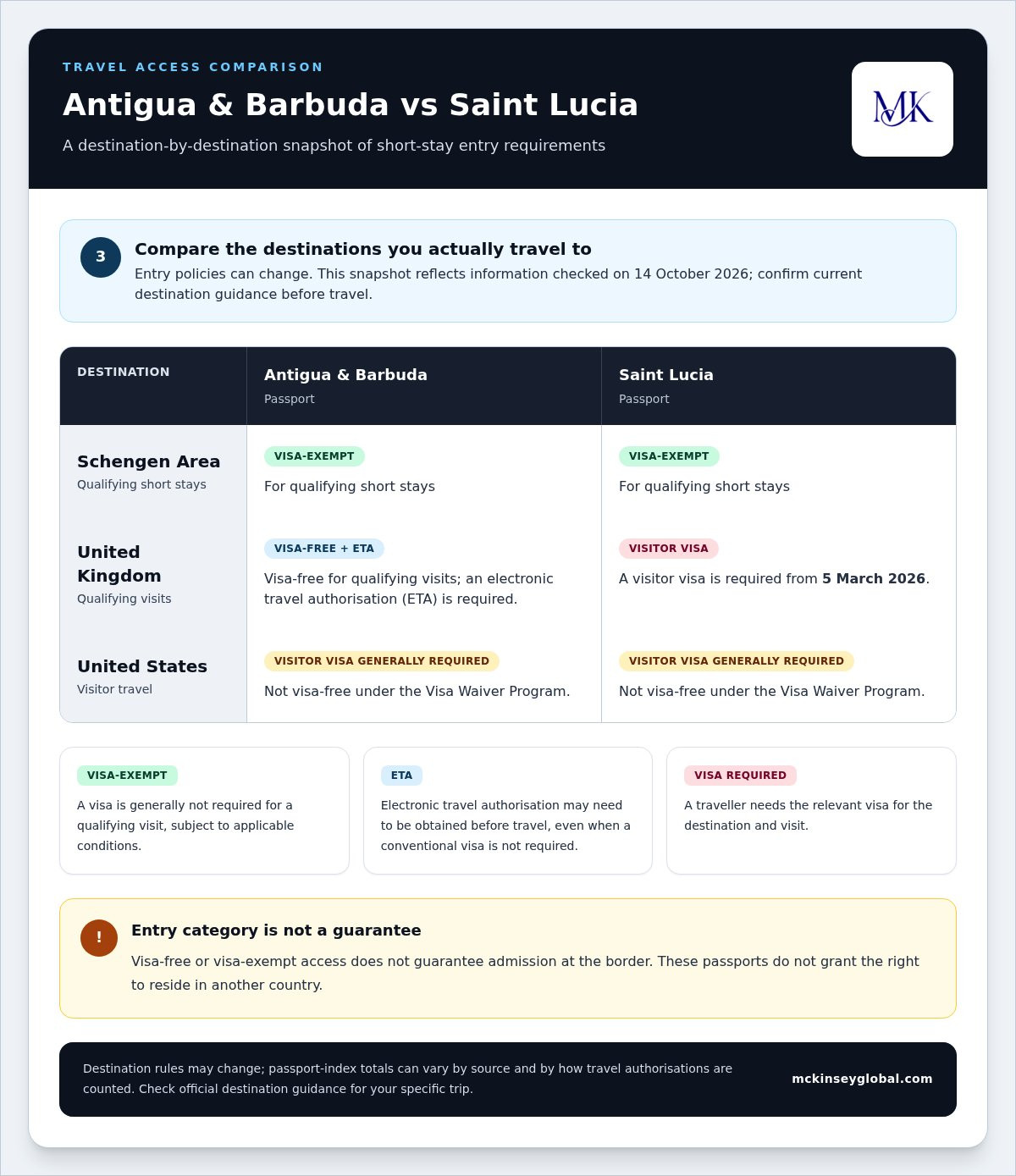
Compare travel access destination by destination rather than relying on a single passport-strength score. The table below reflects information available as of 14 October 2026. Entry rules can change, so recheck official destination guidance before booking. “Visa-free” describes an entry category, not a guarantee of admission or permission to live in the destination.
| Destination | Antigua and Barbuda passport | Saint Lucia passport | Official source checked |
|---|---|---|---|
| Schengen Area | Visa-exempt for qualifying short stays | Visa-exempt for qualifying short stays | European Commission short-stay visa policy, checked 14 October 2026 |
| United Kingdom | Visa-free for qualifying visits; an electronic travel authorisation (ETA) is required | Visitor visa required from 5 March 2026 | UK government visitor visa and ETA guidance, checked 14 October 2026 |
| United States | Visitor visa generally required; not visa-free under the Visa Waiver Program | Visitor visa generally required; not visa-free under the Visa Waiver Program | U.S. Department of State visitor visa and Visa Waiver Program guidance, checked 14 October 2026 |
This is a dated snapshot, not a promise of future access. Destination-access totals change as entry rules change, and sources may count different travel authorizations in different ways. Treat third-party passport-index totals as estimates, not permanent entitlements. Even when a visa is not required, a border authority may assess a traveller’s circumstances and decide whether to admit them. Neither passport grants residence rights in another country.
How should readers interpret visa-free access and destination counts?
Visa-exempt short-stay entry generally allows a qualifying traveller to visit without obtaining a visa in advance, subject to the destination’s conditions. It differs from a visa on arrival, which involves a visa procedure at the border, and from an ETA, which must be obtained electronically before travel. For a specific trip, check the European Commission or relevant destination-government guidance, and record the date. These sources are more useful than an undated aggregate ranking.
Do either passports provide visa-free entry to the United States?
Neither passport, by itself, provides visa-free visitor entry to the United States. Travellers generally need to apply for the appropriate visitor visa, and a visa does not guarantee admission: entry remains subject to U.S. inspection. The research available for this comparison also notes restrictions affecting some new Antigua and Barbuda applicants, so individual circumstances matter. For program context, consult the Official Antigua and Barbuda Citizenship by Investment Program. For a personal comparison of both citizenship pathways, McKinsey Citizenship and Residency Solutions supports applicants through consultation and application management.
How Do Antigua and Saint Lucia Citizenship Programs Compare?
For investors, the comparison goes beyond passport access. Consider the qualifying route, how any investment or contribution is treated, which family members may apply, and the steps involved in reaching a decision. Program rules can change, so use the route categories below as a comparison framework, not a substitute for current official terms. Verify each route and eligibility detail against the relevant government program materials before deciding.
| Comparison point | Antigua and Barbuda | Saint Lucia |
|---|---|---|
| Route categories to examine | National Development Fund contribution, University of the West Indies Fund, approved real estate, and eligible business investment | National Economic Fund contribution, government bonds, approved real estate, and enterprise projects |
| Terms to compare | Contribution or investment conditions, holding period where applicable, and route-specific requirements | Contribution or investment conditions, holding period where applicable, and route-specific requirements |
| Family and application rules | Check current dependant definitions, evidence requirements, and application stages in official program materials | Check current dependant definitions, evidence requirements, and application stages in official program materials |
Which investment route categories should applicants compare?
The route names describe different structures, not equivalent terms. A contribution is not the same as an investment in property, a business, bonds or an enterprise project. Compare what each route requires, whether capital must be held for a defined period, and what conditions govern its treatment at the end of that period. Do not assume that a property or financial instrument is suitable just because it appears in a program category.
Quotable distinction: A contribution is non-refundable unless the official terms state otherwise; investment capital is refundable only where the applicable route’s verified conditions provide for its return. Check this distinction route by route rather than inferring it from labels such as “bond” or “real estate.” Saint Lucia’s Official Saint Lucia Citizenship by Investment Programme is a primary reference for its current route descriptions and application information.
How do family eligibility and application requirements differ?
Family definitions are jurisdiction-specific and may depend on the relationship, circumstances and supporting evidence required under the current rules. Do not assume a dependant who qualifies under one program will qualify under the other, or rely on age limits and family categories copied from an undated third-party summary. Review the official materials for every proposed family member before comparing your application profile.
Compare application stages as well. Confirm the current sequence for preparing and submitting an application, completing required checks or interviews, receiving a decision and proceeding to passport issuance. Each jurisdiction assesses documentation and qualifications under its own rules; a complete file for one pathway does not automatically satisfy the other.
McKinsey Citizenship and Residency Solutions advises on both pathways and supports application processing and management. Applicants can use a structured comparison to align route terms and family circumstances before proceeding. The Antigua vs St Lucia passport decision is strongest when based on current official rules and your objectives, not assumptions about which route sounds more familiar.
How Can You Decide Which Caribbean Passport Fits Your Priorities?
Start with your travel patterns, family circumstances and preferred investment structure, not a race to select the passport with the largest reported destination count. Compare each pathway in the same order. The result should be a shortlist for further review, not a universal verdict on which citizenship is superior.
- Map your actual travel needs. List the countries you visit regularly or expect to visit, then check each passport’s current entry conditions using official destination guidance. Give more weight to destinations that matter to your work, family or personal plans than to places you are unlikely to visit. A higher reported count may include different entry categories and does not establish that a passport better serves your itinerary.
- Assess your family profile. Identify the relatives you may want to include and compare their circumstances with each program’s current dependant definitions. Note any relationship, identity or other supporting documents that may be required. Evaluate each family member against each program’s rules; eligibility in one jurisdiction does not carry over to the other.
- Compare route preferences and obligations. Decide whether you are more comfortable considering a contribution or an investment route, then examine the relevant terms, holding obligations and conditions separately. If a particular structure is central to your decision, review the Antigua and Barbuda investment options guide for route-specific context. Verify current details against official program materials before relying on them.
- Set out your long-term plans. Consider how citizenship may fit your plans for travel, family and future flexibility. Citizenship planning is not the same as tax-residence planning: tax residence depends on applicable rules and personal circumstances, and a second passport alone does not determine it. Assess these questions separately rather than treating citizenship as a tax outcome.
When might one program align more closely with your objectives?
A route preference can affect fit. For example, an applicant who strongly prefers one program’s current qualifying structure may find that pathway more consistent with their priorities, provided they meet its requirements and accept its terms. A family whose circumstances fit one jurisdiction’s dependant rules more readily may also have a clearer basis for comparison. These are conditional considerations, not a claim that one passport is best for every investor.
If your review expands to another Caribbean option, the St. Kitts and Nevis citizenship guide can help you place that pathway alongside your initial comparison. McKinsey Citizenship and Residency Solutions is an independent boutique advisory firm that supports applicants considering Antigua and Barbuda and Saint Lucia through consultation, application processing and management. Discuss your citizenship pathway priorities after defining your criteria.
What Are the Next Steps for Comparing Antigua and Saint Lucia Citizenship?
There is no universal winner in the Antigua vs St Lucia passport comparison. The more useful question is which citizenship pathway fits your travel priorities, family circumstances, preferred investment structure and longer-term plans. Before deciding, use current official program materials to verify route terms, eligibility and documentation requirements, and destination-country guidance for the entry rules that matter to you. Record the date and source for each finding so older research is not mistaken for current guidance.
What information should applicants organize before planning?
A preliminary review is more useful when your priorities and records are organized. Prepare the following information for comparison; requirements depend on the relevant program and individual circumstances.
- Travel priorities: Note the destinations you visit or expect to visit, then record each passport’s current entry conditions and the source date.
- Family composition: Identify the relatives you may wish to include, with relevant relationship details, and compare each person with the current program definitions.
- Investment preferences: Set out which route structures you are prepared to consider, along with any holding conditions or other terms that may affect your decision.
- Timing considerations: Record personal or family planning factors that could influence when you want to proceed, without assuming a program outcome or processing schedule.
- Supporting records: Organize identity documents and relevant family or financial records for a preliminary assessment, then map them against current official application requirements.
Keep a comparison file with separate entries for Antigua and Barbuda and Saint Lucia. For each route, note the official source, date reviewed, eligibility points, required records and questions that remain. Use the same method for destination-access research. This makes differences easier to identify and prevents a passport ranking or undated summary from carrying more weight than the underlying rules.
How can professional guidance support a program decision?
After your independent research, an adviser can help organize your objectives against both program frameworks, identify the route terms and family rules relevant to your circumstances, and support application processing and management. This is advisory support, not a promise of approval or a guaranteed result. Decisions remain subject to applicable program and government procedures.
McKinsey Citizenship and Residency Solutions is an independent boutique advisory firm, separate from McKinsey & Company, that advises on investment-based citizenship pathways in Antigua and Barbuda and Saint Lucia. If you have organized your priorities and want a structured discussion of how they align with the two programs, you can discuss your citizenship objectives with the firm.
Move From Comparison to a Clear Plan
Turn broad priorities into decision criteria: identify what matters most, note unresolved questions, and use current program or destination guidance to answer them. This gives you a practical foundation for weighing the Antigua vs St Lucia passport options against your circumstances, rather than relying on a headline ranking to decide for you.
McKinsey Citizenship and Residency Solutions advises on both Antigua and Barbuda and Saint Lucia pathways, with support spanning consultation, application processing and management. A discussion can help organize your objectives against the relevant program frameworks without treating any outcome as assured.
Discuss your citizenship objectives with our advisory team and take the next step with greater clarity.
Frequently Asked Questions
Is the Antigua passport stronger than the Saint Lucia passport?
There is no universal winner: the stronger passport depends on your destinations and travel pattern. Compare the rules for countries you visit regularly and note whether each requires a visa, electronic authorization or a visa on arrival. An Antigua vs St Lucia passport assessment should focus on those practical needs. Treat rankings and destination totals as dated reference points, not guarantees of entry or admission.
Can citizens of Antigua and Barbuda or Saint Lucia travel to the United States without a visa?
Do not assume either passport provides visa-free entry to the United States. A traveller may need to apply for the appropriate visa, and visa issuance is separate from the decision to admit someone at the border. Before booking, review current U.S. government guidance for the traveller’s nationality, purpose and circumstances. A second passport does not guarantee that a visa will be issued or that the traveller will be admitted.
Can a person hold both an Antigua and Barbuda and a Saint Lucia passport?
Both Antigua and Barbuda and Saint Lucia permit dual citizenship, but whether you can acquire and retain both nationalities also depends on your existing nationality and the rules that apply to you. A passport is evidence of citizenship, not proof that every relevant country recognizes multiple citizenships. Before pursuing both, review current official rules and obtain individualized legal advice, particularly if your present nationality restricts acquiring another citizenship.
Do Antigua and Saint Lucia citizenship programs include family members?
Both programs may allow family members to be considered, but eligibility is assessed under each jurisdiction’s current rules. List each relative you hope to include and document their relationship to the main applicant. Then compare those details with the official definitions and supporting-record requirements for both programs. A general description such as “family-friendly” cannot establish that a particular relative qualifies or that the required evidence is sufficient.
Does an Antigua or Saint Lucia passport automatically make its holder a tax resident?
No. Citizenship and tax residence are separate matters, and holding either passport does not alone determine where you are tax resident. The assessment may depend on residence, personal ties, income and the rules that apply across relevant jurisdictions. For example, a person with homes or income in more than one country may need to consider several sets of rules. Obtain qualified tax advice before making citizenship decisions on the assumption of a particular tax outcome.
How often should visa-free access information for these passports be checked?
Check current access rules close to travel and whenever a specific destination is central to your citizenship decision. For a family trip, review entry requirements for every traveller and the trip’s purpose rather than relying on an older comparison. Destinations may apply different procedures, including visa exemptions, electronic authorization or visas on arrival. Use official destination-government information, record the date checked and review it again before departure.
Does citizenship by investment guarantee that an application will be approved?
No. An application remains subject to applicable program rules, government review, required documentation and individual assessment. Satisfying a stated investment or eligibility condition does not assure approval. Treat the process as a formal application: provide accurate information, organize supporting records and follow current official instructions. If circumstances change or a document is unclear, resolve the issue through appropriate professional guidance before submitting rather than assuming it will not affect the assessment.