The acquisition of a Tier-1 Caribbean passport has transitioned from a mark of prestige to a fundamental requirement for the modern, risk-conscious investor. You likely recognize that as global volatility increases, the necessity for unrestricted mobility and a secure hedge against domestic instability becomes paramount. It’s clear that the recent 2026 regulatory shifts and the implementation of the CARICOM Memorandum of Agreement have introduced layers of complexity that demand professional scrutiny. Choosing the wrong path can lead to significant delays or exposure to non-compliant real estate projects.
This comprehensive guide provides a meticulous analysis of the four statutory antigua and barbuda investment options; it ensures your capital is deployed into government-approved pathways that strictly adhere to the latest international compliance standards. We will evaluate the National Development Fund, the University of the West Indies Fund, approved real estate projects, and direct business investments to determine which route offers the most robust alignment with your long-term wealth preservation goals. By examining the updated pricing structures and mandatory due diligence requirements, we provide the clarity needed to secure your global future with confidence.
Key Takeaways
- Understand how the 2024 CARICOM Memorandum of Agreement has redefined investment thresholds and due diligence standards for the 2026 fiscal year.
- Analyze the four statutory antigua and barbuda investment options to identify the most capital-efficient pathway for your specific family structure.
- Compare the total cost of ownership between real estate and the National Development Fund to mitigate risks associated with the secondary property market.
- Prepare for the rigorous multi-tiered vetting process, including the mandatory virtual interviews now required for all applicants over the age of 16.
- Understand why it’s essential to utilize a strategic advisory approach when navigating the complex regulatory framework of the Citizenship by Investment Unit.
Evaluating the 2026 Investment Climate in Antigua and Barbuda
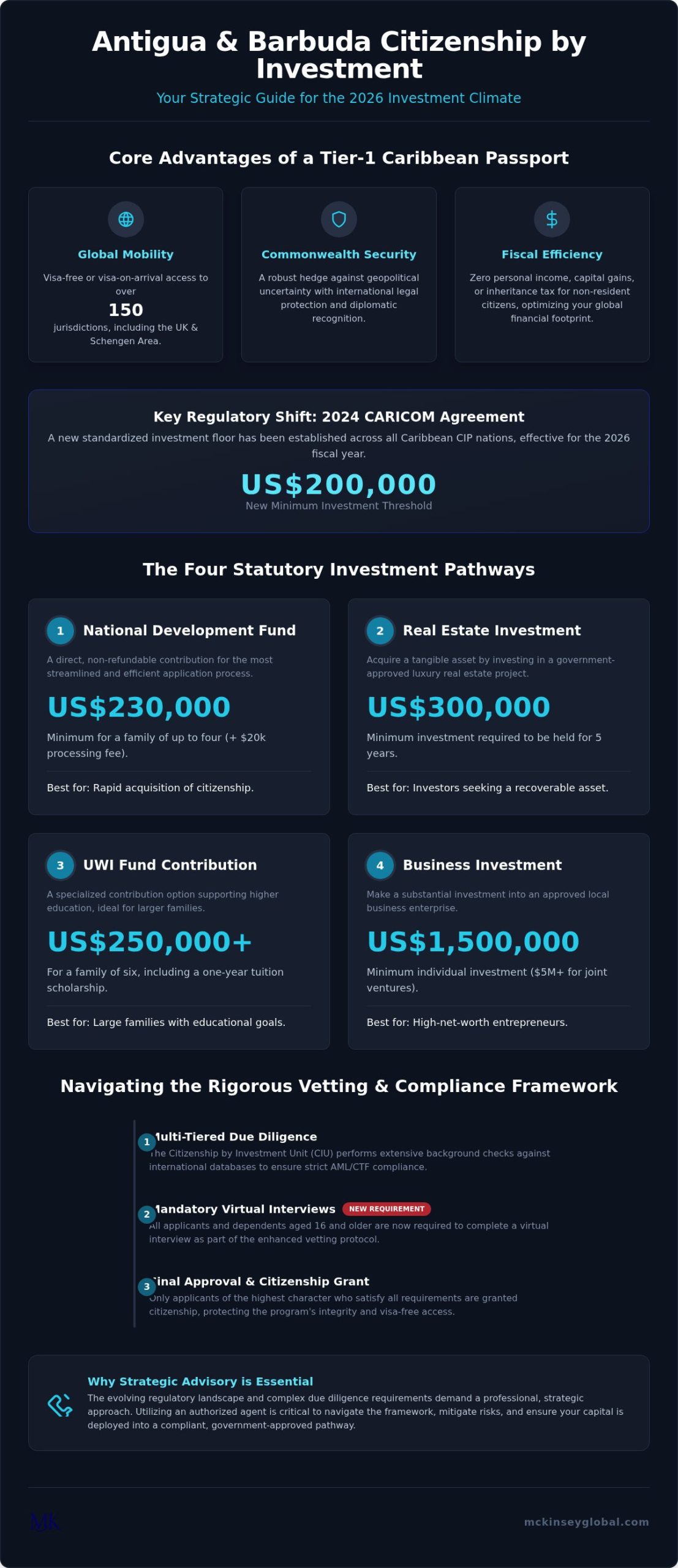
Antigua and Barbuda has solidified its position as a premier jurisdiction for global citizens who prioritize stability and regulatory transparency. The Economy of Antigua and Barbuda is increasingly bolstered by strategic capital inflows managed with rigorous oversight. In 2026, the concept of economic citizenship has evolved beyond a mere transactional process; it now represents a sophisticated integration of legal standing and strategic mobility. This transformation was largely accelerated by the 2024 CARICOM Memorandum of Agreement, which established a standardized price floor of US$200,000 across the region. While this led to a harmonization of costs, Antigua and Barbuda remains a highly competitive choice due to its diverse array of antigua and barbuda investment options and its unwavering commitment to program longevity.
The Strategic Value of the Antigua and Barbuda Passport
Securing citizenship in this twin-island nation offers more than just a travel document. It provides a comprehensive hedge against geopolitical uncertainty and domestic instability. Investors gain several distinct advantages:
- Global Mobility: Visa-free or visa-on-arrival access to over 150 jurisdictions, including the United Kingdom and the Schengen Area.
- Commonwealth Security: As a Commonwealth member state, the nation offers a level of international legal protection and diplomatic recognition that’s highly valued by global investors.
- Fiscal Efficiency: There are no personal income, capital gains, or inheritance taxes for non-resident citizens, allowing for the optimization of a global financial footprint.
Regulatory Oversight: The Citizenship by Investment Unit (CIU)
The integrity of the program is maintained by the Citizenship by Investment Unit (CIU), a specialized government body that acts as a meticulous gatekeeper. The CIU ensures that all antigua and barbuda investment options meet strict international Anti-Money Laundering (AML) standards. By 2026, vetting protocols have become even more stringent to protect the nation’s reputation and its visa-free privileges. Applicants should prepare for a multi-tiered due diligence process that now includes mandatory virtual interviews for all dependents aged 16 and older. This disciplined approach minimizes risk and guarantees that only individuals of the highest character are granted citizenship. It’s a system built on precision and procedural integrity, providing peace of mind for the sophisticated investor who values order and compliance.
The Four Statutory Pathways to Citizenship by Investment
The Citizenship by Investment Unit (CIU) governs four distinct antigua and barbuda investment options, each designed to meet specific capital and family requirements. Since the implementation of the 2024 OECS price floor, the minimum entry point for any Caribbean program is now US$200,000. Antigua and Barbuda has structured its pathways to provide maximum utility for both individual investors and large, multi-generational families. Selecting the appropriate route requires a disciplined evaluation of your long-term liquidity needs and the total cost of acquisition. Each pathway carries unique regulatory obligations that must be met to ensure the security of your status.
National Development Fund (NDF): The Direct Contribution Route
The NDF remains the most straightforward pathway for those seeking a streamlined application process. For a family of four or fewer, a non-refundable contribution of US$230,000 is required. This option is characterized by its efficiency, as it avoids the complexities of property management or business oversight. Applicants must also account for a US$20,000 processing fee. While the contribution is a “sunk cost,” the speed of processing and lower total capital outlay often make it the preferred choice for applicants prioritizing citizenship by investment for global mobility over asset retention.
Real Estate Investment: Asset Acquisition for Residency
Investors looking to maintain a tangible asset in the Caribbean often choose the real estate pathway. This route requires a minimum investment of US$300,000 in a government-approved project. To maintain citizenship eligibility, the property must be held for at least five years before divestment. Eligible assets typically include luxury resorts, villas, or fractional ownership shares in high-end developments. When evaluating the Antigua and Barbuda investment climate, it’s vital to select projects with proven developers to ensure future liquidity. For those requiring a detailed risk assessment of specific projects, consulting a specialist advisory firm is a prudent step before committing capital.
Business Investment and UWI Fund Options
The program offers specialized routes for large families and high-impact entrepreneurs. The University of the West Indies (UWI) Fund is specifically tailored for families of six or more, requiring a US$260,000 investment that includes processing fees for the entire group. This makes it the most cost-effective of the antigua and barbuda investment options for multi-generational applications. Alternatively, the business investment route requires a minimum of US$1.5 million for a single applicant. This pathway is intended for those looking to establish a significant commercial footprint within the jurisdiction, though it involves a more complex regulatory approval process than the contribution-based models.
Strategic Comparison: Real Estate vs. National Development Fund
Choosing between the primary antigua and barbuda investment options requires a comprehensive understanding of the Total Cost of Ownership (TCO) versus the potential for capital recovery. The National Development Fund (NDF) represents a definitive, non-recoverable contribution that offers the highest level of procedural certainty and simplicity. In contrast, the real estate pathway involves acquiring a physical asset within the official Citizenship by Investment Program, which introduces variables such as market liquidity and developer performance. While the NDF is often viewed through the lens of a “sunk cost,” it eliminates the ongoing management obligations and market risks inherent in property ownership. For many, the decision rests on whether they prefer the finality of a donation or the long-term potential of an equity-based asset.
Financial Modeling: Donation vs. Investment
A five-year financial projection for a family of four reveals significant differences in capital allocation and cash flow. The NDF route requires a fixed US$230,000 contribution plus US$20,000 in processing fees, totaling US$250,000 with no prospect of financial return. Real estate investors must commit a minimum of US$300,000, yet they must also account for recurring hidden costs: annual maintenance fees, insurance premiums, and property taxes typically add 2% to 5% to the initial investment value each year. The break-even point for real estate investors is achieved when the combination of net rental yields and capital appreciation exceeds the cumulative holding costs and the initial US$70,000 premium over the NDF contribution. Investors should carefully evaluate the secondary market, as divesting after the mandatory five-year period can be complex if the project lacks strong independent demand from non-CBI buyers.
Portfolio Diversification Strategy
For the sophisticated investor, Antiguan real estate serves as a strategic hedge against currency volatility and domestic instability. Selecting high-tier hospitality projects allows for participation in the nation’s robust luxury tourism sector, which remains a primary driver of the national economy. A physical “Plan B” residence in a neutral, Commonwealth jurisdiction provides a level of security and tangible utility that a donation cannot match. Investors seeking a comparable European alternative may also wish to explore greece residency by investment, which offers a distinct three-tiered framework under the 2026 regulatory landscape and unrestricted access across the Schengen Area. In 2026, capital appreciation potential is highest in projects that offer unique lifestyle amenities or fractional ownership in globally recognized resort brands. This approach transforms a regulatory requirement into a portfolio asset, provided the investor conducts rigorous due diligence on the private developer’s track record and the project’s long-term viability. When analyzing antigua and barbuda investment options, the focus must remain on the alignment of the asset with your broader global wealth strategy.
Navigating the Vetting and Regulatory Compliance Framework
The 2026 regulatory framework for the Antigua and Barbuda Citizenship by Investment Program is defined by a commitment to absolute transparency and international cooperation. To maintain the passport’s high ranking and visa-free access, the Citizenship by Investment Unit (CIU) has implemented a multi-tiered due diligence process that leaves no room for ambiguity. Prospective citizens must understand that evaluating antigua and barbuda investment options is only the first stage of a complex legal journey. The subsequent vetting process is designed to protect the jurisdiction’s integrity, requiring a level of disclosure that aligns with global Anti-Money Laundering (AML) standards. This disciplined approach ensures that the program remains a secure and respected pathway for the global elite.
The Application Lifecycle: From Submission to Passport
The path to citizenship follows a structured timeline, typically spanning three to six months from the initial filing. This progression is divided into three critical phases:
- Step 1: Document Procurement and Professional Vetting. This initial phase involves the meticulous collection of civil documents and the verification of financial records. A strategic advisor ensures your file is beyond reproach before it reaches government officials.
- Step 2: Submission and Initial Screening. Once the CIU receives the application, they perform an internal review to ensure all statutory requirements are met.
- Step 3: Third-Party Due Diligence and Mandatory Interviews. In 2026, all main applicants and dependents aged 16 or older must undergo a mandatory virtual interview. This is conducted alongside deep-background checks performed by independent international intelligence firms.
Following the successful grant of citizenship, individuals must fulfill the five-day residency requirement. This mandate requires all new citizens to spend at least five days in the country within the first five years of obtaining their passport. It’s a procedural necessity for future passport renewal and serves as an opportunity to establish a physical connection with the islands.
Common Pitfalls and How to Avoid Rejection
The most frequent cause of application delays or rejections is the inadequate documentation of the Source of Wealth (SoW). The CIU requires a clear, chronological narrative of how your capital was accumulated; this includes tax returns, audited financial statements, and corporate records. Inconsistencies in these records can trigger additional inquiries that extend the processing timeline significantly. Additionally, Politically Exposed Persons (PEPs) face an even higher level of scrutiny, requiring exhaustive disclosure of all business affiliations and political connections.
Ensuring that all dependents meet the 2026 eligibility criteria is equally vital. The rules regarding adult children, siblings, and elderly parents have become more precise, requiring documented proof of financial dependency. To ensure your application meets these rigorous standards without compromise, you should contact a specialist advisor for a preliminary file audit before submission.
Optimizing Your Global Strategy with McKinsey Advisory
The successful acquisition of a second citizenship depends on more than just meeting financial thresholds. It requires the guidance of a partner who understands the intricate interplay between global mobility, tax residency, and long-term asset protection. McKinsey Citizenship and Residency Solutions operates as a meticulous gatekeeper for high-net-worth individuals, ensuring that every application for antigua and barbuda investment options is prepared with the precision of a strategic report. Our advisory moves beyond simple document processing. We provide a disciplined framework that minimizes uncertainty and secures your standing in a Tier-1 jurisdiction.
Bespoke Solutions for High-Net-Worth Families
For families with complex international footprints, a one-size-fits-all approach is insufficient. We tailor the selection of investment pathways to align with your specific succession planning and wealth preservation objectives. Whether you are integrating citizenship into a trust structure or securing a physical residence as a hedge against domestic instability, our team ensures your investment remains compliant with both local and international standards. With over five years of specialist experience in Caribbean migration, we possess the institutional knowledge required to manage the 2026 CARICOM regulatory shifts. This expertise allows us to anticipate potential obstacles and provide a seamless, end-to-end management experience that extends from the initial evaluation to the final passport renewal.
Next Steps: Initiating Your Private Briefing
Securing a strategic position in Antigua and Barbuda requires early intervention and careful planning. We invite you to schedule a confidential assessment with our senior consultants to begin your journey. During this initial briefing, we will conduct a thorough evaluation of the available antigua and barbuda investment options and provide a preliminary risk assessment of your chosen route. This methodical approach ensures that your application is positioned for success before it is submitted to the Citizenship by Investment Unit. To start this process, you may secure your global future with a professional consultation through our private advisory channel. Our commitment to confidentiality and procedural integrity ensures that your transition to global citizenship is managed with the highest level of discretion and professional care.
Securing Your Global Legacy in a Standardized Regulatory Environment
The 2026 investment landscape in the Caribbean has entered a new era of regional harmonization and rigorous oversight. Navigating the diverse antigua and barbuda investment options now requires a sophisticated understanding of the CARICOM price floors and the multi-tiered vetting protocols implemented by the Citizenship by Investment Unit. Whether you prioritize the streamlined efficiency of the National Development Fund or the tangible asset security of approved real estate, your choice must align with a broader strategy of global mobility and wealth preservation.
McKinsey Citizenship and Residency Solutions operates as a boutique advisory with a focus on regulatory precision. We provide specialized expertise in 2026 Caribbean CBI compliance, acting as a discreet, high-level consultancy for global investors. Our approach ensures that every variable is meticulously evaluated before your application is submitted. To begin your private evaluation, you should Schedule a Strategic Consultation with McKinsey Citizenship and Residency Solutions. Establishing a resilient global hedge is a significant step toward long-term stability; we’re prepared to guide you through every stage of this disciplined process.
Frequently Asked Questions
What is the minimum investment for Antigua and Barbuda citizenship in 2026?
The minimum contribution for a single applicant or a family of four is US$230,000 through the National Development Fund. This threshold adheres to the standardized price floor established by the 2024 CARICOM Memorandum of Agreement. Other antigua and barbuda investment options include real estate acquisitions starting at US$300,000 and the University of the West Indies Fund, which requires US$260,000 for families of six or more.
Can I include my parents and grandparents in the application?
You may include parents and grandparents in your application, provided they are at least 55 years old and demonstrate full financial dependency on the main applicant. This provision allows for the consolidation of family security within a single legal framework. It’s important to note that each additional dependent beyond a family of four typically incurs a government processing fee of US$10,000.
How long does the entire process take from submission to approval?
The official processing time for applications is approximately three to six months from the date of submission to the Citizenship by Investment Unit. This period allows for a multi-tiered due diligence process and comprehensive background checks by international intelligence agencies. Meticulous document preparation and professional vetting of financial records are essential to ensure your application moves through the system without administrative delays.
Is the 5-day residency requirement mandatory for all family members?
The five-day residency requirement is a mandatory obligation for the main applicant and all included dependents. This visit must be completed within the first five years of obtaining citizenship to maintain eligibility for passport renewal. While the requirement is brief, it serves as a formal touchpoint that establishes a physical connection to the jurisdiction, ensuring the long-term validity of your status.
Can I sell my real estate investment after obtaining citizenship?
You are permitted to divest from your property after a mandatory holding period of five years from the date citizenship is granted. Selling the asset before this period concludes can lead to the revocation of your citizenship status. When evaluating antigua and barbuda investment options, it’s vital to select projects with strong secondary market appeal to facilitate an efficient exit strategy after the holding period ends.
What happens if my application for citizenship is denied?
If an application is denied, the principal investment amount is either not transferred or is returned to the applicant; however, all government processing and due diligence fees are non-refundable. Most rejections stem from inconsistencies in the source of wealth documentation or undisclosed legal issues. Utilizing a strategic advisory firm for a preliminary audit ensures that potential red flags are addressed before the formal filing.
Are there any restricted nationalities for the Antigua CBI program in 2026?
Antigua and Barbuda maintains a restricted list that currently includes nationals from Afghanistan, Iran, North Korea, Somalia, Sudan, and Yemen. Applicants from these countries are generally ineligible unless they have migrated before majority age or maintained residency in approved third countries for a specified period. The program remains a viable route for stateless individuals from Brunei, Saudi Arabia, Kuwait, and the UAE who meet strict vetting criteria.
How does the mandatory interview process work for investors?
The mandatory interview is a virtual session required for the main applicant and all dependents aged 16 or older. This protocol is a cornerstone of the 2026 due diligence framework, designed to verify the identities and backgrounds of all prospective citizens. The interview is conducted in a formal, professional manner by the CIU or an authorized third-party firm to ensure the highest standards of program integrity.