The era of the flat-rate European residency permit has concluded. In 2026, the Greek Golden Visa has evolved into a sophisticated instrument of geopolitical and financial strategy that requires precise geographic and regulatory alignment. You’re likely aware that securing a permanent greece residency by investment is no longer a matter of simple acquisition; it’s a process of navigating a three-tiered landscape designed to balance urban demand with regional development.
This briefing offers the technical clarity necessary to master the application process under the latest Law 5275/2026 framework. We’ll detail the specific requirements for the €800,000, €400,000, and €250,000 investment tiers while addressing the new prohibitions on short-term rentals that affect your asset’s yield profile. You’ll gain a comprehensive understanding of the 2026 start-up pathways, family reunification protocols, and the essential compliance steps needed to secure a stable “Plan B” for your family and maintain unrestricted access across the 29 nations of the Schengen Area.
Key Takeaways
- Identify the strategic implications of the 2026 tiered structure to ensure capital allocation meets the latest geographic and regulatory requirements.
- Evaluate the specific entry requirements for greece residency by investment, including the €250,000 restoration pathway and the €400,000 regional residential options.
- Execute the application lifecycle with precision, focusing on meticulous due diligence and the submission of comprehensive family reunification documentation.
- Benchmark the Greek Golden Visa against regional alternatives like the Portugal Golden Visa to determine the most efficient path toward European mobility.
- Utilize boutique advisory services that prioritize risk mitigation and unbiased evaluation over direct real estate brokerage for long-term stability.
The Strategic Value of Greece Residency by Investment in 2026
The Greek Golden Visa functions as a permanent residence permit designed for non-EU nationals who prioritize long-term security and European market access. Within the broader framework of investment migration, the program stands as a premier mechanism for capital preservation and personal mobility. It’s not merely a transaction; it’s a strategic alignment of assets that secures a foothold in one of the world’s most stable regulatory environments. By obtaining greece residency by investment, applicants transform their capital into a multi-generational legacy that transcends simple property ownership.
Schengen Mobility as a Business Tool
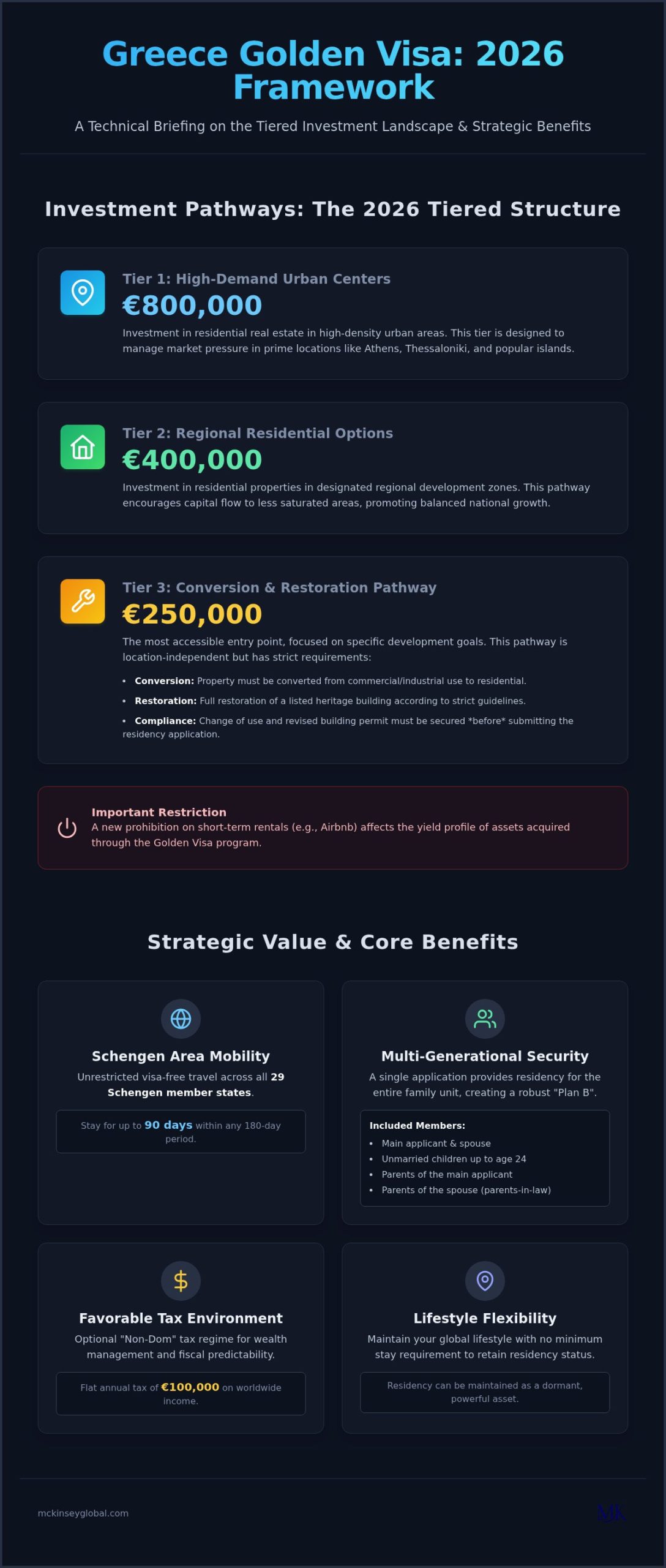
The most immediate operational advantage is the grant of unrestricted travel across the 29 member states of the Schengen Area. For the high-frequency business traveler, this benefit eliminates the administrative friction associated with recurring visa applications and embassy appointments. Holders of the residence permit can move through these territories for up to 90 days within any 180-day period. This creates a seamless corridor for commerce, allowing for the rapid deployment of resources and personnel across the European market. Greece effectively serves as a strategic gateway, positioning your operations within a single, unified economic zone.
Multi-Generational Residency Benefits
The Greek program is distinguished by its inclusive family structure, which provides security for three distinct generations within a single application. Unlike many alternative European programs, the Greek framework allows for the inclusion of the following family members:
- The spouse of the main applicant.
- Unmarried children under the age of 21, with the possibility of extension until they reach 24.
- The biological parents of the main applicant.
- The biological parents of the spouse, often referred to as parents-in-law.
This structure ensures that the entire family unit enjoys the right to live, reside, and study in Greece. It functions as a robust “Plan B” that protects family members against regional instability while providing access to high-tier educational and healthcare systems. The lack of a minimum stay requirement means that families can maintain their global lifestyle while keeping the residency as a dormant yet powerful asset.
Beyond mobility and security, the jurisdiction offers significant fiscal advantages for those who choose to establish tax residency. The “Non-Dom” tax regime provides a flat annual tax of €100,000 on worldwide income, provided the individual meets the investment criteria. This creates a predictable environment for wealth management, allowing for the consolidation of global earnings within a Mediterranean jurisdiction that prioritizes privacy and procedural integrity. For the discerning investor, greece residency by investment represents a comprehensive solution that balances lifestyle excellence with financial precision.
Investment Pathways: Navigating the 2026 Tiered Pricing Structure
The Greek government has established a tiered investment framework that prioritizes urban sustainability and regional development. For those seeking greece residency by investment, the choice of pathway depends heavily on the intended asset class and geographic preference. While real estate remains the primary vehicle, the 2026 landscape requires a more nuanced approach to asset selection than in previous years. Each tier is designed to address specific economic objectives, ranging from the preservation of historic architecture to the mitigation of housing shortages in high-density urban centers.
The Conversion and Restoration Pathway (€250k)
The €250,000 threshold represents the most accessible entry point, provided the investment aligns with specific industrial or cultural objectives. To qualify under the conversion clause, the property must be transitioned from a commercial or industrial use to a residential one before the application is filed. This pathway is location-independent, allowing investors to target high-demand urban centers without the higher price tags associated with standard residential units. For heritage assets, the restoration clause mandates that the investor fully restores the listed building according to strict architectural guidelines. Applicants utilizing the conversion pathway in 2026 must complete the change of use and obtain the revised building permit before submitting their residency application to ensure the investment is recognized under the €250,000 threshold.
High-Demand Zone Investment (€800k)
In prime jurisdictions such as the Attica region, Thessaloniki, and major islands like Santorini and Mykonos, the minimum investment threshold is set at €800,000. These zones require the acquisition of a single residential property with a minimum interior area of 120 square meters. This regulation aims to curb housing shortages while offering investors a stake in Greece’s most resilient real estate markets. Investing in these prime zones provides a hedge against market volatility, as these areas consistently demonstrate the highest potential for capital appreciation and long-term rental demand. You can review the Official Golden Visa Requirements to confirm the specific geographic boundaries for these high-value zones.
For properties located outside these high-demand zones, a mid-tier threshold of €400,000 applies, also requiring a minimum of 120 square meters for a single property. Beyond real estate, the program permits a capital contribution of €500,000 into Greek companies or the purchase of government bonds. A new 2026 pathway also allows for a €250,000 investment in registered start-ups via the Elevate Greece platform. Selecting the optimal route requires a careful evaluation of your risk tolerance and long-term liquidity needs. Engaging a specialized partner for greece residency by investment advisory ensures that your chosen pathway aligns with your broader wealth management strategy.
The Application Lifecycle: Compliance and Procedural Integrity
The application lifecycle for greece residency by investment is a rigorous multi-stage process that demands absolute adherence to regulatory standards. It begins long before the first wire transfer, requiring a disciplined approach to documentation and legal vetting. Success depends on the alignment of the applicant’s profile with the stringent expectations of the Hellenic Ministry of Migration and Asylum. A single procedural oversight can lead to significant delays, making meticulousness the primary requirement for any successful submission.
Due Diligence and Risk Mitigation
Initial due diligence serves as the foundation of a strategic residency portfolio. We prioritize the verification of fund origins, ensuring all capital is traceable and compliant with international anti-money laundering protocols. Our boutique pre-screening process evaluates the applicant’s professional and financial history to identify potential hurdles before they manifest in the official review. Simultaneously, the underlying real estate asset undergoes an exhaustive legal audit. This includes verifying the absence of liens, confirming zoning compliance, and ensuring the property meets the specific 120-square-meter requirement established in the 2026 tiered structure. By maintaining an unbiased advisory stance and excluding direct real estate brokerage, we ensure that the asset evaluation remains focused solely on your long-term security.
Once the investment is finalized through a notarized contract, the formal submission triggers the issuance of the “Blue Paper.” This document serves as a temporary residence permit, allowing the applicant to reside in Greece while the permanent card is processed. Biometric data collection follows, requiring a physical visit to the decentralized administration. In 2026, processing timelines typically range from six to nine months, though well-prepared files often reach completion within a three-to-six-month window. The final approval results in the issuance of a five-year permanent residence permit card. For a comprehensive breakdown of each procedural stage, our detailed guide on the greece golden visa application process provides the precise management template required to navigate Law 5275/2026 with regulatory confidence.
Residency Management and Renewal Protocols
Maintenance of the residency status requires persistent compliance. The five-year permanent residence permit is contingent upon the continued ownership of the qualifying investment. If the asset is sold without an immediate and qualifying replacement, the permit is revoked. Renewal occurs every five years, requiring updated criminal record checks and proof of sustained investment. While there’s no physical presence requirement to maintain the residency, those pursuing Greek citizenship must reside in the country for at least 183 days per year for seven consecutive years. This transition from resident to citizen represents the final stage of long-term strategic planning, requiring the applicant to demonstrate genuine ties to the Hellenic Republic and a basic command of the Greek language.
Comparative Analysis: Greece vs. Portugal Golden Visa
Selecting the optimal European residency program requires a meticulous evaluation of long-term capital goals and personal mobility requirements. While both jurisdictions offer high-tier access to the European Union, the structural differences between their 2026 frameworks are significant. Portugal has undergone a substantial legislative shift, effectively eliminating the real estate pathway in favor of fund-based investments. In contrast, greece residency by investment continues to offer a diverse range of tangible property assets, providing a more traditional risk profile for investors who prioritize physical ownership over intangible financial instruments. For a detailed side-by-side evaluation, our comprehensive analysis of the Portugal vs. Greece Golden Visa Schengen access landscape provides the definitive framework for making this critical decision.
Flexibility and Physical Presence
The Greek framework provides a distinct administrative advantage for global citizens who don’t intend to relocate immediately. Unlike the Portuguese program, which mandates a minimum stay of seven days per year, the Greek residence permit requires zero days of physical presence to maintain validity. This makes Greece the preferred choice for those managing complex international operations from abroad. For investors currently evaluating Antigua and Barbuda investment options as part of a broader global strategy, the Greek program serves as a low-friction EU base that doesn’t impose mandatory travel burdens. This “no-stay” rule ensures that your residency remains a secure asset without disrupting your primary professional or personal schedule.
Asset Liquidity and Long-Term Value
The risk profiles of the two programs have diverged sharply. Greek real estate in 2026 remains a high-performance asset class, with property appreciation rates in prime zones reaching approximately 10% annually. Residential property offers inherent liquidity and the potential for gross rental yields ranging from 3% in regional areas to 10% in island hotspots. Conversely, Portugal’s shift toward venture capital and private equity funds introduces variables such as lock-up periods, management fees, and the specific performance of the underlying fund manager. For the disciplined investor, the transparency of the Greek real estate market offers a more predictable path to capital preservation and growth. Those weighing the structural differences between tangible property and non-refundable contributions should consult our rigorous analysis of citizenship by investment donation vs real estate strategies for 2026 to understand the true total cost of ownership across each pathway.
One must also evaluate the timeline for naturalization. Portugal offers a five-year path to citizenship, whereas Greece requires seven years of qualifying residence. However, the Greek program’s lack of stay requirements makes it a superior strategic asset for those who view residency as a long-term “Plan B” rather than a precursor to immediate relocation. Investors who are simultaneously weighing non-European alternatives should consult our rigorous evaluation of turkey vs uae residency by investment to understand how Middle Eastern and emerging market programs compare as complementary components of a diversified global mobility portfolio. If you require a detailed comparison tailored to your specific capital allocation goals, we invite you to contact our advisors for a bespoke residency strategy session.
McKinsey Advisory: Strategic Management of Your Residency Portfolio
McKinsey Citizenship and Residency Solutions functions as a disciplined authority for high-net-worth individuals seeking to secure their global footprint. We recognize that greece residency by investment is a critical component of a broader wealth-protection strategy. Our boutique advisory model prioritizes meticulousness over volume, ensuring that every application is treated with the high-stakes precision it deserves. By maintaining an unbiased stance and explicitly excluding direct real estate brokerage, we provide an objective evaluation of every asset and regulatory variable involved in your portfolio.
Our engagement begins with a comprehensive briefing on regulatory alignment, ensuring that your investment adheres strictly to Law 4251/2014 and the latest 2026 amendments. We manage the entire application lifecycle, from the initial due diligence of fund origins to the final issuance of the residence permit card. This end-to-end management mitigates the risks associated with Greek bureaucracy, providing a steady hand through complex administrative procedures. Confidentiality and exclusivity remain the cornerstones of our service, protecting your family’s privacy while securing a permanent Mediterranean base.
Beyond the Application: Long-Term Partnership
Securing the permit is merely the initial phase of our professional relationship. We provide ongoing support to manage annual compliance requirements and coordinate with property management entities to ensure your asset remains in good standing. For clients seeking to diversify their international holdings, we offer strategic advice on expanding your global mobility portfolio. This often involves the seamless integration of your European residency with other high-tier programs, such as St. Kitts and Nevis citizenship by investment, creating a multi-layered security framework for your family’s future.
Why McKinsey Citizenship and Residency Solutions?
With over five years of specialized experience in investment migration, we’ve developed a reputation for procedural integrity and risk mitigation. We understand that residency is a long-term commitment, and we’re dedicated to maintaining the validity of your “Plan B” through every five-year renewal cycle. Our expertise across European and Caribbean jurisdictions allows us to offer a unique perspective on global wealth goals. If you’re ready to secure your position in the EU market, schedule a confidential consultation with our Greek residency experts to begin your strategic briefing.
Securing Your European Strategic Asset
The 2026 regulatory landscape for the Greek Golden Visa requires a fundamental shift from passive acquisition to active strategic management. Success in securing greece residency by investment now depends on precise geographic selection within the new tiered pricing model and a commitment to meticulous regulatory compliance. By aligning your capital with high-demand zones or specialized restoration projects, you establish a resilient foundation for multi-generational security and unrestricted Schengen mobility. It’s a process that rewards foresight and procedural integrity over simple transactionality.
McKinsey Citizenship and Residency Solutions brings over five years of expertise in investment migration, specializing in the complex multi-jurisdictional applications that global wealth goals demand. Our boutique advisory remains focused on absolute regulatory compliance and risk mitigation to ensure your residency remains a stable, long-term asset. We invite you to consult with McKinsey Citizenship for your Greek Residency Strategy to begin your formal briefing. We’re prepared to navigate these complexities on your behalf, ensuring your transition into the Greek market is both seamless and secure.
Frequently Asked Questions
What is the minimum investment for the Greece Golden Visa in 2026?
The entry-level threshold is €250,000 for specific projects like commercial-to-residential conversions or the restoration of listed buildings. For standard residential property in low-demand areas, the requirement is €400,000. Prime locations like Athens, Thessaloniki, and Mykonos require a minimum of €800,000 for a single property. These tiers ensure that greece residency by investment remains accessible while directing capital toward strategic national development goals.
Can I include my extended family in the Greek residency application?
The program allows for the inclusion of three generations within a single application. You may include your spouse, unmarried children under 21, and the biological parents of both the main applicant and the spouse. This multi-generational approach provides a comprehensive security solution for the entire family unit. All family documentation must be submitted simultaneously with the initial application to ensure procedural efficiency under the latest 2026 regulations.
How long does it take to get a Greek residence permit after investing?
Processing timelines in 2026 typically range from six to nine months from the date of submission. For applications that are meticulously prepared and involve clear fund origins, approval can be secured as quickly as three to six months. Upon successful submission, you receive the “Blue Paper,” which grants temporary residency rights while the permanent card is being processed. Biometric data collection is a mandatory step in this administrative cycle.
Do I need to live in Greece to maintain my Golden Visa residency?
There is no minimum physical residency requirement to maintain the Greek Golden Visa. You aren’t required to spend a single day in the country to keep your residence permit valid. This flexibility makes it an ideal “Plan B” for global citizens who manage international portfolios. However, if your long-term goal is naturalization, you must establish actual residency and spend at least 183 days per year in Greece for seven years.
Is it possible to apply for Greek citizenship through the investment program?
The Golden Visa is a residency program that provides a potential pathway to citizenship after seven years of qualifying residence. Applicants must demonstrate a genuine connection to the country and fulfill specific physical presence requirements during that period. You’ll also need to pass a basic Greek language and culture examination. It’s a structured transition from investor status to full European Union citizenship, requiring careful long-term planning and adherence to tax residency standards.
Can I rent out my property investment while holding the Golden Visa?
You are permitted to lease your property on a long-term basis, but 2026 regulations strictly prohibit short-term rentals. Utilizing platforms like Airbnb for properties acquired under the Golden Visa program is currently banned to preserve local housing availability. Long-term rental yields in regional areas typically range from 3% to 4%. This restriction ensures that your greece residency by investment contributes to the stable residential market rather than transient tourism.
What are the main differences between the €250,000 and €800,000 tiers?
The primary distinction lies in the asset’s geographic location and intended use. The €800,000 tier applies to single residential properties of at least 120 square meters in high-demand zones such as Attica and major islands. In contrast, the €250,000 tier is reserved for specific conversion or restoration projects regardless of location. The higher tier offers exposure to prime real estate markets, while the lower tier requires more intensive project management and regulatory oversight.
What happens to my residency if I sell the investment property?
Selling the underlying investment property results in the immediate revocation of the residence permit for the main applicant and all family members. To maintain residency, you must hold the qualifying asset for the duration of the permit’s validity. If you wish to divest, you must replace the property with another qualifying investment that meets current 2026 threshold requirements. This continuity is essential for the five-year renewal cycle and overall procedural compliance.