
The most expensive residency program is often the one that requires the least initial capital but carries the highest cost in lost strategic opportunity. As traditional European Golden Visas succumb to increasing regulatory hurdles and shifting political climates, global investors are refocusing their attention on two primary contenders for capital security and mobility. This strategic comparison of turkey vs uae residency by investment moves beyond simple real estate metrics to analyze how these jurisdictions function as distinct asset classes within a 2026 portfolio.
You likely recognize that geopolitical instability in home jurisdictions necessitates a robust contingency plan, yet the transition from residency to citizenship remains obscured by complex legal frameworks. This article provides a rigorous evaluation of the investment thresholds, mobility benefits, and fiscal implications of the Turkish and Emirati programs. We will deliver a clear framework for your selection process; we will confirm the exact capital requirements for 2026 and detail the tax optimization potential inherent in each pathway. By the conclusion of this briefing, you will possess the expert insight required to choose between the mobility-driven exit of Turkey and the stability-driven hub of the United Arab Emirates.
Key Takeaways
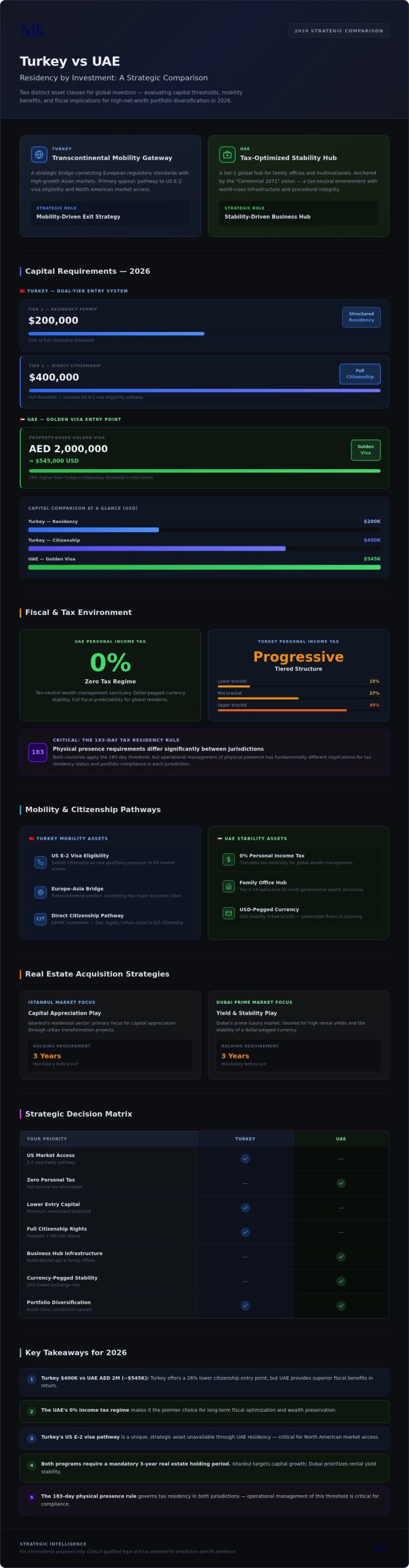
- Identify the definitive 2026 capital entry points, contrasting Turkey’s $400,000 citizenship threshold with the UAE’s AED 2 million requirement for property-based Golden Visas.
- Assess the strategic value of Turkey as a mobility-driven exit strategy versus the UAE’s role as a stability-oriented regional business hub.
- Compare the fiscal implications of the UAE’s 0% personal income tax regime against Turkey’s progressive tax structure for global residents.
- Understand the operational differences in turkey vs uae residency by investment regarding physical presence requirements and the 183-day rule for tax residency.
- Access a structured decision matrix to align jurisdictional selection with specific long-term goals, including US E-2 visa eligibility and global portfolio diversification.
The Strategic Evolution of Middle Eastern Residency Hubs in 2026
Global capital is increasingly gravitating toward the “Middle Corridor,” a strategic shift driven by the search for jurisdictions that offer both operational efficiency and geopolitical neutrality. In this context, residency by investment has transitioned from a lifestyle choice into a critical risk-mitigation tool for the preservation of family legacy and wealth. While traditional European programs often face protracted processing delays and shifting regulatory goalposts, the 2026 landscape highlights Turkey and the UAE as superior alternatives for high-net-worth individuals seeking immediate security. Choosing between turkey vs uae residency by investment requires a meticulous analysis of how each jurisdiction aligns with a portfolio’s long-term stability and mobility requirements. These programs are no longer mere alternatives; they are now the primary engines for securing multi-generational interests in a volatile global market.
Turkey: The Transcontinental Mobility Gateway
Turkey serves as a unique transcontinental bridge, offering investors a strategic foothold that connects European regulatory standards with the high-growth markets of Asia. The historical “Ikamet” or residence permit has evolved into a sophisticated investment pathway, reflecting the state’s commitment to attracting disciplined global capital. For many, the primary appeal lies in the strategic bridge to the West: Turkish citizenship remains a rare and valuable precursor to US E-2 visa eligibility. This pathway provides a level of global mobility and market access that few other residency solutions can match, particularly for those prioritizing an exit strategy into North American markets. The program’s efficiency is a hallmark of its design, ensuring that capital is deployed with speed and legal certainty.
The UAE: A Global Hub for Tax-Optimized Stability
The United Arab Emirates has solidified its position as a tier-1 global hub, attracting family offices and multinational enterprises through its commitment to tax-optimized stability. Central to this strategy is the Golden Visa, a component of the nation’s ambitious “Centennial 2071” vision aimed at securing a diversified, knowledge-based economy. For investors, the UAE offers a sanctuary for tax-neutral wealth management, characterized by a 0% personal income tax regime and a highly compliant regulatory environment. It’s a jurisdiction designed for those who value a permanent base for business operations within a secure, high-stakes environment. When evaluating turkey vs uae residency by investment, the UAE stands out as the premier choice for long-term fiscal predictability and lifestyle security. Its world-class infrastructure and commitment to procedural integrity provide a level of reassurance that is becoming increasingly scarce in traditional Western markets.
Comparative Investment Frameworks: Capital Requirements and Asset Classes
The financial commitment required for turkey vs uae residency by investment involves more than a simple comparison of headline figures; it necessitates a deep understanding of qualifying asset classes and the regulatory frameworks that govern them. For the 2026 fiscal year, Turkey offers a dual-tier entry system that addresses different investor needs. A $200,000 threshold secures a structured residency permit, while a $400,000 investment provides a direct pathway to citizenship. This stands in contrast to the UAE Golden Visa, which maintains a minimum entry point of AED 2 million, approximately $545,000, for property investors. Navigating these requirements requires meticulous attention to the Foreign Exchange Purchase Certificate (Döviz Alım Belgesi) issued by the Central Bank of Turkey (CBRT), ensuring all capital is correctly converted and registered.
Real Estate Acquisition Strategies
Both jurisdictions impose a mandatory three-year holding period for real estate assets, yet the market dynamics differ significantly. Istanbul’s residential sector remains a primary focus for those seeking capital appreciation through urban transformation projects. In contrast, Dubai’s prime luxury market is favored for its high rental yields and the stability of a dollar-pegged currency. To maintain application integrity, investors must adhere to 2026 SPK valuation standards, which require independent, accredited appraisals to verify that the acquisition price reflects true market value. Strategic planning in these jurisdictions requires a disciplined approach to asset selection. Investors often benefit from United Arab Emirates Residency Solutions to navigate these complex capital requirements with precision.
Alternative Financial Instruments
For investors prioritizing liquidity over physical property, alternative vehicles provide a streamlined entry point. Turkey allows for a $500,000 investment in bank deposits, government bonds, or real estate investment fund (REIF) shares, provided the capital is maintained for three years. The UAE offers diverse routes for executive talent, researchers, and entrepreneurs that don’t always necessitate large-scale property acquisition, focusing instead on professional merit and business innovation. When considering turkey vs uae residency by investment, the ease of exit is a critical factor; financial instruments generally offer a more efficient liquidation process than real estate once the mandatory holding period concludes. Investors weighing the structural differences between contribution-based and property-based pathways will find a rigorous analysis of citizenship by investment donation vs real estate strategies essential for calculating the true total cost of ownership across both jurisdictions. This flexibility is essential for global portfolios that require periodic rebalancing without the delays associated with property divestment.
Mobility and Citizenship Pathways: Evaluating Strategic Value
The distinction between a residence permit and a sovereign passport represents the most significant divergence in the turkey vs uae residency by investment debate. While the UAE offers a high-tier residency solution designed for long-term operational stability, Turkey provides a definitive exit strategy through full citizenship. This difference is not merely administrative; it dictates the investor’s ability to hedge against future geopolitical shifts. A Turkish passport serves as a permanent asset that remains valid regardless of future investment divestment, whereas UAE residency remains contingent upon the maintenance of specific qualifying conditions. For global strategists, the choice hinges on whether they require a secure regional base or a secondary nationality that offers a comprehensive “Plan B.”
The Turkish Path to Full Citizenship
Turkey’s citizenship by investment program is characterized by its efficiency, typically moving from initial capital deployment to passport issuance within eight to twelve months. This pathway includes the investor’s spouse and dependents under 18, securing a multi-generational right of abode and the benefits of dual citizenship. Beyond the 110+ visa-free destinations available to Turkish nationals, a critical differentiator is the E-2 Investor Treaty with the United States. This treaty allows Turkish citizens to establish businesses and reside in the US through a streamlined visa process, an advantage not currently available to residents of the UAE. Additionally, Turkish nationals often qualify for five-year C-2 Schengen visas, providing consistent access to European commercial centers. These mobility benefits position Turkey as a powerful tool for those prioritizing global market access and jurisdictional flexibility. Investors seeking a comprehensive understanding of the full scope of Türkiye citizenship by investment benefits, including the 20-year tax exemption on foreign-source income, will find the Turkish program offers significant advantages beyond passport mobility alone.
The UAE Golden Visa: Long-Term Security
The UAE Golden Visa offers a ten-year renewable residency that provides a level of autonomy previously unavailable in the region. This “sponsor-free” status allows investors and their families to live, work, and study without the need for a local employer or partner. While the UAE does not offer a direct path to citizenship for most investors, the trade-off is found in its world-class infrastructure and its status as a premier global business hub. The Golden Visa is designed for those who view the Emirates as a permanent lifestyle and professional anchor rather than a mobility tool. It provides a secure environment for wealth preservation and family office operations, supported by a legal framework that prioritizes investor rights and long-term residency security. Investors seeking a detailed breakdown of the exact AED 2 million thresholds and procedural requirements should consult the comprehensive Dubai Golden Visa 2026 strategic FAQ for global investors to fully understand the current eligibility criteria and recent regulatory changes. When analyzing turkey vs uae residency by investment, the UAE remains the superior choice for those whose primary objective is a high-functioning, tax-neutral base for international operations.
Fiscal and Regulatory Environments: Tax Optimization and Compliance
The fiscal architecture of turkey vs uae residency by investment presents a stark contrast in liability and reporting obligations. Turkey employs a traditional tax residency model based on the 183-day rule; individuals exceeding this threshold are typically taxed on their worldwide income at progressive rates. Conversely, the UAE offers a more flexible stay requirement for maintaining Golden Visa status, though obtaining a Tax Residency Certificate often requires a specific duration of presence. While the UAE remains a global leader in personal tax neutrality with its 0% income tax regime, Turkey applies progressive rates to its residents. Understanding these nuances is vital for investors who wish to avoid unintended fiscal exposure in a landscape of increasing global transparency.
Tax Planning for the Global Investor
Strategic tax planning within these jurisdictions requires an analysis of Double Taxation Treaties (DTTs) and local inheritance laws. Turkey’s extensive network of DTTs allows dual-resident investors to mitigate exposure, ensuring they aren’t taxed twice on the same income. In the UAE, the absence of personal income, capital gains, and inheritance taxes for residents provides a significant advantage for wealth preservation. However, investors must account for the 9% corporate tax on business profits exceeding AED 375,000, a measure introduced to align with international standards. For those seeking a tailored strategy, our experts provide United Arab Emirates Residency Solutions that prioritize long-term fiscal efficiency.
Regulatory Compliance and Vetting
Compliance and due diligence in 2026 have reached a level of unprecedented rigor. Both jurisdictions require comprehensive Source of Funds (SoF) documentation to ensure capital integrity and adherence to anti-money laundering (AML) standards. When evaluating turkey vs uae residency by investment, the administrative burden of compliance must be factored into the timeline. The Turkish process involves managing the Foreign Currency Purchase Certificate (DAB) and the subsequent Foreign Capital Presence Certificate (FCPC), which are essential for property-based applications. In both regions, biometrics and security clearances are mandatory components of the vetting process. These hurdles act as a filter, ensuring that only compliant, high-caliber investors gain entry into these strategic hubs. Managing these requirements with precision is the only way to avoid application rejection or protracted delays.
Implementation Strategy: Aligning Selection with Global Portfolios
The final determination between turkey vs uae residency by investment is rarely a matter of identifying a superior program in isolation. Instead, it requires a disciplined analysis of which jurisdiction functions as the more effective instrument for your specific risk profile and long-term objectives. Turkey is the prioritized choice when the primary goal is a definitive exit strategy or a strategic bridge to Western markets. It’s particularly suitable for investors who require full citizenship, the ability to pass nationality to future generations, or access to the United States through the E-2 treaty visa. Conversely, the UAE is the superior option for those focused on establishing a tax-neutral operational hub within a stable, high-growth environment. Its Golden Visa provides a level of lifestyle security and business infrastructure that remains unmatched in the Middle East.
Choosing the correct pathway involves a structured decision matrix that considers the following variables:
- Prioritize Turkey if: You require the permanent security of a second passport, seek to diversify into the Mediterranean real estate market, or intend to utilize the E-2 visa for US market entry.
- Prioritize the UAE if: Your objectives center on 0% personal income tax, you require a world-class base for family office operations, or you value the stability of a dollar-pegged currency.
The McKinsey Strategic Approach
Our boutique advisory functions as a meticulous gatekeeper, matching individual investor profiles to the program that offers the highest strategic return. We manage the end-to-end process with disciplined precision, from the initial navigation of Turkish Central Bank requirements to the opening of local accounts in Dubai. This high-touch service ensures that every regulatory hurdle is cleared with minimal friction. For investors who find the Middle Corridor programs unaligned with their European mobility needs, we also provide a Greece Residency by Investment guide as a strategic EU alternative. Our role is to provide the clarity and procedural integrity required to navigate these complex international landscapes.
Securing Your Global Legacy
Parallel planning is an increasingly common strategy among high-net-worth individuals who choose to hold both Turkish and Emirati residency simultaneously. This dual-jurisdictional approach provides a comprehensive hedge, combining Turkey’s mobility and citizenship benefits with the UAE’s fiscal advantages and tax neutrality. Post-approval, maintaining compliance requires rigorous monitoring of holding periods and renewal timelines to ensure the long-term integrity of the asset. The first step in this journey is a thorough pre-screening and document preparation phase to mitigate any potential regulatory risks. We invite you to schedule a strategic consultation with our advisors to begin aligning these programs with your global portfolio and legacy goals.
Securing Your Jurisdictional Advantage for 2026
Navigating the choice of turkey vs uae residency by investment requires a clear alignment between your capital deployment and your family’s long-term security. While Turkey provides a definitive pathway to citizenship and Western market access through the E-2 treaty, the UAE remains the premier destination for tax-neutral wealth management and world-class infrastructure. Both programs serve as critical hedges against geopolitical volatility, yet their strategic functions differ significantly within a global portfolio. The decision ultimately hinges on whether you prioritize mobility-driven citizenship or a stability-driven business hub.
As a boutique advisory with over five years of high-stakes investment migration experience, we provide the meticulous oversight necessary for such complex transitions. Our firm offers comprehensive support for both Caribbean and Middle Eastern programs, ensuring every project undergoes independent compliance vetting before capital is committed. We act as your disciplined gatekeeper, minimizing regulatory uncertainty and securing your global legacy with precision. To begin your evaluation, you’re invited to Consult with our Strategic Residency Advisors today. Aligning your assets with the right jurisdiction is the most effective way to ensure stability in an unpredictable global landscape.
Frequently Asked Questions
Does the UAE Golden Visa lead to citizenship after 10 years?
The UAE Golden Visa is a long-term residency solution and doesn’t provide a direct, guaranteed pathway to citizenship based on the duration of stay. While the UAE has introduced limited naturalization pathways for exceptional talents, these are discretionary and distinct from the investment program. Investors should view the Golden Visa as a secure, renewable 10-year residency that offers stability without the sovereign rights associated with a passport.
What is the minimum real estate investment for Turkish residency in 2026?
For the 2026 period, the minimum real estate investment required to secure a structured residency permit in Turkey is $200,000. This threshold is specifically for residency and shouldn’t be confused with the $400,000 requirement for the citizenship-by-investment program. All property acquisitions must be supported by an independent SPK valuation report to ensure the transaction meets regulatory compliance standards and reflects current market values.
Can I include my adult children in a Turkish citizenship application?
Standard Turkish citizenship by investment regulations limit eligibility for dependents to the main applicant’s spouse and children under the age of 18. Adult children, those aged 18 and over, are generally excluded from the primary application and must qualify through their own independent investments. Exceptions are extremely rare and typically limited to children with specific disabilities who require permanent parental care, subject to rigorous medical documentation.
Is the UAE Golden Visa better than the Portugal Golden Visa for tax planning?
The UAE Golden Visa offers a distinct fiscal advantage through its 0% personal income tax regime, which is significantly more favorable than Portugal’s progressive tax system. While Portugal’s program provides a pathway to an EU passport, the UAE focuses on immediate tax neutrality for global dividends and capital gains. When comparing turkey vs uae residency by investment or European alternatives, the UAE remains the superior choice for high-stakes wealth preservation.
How does the Turkish Lira volatility affect the $400,000 investment requirement?
The $400,000 investment requirement is anchored to the US Dollar, meaning the volatility of the Turkish Lira doesn’t decrease the required capital commitment. Investors must convert their foreign currency into Lira through the Central Bank of Turkey (CBRT) to obtain a Foreign Exchange Purchase Certificate (DAB). This process ensures that the investment value is officially recorded in Lira at the prevailing exchange rate to meet the USD-denominated threshold.
What are the stay requirements to maintain a UAE Golden Visa?
The UAE Golden Visa is highly flexible and doesn’t require investors to maintain a minimum number of days in the country to keep the residency active. Unlike standard residency permits that often expire if the holder stays outside the UAE for more than six months, Golden Visa holders can remain abroad for extended periods. This flexibility makes it an ideal residency-as-an-asset for global citizens who travel frequently.
Can I apply for a US E-2 visa immediately after receiving a Turkish passport?
Investors can initiate the US E-2 visa application process as soon as their Turkish citizenship is finalized and the passport is issued. Because Turkey is a treaty country with the United States, its citizens are eligible to apply for this non-immigrant investor visa to establish or manage a business. This bridge to the US market is a primary differentiator when evaluating turkey vs uae residency by investment for global mobility.
Are there any nationalities restricted from applying for these programs?
Both Turkey and the UAE maintain specific lists of restricted nationalities based on geopolitical considerations and international sanctions. For instance, citizens of Armenia, Cuba, and North Korea currently face significant hurdles or outright prohibitions when applying for Turkish investment programs. Similarly, the UAE may apply enhanced due diligence or restrictions on certain jurisdictions. Applicants should undergo a preliminary compliance screening to verify their eligibility before committing capital.