The assumption that a non-refundable contribution is always the most economical route to global mobility is often a strategic oversight. While the initial capital outlay for a donation appears lower, the true cost of citizenship by investment donation vs real estate requires a more disciplined evaluation of long-term asset performance and total cost of ownership. You likely recognize that opaque fee structures and the shifting 2026 real estate landscape make this decision increasingly complex. Concerns regarding market volatility and hidden maintenance costs often cloud the path to a secure second passport.
This article provides a rigorous strategic analysis designed to help you navigate these investment migration pathways with precision. We’ll establish a clear framework for calculating the actual financial commitment of each option, ensuring you understand which path offers better long-term security for your capital. Our briefing covers the new $200,000 regional investment floor, the impact of mandatory 2026 vetting standards, and the operational realities of tangible asset acquisition in the Caribbean and Europe. By the end of this report, you’ll have the clarity required to align your migration strategy with your broader financial objectives.
Key Takeaways
- Analyze the implications of the $200,000 minimum investment floor and the harmonized regulatory standards introduced by the ECCIRA for 2026.
- Utilize a rigorous comparative framework to assess citizenship by investment donation vs real estate, focusing on the Total Cost of Ownership beyond initial capital outlays.
- Determine the strategic thresholds where tangible property assets offer superior long-term security and cost-efficiency for larger family applications.
- Understand the shifting requirements for physical presence and biometric enrollment that now define the integrity of Caribbean and European pathways.
- Establish a disciplined methodology for selecting government-approved projects that mitigate market volatility while supporting global mobility objectives.
The Evolution of Global Residency and Citizenship Strategy in 2026
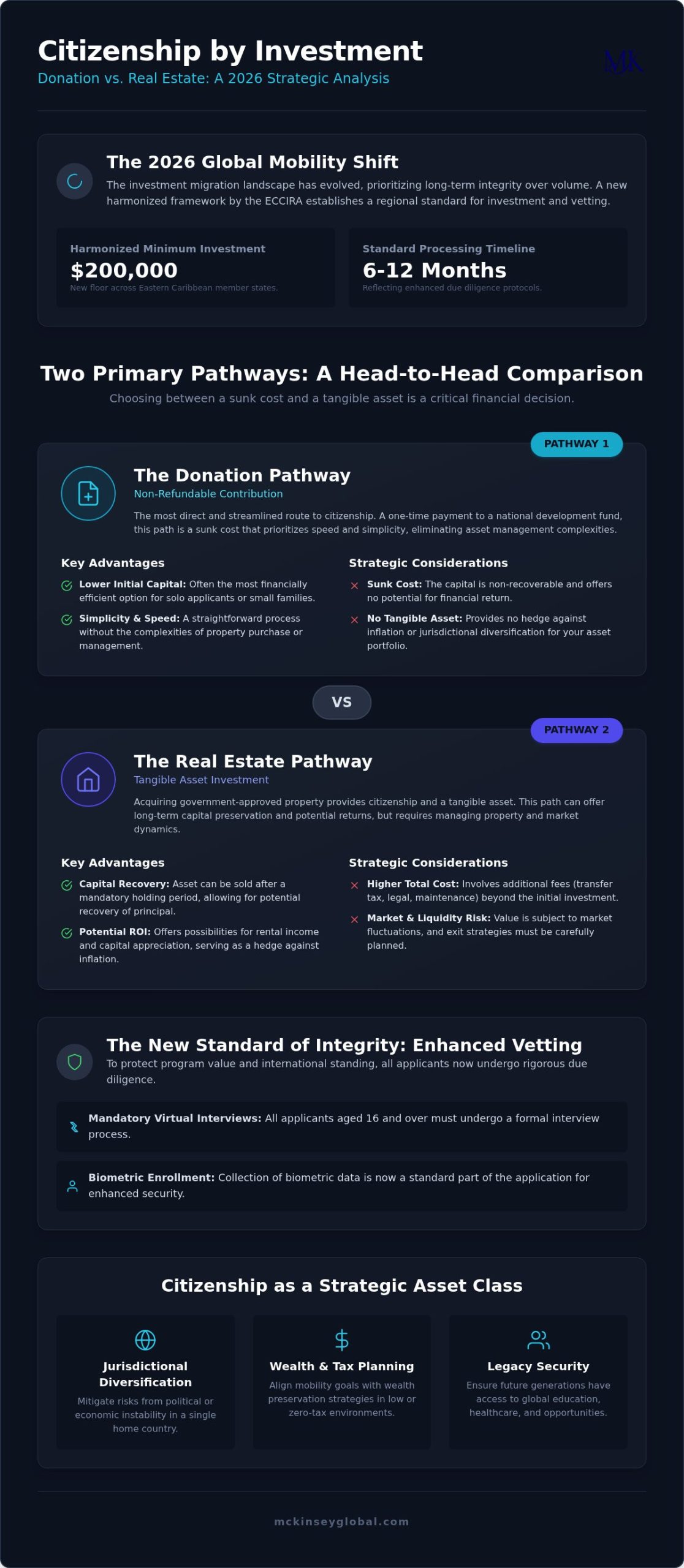
The global landscape for investment migration has undergone a fundamental transformation as of 2026. National programs have shifted away from transactional models toward a framework defined by regional cooperation and standardized pricing. The establishment of the Eastern Caribbean Citizenship by Investment Regulatory Authority (ECCIRA) has successfully harmonized the minimum investment floor at $200,000 across member states. This change signifies that the era of low-cost, high-speed acquisition has ended, replaced by a climate that prioritizes program longevity and international compliance over mere volume.
Choosing between a non-refundable contribution and a property purchase represents more than a simple cost comparison. It’s a foundational financial decision that dictates the future liquidity and tax implications of your global portfolio. The debate of citizenship by investment donation vs real estate now centers on whether you require immediate capital efficiency or a tangible hedge against inflation. While Caribbean nations provide direct paths to citizenship, European jurisdictions like Greece and Portugal continue to offer residency-to-citizenship routes that require careful long-term planning and adherence to evolving physical presence standards.
The New Regulatory Standard for Investment Migration
International pressure, particularly from the European Commission, has forced a rigorous re-evaluation of how immigrant investor programs operate. Vetting processes are no longer perfunctory; they now involve mandatory virtual interviews and biometric enrollment for all applicants aged 16 and over. These enhanced due diligence protocols have extended processing timelines to a standard 6 to 12 month window. This deliberate pace ensures that only high-integrity individuals gain access to these jurisdictions, protecting the visa-free privileges associated with the passports and providing a more stable environment for all stakeholders.
Citizenship as an Alternative Asset Class
Modern high-net-worth individuals treat a second citizenship as a critical component of an insurance policy against domestic volatility. It’s no longer just about mobility. It’s about strategic wealth preservation and risk mitigation. To maintain the integrity of these programs, many nations have introduced “genuine link” requirements that demand a more significant connection to the host country. Consider the following strategic benefits of this asset class:
- Jurisdictional Diversification: Reducing exposure to the political or economic instability of a single home nation.
- Tax Residency Planning: Aligning mobility goals with wealth preservation strategies in low-tax environments.
- Legacy Security: Ensuring that future generations have access to global education and healthcare systems.
The distinction between residency and direct citizenship is vital. Residency programs often act as a gateway, requiring years of adherence to local regulations before naturalization becomes an option. In contrast, direct citizenship programs offer immediate permanence, provided you navigate the initial compliance hurdles with professional precision.
The Non-Refundable Contribution: Analyzing the Donation Pathway
The donation model, often structured as a contribution to a National Development Fund (NDF), represents the most streamlined entry point for global mobility. It’s fundamentally a sunk cost. You provide a one-time, non-refundable payment to the host government in exchange for citizenship. While this capital isn’t recoverable, it eliminates the complexities of asset management and market exit strategies. For many high-net-worth individuals, the primary objective is the security of the passport itself rather than the performance of an offshore property. When evaluating citizenship by investment donation vs real estate, the contribution path often appeals to small families or solo investors who prioritize speed and simplicity over tangible equity.
Financial Efficiency of Government Contributions
The financial appeal of the donation route lies in its lower initial capital requirement. Under the 2026 harmonized standards, programs like the St. Kitts and Nevis Sustainable Island State Contribution (SISC) require a minimum of $250,000. This is significantly lower than the entry price for developer-approved property. You can explore a detailed comparison of CBI routes to see how these initial figures stack up against long-term holding costs. For example, Antigua and Barbuda investment options now start at $230,000 for the NDF pathway, providing a cost-effective solution for families of up to four. This route minimizes the total cash flow required during the application phase, as government processing fees for donations are typically less burdensome than those associated with property transfers.
Risk Mitigation in the Donation Model
The donation path offers a level of procedural certainty that real estate cannot match. It’s the “cleanest” route from a regulatory perspective. You aren’t exposed to foreign real estate market fluctuations, local property taxes, or the risk of developer insolvency. Documentation is often simpler. Government approval timelines for contributions are generally more predictable because there’s no need for property title verification or site inspections. If your goal is to secure global access without the burden of ongoing management, this model provides the most disciplined approach to risk mitigation. To determine if this streamlined path aligns with your long-term wealth preservation strategy, consider a consultation with our advisors at McKinsey Citizenship and Residency Solutions.
Real Estate Investment: Tangible Assets as a Gateway to Citizenship
Acquiring property within a foreign jurisdiction represents a shift from capital expenditure to asset allocation. Unlike the non-refundable contribution, the real estate pathway allows you to retain equity in a tangible asset that may appreciate over time. In the 2026 landscape, this option is increasingly utilized by investors who view citizenship as one component of a broader international property portfolio. When analyzing citizenship by investment donation vs real estate, the decision often hinges on your tolerance for illiquidity in exchange for the potential recovery of your initial principal. Government-approved projects typically fall into three categories: fractional ownership in luxury hotels, private condominiums, or high-end villas. Each carries distinct implications for maintenance, personal use, and fiscal responsibility.
The 2026 regulatory environment has established stricter holding periods to ensure program integrity and local economic stability. For instance, St. Kitts and Nevis now requires a seven-year holding period for real estate, while Antigua and Barbuda maintains a five-year threshold. While rental income is often marketed as a primary benefit, the reality of property management in island nations requires a disciplined approach. Yields are heavily dependent on tourism fluctuations and high operational costs; therefore, investors should prioritize projects with established management brands to mitigate these variables.
Capital Preservation and ROI Potential
Tangible assets serve as a strategic hedge against currency devaluation and domestic inflation. In emerging Caribbean markets, well-selected property can offer modest capital appreciation, provided the development is situated in a high-demand tourism corridor. You aren’t simply paying for a passport; you’re securing a stake in a growing hospitality sector. However, the return on investment (ROI) must be calculated net of insurance, property taxes, and mandatory maintenance fees, which can erode nominal gains if not professionally audited during the due diligence phase.
Exit Strategies and Secondary Market Liquidity
The most significant challenge in the property route is the secondary market. Many CBI-approved developments are priced at a premium compared to local non-CBI housing, which can complicate resale to traditional buyers. To ensure liquidity, it’s vital to select properties that possess “lifestyle appeal” beyond their status as a gateway to citizenship. Timing your exit is equally critical; listing a property immediately after the mandatory holding period may result in a crowded market if multiple investors seek to divest simultaneously.
The liquidity profile of Caribbean property differs sharply from European pathways like Greece residency by investment, where the underlying real estate market is supported by a robust domestic and continental buyer base. In Greece, the asset is often easier to liquidate because it isn’t tethered exclusively to an investment migration scheme. For those prioritizing a clear exit strategy, understanding these regional market dynamics is essential before committing significant capital to a specific jurisdiction.
Donation vs. Real Estate: A Comparative Framework for Decision-Making
The choice between citizenship by investment donation vs real estate requires a meticulous evaluation of the Total Cost of Ownership (TCO). While the donation route represents a transparent, single-phase capital event, property acquisition introduces a sequence of recurring fiscal obligations. These include property insurance, local taxes, and professional management fees that can aggregate to a significant percentage of the asset’s value over the mandatory holding period. For solo applicants, the donation remains the benchmark for capital efficiency. However, as family size increases, the fixed nature of real estate pricing often becomes more attractive. Government fees for large families are typically tiered; consequently, a single property investment can often cover a primary applicant and multiple dependents without the exponential increase seen in donation-based contributions. Families evaluating this threshold should review the best citizenship by investment programs for family relocation to identify which jurisdictions offer the most favorable dependent inclusion policies in 2026.
Processing timelines also diverge based on the selected asset class. Donation applications generally move through the due diligence phase with greater velocity because they lack the requirement for property title verification and developer compliance checks. If your primary objective is a rapid exit from your current jurisdiction, the contribution path is superior. If you possess the operational capacity for international property management, the real estate route offers a more robust paper trail for the “genuine link” requirements that have become standard in 2026. Regardless of which pathway you select, ensuring your financial history is meticulously documented is paramount; a comprehensive understanding of the source of funds for citizenship by investment is now a non-negotiable component of any successful 2026 application.
The Break-Even Analysis
A disciplined financial briefing must account for the point where property appreciation offsets the non-recoverable donation amount. Real estate applicants face higher government processing fees, which in jurisdictions like Dominica reach $75,000 for a single applicant, increasing the initial negative balance. The opportunity cost of capital tied up in property versus a liquid donation represents the potential returns forfeited from alternative high-yield investments during the mandatory holding period. To ensure your selection aligns with your fiscal reality, we recommend a bespoke portfolio audit with our senior consultants.
Strategic Mobility vs. Lifestyle Investment
Determining the utility of the asset is the final pillar of this framework. A property can serve as a functional vacation home or a pure financial vehicle held within a corporate structure. In jurisdictions like those covered in our St. Kitts and Nevis citizenship by investment guide, high-end real estate acts as a powerful signal of a “genuine link” to the nation. This connection is increasingly relevant as global regulators scrutinize the substance of investment migration. Whether you prioritize the simplicity of a donation or the permanence of an address, your decision should reflect a long-term commitment to jurisdictional stability.
Strategic Advisory: Aligning Investment Pathways with Global Objectives
The investment migration market in 2026 is increasingly complex, characterized by a high volume of developers whose primary objective is capital acquisition rather than investor security. Independent advisory remains the only reliable safeguard against misaligned incentives. Selecting between citizenship by investment donation vs real estate requires an objective lens that prioritizes your 10-year global mobility and wealth preservation objectives. At McKinsey Citizenship and Residency Solutions, we operate as a disciplined gatekeeper, ensuring that every pathway is scrutinized for its long-term viability and adherence to evolving international standards. Our role is to provide clarity and minimize uncertainty in a high-stakes environment where procedural integrity is paramount.
The McKinsey Meticulousness: Our Selection Process
Our methodology extends far beyond the mandatory government background checks. We conduct a rigorous independent audit of developer track records, construction milestones, and the underlying financial health of approved projects to mitigate the risk of asset depreciation or project abandonment. This meticulous evaluation ensures that your capital is allocated to projects with genuine market appeal and secondary market liquidity. By maintaining strict attorney-client privilege, we provide a confidential environment where your specific tax residency and succession planning needs are integrated into the final recommendation. We don’t simply process documents; we structure a comprehensive migration strategy that aligns with your broader financial legacy.
Beyond the Passport: Long-Term Support
Securing a passport or residency permit is merely the initial phase of a multi-decade global strategy. Ongoing compliance, such as physical presence monitoring and timely document renewals, is essential to maintaining the integrity of your international status. We guide clients through complex transitions, such as evaluating the strategic advantages of Turkey vs. UAE residency by investment as they move toward permanent citizenship. Our commitment to accuracy and procedural integrity ensures that your global footprint remains secure as regulatory landscapes continue to shift. Choosing the correct path requires a comprehensive understanding of how current decisions impact your future flexibility. To begin a formal briefing and align your migration goals with a disciplined strategy, we invite you to Consult with a McKinsey Global Strategist.
Strategic Alignment for Long-Term Jurisdictional Security
The decision between citizenship by investment donation vs real estate is a foundational choice that dictates your global fiscal footprint for decades to come. While a non-refundable contribution offers immediate capital efficiency and a simplified path to global mobility, tangible property acquisition provides a strategic hedge and potential capital preservation for larger family units. You must carefully weigh the transparency of a sunk cost against the operational complexities and holding periods associated with international asset management in the 2026 landscape.
McKinsey Citizenship and Residency Solutions operates as a boutique advisory with over five years of specialist experience in Caribbean and European regulatory frameworks. We maintain a strict adherence to attorney-client privilege and confidentiality, providing the meticulous oversight necessary to protect your interests in high-stakes environments. Our consultants ensure that every variable, from tax residency to succession planning, is addressed with precision. We invite you to Secure Your Global Future with a Strategic Consultation. Your path to a secure second citizenship is a journey we’re prepared to guide with the highest standards of professional integrity.
Frequently Asked Questions
Is the donation to a citizenship program tax-deductible?
Donations to government-led development funds are almost never tax-deductible in the applicant’s home jurisdiction. These payments are classified as non-refundable contributions for a specific legal benefit rather than charitable gifts. You should consult with a qualified tax strategist to evaluate how this expenditure impacts your global tax position. While it doesn’t reduce your tax liability, it serves as a critical entry point when comparing citizenship by investment donation vs real estate.
Can I sell my real estate investment and still keep my second citizenship?
You may divest from your property once the statutory holding period has expired without jeopardizing your citizenship status. In 2026, member nations of the ECCIRA have standardized these durations; for instance, St. Kitts and Nevis requires a seven-year holding period. If you sell before this period concludes, you risk the revocation of your passport. Once the threshold is met, the citizenship is yours for life and can typically be passed to future generations.
Which is faster for obtaining a passport: donation or real estate?
The donation pathway is typically the more efficient route regarding processing speed. This efficiency stems from the absence of property-related documentation, such as title deeds and site inspections. While both paths require rigorous due diligence and mandatory interviews as of 2026, the financial transfer for a contribution is instantaneous. Real estate transactions involve escrow arrangements and developer compliance checks that often add several weeks to the overall government approval timeline.
What are the hidden costs of the real estate investment path?
Property acquisition involves several recurring and upfront costs that aren’t always immediately apparent. These include government administrative fees, which are significantly higher for real estate than for donations. You must also factor in property insurance, annual maintenance levies, and local property taxes. When evaluating citizenship by investment donation vs real estate, these ongoing liabilities can erode the potential return on investment if the property is not professionally managed and audited.
How does family size affect the cost difference between donation and real estate?
Family size is a decisive factor in the comparative cost analysis. Donation amounts typically scale for each additional dependent, whereas the minimum real estate investment remains fixed regardless of the number of family members. For a single applicant, the donation is usually more economical. However, for families of six or more, the property route often becomes the more efficient allocation of capital as it avoids the exponential increase in non-refundable contribution requirements.
Can I buy any property in a country to qualify for citizenship by investment?
You cannot qualify by purchasing a private residence on the open market. Only government-approved developments, typically luxury hotels, villas, or specific condominiums, are eligible for the citizenship program. These projects undergo their own vetting process by the national Citizenship by Investment Unit to ensure they contribute to the local economy. Selecting a project outside of this approved list will lead to an automatic rejection of your citizenship application regardless of the purchase price.
What happens if the real estate project I invested in is never completed?
Project abandonment represents a significant risk in the real estate pathway. While your citizenship status is usually protected if the government approved the project, your capital may be at risk if the developer becomes insolvent. It’s essential to conduct due diligence on the developer’s track record and construction milestones. Many jurisdictions now require funds to be held in escrow until specific completion stages are reached to mitigate this specific uncertainty for international investors.
Are rental yields guaranteed for CBI-approved real estate projects?
Rental yields are rarely guaranteed and are subject to the operational performance of the resort or hotel. Some developers offer fixed returns for the initial years, but these are often priced into the purchase cost of the unit. You should treat these guarantees with professional skepticism. Actual returns depend on tourism occupancy rates and management efficiency. A disciplined evaluation of the project’s commercial viability is necessary before committing your capital to any development.