In the current regulatory climate, your financial history is no longer a private record; it’s a forensic narrative that determines your global mobility. The establishment of the Eastern Caribbean Citizenship by Investment Regulatory Authority (ECCIRA) and the 2026 biometric mandates have transformed the application process into a high-stakes audit. You likely recognize that documenting the source of funds for citizenship by investment is the most critical hurdle in securing a second passport. It’s natural to feel concerned about the invasive nature of these inquiries or the risk of a rejection due to a minor technical error in multi-jurisdictional wealth reporting.
This briefing provides the strategic clarity you need to master these complexities. We’ll provide a definitive roadmap for financial disclosure that prioritizes both compliance and asset protection. By following this structured approach, you can ensure your application meets the stringent 2026 standards with minimal requests for further information. You’ll gain the insight required to align your documentation with global standards, ensuring a seamless path to approval while maintaining the integrity of your global estate.
Key Takeaways
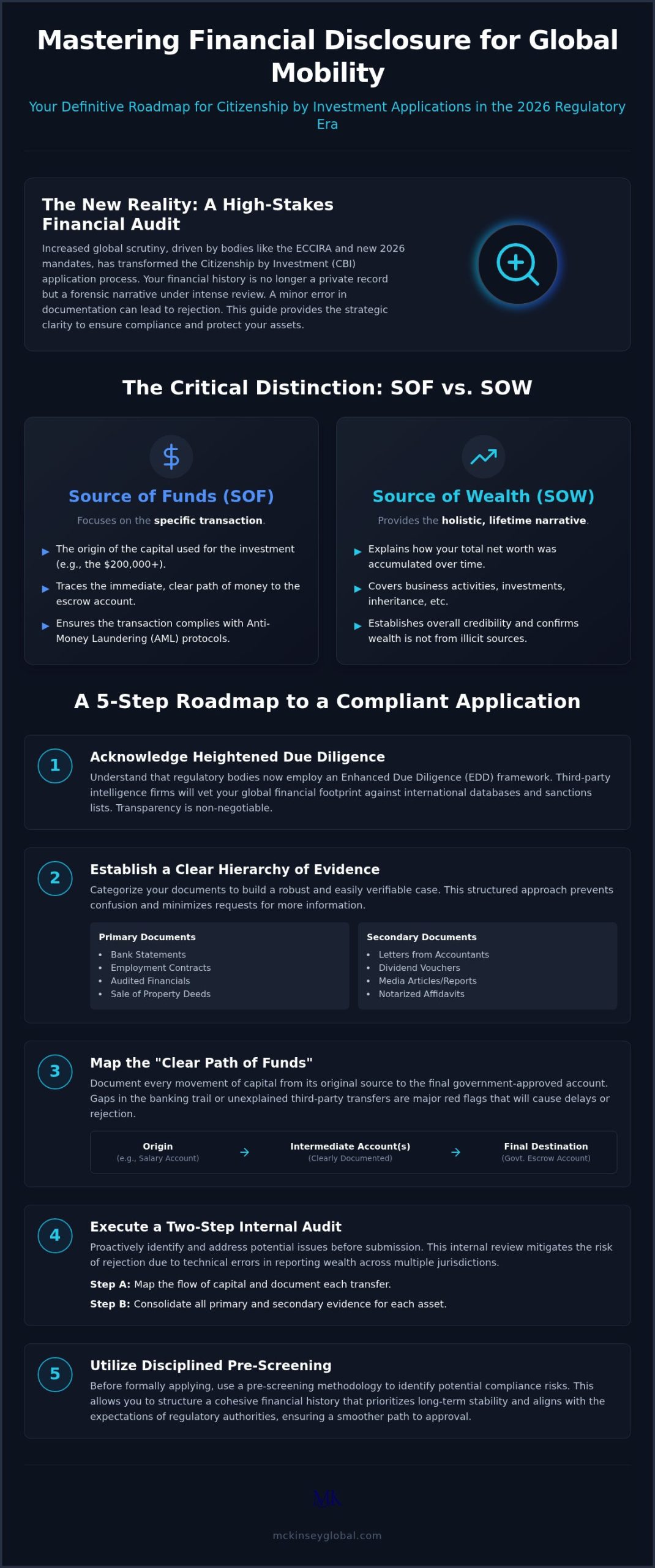
- Distinguish between the forensic narrative of Source of Wealth and the transactional clarity of Source of Funds; this alignment is essential to meet 2026 regulatory expectations.
- Understand the heightened due diligence standards imposed by the Eastern Caribbean Citizenship by Investment Regulatory Authority (ECCIRA) and the EU’s evolving directives.
- Establish a clear hierarchy of evidence by categorizing primary and secondary documentation to validate the source of funds for citizenship by investment with precision.
- Execute a two-step internal audit to map the flow of capital across complex jurisdictions: this process effectively mitigates the risk of application rejection due to technical errors.
- Utilize a disciplined pre-screening methodology to identify potential compliance risks and structure a cohesive financial history that prioritizes long-term stability.
The Strategic Importance of Source of Funds in 2026
The 2026 regulatory environment has fundamentally altered the requirements for global mobility. The establishment of the Eastern Caribbean Citizenship by Investment Regulatory Authority (ECCIRA) and the increased oversight from the European Commission have necessitated a shift toward forensic-level financial transparency. Within this context, the documentation of the source of funds for citizenship by investment serves as the primary mechanism for mitigating risk and ensuring program integrity. Understanding the distinction between specific capital and general wealth is the first step in a successful application. This distinction isn’t merely academic; it’s the foundation upon which a secure and compliant future is built.
Global standards for Immigrant investor programs are largely shaped by the Financial Action Task Force (FATF). Their 2026 frameworks emphasize the need for host nations to identify the origin of every dollar used in high-value transactions. A well-prepared financial narrative doesn’t just satisfy these requirements; it actively accelerates the approval timeline by reducing the need for repetitive requests for information (RFIs). By presenting a transparent and verifiable history, applicants position themselves as low-risk candidates. This is essential for navigating the current high-stakes environment where precision is the only path to security.
Source of Funds (SOF) Explained
Source of Funds refers specifically to the origin of the capital being deployed for the investment, such as the minimum $200,000 threshold now common across Caribbean jurisdictions. This documentation must trace the immediate path of the money from its point of origin to the government escrow account. When you provide the source of funds for citizenship by investment, you’re detailing the liquid assets used for the transaction. Common pitfalls often include gaps in the banking trail or the use of third-party transfers that lack clear authorization. Precise SOF reporting ensures that the specific transaction complies with anti-money laundering (AML) protocols and prevents unnecessary delays in the vetting process.
Source of Wealth (SOW) Explained
While SOF focuses on the transaction, Source of Wealth provides a holistic view of how an applicant’s total net worth was accumulated over time. This requirement addresses the lifetime of professional, business, and investment activities that generated the applicant’s assets. Regulatory bodies often scrutinize SOW more intensely than the investment amount itself; they seek to confirm that the wealth wasn’t derived from illicit activities. Providing a clear, chronological account of business ownership, inheritance, or capital gains is vital. It establishes the credibility of the entire application and protects the applicant from future regulatory scrutiny, ensuring long-term stability in their new jurisdiction.
Investment Migration Regulatory Compliance Standards
Regulatory frameworks have reached a peak of sophistication. Caribbean nations, under the oversight of the Eastern Caribbean Citizenship by Investment Regulatory Authority (ECCIRA), now employ an Enhanced Due Diligence (EDD) framework that mirrors the rigor of institutional banking. Simultaneously, the European Union’s Sixth Anti-Money Laundering Directive (AMLD6) has expanded the scope of criminal liability, directly impacting residency programs across the continent. These regulations demand a “clear path of funds” requirement. This means every movement of capital, from its initial origin to the final destination in a government-approved account, must be documented without interruption. Governments no longer rely solely on internal reviews; they engage specialized third-party intelligence firms to vet your global financial footprint.
These firms cross-reference international databases, corporate registries, and sanctions lists to ensure that the source of funds for citizenship by investment is beyond reproach. Adhering to OECD guidance on investment schemes is critical here. It helps prevent the mischaracterization of assets that could lead to tax reporting complications or allegations of circumventing global transparency standards. When your financial history is transparent, you minimize the risk of being flagged by these automated and manual vetting systems. For investors evaluating their options, understanding the divergent compliance demands of each pathway is essential, as explored in our analysis of caribbean citizenship vs european residency by investment in the current regulatory climate.
Anti-Money Laundering (AML) Protocols
Identifying “Red Flags” is the first priority of any vetting authority. These triggers include large cash deposits, unexplained transfers from high-risk jurisdictions, or inconsistencies in professional history. Politically Exposed Person (PEP) screening is equally rigorous. Individuals with significant public influence must provide even higher levels of transparency to mitigate corruption risks. AML protocols function as a vital safeguard that preserves the long-term value and international reputation of the passport. If you require a meticulous review of your file before submission, a consultation with McKinsey Citizenship and Residency Solutions can provide the necessary oversight.
Know Your Customer (KYC) in 2026
The KYC process has evolved to include digital identity verification and blockchain-based audit trails. These technologies provide an immutable record of identity and transaction history, satisfying both local and international banking compliance requirements. For those considering specific Caribbean pathways, our Antigua and Barbuda Investment Options: 2026 Guide details how these standards apply to local real estate and donation routes. Ensuring your documentation is structured to withstand this level of scrutiny is the only way to avoid the anxiety of a technical rejection. Every detail must align with the global expectation of procedural integrity and absolute accuracy.
Validating Wealth: Acceptable Sources and Evidence
The validation of wealth requires a structured hierarchy of evidence to ensure a seamless approval process. Primary documentation, such as certified bank statements and executed contracts, forms the core of your submission; secondary evidence, including professional references or public records, serves to substantiate the broader narrative. When managing multi-currency or cross-border asset transfers, it’s vital to provide a continuous paper trail that accounts for exchange rate fluctuations and jurisdictional compliance. While the Portuguese Golden Visa focuses on the specific legality of the investment vehicle, Caribbean programs typically prioritize a more exhaustive review of the liquid path of capital. This distinction is critical for applicants who hold wealth in multiple jurisdictions and require a cohesive strategy to present their financial history with precision.
Business Profits and Dividends
Documenting company success requires more than a simple balance sheet. Vetting authorities expect audited financial statements and corresponding personal tax returns to verify that dividends were distributed legally. You must clearly illustrate the link between corporate profitability and your personal accumulation of capital. This includes addressing retained earnings or shareholder loans, ensuring that every withdrawal is supported by a board resolution or a formal dividend declaration. Precise documentation here prevents the risk of your income being mischaracterized as “unexplained wealth,” which is a common trigger for application delays or intense regulatory scrutiny.
Real Estate and Capital Gains
Proving the legitimacy of property-derived wealth often requires identifying the “source of the source.” If you’re using proceeds from a property sale, you must document how the original asset was acquired years or even decades prior. Required evidence includes original purchase agreements, contemporary sale deeds, and bank transfer slips that confirm the flow of funds. This forensic approach is particularly relevant when choosing between different investment routes, as explored in our guide on Citizenship by Investment: Donation vs Real Estate Strategy for 2026. Clear evidence of capital gains tax payment is often the final piece of the puzzle that satisfies the meticulous gatekeepers of modern CBI programs.
Inheritance, Gifts, and Digital Assets
Modern wealth profiles frequently include decentralized finance (DeFi) or cryptocurrency gains, which require specialized forensic tracing to be accepted by global banks and regulatory bodies. For these digital assets, you must provide a comprehensive history of wallet addresses and exchange statements to prove the legitimacy of the initial capital used for trading. In cases involving gifts, the burden of proof extends to the donor; you’re required to document the legality of their wealth to satisfy the source of funds for citizenship by investment requirements. Inherited wealth must be supported by probate records and tax clearance certificates to confirm that all legal obligations were met before the assets were transferred. This level of detail ensures that your wealth narrative is both accurate and compliant with 2026 standards.
The Documentation Framework: Avoiding Application Rejection
Avoiding a rejection requires moving beyond a simple checklist to adopt a meticulous documentation framework. In 2026, the success of your application depends on how effectively you curate your financial narrative. To ensure your file withstands the scrutiny of international vetting agencies, you should follow a structured five-step process:
- Step 1: Conduct a preliminary internal audit: You must identify any potential inconsistencies in your financial history before they reach the vetting agency. This involves reviewing years of tax filings and bank records to ensure they present a logical progression of wealth.
- Step 2: Map the flow of funds: Detail the movement of capital across all involved jurisdictions. You must account for every transfer, including currency conversions and the specific banking institutions involved in moving money from its origin to the government escrow account.
- Step 3: Secure certified translations and apostilles: Every document must meet the host nation’s specific linguistic and legal standards. This ensures your evidence is “legalized” for international recognition and accepted by foreign government departments.
- Step 4: Draft a comprehensive Source of Wealth Statement: This document acts as a professional summary of your financial life. It details how initial capital was earned, reinvested, and grown into your current portfolio, resolving potential ambiguities before they become formal requests for information (RFIs).
- Step 5: Final review by a compliance expert: A professional audit of your source of funds for citizenship by investment ensures that your presentation aligns with the 2026 regulatory expectations of the destination country.
Common Documentation Errors
Technical errors often stem from a lack of foresight regarding how the source of funds for citizenship by investment is interpreted by third-party intelligence firms. Unexplained gaps in bank statement history are a primary cause for delay; these suggest a lack of transparency that authorities find unacceptable. Similarly, an inconsistency between reported income and lifestyle assets can trigger a red flag. If your professional history doesn’t logically support your current net worth, you must provide the “Source of the Source” for early-career wealth to establish a legitimate foundation. Failing to document the origin of initial seed capital is a frequent oversight that can compromise an otherwise strong application.
The Role of Professional Translation and Notarization
Meeting the specific linguistic standards of the host nation is a non-negotiable requirement for international compliance. Documents must be translated by certified professionals to ensure that technical financial terminology is accurately represented. This level of procedural integrity is particularly important for Caribbean programs where vetting is increasingly harmonized. For example, the St. Kitts and Nevis Citizenship by Investment: The 2026 Strategic Guide outlines how these standards integrate with the mandatory biometric data collection active as of April 2026. To ensure your file is beyond reproach, request a comprehensive file audit from McKinsey Citizenship and Residency Solutions.
Managing Complexity: The McKinsey Approach to Compliance
McKinsey Citizenship and Residency Solutions operates as a disciplined authority in a field where procedural errors often lead to permanent rejection. Our pre-screening process identifies compliance risks before an application is even filed; this proactive stance is what distinguishes a successful global mobility strategy from a failed attempt. We utilize a proprietary methodology to structure Source of Wealth narratives, ensuring that complex financial histories are presented with absolute clarity. This involves coordinating with international banking institutions to facilitate the smooth transfer of capital while satisfying the rigorous source of funds for citizenship by investment requirements of 2026.
In a rigid regulatory environment, bespoke advisory offers a significant advantage. We don’t rely on generic checklists. Instead, we provide a strategic assessment of your global assets, ensuring every link in the financial chain is documented. This level of meticulousness is essential for maintaining the long-term stability of your investment and protecting your reputation across multiple jurisdictions. Our firm acts as a steady guide, providing the insight required to align complex variables into a cohesive, compliant file.
Bespoke Risk Mitigation
Investors from high-risk jurisdictions face unique hurdles that require strategic foresight to overcome. We address these challenges by creating robust documentation packages that preemptively resolve regulatory concerns and satisfy enhanced due diligence standards. For those relocating with their dependents, we align these financial disclosures with the specific requirements of the Best Family Citizenship by Investment Programs 2026. This integrated approach ensures that the entire family’s transition is secured through initial compliance, preventing future legal or financial complications in the host nation.
Next Steps for Strategic Investors
The first step in securing your global future is an initial consultation to assess your documentation readiness. Our compliance team then conducts a forensic file review to identify and correct any technical errors in your reporting of the source of funds for citizenship by investment. This process provides the clarity and certainty required to proceed with confidence. Secure your international standing with a compliant and strategically sound financial narrative.
Securing Your Global Legacy Through Compliance
The 2026 landscape for investment migration is defined by a shift from simple checklists to rigorous, forensic-level transparency. Success now requires a meticulous alignment of your global financial history with the stringent standards set by bodies like ECCIRA and the European Commission. By establishing a clear, uninterrupted path of funds and a comprehensive narrative of your wealth accumulation, you effectively mitigate the risk of technical rejections. This disciplined approach ensures long-term stability for your global estate and protects your reputation across multiple jurisdictions.
Mastering the documentation for the source of funds for citizenship by investment is the definitive factor in securing your international standing. At McKinsey Citizenship and Residency Solutions, we provide the disciplined advisory and forensic-level pre-screening necessary to navigate these high-stakes frameworks with absolute precision. Our expertise in Caribbean and European programs ensures that your application is prepared with the strategic foresight required for a seamless approval. We invite you to Consult with a McKinseyGlobal Compliance Strategist to initiate a confidential review of your documentation. Your journey toward global mobility is a significant strategic undertaking; with the right partner, it’s a secure path to a resilient future.
Frequently Asked Questions
What is the difference between source of funds and source of wealth?
Source of funds refers to the specific capital used for the investment transaction, such as the $200,000 minimum required for many Caribbean programs. In contrast, source of wealth describes the holistic accumulation of your entire net worth over your professional lifetime. While the former focuses on the immediate banking trail and liquidity, the latter provides the forensic context necessary to satisfy global anti-money laundering standards. Both require meticulous documentation to ensure a seamless application process.
Can I use cryptocurrency for citizenship by investment in 2026?
You can utilize cryptocurrency gains, provided you provide a comprehensive forensic audit of the digital assets. In 2026, most jurisdictions require these funds to be liquidated through a regulated exchange before the transfer to a government escrow account. You must document the original fiat investment used to acquire the crypto, along with a complete transaction history. This level of transparency is essential to satisfy the source of funds for citizenship by investment requirements of modern vetting authorities.
How far back do I need to document my financial history?
Standard requirements typically involve ten years of banking history and tax returns to establish a clear financial pattern. However, the narrative of your wealth accumulation often extends to the beginning of your professional career. Meticulous gatekeepers look for a logical progression from your initial earnings to your current net worth. Providing a chronological account of business successes and investment gains helps pre-empt concerns regarding unexplained wealth or sudden capital influxes that could trigger an audit.
What happens if I cannot find documents for wealth acquired 20 years ago?
If primary documents from several decades ago are unavailable, you should utilize a hierarchy of secondary evidence. This includes historical corporate filings, public news archives, or notarized affidavits from professional intermediaries who oversaw the transactions. Compliance experts often use these alternative records to reconstruct a credible narrative. A well-structured explanation of the document’s absence, supported by verifiable context, is often sufficient to satisfy the “source of the source” requirement for long-held assets.
Are gifts from family members an acceptable source of funds?
Gifts are an acceptable source of funds for citizenship by investment, though they trigger additional scrutiny of the donor’s financial background. You must provide a formal deed of gift and comprehensive documentation proving the donor accumulated those funds through legitimate professional or investment activities. The vetting authority treats the donor with the same forensic rigor as the primary applicant. This ensures that the capital entering the program is fully compliant with international anti-money laundering protocols and procedural standards.
Will my financial information be shared with my home country’s tax authorities?
Most investment migration jurisdictions participate in the Common Reporting Standard (CRS) for the automatic exchange of information. While the citizenship application itself is confidential, the resulting financial accounts and residency status may be reported to your home country’s tax authorities under these global transparency frameworks. It’s vital to align your global mobility strategy with existing tax obligations. Professional advisory ensures that your transition remains compliant with both international reporting standards and the local regulations of your new jurisdiction.
How does the vetting process for the Portugal Golden Visa differ from the Caribbean?
The Portugal Golden Visa vetting process focuses heavily on the structural legality of the investment vehicle, particularly within regulated funds. Caribbean programs, governed by the ECCIRA framework, prioritize the forensic path of the liquid capital from its origin to the government account. While Portugal emphasizes European anti-money laundering directives, Caribbean nations utilize a centralized authority to conduct mandatory biometric data collection and enhanced due diligence. Both systems require a disciplined approach to documentation to avoid unnecessary delays. Investors weighing these distinct pathways will find a comprehensive framework in our strategic comparison of Caribbean citizenship vs European residency by investment, which examines how jurisdictional stability and source of funds scrutiny differ across both regions.
Does a rejection from one program affect my eligibility for others?
A rejection from one program significantly impacts your eligibility for others, as jurisdictions frequently share vetting data through centralized registries. This is particularly true among the five Caribbean nations, which have harmonized their standards under the 2026 regulatory framework. If an application is denied due to compliance failures or technical errors in your financial narrative, it’s likely to trigger an automatic rejection in neighboring programs. Securing a compliant file before the initial submission is therefore a strategic necessity. Investors who have not yet committed to a specific investment vehicle should review our detailed analysis of caribbean citizenship real estate vs donation options, which examines how each route’s documentation requirements and capital recovery potential affect long-term compliance positioning.