The traditional belief that a second passport serves as a permanent insurance policy is facing its most significant challenge as we move through 2026. With the European Union’s June 2028 deadline for Caribbean programs approaching and the implementation of intensified vetting protocols this September, the debate regarding caribbean citizenship vs european residency by investment has moved beyond simple cost comparisons. You likely recognize that the landscape of global mobility is no longer defined by speed of acquisition; instead, it’s defined by the long term stability of the jurisdiction you choose.
This strategic briefing analyzes the shifting regulatory environment to determine whether the immediate autonomy of a Caribbean passport or the structured residency pathways in Europe best secure your family’s interests. We provide a comprehensive framework to evaluate these options against the risks of jurisdictional obsolescence and increased source of funds scrutiny. By examining the transition from real estate to sophisticated fund investments in Portugal and Greece alongside the harmonization of Caribbean standards, we clarify how to maintain maximum mobility with minimal regulatory exposure. The following analysis ensures your capital is deployed into a structure that offers both immediate utility and enduring security.
Key Takeaways
- Determine the optimal allocation for your global portfolio by comparing the tactical advantages of caribbean citizenship vs european residency by investment within the context of 2026 regulatory shifts.
- Identify the specific implications of the September 2026 vetting protocols on Caribbean programs to secure your interests before the 2028 EU mandate takes full effect.
- Explore the strategic shift in European residency programs, such as the Portugal Golden Visa, from traditional real estate toward diversified investment fund structures.
- Utilize a rigorous decision-making framework to align your immediate requirements for mobility with the necessity for long-term family security and jurisdictional stability.
- Establish a multi-jurisdictional approach that emphasizes meticulous adherence to international standards and sophisticated risk management.
The 2026 Investment Migration Landscape: A Strategic Overview
In the current geopolitical climate, the deployment of capital into sovereign programs has evolved into a sophisticated risk management exercise. High net worth individuals no longer view these programs as mere travel documents; they treat them as critical components of a diversified jurisdictional portfolio. The primary challenge in 2026 involves the choice between caribbean citizenship vs european residency by investment, a decision that requires balancing the immediate utility of a second passport with the long term stability of a European residency pathway. As regulatory bodies increase their oversight, the focus has shifted from simple visa-free travel to the acquisition of a secure, compliant, and enduring global status.
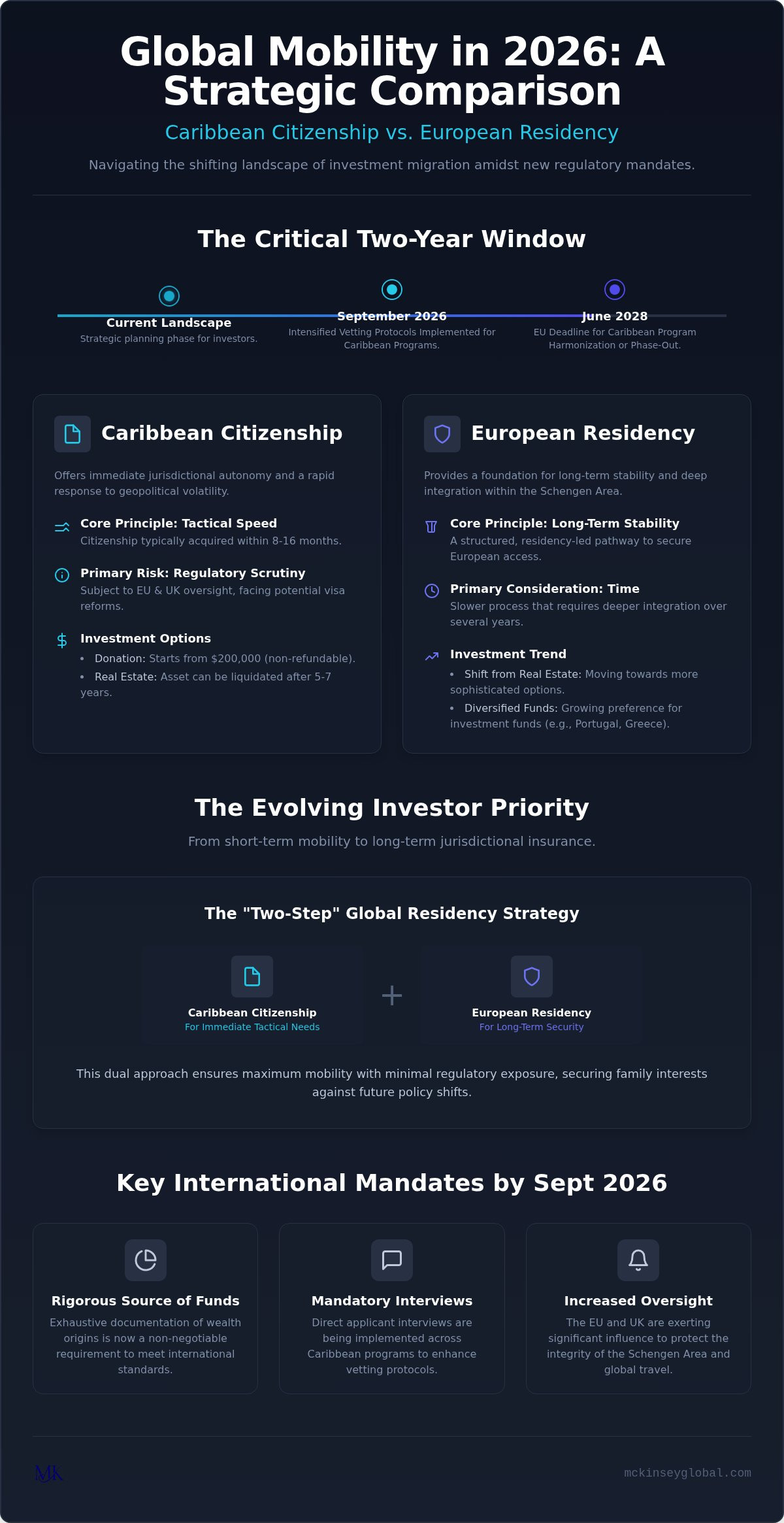
The core distinction between these two paths lies in the speed of acquisition versus the depth of integration. Caribbean programs offer immediate citizenship, often within eight to sixteen months, providing a rapid solution for those requiring a secondary travel document. Conversely, European pathways function as offshore residency for investors, offering a foundation for long term stability within the Schengen Area. While the Caribbean provides tactical speed, European residency serves as a strategic portfolio diversifier that mitigates the risk of sudden policy shifts. The 2026 EU mandate, which requires Caribbean nations to implement enhanced vetting by September, highlights the necessity of choosing a jurisdiction that can withstand international scrutiny.
Shifting Investor Priorities in 2026
Investors have shifted their focus from mobility-only solutions to what we define as jurisdictional insurance. There’s a growing preference for programs that demonstrate robust regulatory compliance, as these are less likely to face future restrictions. This has led to the emergence of a “Two-Step” global residency strategy. Many families are now securing Caribbean citizenship for immediate tactical needs while simultaneously initiating a European residency process. This dual approach ensures that even if Caribbean programs face visa reforms before the 2028 EU deadline, the family’s access to the European continent remains secure through a residency-led pathway.
The Role of Regulatory Oversight
The landscape of Immigrant investor programs is now governed by an unprecedented level of international oversight. Both the European Union and the United Kingdom have exerted significant influence, mandating that Caribbean nations implement mandatory interviews and rigorous source of funds checks by September 2026. These standards are designed to protect the integrity of the Schengen Area and ensure that only the most qualified applicants are approved. While transparency has increased, a disciplined advisory approach allows for the maintenance of confidentiality. We achieve this through meticulous procedural integrity and strict alignment with these evolving global frameworks, ensuring your application meets the highest standards of the 2026 landscape.
Caribbean Citizenship: Tactical Speed and the 2026 EU Mandate
Caribbean programs provide immediate jurisdictional autonomy, offering a rapid response to geopolitical volatility. The “Two-Year Window” refers to the critical period between the implementation of intensified vetting standards in September 2026 and the June 1, 2028, deadline set by the European Union for program phase-outs. When evaluating caribbean citizenship vs european residency by investment, the Caribbean route is characterized by its efficiency; however, the regulatory landscape has become significantly more complex. Applicants must now strictly adhere to the source of funds for citizenship by investment 2026 protocols, which require exhaustive documentation of wealth origins to satisfy international observers.
The decision between a non-refundable contribution and a real estate acquisition remains a primary strategic consideration. While the donation route, typically starting at $200,000 in Dominica or $230,000 in Antigua, offers the lowest entry cost, real estate provides a tangible asset that can be liquidated after a holding period of five to seven years. This choice depends on your preference for capital liquidity versus long-term asset appreciation within a disciplined investment framework. Investors seeking a rigorous breakdown of these trade-offs should consult our detailed analysis of caribbean citizenship real estate vs donation strategies for 2026, which examines the all-in costs and holding periods across key jurisdictions.
Strategic Utility Post-EU Reform
Even as the relationship with the Schengen Area evolves, Caribbean passports retain high utility. They provide essential visa-free access to major global financial hubs, including the United Kingdom, Hong Kong, and Singapore. St. Kitts and Nevis citizenship by investment continues to be the regional benchmark for exclusivity, maintaining a $250,000 minimum threshold that signals stability to global regulators. By aligning with the OECD framework for high-risk CBI/RBI schemes, these programs have proactively addressed concerns regarding financial transparency and tax reporting standards. Additionally, the Antigua and Barbuda investment options remain particularly attractive for large families, offering unique pathways through the University of the West Indies Fund.
The Financial Logic of Caribbean CBI
The financial rationale for Caribbean citizenship is rooted in its low maintenance costs compared to European residency. Once citizenship is granted, there are no recurring residency requirements or mandatory annual renewals. Processing timelines in 2026 have stabilized; St. Kitts and Nevis remains the fastest at approximately 4 to 6 months, while St. Lucia may require up to 16 months for full processing. For investors seeking fiscal efficiency, the Eastern Caribbean jurisdictions offer significant tax benefits of caribbean citizenship, provided the application is managed through a boutique advisory firm that prioritizes procedural integrity and meticulous compliance.
European Residency: Foundation for Long-Term Jurisdictional Stability
European residency programs function as the primary mechanism for establishing a deep, legally recognized connection to the Schengen Area. While the debate over caribbean citizenship vs european residency by investment often centers on the speed of acquisition, the European model prioritizes jurisdictional stability and long-term integration. For the global strategist, residency in an EU member state provides an essential hedge against the volatility often associated with standalone citizenship programs. It ensures permanent access to the European market, facilitating uninterrupted business continuity and providing a secure base for family relocation within a highly regulated environment that values procedural integrity.
The strategic asset of a Golden Visa lies in its ability to offer a “genuine link” to the continent, a factor that European regulators increasingly prioritize. This residency-led pathway allows investors to build a verifiable history within a jurisdiction, mitigating the risks of sudden policy shifts that might affect visa-free travel for non-EU citizens. By securing a foothold in a stable European economy, you ensure that your global mobility is not dependent on the shifting sands of bilateral travel agreements but is instead anchored in a robust legal framework.
The Portugal Golden Visa Framework
The Portugal Golden Visa has undergone a significant transformation, moving away from passive real estate holdings toward a more sophisticated capital deployment model. As of 2026, the primary route to residency involves a minimum investment of €500,000 in qualifying Portuguese investment funds. This shift aligns with the EU’s broader objective of attracting productive capital into the local economy. Investors must now manage their expectations regarding the citizenship timeline, as the required residency period to apply for a passport has been increased to ten years. Despite this extension, the program remains a premier choice for those who value a structured, compliant pathway that requires a minimal physical presence of only seven days per year.
Security and Compliance in the EU Bloc
The Greece residency by investment model offers a tiered entry structure that reflects the country’s economic priorities in 2026. While the baseline investment remains €250,000 for specific projects, the threshold for high-demand areas like Athens, Thessaloniki, Mykonos, and Santorini has been raised to €800,000. Other regional areas typically require a €400,000 commitment. When evaluating the best citizenship by investment programs for family relocation, the European residency path offers superior protections against global policy shifts. It provides immediate access to world-class educational institutions and healthcare systems, ensuring your family’s security is anchored in a jurisdiction with a proven commitment to the rule of law and international standards.
Strategic Comparison: Framework for Jurisdictional Selection
Selecting the correct jurisdiction in 2026 requires a disciplined evaluation of your primary objectives. The choice between caribbean citizenship vs european residency by investment is not merely a matter of price; it’s an assessment of whether you require tactical speed or long-term stability. Caribbean programs offer rapid processing, yet they face the looming June 2028 EU mandate that may impact future travel privileges. European residency, while slower to reach the ultimate goal of a passport, provides a foundation that’s less susceptible to sudden changes in international travel treaties. You must decide if your priority is immediate autonomy or the establishment of a permanent, legally anchored presence within the European bloc.
Investors must analyze the citizenship by investment donation vs real estate strategy for 2026 to understand the total cost of ownership. A donation is a non-recoverable expense that secures immediate status with minimal administrative burden. In contrast, real estate or fund investments involve higher capital outlays but offer a path to eventual capital recovery. We evaluate these options by calculating not only the initial investment but also the long-term costs associated with renewals, physical presence requirements, and potential currency exposure within your broader wealth preservation strategy.
Financial Comparison: Asset Liquidity and Recovery
Recovery timelines vary significantly between these two regions. Caribbean real estate generally requires a five to seven year holding period before liquidation is permitted under program rules. European fund investments, particularly the Portuguese model, are structured to align with the residency period; they often offer professional management that prioritizes capital preservation. While the Caribbean donation route minimizes initial complexity, the capital-heavy residency models in Europe often provide superior long-term value by retaining the underlying asset’s worth. This makes the European path more attractive for those who view migration as an extension of their investment portfolio.
Relocation vs. Mobility: The “Plan B” Test
The final selection often hinges on your family’s immediate relocation needs. Caribbean citizenship is primarily a mobility tool that requires no physical presence, making it an ideal “Plan B” for those who wish to remain in their home country. European residency is a relocation tool that grants the right to live, work, and study within the EU. Many sophisticated investors now adopt a “Citizenship Insurance” model, acquiring Caribbean status for rapid mobility while simultaneously maintaining a European Golden Visa for long-term family security. This multi-jurisdictional approach ensures that your interests are protected regardless of shifts in global policy. Schedule a confidential consultation to develop a customized jurisdictional roadmap that aligns with your 2026 objectives.
Implementing a Multi-Jurisdictional Strategy with McKinsey Solutions
McKinsey Citizenship and Residency Solutions operates with the precision of a global strategist, ensuring that every application adheres to the highest standards of international compliance. The choice between caribbean citizenship vs european residency by investment requires an advisor who understands the nuanced interplay of 2026 regulations. We provide end-to-end support, acting as a meticulous gatekeeper through complex international landscapes to minimize uncertainty. Our approach prioritizes long-term stability and risk mitigation, ensuring that your family’s global interests are secured through a disciplined and transparent process.
The 2026 regulatory environment demands more than just a surface-level understanding of program requirements. It requires a partner who can navigate the intensified scrutiny from the European Union and other international bodies. We manage high-stakes cases with a focus on procedural integrity, ensuring that every variable is aligned with the latest vetting standards. By initiating a confidential briefing, you gain access to a tailored evaluation of your global residency portfolio, allowing for a strategic deployment of capital that balances immediate utility with enduring security.
The Importance of Boutique Advisory
The 2026 EU mandate has introduced a level of scrutiny that necessitates a sophisticated approach to documentation. Specifically, the “Source of Funds” (SOF) protocols now require an exhaustive, forensic-level accounting of wealth origins. We specialize in managing these complex requirements, ensuring that your financial history is presented with absolute clarity and adherence to 2026 standards. A boutique firm provides the discretion and insight necessary to navigate these forensic audits. We don’t just process applications; we engineer a compliant pathway that protects your reputation and your assets throughout the application lifecycle.
Next Steps for the Strategic Investor
Formalizing your 2026 global residency strategy begins with a comprehensive assessment of your mobility, residency, and wealth preservation goals. We match your specific profile to the most resilient programs, whether that involves the tactical speed of St. Kitts and Nevis or the jurisdictional stability of the Portugal Golden Visa. This initial assessment serves as the foundation for a multi-jurisdictional hedge. To begin this process, we recommend the following steps:
- Audit of Jurisdictional Exposure: Evaluating your current travel and residency limitations against the 2026 regulatory backdrop.
- Strategic Program Matching: Aligning family relocation requirements with specific Caribbean or European investment vehicles.
- SOF Readiness Assessment: Preparing detailed documentation to meet the forensic standards required for 2026 vetting.
- Portfolio Finalization: Implementing a structured plan that ensures perpetual global access and long-term family security.
The decision-making process is rigorous. It demands accuracy. We provide that clarity through a methodical and thorough advisory journey. By establishing a multi-jurisdictional strategy today, you ensure that your global mobility remains uninterrupted by future policy shifts.
Securing Your Jurisdictional Future in 2026
The transition from simple passport acquisition to complex jurisdictional diversification defines the current landscape of investment migration. While Caribbean programs offer immediate tactical autonomy, European residency led pathways provide a foundation of enduring stability within a highly regulated bloc. Successfully managing the choice of caribbean citizenship vs european residency by investment requires a meticulous evaluation of your family’s long term mobility and wealth protection goals. Our independent boutique advisory provides the expert guidance on 2026 regulatory compliance necessary to navigate these high stakes transitions with global reach.
We invite you to Consult with McKinsey Citizenship and Residency Solutions to align your capital with a secure and compliant global residency portfolio. With the right strategic alignment, you can maintain maximum global access while effectively mitigating future regulatory risks. It’s a prudent time to establish a legacy that remains resilient against shifting international travel treaties.
Frequently Asked Questions
How does the 2026 EU mandate affect Caribbean citizenship by investment?
The 2026 EU mandate requires the five Eastern Caribbean nations to implement enhanced due diligence and mandatory applicant interviews by September. These directives aim to harmonize Caribbean vetting standards with European security protocols. While visa-free travel to the Schengen Area remains active, the European Union has established a June 1, 2028, deadline for these programs to demonstrate full compliance or face a potential suspension of travel privileges.
What is the fastest way to obtain a second citizenship in 2026?
St. Kitts and Nevis continues to offer the most efficient route for acquiring a second passport, with processing times typically ranging between four and six months. Dominica and Antigua and Barbuda also provide streamlined pathways that generally conclude within eight to nine months. These jurisdictions represent the fastest available options for investors who prioritize tactical speed and immediate global mobility over the longer residency-led models found in Europe.
Can I obtain European citizenship directly through investment?
Direct citizenship by investment is no longer available within the European Union following the closure of the Maltese program in April 2025. Investors must now utilize residency-led pathways, such as the Portugal Golden Visa or Greece Residency by Investment. These programs grant legal residency initially, providing a path to apply for citizenship after five to ten years, provided all statutory residency and integration requirements are met.
What are the main differences between the Portugal Golden Visa and Caribbean CBI?
The fundamental distinction in the caribbean citizenship vs european residency by investment debate involves the speed of status acquisition and the nature of the legal bond. Caribbean programs grant immediate citizenship and a passport within months for a lower capital outlay. Conversely, the Portugal Golden Visa provides residency and a ten-year path to citizenship through a €500,000 fund investment, offering a more stable jurisdictional anchor.
Is real estate or donation a better strategy for offshore residency in 2026?
The optimal strategy depends on your specific requirements for capital liquidity and asset recovery. Non-refundable donations offer the lowest entry cost and administrative simplicity, making them ideal for rapid status acquisition. Real estate investments require a higher initial commitment but allow for capital recovery after a five to seven year holding period. In 2026, European programs have largely shifted toward investment funds, while Caribbean jurisdictions continue to offer both. For a comprehensive evaluation of these trade-offs across specific jurisdictions, our guide on caribbean citizenship real estate vs donation in 2026 provides a detailed framework for capital recovery and holding period analysis.
What are the 2026 vetting requirements for investment migration?
Vetting requirements in 2026 have become significantly more rigorous, characterized by mandatory applicant interviews and forensic source of funds documentation. These standards are enforced through international oversight to ensure absolute financial transparency. Every applicant must undergo a multi-tiered due diligence process that evaluates criminal history, global sanctions lists, and the precise origins of the invested capital to maintain the integrity of the chosen jurisdiction.
How much does it cost to maintain a European residency permit?
Maintenance costs for European residency include recurring government renewal fees, mandatory private health insurance, and administrative costs for maintaining a local legal address. While specific fees vary by jurisdiction, investors should also consider the potential fiscal implications of tax residency if they exceed physical presence thresholds. Unlike Caribbean citizenship, which has negligible maintenance costs, European residency requires ongoing compliance and periodic permit renewals to remain in good standing. Investors weighing these ongoing fiscal obligations against the tax benefits of caribbean citizenship will find that the two models serve fundamentally different wealth optimization objectives.
Can my family be included in a Caribbean citizenship application in 2026?
Most Caribbean programs allow for the inclusion of a spouse, dependent children, and often elderly parents within a single application. Antigua and Barbuda remains particularly attractive for large households, as its University of the West Indies Fund option covers families of six or more. When weighing caribbean citizenship vs european residency by investment, the Caribbean route often provides a more cost-effective solution for securing the mobility of multiple generations simultaneously.