In 2026, the traditional model of domicile-based taxation is no longer an immutable constraint for the global elite, but a variable that can be meticulously managed through sovereign diversification. The tax benefits of Caribbean citizenship represent a sophisticated mechanism for achieving this objective; they offer a robust shield against the increasingly restrictive fiscal policies currently emerging in many home jurisdictions.
You likely recognize that overtaxation on global income and the escalating complexity of international tax compliance are significant threats to long-term wealth stability. This strategic guide illustrates how Caribbean citizenship serves as a cornerstone for legal tax optimization and the preservation of global assets. If you’re seeking to integrate a second passport into a wealth protection plan, our analysis provides a clear framework: it also verifies the 2026 investment requirements for programs in Antigua and Barbuda, St. Kitts and Nevis, Dominica, and St. Lucia.
Key Takeaways
- Understand the 2026 regulatory environment of Caribbean Citizenship by Investment as a sophisticated tool for fiscal diversification and long-term asset protection.
- Evaluate the specific tax structures of the “Big Five” nations, including the personal income tax exemptions found in jurisdictions like St. Kitts and Nevis.
- Learn the critical distinctions between legal citizenship and tax residency, specifically how the 183-day rule governs your global fiscal obligations.
- Discover how to align your investment with specific wealth preservation goals to maximize the tax benefits of caribbean citizenship within a compliant international framework.
- Gain insights into the necessity of professional vetting and bespoke advisory services to ensure procedural integrity throughout the application process.
The Evolution of Caribbean Tax Incentives in 2026
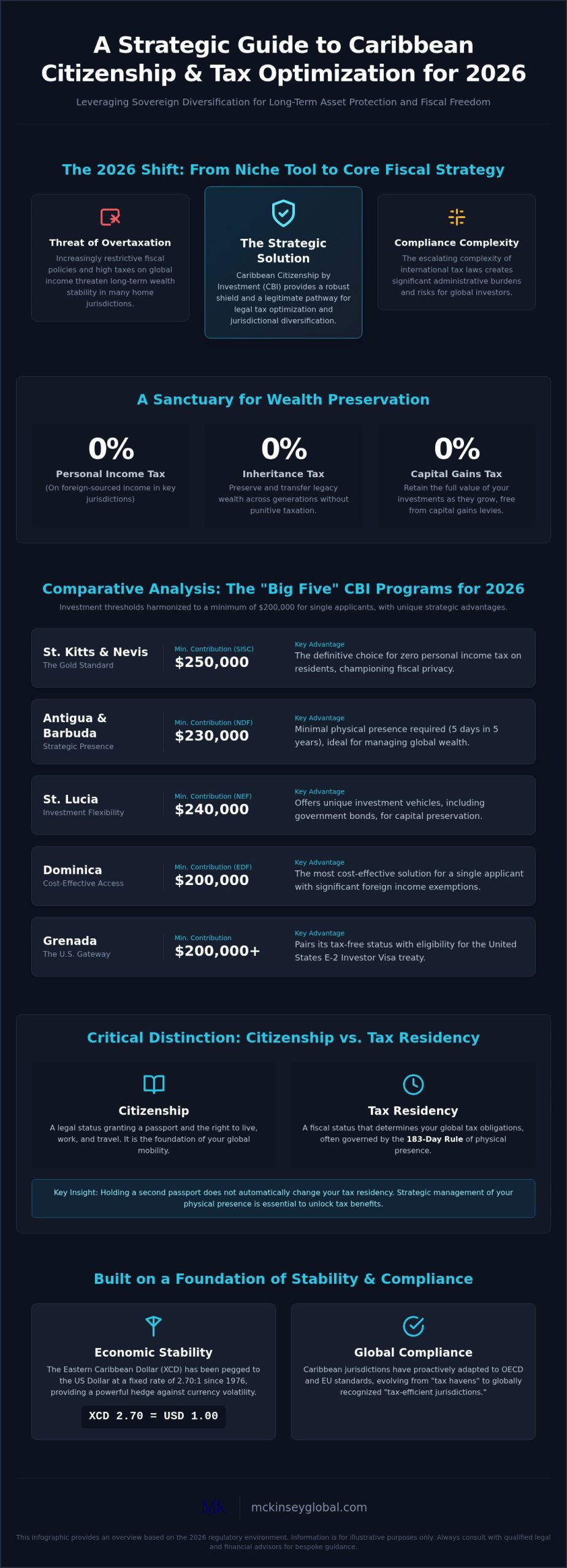
By 2026, the strategic utilization of Caribbean Citizenship by Investment (CBI) has transitioned from a niche mobility tool to a core component of sophisticated fiscal planning. The current landscape is defined by a move toward institutionalized stability; these nations have successfully balanced investor incentives with rigorous international standards. The tax benefits of caribbean citizenship are no longer viewed through the lens of opaque financial secrecy, but rather as a legitimate means of jurisdictional diversification. For the discerning investor, the “Big Five” Caribbean nations, including Antigua and Barbuda, St. Kitts and Nevis, Dominica, and St. Lucia, represent the gold standard due to their established legal frameworks and long-standing commitment to private property rights.
The year 2026 marks a definitive shift in the accessibility and transparency of these programs. Following the regional Memorandum of Understanding signed by the participating heads of government, investment thresholds have been harmonized to a minimum of USD $200,000 for a single applicant. This adjustment reflects a collective commitment to program integrity and sustainable economic development. Despite these higher entry points, the primary appeal remains unchanged: the potential for zero or nominal taxation on global income, inheritance, and capital gains. These jurisdictions offer a sanctuary for wealth preservation in an era of increasingly aggressive fiscal policies in many home jurisdictions.
Fiscal Sovereignty and Investor Appeal
Caribbean nations leverage their fiscal sovereignty to attract foreign direct investment, creating a mutually beneficial ecosystem for the state and the investor. A critical element of this appeal is the stability of the Eastern Caribbean Dollar (XCD). Since 1976, the XCD has maintained a fixed peg to the United States Dollar at a rate of 2.70:1, providing a reliable hedge against currency volatility. In 2026, this stability is a pivotal factor for those looking to secure legacy wealth through a second passport. By aligning one’s personal and fiscal interests with a jurisdiction that prioritizes economic steadiness, investors can mitigate the risks associated with more turbulent global markets.
The Role of Global Compliance Standards
The evolution of these programs is deeply intertwined with global regulatory expectations and the need for meticulous oversight. Caribbean jurisdictions have proactively adapted to OECD and EU tax transparency requirements, effectively shedding the “tax haven” label in favor of being recognized as “tax-efficient jurisdictions.” This transition is essential for maintaining the long-term viability of the passports and the financial systems they support. The historical context of Immigrant investor programs reveals a clear trajectory toward enhanced due diligence and mandatory information exchange. Citizenship by investment is a regulated pathway for international fiscal optimization.
Comparative Analysis: Tax Benefits Across the “Big Five”
While the 2026 regulatory environment has introduced a unified price floor across the region, the specific tax benefits of caribbean citizenship still vary significantly between the “Big Five” nations. St. Kitts and Nevis remains the definitive choice for those prioritizing the absence of personal income tax on residents. With the 2026 Sustainable Island State Contribution (SISC) set at a minimum of USD $250,000, it offers a high-tier entry into a jurisdiction that has historically championed fiscal privacy and zero-tax residents. For global entrepreneurs, Antigua and Barbuda provides a strategic alternative; it requires only five days of physical presence within the first five years, yet offers a robust framework for managing personal wealth through its USD $230,000 National Development Fund option.
Dominica and St. Lucia continue to serve as the most accessible pathways for capital preservation. Dominica’s Economic Diversification Fund requires a minimum contribution of USD $200,000, making it a cost-effective solution for single applicants. According to the Dominica Citizenship by Investment Unit, the program’s legislative structure provides significant exemptions on foreign-sourced income, provided the individual doesn’t meet the local tax residency thresholds. St. Lucia, with its USD $240,000 minimum for the National Economic Fund, offers similar incentives alongside unique investment vehicles like government bonds. For a comprehensive breakdown of the updated thresholds and asset classes available in this jurisdiction, the St. Lucia Citizenship by Investment Program: The 2026 Strategic Guide provides an authoritative analysis of the National Economic Fund, National Action Bond, and approved real estate projects. Grenada distinguishes itself by pairing its local tax-free status with eligibility for the United States E-2 Investor Visa; successful applicants must be domiciled in Grenada for three continuous years to qualify for the US visa application.
Direct vs. Indirect Taxation in the Region
Investors must look beyond personal income tax to understand the full fiscal impact of their second passport. Corporate tax rates for international business companies remain competitive across the CARICOM framework, though they’re increasingly subject to global transparency standards. You should also evaluate indirect costs, such as Value Added Tax (VAT) and property levies, which vary by island. These factors are particularly relevant for those choosing the real estate investment pathway, where holding costs can influence the total return on investment.
Wealth Preservation: Inheritance and Capital Gains
The tax benefits of caribbean citizenship are perhaps most evident when evaluating intergenerational wealth transfer. Most “Big Five” jurisdictions maintain a total absence of inheritance, gift, and wealth taxes, allowing for the seamless transition of assets to heirs without the erosion caused by probate duties. Capital gains exemptions also act as a major driver for portfolio diversification, as investors can reallocate global assets without triggering immediate tax liabilities in their new home of citizenship. A detailed review of these nuances is essential before committing capital. Our advisors provide the clarity needed to navigate these investment pathways with precision; you may consult our strategic specialists to ensure your selection aligns with your long-term fiscal objectives.
Citizenship vs. Tax Residency: Navigating the Critical Distinction
A common misconception among high-net-worth individuals is that acquiring a second passport automatically resets their global fiscal profile. It’s essential to understand that citizenship is a permanent legal status, whereas tax residency is a logistical status determined by physical presence and economic ties. While the tax benefits of caribbean citizenship are substantial, they only manifest fully when a strategic shift in tax residency is executed correctly. In most Caribbean jurisdictions, the 183-day rule serves as the primary metric; staying in the country for more than half a year typically triggers tax residency. However, authorities also evaluate your center of vital interests, which includes the location of your primary home, family, and business activities. Citizenship provides the unconditional right to reside, which is the necessary legal precursor to establishing a new tax home.
The Legal Framework of Dual Citizenship
The “Big Five” Caribbean nations fully recognize dual citizenship, which allows investors to maintain their original nationality while optimizing their global tax footprint. This flexibility is a cornerstone of modern wealth management. Managing obligations between your home jurisdiction and your new citizenship requires a meticulous approach to avoid double taxation. For instance, the Saint Lucia Citizenship by Investment Programme offers a clear pathway to legal status, but the transition must be supported by rigorous documentation. We emphasize the necessity of professional source of funds guidance during the application process to ensure all capital transfers meet global compliance and anti-money laundering standards.
Avoiding Common Pitfalls in Fiscal Planning
Investors frequently face the risk of accidental tax residency through property ownership or prolonged stays without a structured plan. Simply owning real estate in a Caribbean nation doesn’t grant you a tax-free life; it merely provides the infrastructure to build one. A second citizenship should be viewed as a strategic Plan B for mobility that must be paired with specific tax advice from qualified professionals. Working with experienced citizenship by investment consultants who understand the intersection of fiscal planning and international compliance is essential to avoid costly missteps. It’s also vital to understand the role of Tax Identification Numbers (TIN). Obtaining a TIN in your new jurisdiction is often a requirement for opening bank accounts or registering assets, but it must be handled with an understanding of how it interacts with your existing tax obligations. Without this foresight, the tax benefits of caribbean citizenship can be undermined by unforeseen compliance requirements in other countries.
Strategic Implementation: Integrating CBI into Your Portfolio
Integrating a second passport into a broader wealth management strategy requires a methodical, multi-step approach that aligns with your specific fiscal objectives. In 2026, the process begins with a precise definition of your long-term goals; you must determine if your primary focus is immediate income tax reduction, long-term estate planning, or enhanced global mobility. Once these goals are established, the next phase involves selecting a jurisdiction based on its tax treaty networks. While the “Big Five” offer significant tax benefits of caribbean citizenship, their individual agreements with other nations can influence how effectively you can manage cross-border liabilities. This level of strategic foresight ensures that your investment provides a functional shield rather than just a travel document.
The execution phase requires a choice between the real estate vs. donation strategy. With the 2026 price floor harmonized at a minimum of USD $200,000 for contributions, the financial gap between these two pathways has narrowed, making the decision more about liquidity versus asset ownership. Following this selection, you’ll undergo a rigorous due diligence process. Success in 2026 depends on procedural integrity; any ambiguity in your documentation can lead to delays or denials. Finally, your strategy must include a provision for regular reviews of global tax regulations to ensure your structure remains compliant as international standards evolve.
Real Estate Investment as a Tax-Efficient Asset
For many investors, Caribbean real estate serves as a dual-purpose asset that provides both a legal domicile and potential rental yields. In jurisdictions like Antigua or St. Kitts, properties in approved projects can be leveraged for income while you maintain non-resident status. Generally, rental income for non-resident citizens is subject to specific local withholding taxes, which are often lower than the personal income tax rates in high-tax jurisdictions. When comparing these to European residency options, Caribbean real estate often presents a lower entry point with fewer ongoing physical presence requirements, making it a more flexible component for a global portfolio.
Banking and Corporate Structure Advantages
The acquisition of a Caribbean passport often simplifies the process of opening international bank accounts and establishing offshore corporate structures. These jurisdictions provide a stable environment for holding companies that can manage global assets with increased privacy and reduced fiscal drag. Caribbean citizenship facilitates access to global financial hubs by providing the necessary documentation to satisfy stringent international KYC and AML standards. By utilizing a second citizenship to anchor your corporate interests, you create a layer of separation between your personal assets and the shifting political or economic risks of your home country. To begin your journey with a disciplined and authoritative partner, contact our strategic advisors today.
The McKinsey Advantage: Bespoke Advisory for 2026
Navigating the complexities of sovereign diversification in 2026 requires a level of precision that only a boutique advisory firm can provide. As global regulatory environments become increasingly stringent, the margin for error in citizenship applications has effectively vanished. We operate as a disciplined authority, ensuring that every variable of your investment is aligned with long-term stability and risk mitigation. The tax benefits of caribbean citizenship are a powerful tool, but their efficacy depends entirely on the procedural integrity of your acquisition. We don’t just facilitate a transaction; we guide you through a comprehensive wealth preservation strategy that considers the unique needs of your global footprint.
A central component of our advisory is matching specific family objectives to the most suitable jurisdictions. For those prioritizing education or multi-generational security, we evaluate the best programs for family relocation to ensure your new status serves your heirs as effectively as it serves your current interests. McKinsey Citizenship and Residency Solutions acts as a confidential gatekeeper, providing the strategic foresight needed to protect your legacy in an era of fiscal uncertainty.
A Meticulous Approach to Due Diligence
In 2026, the vetting standards across the Caribbean have reached an unprecedented level of rigor. These enhanced protocols, which include mandatory interviews for applicants aged 16 and over, are designed to protect the international standing of the passports. We prepare our clients for this scrutiny by conducting exhaustive internal audits before any documentation is submitted to the government. The importance of providing “clean” and verifiable source of funds documentation can’t be overstated; it’s the primary factor that determines application success in the current regulatory climate. Our role is to ensure that your file is beyond reproach, reflecting the transparency required by global financial institutions. To understand how elite expert citizenship by investment consultants evaluate and structure these applications, our 2026 strategic advisory guide outlines the rigorous standards that define best-in-class practice.
Your Strategic Roadmap to Global Mobility
Every journey toward a second citizenship begins with a customized roadmap that aligns with your specific business and personal goals. We don’t believe in one-size-fits-all solutions; instead, we offer a jurisdictional assessment that weighs the tax benefits of caribbean citizenship against your existing asset structures. Your next step is an initial consultation and a comprehensive briefing from our seasoned consultants. This professional engagement provides the clarity needed to make informed decisions about your future. Secure your global mobility and wealth preservation by engaging with a partner committed to accuracy and procedural excellence. Contact us to schedule your private strategic briefing.
Securing Your Global Fiscal Legacy
In 2026, the landscape of international wealth management demands a proactive approach to jurisdictional diversification. Acquiring a second passport is no longer merely about travel freedom; it’s a calculated move to establish a robust foundation for long-term asset protection. By understanding the specific tax benefits of caribbean citizenship, you can legally optimize your global footprint while adhering to the highest standards of international compliance.
Success in this high-stakes environment depends on meticulous planning and the selection of a jurisdiction that aligns with your unique fiscal profile. Whether your goals involve personal income tax mitigation or the seamless transfer of intergenerational wealth, the “Big Five” nations offer unparalleled opportunities for stability. Our team provides bespoke wealth protection strategies backed by a 5+ year track record and deep expertise in the programs of Antigua, St. Kitts, Dominica, and St. Lucia.
As an independent boutique advisory, we ensure your application meets the industry’s most rigorous vetting standards with absolute discretion. We invite you to Schedule a Strategic Consultation with our Global Advisory Team to begin your jurisdictional assessment. Your future of global mobility and financial security is within reach.
Frequently Asked Questions
Which Caribbean country offers the best tax benefits for investors in 2026?
St. Kitts and Nevis is frequently cited as the premier choice due to its total absence of personal income tax for residents. However, the optimal choice depends on your specific fiscal profile and whether you require corporate advantages or minimal physical presence. Antigua and Barbuda also offers significant tax benefits of caribbean citizenship for those managing global corporations. We recommend a bespoke assessment to align your investment with your long-term wealth preservation goals.
Does a Caribbean passport automatically make me a tax resident?
No, acquiring a passport doesn’t automatically establish tax residency. Citizenship is a permanent legal status, while tax residency is typically determined by physical presence and your center of vital interests. Most Caribbean nations apply the 183-day rule to determine residency for tax purposes. You must carefully plan your physical movements and economic ties to ensure you don’t inadvertently trigger tax obligations in multiple jurisdictions simultaneously.
Are there capital gains taxes in St. Kitts and Nevis?
St. Kitts and Nevis doesn’t levy capital gains taxes on its citizens or residents. This jurisdiction is highly regarded for its favorable fiscal environment, which also excludes taxes on inheritance, gifts, and global wealth. These exemptions make the Federation a strategic hub for investors looking to diversify their portfolios and protect their assets from the erosion of high-tax home jurisdictions. It remains a cornerstone of sophisticated international financial planning.
Can I legally keep my original citizenship while having a Caribbean one?
Yes, all the “Big Five” Caribbean nations, including Dominica and St. Lucia, legally recognize dual citizenship. This allows you to retain your original nationality while enjoying the mobility and security of a second passport. It’s essential to verify that your home country also permits dual nationality to avoid any legal complications. Our advisors provide the necessary procedural guidance to ensure your transition into dual status is compliant and meticulously documented.
What is the minimum investment for Caribbean citizenship in 2026?
As of September 2026, the harmonized minimum investment for Caribbean citizenship starts at USD $200,000. Dominica requires a minimum contribution of USD $200,000 to its Economic Diversification Fund for a single applicant. Antigua and Barbuda follows with a USD $230,000 threshold, while St. Kitts and Nevis requires a USD $250,000 contribution. These figures represent the regional commitment to program sustainability and ensure that each investment effectively supports the host nation’s national development goals.
How does Caribbean citizenship help with US tax planning?
For United States citizens, tax obligations are based on citizenship rather than residency, meaning a second passport doesn’t immediately eliminate IRS liabilities. However, Caribbean citizenship can facilitate strategic business structures and provide a pathway for those considering long-term jurisdictional shifts. Grenada’s unique eligibility for the US E-2 Investor Visa allows citizens to reside and work in the United States, provided they meet the three-year domicile requirement established in recent regulatory updates.
Do Caribbean countries share tax information with other nations?
Yes, Caribbean nations adhere to international transparency standards, including the Common Reporting Standard (CRS) and FATCA. They share financial information with other jurisdictions to maintain their standing with the OECD and the European Union. This transition from “tax havens” to “tax-efficient jurisdictions” ensures the longevity of the programs. While they remain low-tax environments, they operate within a framework of global compliance that prioritizes security and the prevention of financial crimes.
Can my family members also benefit from the tax advantages of my second citizenship?
Family members included in your application as dependents can share in the tax benefits of caribbean citizenship, provided they also meet the relevant residency requirements. Spouses, children, and often elderly parents can be granted citizenship alongside the main applicant. Establishing a collective family residency in a tax-efficient jurisdiction can significantly enhance the efficacy of your estate planning and facilitate the compliant transfer of assets across generations within a stable legal environment.