The most affordable entry point into a second passport is frequently the most expensive choice when measured against long-term asset preservation. While a non-refundable contribution offers a streamlined path to global mobility, the perceived simplicity often masks the strategic advantages of recoverable property assets. When evaluating caribbean citizenship real estate vs donation in 2026, investors must reconcile the immediate liquidity of a donation with the potential for capital recapture through real estate. You likely recognize the tension between these two paths; the desire for a swift, uncomplicated process often conflicts with the instinct to protect and eventually recover one’s principal investment.
This expert comparison provides a disciplined framework to help you evaluate these strategic trade-offs with high-stakes precision. You’ll understand the “all-in” costs of property versus donation, identifying which jurisdictions offer the most efficient processing for 2026 mobility requirements. We’ll examine the specific holding periods for St. Kitts and Antigua, the tax implications of foreign ownership, and the procedural nuances that determine your final success. This briefing provides the clarity needed to align your citizenship goals with a rigorous investment strategy that prioritizes long-term stability and risk mitigation.
Key Takeaways
- Analyze how the 2026 regional Memorandum of Understanding has standardized pricing and vetting protocols to ensure a more predictable and secure application environment.
- Evaluate the strategic trade-offs of caribbean citizenship real estate vs donation by weighing the immediate capital liquidity of a contribution against the long-term recovery potential of property assets.
- Identify the specific holding periods and secondary market regulations that’ll influence the total return on investment for government-approved real estate projects.
- Determine which pathway aligns with your internal cost of capital by calculating the opportunity cost of non-refundable contributions versus the management of tangible foreign assets.
- Understand how it’s possible to minimize processing delays and ensure adherence to 2026 compliance standards through a disciplined approach to pre-submission due diligence.
The 2026 Caribbean Investment Landscape: Donation vs. Real Estate
The Caribbean investment migration sector has entered a period of unprecedented regulatory alignment. For high-net-worth individuals, the decision regarding caribbean citizenship real estate vs donation is no longer solely about the lowest entry price but about the strategic integration of an asset within a global portfolio. The 2026 landscape is defined by a regional Memorandum of Understanding (MoU) that has effectively eliminated the aggressive price competition of previous years. This harmonization ensures that jurisdictional stability and the strength of the passport’s global access are now the primary drivers of investor choice. Sophisticated applicants now view these programs as either a streamlined “Plan B” via donation or a lifestyle investment through tangible property.
The 2026 Pricing Harmonization
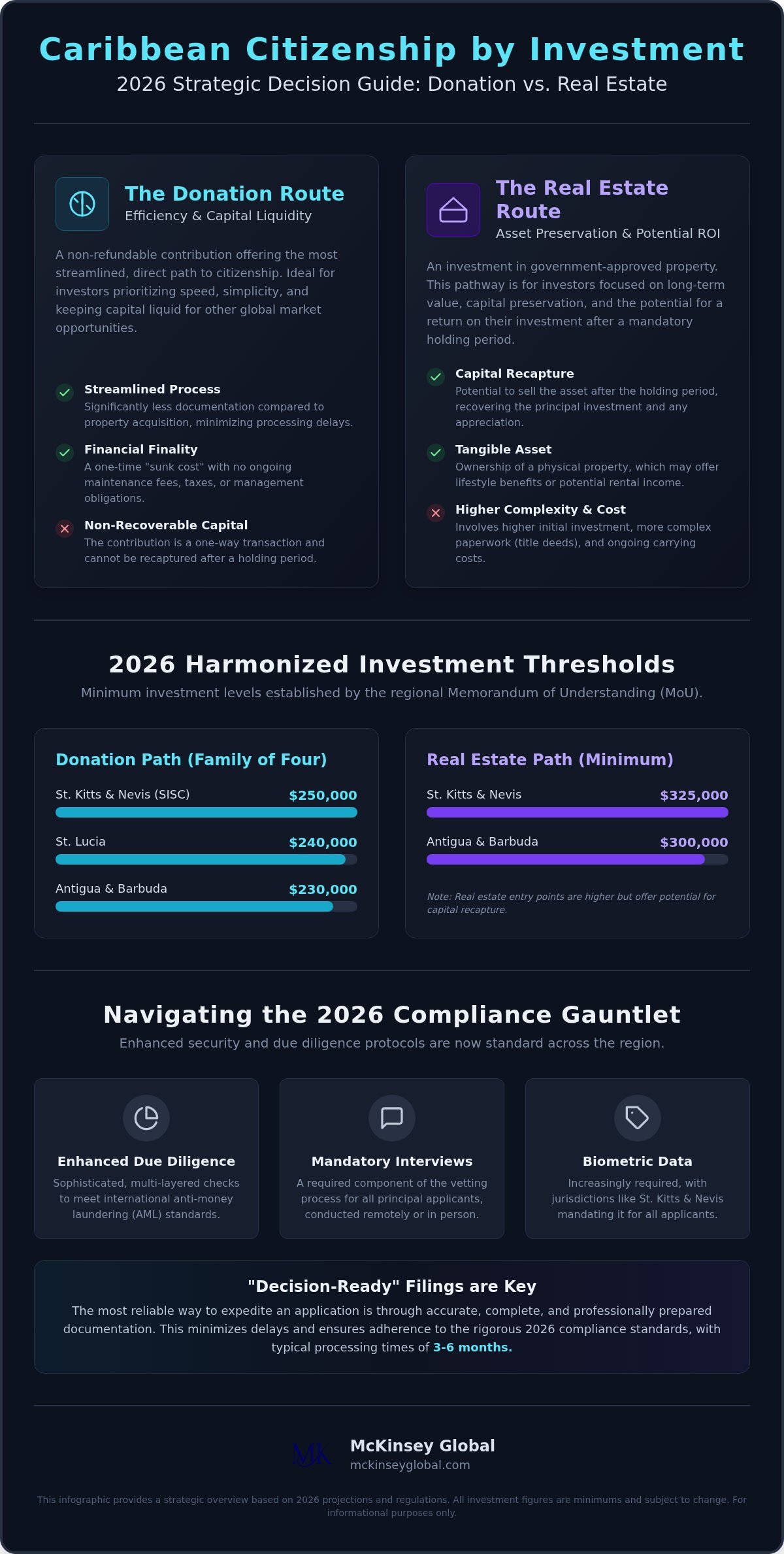
Recent legislative updates have established a standardized floor for investment across the five participating Caribbean nations. While a regional minimum of $200,000 is now the baseline, specific 2026 fee structures reflect the unique value propositions of each island. For instance, Antigua and Barbuda requires a minimum donation of $230,000 for a family of four, while St. Kitts and Nevis has set its Sustainable Island State Contribution at $250,000. St. Lucia currently maintains a $240,000 entry point for its national fund. Evaluating the citizenship by investment donation vs real estate model requires a thorough analysis of these specific fee structures. Investors must account for the fact that real estate entry points remain higher, often starting at $300,000 in Antigua or $325,000 in St. Kitts, but they offer the potential for capital recapture that a donation cannot provide.
Vetting Standards and Compliance in 2026
Security protocols have reached a new level of sophistication to meet international anti-money laundering standards. Every Caribbean nation now employs enhanced due diligence, which includes mandatory interviews and, in several jurisdictions, the collection of biometric data. A broader understanding of these frameworks can be found in the Immigrant Investor Programs Overview, which details how nations utilize foreign capital for national development while maintaining strict security. As of April 1, 2026, St. Kitts and Nevis requires all new applicants to submit biometric data, a move that mirrors the rigorous vetting seen in European programs. Success in 2026 depends on “decision-ready” filings. Processing times, which generally range from three to six months, are heavily influenced by the accuracy of the initial documentation. Procedural integrity is now the most reliable way to expedite an application, regardless of whether you choose the donation or real estate route.
The Donation Route: Efficiency and Capital Liquidity
The non-refundable contribution remains the primary benchmark for investors prioritizing administrative speed and capital liquidity. By selecting the National Development Fund (NDF) or the Sustainable Island State Contribution (SISC), applicants bypass the complexities of title deeds and property maintenance. This “sunk cost” approach is often the most logical path for time-poor professionals who prefer to keep their remaining capital active in global markets rather than tied to illiquid foreign real estate. In the debate of caribbean citizenship real estate vs donation, the contribution route’s chief advantage is its financial finality; once the payment is made, no further carrying costs, insurance premiums, or management obligations exist. For a single applicant, the minimum entry point in Dominica is currently $200,000, while St. Kitts and Nevis requires $250,000 for its SISC model.
Simplicity in Documentation
Contribution-based applications are inherently more streamlined than those involving property acquisitions. Because the financial transaction is a direct transfer to a government-held account, the volume of required documentation is significantly reduced. This simplicity minimizes the risk of Requests for Information (RFIs), which are the most common cause of processing delays. When making a caribbean citizenship vs european residency by investment comparison, it’s clear that Caribbean donation routes offer a more decisive timeline, often concluding in as little as 45 to 90 days in jurisdictions like Dominica. However, investors must recognize that simplicity doesn’t equate to laxity. The European Parliament on Golden Passports continues to advocate for stringent oversight, influencing Caribbean nations to maintain rigorous Source of Funds vetting even for donation-based entries.
Cost-Benefit for Large Families
The donation model offers unique fiscal efficiencies for larger family units. Antigua and Barbuda’s University of the West Indies (UWI) fund is a prime example; it provides a pathway for families of six or more for a contribution of $260,000. This option even includes a one-year, tuition-only scholarship for one family member, adding tangible value beyond the passport. In 2026, the “per-passport” cost in a donation model often decreases as the family size increases, making it a highly competitive alternative to real estate, which usually requires fixed investment amounts regardless of applicant numbers. St. Lucia’s National Economic Fund also provides a structured scaling, starting at $240,000 for a single applicant; investors seeking a detailed breakdown of the National Economic Fund, National Action Bond, and approved real estate options can consult the St. Lucia citizenship by investment program strategic guide for 2026. For families seeking a bespoke fit, a consultation with a specialized migration advisor can clarify which jurisdiction offers the most favorable scaling for their specific structure.
Caribbean Real Estate Investment: Asset Preservation and ROI
While the contribution route is defined by its financial finality, the real estate pathway appeals to investors who prioritize capital preservation over immediate liquidity. By acquiring a tangible asset in a stable jurisdiction, you aren’t merely paying for a passport; you’re securing a recoverable interest in the Caribbean’s luxury hospitality sector. The mechanics involve purchasing a share or full title in a government-approved resort or villa project. In the strategic evaluation of caribbean citizenship real estate vs donation, this route shifts the primary financial consideration from a “sunk cost” to a timed asset hold. Your capital remains active, potentially generating rental income while fulfilling the requirements for citizenship.
Asset preservation is contingent upon the mandatory holding periods established by each nation’s 2026 regulations. These periods are designed to ensure the stability of the local property market and are structured as follows:
- Antigua and Barbuda: A minimum 5-year holding period for approved projects.
- St. Kitts and Nevis: A 7-year holding period before the asset can be resold.
- Dominica: A more flexible 3-year holding period.
- St. Lucia: A 5-year holding period for real estate or government bonds.
Rental yields in these jurisdictions typically range from 2% to 5% annually, though these are often managed through a pool and can be offset by recurring maintenance fees. Capital appreciation isn’t guaranteed and depends heavily on the project’s brand and location, making the initial selection critical for long-term ROI.
The True ‘All-In’ Cost of Property
Many prospective applicants overlook the secondary layer of expenses that accompany the property route. Beyond the $300,000 or $325,000 investment, you’ll encounter post-approval government fees that don’t apply to the donation route. These include stamp duties, closing costs, and professional legal dues required for title transfer. Ongoing maintenance fees and insurance must also be factored into your annual cash flow projections. For a family of four, the real estate route typically carries an “all-in” premium of approximately $50,000 to $80,000 above the donation route once all government levies and maintenance reserves are calculated.
Exit Strategies and Liquidity
Liquidity remains the primary concern for real estate investors in foreign jurisdictions. The secondary market for CBI-approved property is specialized; you’ll often be selling to the next wave of citizenship applicants. In 2026, navigating the resale process requires a clear understanding of the jurisdiction’s specific rules regarding “resellable” status. Selecting a project with a strong independent tourism draw, rather than one solely reliant on the citizenship program, is the most effective way to ensure long-term value and a viable exit strategy.
The Strategic Decision Framework: Which Pathway Fits Your 2026 Goals?
Selecting the optimal route requires a disciplined evaluation of your broader financial objectives. While previous sections detailed the technical costs, a strategic framework must account for the interplay between capital deployment and long-term security. Investors should prioritize a methodical four-step assessment before committing to a specific jurisdiction. This process ensures that the chosen path isn’t just a regulatory formality but a calculated component of a global wealth strategy.
- Step 1: Calculate the internal cost of capital. Determine if the premium associated with property ownership outweighs the potential returns from alternative market investments over a seven-year horizon.
- Step 2: Define mobility and residency requirements. Assess whether your goal is strictly visa-free travel or the establishment of a physical “Plan B” residence for potential relocation.
- Step 3: Evaluate family structure. Consider how dependents affect the “per-head” cost, particularly given the favorable scaling of donation routes for larger groups in 2026.
- Step 4: Assess liquidity tolerance. Gauge your comfort level with holding illiquid offshore assets for the mandatory five to seven-year holding periods.
The Opportunity Cost of Capital
A critical component of the caribbean citizenship real estate vs donation analysis is the opportunity cost of the initial capital outlay. When you factor in post-approval government fees and recurring maintenance, the real estate route often carries a premium exceeding $125,000 compared to a straightforward contribution. For active investors, this capital could potentially generate significant returns in global equities or private equity over the mandatory holding period. If your investment strategy prioritizes high-velocity capital, the donation route’s “sunk cost” is often the more efficient choice. Before proceeding, it’s essential to consult a comprehensive source of funds for citizenship by investment to ensure your documentation is prepared for the rigorous 2026 vetting standards.
Lifestyle vs. Strategic Asset
The maturity of the Caribbean real estate market has transformed property from a mere regulatory requirement into a legitimate lifestyle asset. For HNWIs seeking a physical base in a stable, tax-neutral jurisdiction, the property route offers more than just a passport; it provides a tangible anchor in the region. Understanding the full scope of tax benefits of caribbean citizenship is essential when evaluating whether a property investment in a favorable fiscal environment aligns with your broader wealth preservation strategy. This is particularly relevant when evaluating the best citizenship by investment programs for family relocation, where a secondary home serves as a functional retreat. If your primary goal is the preservation of wealth within a recoverable asset, the illiquidity of property is a calculated trade-off for long-term security. To determine which jurisdiction and investment type align with your specific family profile, request a bespoke program matching session with our senior advisors.
Navigating Compliance and Expediting Your 2026 Application
The acceleration of an application in 2026 is fundamentally linked to the integrity of its initial submission. While anecdotal advice often suggests that certain routes offer inherent speed advantages, the reality is that jurisdictional vetting is now standardized across the Caribbean region. Whether you’re finalizing your choice between caribbean citizenship real estate vs donation, the processing timeline is dictated by the clarity of your documentation and the transparency of your financial history. At McKinsey Citizenship and Residency Solutions, we prioritize a pre-submission audit that mirrors the scrutiny of government units. This disciplined approach ensures that once a file is submitted, it’s “decision-ready,” effectively neutralizing the administrative bottlenecks that often plague less prepared applicants.
Managing 2026 Source of Funds (SOF) requirements is particularly demanding for investors with global portfolios. Regulatory bodies now require granular detail regarding the origin of wealth, often spanning multiple jurisdictions and decades. Our boutique advisory specializes in synthesizing complex financial narratives into compliant, authoritative dossiers. By addressing potential queries before they’re raised, we minimize the likelihood of time-consuming Requests for Information (RFIs). This level of precision is essential in a landscape where mandatory interviews and biometric enrollments, such as those implemented in St. Kitts and Nevis on April 1, 2026, have become the standard. Our role is to act as a meticulous gatekeeper, ensuring that your transition into a second citizenship is both secure and procedurally sound.
The McKinsey Advisory Difference
Our methodology begins with bespoke program matching that accounts for 2026 jurisdictional efficiency. We don’t merely present options; we evaluate how a specific program, such as the Antigua and Barbuda NDF or the St. Kitts and Nevis SISC, aligns with your strategic mobility goals. We manage the entire lifecycle, from the initial document audit to the final issuance of passports. This end-to-end oversight extends beyond the initial approval to include long-term compliance monitoring; this ensures your global asset remains secure through future renewal cycles. By focusing on risk mitigation and procedural integrity, we provide a level of security that’s indispensable for high-stakes international transitions.
Securing Your Global Mobility Asset
The path to a second citizenship begins with a rigorous jurisdictional feasibility assessment. This initial evaluation determines the most viable route by considering your family structure, tax residency goals, and investment preferences. By establishing a clear roadmap from the outset, we ensure that every document is authenticated and every fee is accounted for before the formal filing. Ultimately, a consultant’s primary value lies in their ability to anticipate regulatory hurdles and deliver a flawless application that requires no further clarification from government authorities. We invite you to initiate this process by engaging with our senior strategists to define your 2026 mobility objectives.
Finalizing Your Strategic Path to Caribbean Citizenship
The choice between caribbean citizenship real estate vs donation in 2026 represents a sophisticated trade-off between immediate capital efficiency and long-term asset recovery. While the contribution route offers the most streamlined path for time-sensitive investors, property acquisition provides a tangible anchor in a stable jurisdiction for those prioritizing wealth preservation. Success in this high-stakes environment depends on meticulous adherence to new regional standards; this includes enhanced biometric enrollment and the navigation of increasingly complex financial vetting protocols. As the 2026 landscape continues to prioritize procedural integrity, your choice of investment must align with both your immediate mobility needs and your broader financial legacy.
At McKinsey Citizenship and Residency Solutions, we provide the disciplined oversight required to navigate these evolving international frameworks. Our team offers direct government-approved program experience and specialized expertise in complex Source of Funds documentation. We conduct bespoke risk assessments for HNWI families to ensure every application is decision-ready and aligned with the highest standards of compliance. Secure your global mobility strategy with a McKinsey advisory consultation. We look forward to guiding you through this strategic transition with the precision and discretion your portfolio demands.
Frequently Asked Questions
Which Caribbean citizenship route is fastest in 2026?
The donation route remains the most efficient pathway for investors prioritizing speed. In 2026, Dominica offers the fastest standard processing at 45 to 90 days. St. Kitts and Nevis provides an optional accelerated application process that can reduce wait times to 60 days. While real estate involves property titles and escrow, the donation route’s direct transfer to government funds minimizes administrative friction. This efficiency is critical for those requiring rapid international relocation.
Is the real estate investment refundable after citizenship is granted?
Real estate investments aren’t refundable by the government, but they represent a recoverable asset class. Once you’ve fulfilled the mandatory holding period, you’re permitted to divest and recoup your principal capital. This distinguishes property from the donation route, where funds are non-refundable contributions to a nation’s development. Successful recovery depends on the property’s market value at the time of sale and the strength of the secondary market for qualified assets.
What are the hidden costs of the Caribbean real estate pathway?
Beyond the initial purchase price, the real estate route incurs several significant additional expenses. These include post-approval government fees, stamp duties, and legal costs associated with title transfers. You must also budget for ongoing property taxes, insurance premiums, and annual maintenance fees. These carrying costs can make the total financial outlay considerably higher than the donation route when evaluating caribbean citizenship real estate vs donation options for your family.
Can I sell my CBI property to another citizenship applicant?
Yes, most jurisdictions allow you to sell your approved property to another citizenship applicant after your mandatory holding period expires. This secondary market is the most common exit strategy for global investors. Selling to another applicant ensures the property maintains its “CBI-qualified” status, which often preserves its resale value. However, you must verify that your specific project remains on the government’s list of approved developments at the time you intend to divest.
Does the donation amount increase for larger families in 2026?
Donation thresholds scale according to the number of dependents included in the application. For example, Antigua and Barbuda requires a $230,000 contribution for a family of four, while their University of the West Indies option is $260,000 for families of six or more. St. Lucia and Dominica also employ tiered pricing models. These structures ensure that large families can achieve global mobility through a single, consolidated investment that accounts for every family member.
What is the mandatory holding period for Caribbean real estate in 2026?
Mandatory holding periods vary by jurisdiction and are strictly enforced to ensure local market stability. In 2026, the requirements are as follows:
- Dominica: 3 years.
- Antigua and Barbuda: 5 years.
- St. Lucia: 5 years.
- Grenada: 5 years.
- St. Kitts and Nevis: 7 years.
Divesting before these periods conclude can lead to the revocation of citizenship and the loss of your global mobility assets.
Is the donation route considered more ‘secure’ than real estate?
The donation route is often viewed as more secure from a procedural standpoint because it involves fewer variables. Direct contributions to national funds are less likely to trigger complex Requests for Information regarding property valuations or escrow agreements. However, real estate offers capital security through a tangible asset. Choosing between caribbean citizenship real estate vs donation requires balancing the security of a streamlined process against the strategic security of long-term asset preservation.
How does the Caribbean MoU affect the choice between donation and property?
The regional Memorandum of Understanding has standardized the investment floor at $200,000, effectively ending aggressive price competition between islands. This harmonization shifts the focus from headline costs to jurisdictional strength and vetting integrity. Because pricing is now similar across the region, your choice should be based on a jurisdiction’s long-term stability and the specific mobility benefits offered. The MoU ensures that all pathways now meet rigorous international compliance and security standards.