The most accessible residency program is often the one that entails the highest long-term strategic risk. While the immediate appeal of a European “Plan B” is undeniable, the true differentiator for global investors in 2026 is the structural alignment between an investment vehicle and ultimate citizenship objectives. You likely recognize that securing a foothold in the European Union requires more than just capital; it demands a meticulous navigation of evolving regulatory frameworks and compliance standards. This report provides a definitive analysis of the portugal vs greece golden visa schengen access landscape, focusing on how these premier programs facilitate borderless mobility across 29 countries while maintaining investment security.
We’ll examine the critical implications of Portugal’s revised 10-year naturalization timeline alongside Greece’s new tiered real estate zones and short-term rental restrictions. By evaluating these programs through the lens of high-stakes precision, we offer a clear, low-friction path to permanent residency. This comparison ensures your chosen investment remains a high-performing asset that withstands the complexities of modern EU immigration law while providing the long-term stability your family requires.
Key Takeaways
- Understand how a strategic evaluation of the portugal vs greece golden visa schengen access allows investors to bypass ETIAS requirements and secure unrestricted travel across 29 European nations.
- Navigate the complexities of Greece’s 2026 tiered investment framework, including the strategic implications of the €800,000 premium zone and the prohibition on short-term rentals.
- Evaluate the long-term path to an EU passport by contrasting Portugal’s extended 10-year naturalization timeline with the residency mandates required to maintain Greek status.
- Identify the structural differences between Portuguese private equity funds and Greek real estate conversions to align your capital with your specific risk tolerance and liquidity needs.
- Learn how professional due diligence and end-to-end application management mitigate the risks of regulatory rejection in an increasingly scrutinized international landscape.
The Strategic Value of Schengen Area Residency for Global Investors
High-net-worth individuals (HNWIs) increasingly view residency-by-investment not as a luxury, but as a critical tool for jurisdictional diversification. In an era marked by shifting geopolitical alliances, a “Plan B” residency provides a necessary hedge against volatility. The comparison of portugal vs greece golden visa schengen access highlights two distinct strategic pathways. While both offer a gateway to Europe, the choice between them depends on an investor’s long-term risk appetite and liquidity requirements. It’s no longer just about travel; it’s about securing a position within a stable regulatory environment.
Maintaining a presence in the Schengen Area is essential for modern jurisdictional diversification. As of 2026, this zone encompasses 29 European countries, offering the world’s most significant area of free movement. For global commerce, this region is indispensable. It allows for the seamless transfer of human capital and provides a stable environment for asset protection. Investors prioritize these Mediterranean programs because they offer more than just a travel document. They provide a foothold in a region defined by legal transparency and economic resilience.
Defining Schengen Mobility in 2026
The mechanics of mobility are governed by the 90/180-day rule, which permits residency holders to travel within the zone for up to 90 days in any 180-day period. In 2026, the implementation of the Entry/Exit System (EES) has increased digital scrutiny at borders. However, Golden Visa holders bypass the complexities of the ETIAS travel authorization, enjoying a level of fluid access that standard business or tourist visas can’t replicate. This status eliminates administrative friction. It’s a significant advantage for those who require immediate travel for high-stakes negotiations or personal emergencies.
Economic and Personal Security Benefits
Beyond travel, these programs offer tangible security for an investor’s family. The psychological value of this security is immeasurable. It ensures that a family’s future isn’t tied to the fortunes of a single nation, but is instead anchored in the collective stability of the European continent. Strategic benefits include:
- Access to premier healthcare systems and elite educational institutions across the European Union.
- A guaranteed safe haven in a stable jurisdiction during times of domestic or international unrest.
- Strategic positioning for business interests requiring a physical or legal presence in the European market.
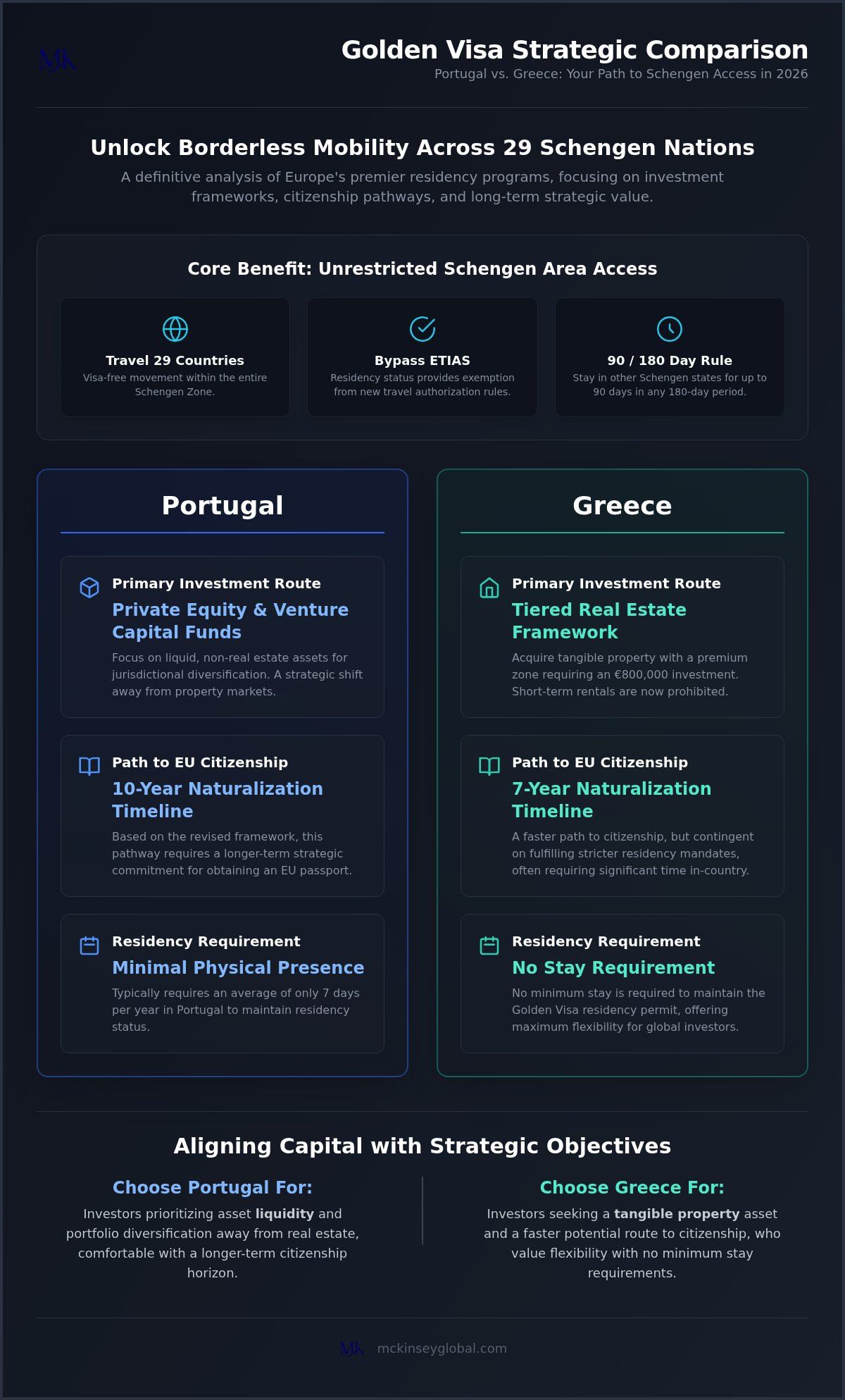
The competitive landscape between Portugal and Greece has intensified. Portugal’s shift toward fund-based investments contrasts with Greece’s tiered real estate model. When evaluating portugal vs greece golden visa schengen access, the decision often hinges on whether the investor prefers the liquidity of private equity or the tangible nature of Mediterranean property. Both pathways require disciplined adherence to compliance standards to ensure the residency remains a high-performing asset.
Mechanics of Mobility: How Golden Visa Residency Grants Schengen Access
The legal foundation of investment migration rests on the conversion of a national residency permit into a regional mobility asset. When analyzing portugal vs greece golden visa schengen access, it’s vital to recognize that both programs issue residence permits based on standardized EU regulations. This status grants the holder the right to enter and move freely within the Schengen Area without the necessity of an additional visa. By 2026, this privilege has become even more significant with the full implementation of the European Travel Information and Authorisation System (ETIAS). While standard visa-exempt travelers must now apply for ETIAS authorization, residents under the Greek Golden Visa program or the Portuguese equivalent are exempt, as their residency status already confirms their adherence to rigorous security protocols.
The 90/180 Day Rule Explained
The 90/180 rule is a rolling window of travel eligibility that permits residency holders to stay in other Schengen states for up to 90 days within any 180-day period. This calculation is continuous, meaning that at any moment of stay, the previous 180 days are scrutinized for compliance. Overstaying this limit can result in entry bans or the potential revocation of the residency permit. For investors managing international portfolios, maintaining a precise log of travel dates is essential to mitigate these regulatory risks.
Border Management and Digital Tracking
The Schengen Information System (SIS) serves as the primary digital architecture for monitoring investor mobility across European borders. In 2026, the Entry/Exit System (EES) has automated this process, replacing traditional passport stamping with biometric registration. Frictionless border crossings now depend entirely on the validity of the physical residency card and its alignment with the digital records held within the SIS. If a card is expired or its data is inconsistent, the probability of administrative delays at internal borders increases.
A significant misconception involves the scope of labor rights. While these programs provide unrestricted travel, they don’t grant the right to seek employment or establish a business in secondary Schengen states like France or the Netherlands. Labor market access is strictly confined to the issuing country. For those seeking to navigate these regulatory boundaries while ensuring their investment remains compliant, a strategic advisory partner can provide the necessary oversight to avoid document rejection or legal pitfalls.
Portugal vs. Greece: Comparative Analysis of Investment Frameworks
The divergence between the Portuguese and Greek investment frameworks reflects a broader shift in European residency policy toward specialized asset classes. While both programs provide a secure gateway to the EU, they cater to different investor profiles through distinct entry thresholds and asset structures. When evaluating portugal vs greece golden visa schengen access, the choice often hinges on whether an investor prefers the tangible nature of Mediterranean real estate or the regulated environment of private equity funds. Each pathway offers unique advantages in terms of capital appreciation and administrative efficiency.
Greece: The Real Estate Powerhouse
Under Law 5275/2026, Greece has implemented a tiered real estate system designed to balance foreign investment with local housing needs. Investors must navigate three distinct zones: Zone A requires an €800,000 minimum for properties in premium areas like Athens and Mykonos; Zone B sets a €400,000 threshold for most mainland regions; and Zone C offers a €250,000 entry point for commercial-to-residential conversions. A critical 2026 regulation prohibits these qualifying properties from being listed on short-term rental platforms, a move intended to stabilize local markets. For a deeper dive, see our Greece Residency by Investment: 2026 Strategic Guide. This model appeals to those seeking high annual rental yields in the long-term residential sector, which reached 4-6% in central Athens this year.
Portugal: The Sophisticated Fund Route
Conversely, Portugal’s Golden Visa Program has evolved into a sophisticated financial instrument, strictly excluding direct real estate acquisitions in favor of CMVM-regulated investment funds. This fund-only model requires a minimum capital contribution of €500,000, appealing to investors who prioritize professional management and tax efficiency over the operational burdens of property maintenance. These funds are often diversified across sectors such as renewable energy or technology, providing a layer of risk mitigation through institutional oversight. This route is particularly attractive for those who value a streamlined, paper-based investment process that doesn’t require physical presence for asset management.
Processing timelines and family inclusion rules also differentiate these programs. Greece offers a significantly faster end-to-end processing time, typically between three and six months, compared to the 12 to 24 months currently seen in Portugal. Both nations provide inclusive family residency, allowing the main applicant to include a spouse, dependent children, and parents. However, the strategic decision between portugal vs greece golden visa schengen access must account for these administrative durations, especially for families requiring immediate mobility. While Greece provides the fastest route to a residency card, Portugal remains a compelling option for those focused on the long-term benefits of a managed investment portfolio.
Beyond Mobility: Evaluating the Path to EU Citizenship
The distinction between temporary travel rights and the acquisition of an EU passport is a critical juncture for global investors. When evaluating portugal vs greece golden visa schengen access, you must distinguish between a mobility tool and a citizenship track. Many investors fall into the “Paper Residency” trap, assuming that a residency permit automatically matures into a passport without significant physical or linguistic integration. This is rarely the case. While Greece offers a robust residency-for-life model, Portugal remains the more viable path for those seeking a second passport without relocating their entire life.
The Portugal Citizenship Advantage
Portugal’s naturalization process underwent a significant structural change on May 19, 2026. The standard residence requirement for naturalization was extended to 10 years for most foreign nationals, while citizens of EU and CPLP countries face a seven-year horizon. Despite this longer timeline, Portugal remains strategically superior due to its minimal physical stay requirements. Investors only need to spend 14 days every two years in the country to maintain eligibility. A 2024 law change also allows the countdown to citizenship to begin from the date the application is submitted, rather than the date of approval. This adjustment mitigates the impact of administrative backlogs, ensuring that your long-term security isn’t compromised by processing delays.
Greece: Permanent Residency as an End Goal
Greece’s Golden Visa is fundamentally designed as a permanent residency solution rather than a direct citizenship track. While the residency permit is renewable every five years indefinitely, obtaining Greek citizenship requires seven years of continuous residency. This mandate requires living in the country for at least 183 days annually. For families who don’t intend to relocate to the Mediterranean, Greece functions as a “Golden Visa for Life.” It’s an ideal choice for those who value the security of a permanent European base and unrestricted Schengen travel without the burdens of naturalization exams or continuous physical presence.
For investors who need to align their family’s global mobility with a compliant and high-performing asset, professional guidance is indispensable. You can explore our strategic citizenship advisory services to determine which timeline best serves your jurisdictional diversification goals. Both programs require a formal declaration of adherence to democratic principles and, in Portugal’s case, an A2-level language proficiency test, making meticulous preparation essential for success.
Navigating Investment Migration: The Role of Expert Advisory
The complexity of the 2026 regulatory environment makes the self-management of residency applications a high-stakes risk. Errors in document legalization, inconsistent proof-of-funds documentation, or a failure to account for the nuances of portugal vs greece golden visa schengen access can lead to immediate rejection. For global investors, the cost of a failed application isn’t just financial; it’s a loss of precious time in a shifting geopolitical landscape. A disciplined advisory partner acts as a meticulous gatekeeper, ensuring that every variable aligns with current EU compliance standards and national laws.
Strategic Onboarding at McKinsey
Our methodology begins with a rigorous evaluation of an investor’s long-term objectives and risk tolerance. We don’t simply process papers; we match individual profiles to the jurisdiction that provides the most stable jurisdictional hedge. Our boutique advisory approach is defined by a blend of legal precision and strategic foresight. By examining the structural differences between Greek real estate and Portuguese funds, we ensure that your capital is positioned for both security and compliance. For those seeking broader diversification, we invite you to explore our Global Residency and Citizenship Strategy for multi-jurisdictional planning.
Case management at McKinsey involves a comprehensive oversight of the entire lifecycle, from the initial due diligence to the final residency card issuance. We manage the intricate details of document legalization and vetting, ensuring that investment pathways remain fully compliant with evolving anti-money laundering (AML) directives. This level of scrutiny is essential when navigating the differing administrative cultures of Lisbon and Athens. Investors who want to understand the precise document vetting protocols and geographic zone strategies involved should review our detailed greece golden visa application process management template to ensure their submission meets the rigorous standards of Law 5275/2026. We also ensure that your migration strategy is perfectly synchronized with your existing wealth management and tax planning structures to avoid unintended fiscal liabilities.
Long-term Compliance Management
Securing a residency permit is only the first step in a multi-year journey toward permanent status or citizenship. We provide ongoing support to monitor renewal deadlines and navigate the technicalities of the new Schengen Information System (SIS) and Entry/Exit System (EES) updates. Our team remains available to manage family additions, such as newborn children or aging parents, and to provide strategic advice when it’s time to liquidate the qualifying investment. This commitment to long-term progress ensures that your European “Plan B” remains a resilient and high-performing asset.
If you’re ready to secure your family’s future with a compliant and strategically sound investment, schedule a confidential consultation with McKinsey Citizenship and Residency Solutions. We provide the clarity and procedural integrity required to navigate the most complex international landscapes with confidence.
Securing Your Jurisdictional Future in Europe
Navigating the complex landscape of portugal vs greece golden visa schengen access requires more than a simple investment; it demands a calculated alignment with your family’s long-term security and mobility goals. Whether you prioritize the streamlined, fund-based citizenship track in Portugal or the tangible, high-yield real estate framework in Greece, the decision must be rooted in meticulous compliance and strategic foresight. The 2026 regulatory environment favors those who treat residency as a sophisticated wealth management tool rather than a mere travel permit.
McKinsey Citizenship and Residency Solutions operates as a boutique advisory with over five years of disciplined procedural integrity. We specialize in high-stakes investment migration, offering deep expertise in both Portuguese private equity funds and Greek property structures. Our commitment to accuracy ensures that your application withstands rigorous vetting processes. To begin your journey with a partner who values order and precision, secure your European residency with a strategic McKinsey advisory session. Your path to borderless mobility and a secure second home in Europe starts with an expert-led evaluation.
Frequently Asked Questions
Does the Greece Golden Visa allow me to live anywhere in the Schengen Area?
The Greek residency permit doesn’t grant the right to establish a permanent domicile in other Schengen member states. While it facilitates unrestricted travel for 90 days within any 180-day period, permanent residence and labor rights are strictly limited to Greece. To relocate to another nation within the zone, you’d need to apply for a specific residency permit under that country’s national laws. This distinction remains vital for investors seeking jurisdictional diversification.
Can I work in Portugal with a Golden Visa residency permit?
Holders of the Portuguese Golden Visa are entitled to live and work in Portugal. This includes the right to establish a business or seek employment within the national territory. However, these labor rights don’t extend to other European Union member states. When evaluating portugal vs greece golden visa schengen access, it’s important to note that while travel is borderless, the legal right to generate income through employment remains geographically constrained to the issuing country.
How does the 2026 ETIAS implementation affect Golden Visa holders?
As of 2026, the European Travel Information and Authorisation System (ETIAS) is mandatory for visa-exempt travelers. However, Golden Visa residency holders are exempt from this requirement. Because your residency permit already involves rigorous security vetting and biometric registration, you may continue to cross internal Schengen borders without additional digital authorization. This exemption reinforces the strategic value of residency status over standard visa-free travel privileges for high-frequency international travelers who value administrative efficiency.
What is the minimum stay requirement to maintain Schengen access in Portugal?
To maintain the validity of your Portuguese residency and its associated travel rights, you must spend an average of seven days per year in the country. In practice, this is satisfied by a physical presence of 14 days during each two-year renewal cycle. This low physical stay requirement is a primary differentiator in the portugal vs greece golden visa schengen access comparison, allowing investors to maintain a global lifestyle while securing their European status.
Which program is faster for obtaining an EU passport, Greece or Portugal?
Portugal offers a more flexible pathway to an EU passport despite the 2026 extension of the naturalization timeline to 10 years. While Greece offers citizenship after seven years, it requires continuous physical residency, meaning at least 183 days per year. Portugal’s minimal stay requirement allows you to reach the application threshold without relocating. Furthermore, Portugal’s policy of counting the residency clock from the date of initial application significantly mitigates the impact of administrative processing delays.
Can I include my adult children in a Golden Visa application?
Both programs allow for the inclusion of adult children, provided they are financially dependent and currently enrolled in full-time education. In Portugal, children must also be unmarried to qualify under the family reunification rules. Maintaining precise documentation of their dependency is essential during each renewal cycle. This provision ensures that the entire family benefits from the security and mobility provided by a Mediterranean residency, facilitating long-term strategic planning for the next generation of global citizens.
What happens to my Schengen access if I sell my investment?
Your residency permit, and the subsequent travel rights it provides, are intrinsically linked to the maintenance of your qualifying investment. If you liquidate the asset before obtaining permanent residency or citizenship, the residency permit will be revoked. For Greek real estate investors, this means the property must remain in your possession throughout the five-year permit term. Strategic liquidation should only be considered after a thorough evaluation of your current residency status and future mobility needs with a qualified advisor.
Is the Portugal Golden Visa real estate route still available in 2026?
Direct real estate investment is no longer a qualifying route for the Portuguese Golden Visa as of 2026. The program has transitioned exclusively to non-real estate assets, such as CMVM-regulated investment funds and contributions to national heritage. This shift contrasts with the Greek model, which continues to prioritize tiered real estate acquisitions. Investors seeking property-based residency in the Mediterranean must now focus on the Greek framework to secure their foothold in the Schengen Area and enjoy borderless mobility.