The best second passport isn’t automatically the one with the broadest visa-free access. Residency gives you permission to live in a country, while citizenship makes you a national and may make you eligible for that country’s passport. Citizenship by investment is a route to nationality through an eligible investment and an application process. Residency by investment grants a different status, even if it may later provide a pathway to citizenship.
It’s understandable to focus on how many destinations a passport can open, but travel access is only one part of a sound decision. Your priorities may also include whether you want citizenship now or a residency pathway, how you expect to use the status, and which program’s requirements fit your circumstances. This article explains the difference between residency and citizenship, why investors consider citizenship by investment, and how to assess passport strength through visa-free travel. A program comparison and practical decision guide will help you identify the factors that matter most for your plans.
Key Takeaways
- Distinguish citizenship, which grants national status, from residency, which provides permission to live in a country.
- Compare investment routes by their requirements and structure, not by headline figures alone.
- Assess passport mobility through visa-free destinations while considering where and how you plan to travel.
- Use your priorities to narrow the options, then explore whether citizenship or residency pathways best align with your plans.
Residency vs Citizenship: What’s the Difference?
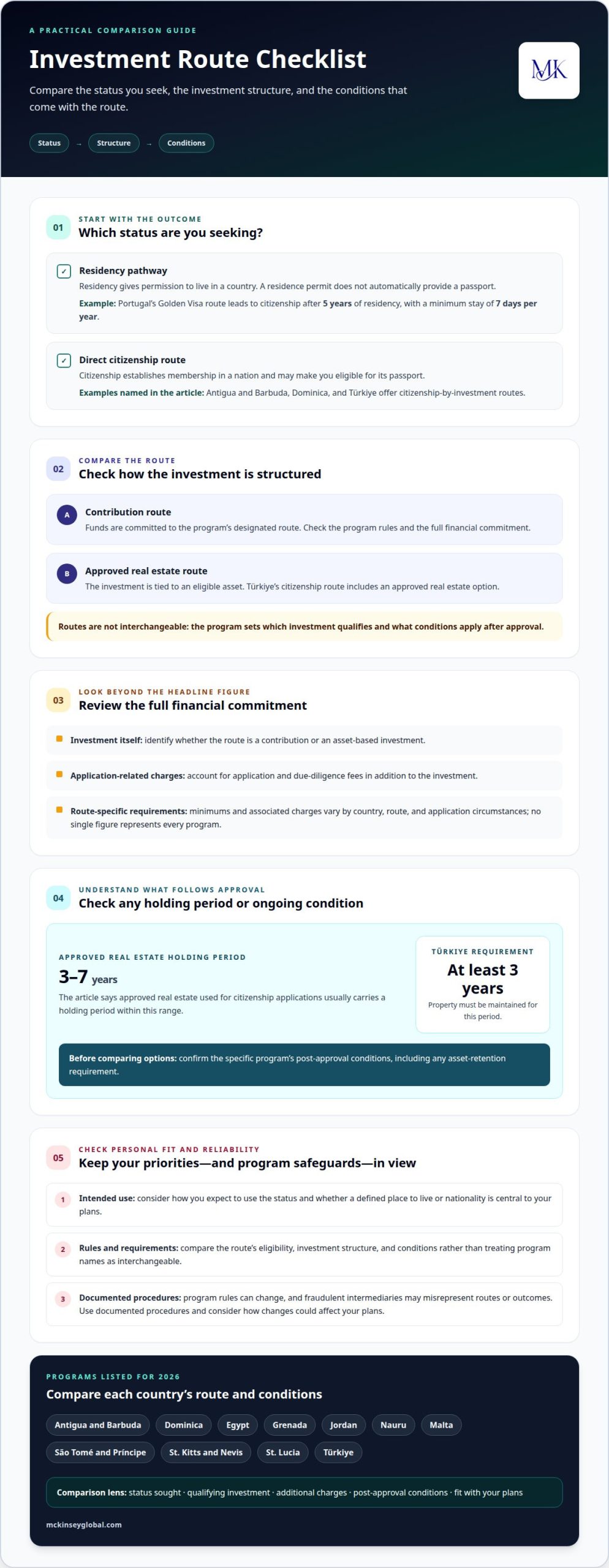
Residency grants permission to live in a country; citizenship establishes membership in that nation. A residence permit does not automatically provide a passport, while citizenship can. Portugal’s Golden Visa route leads to citizenship after 5 years of residency, with a minimum stay of 7 days per year.
Citizenship by descent depends on each country’s nationality laws. Applicants generally need to prove a qualifying family connection with documents such as birth records. Eligibility can depend on the ancestor and generation.
U.S. citizens can hold another citizenship, but that status does not determine their U.S. tax or reporting duties. Consider citizenship alongside income, tax residence, and reporting requirements when evaluating your circumstances.
Citizenship-by-investment options span the Caribbean, Europe, the Middle East, and other regions. Programs listed for 2026 include Antigua and Barbuda, Dominica, Egypt, Grenada, Jordan, Nauru, Malta, São Tomé and Príncipe, St. Kitts and Nevis, St. Lucia, and Türkiye.
| Option | Status sought | Key consideration |
|---|---|---|
| Portugal Golden Visa | Residency pathway | Citizenship after 5 years of residency |
| Antigua and Barbuda | Citizenship by investment | Direct citizenship route |
| Dominica | Citizenship by investment | Direct citizenship route |
| Türkiye | Citizenship by investment | Direct citizenship route |
Choose residency if a gradual pathway and a defined place to live suit your plans. Consider citizenship if nationality and passport access are central objectives.
Investment routes may involve a contribution or investment, as well as application and due-diligence fees. Total costs depend on the route and application circumstances, so no single figure represents every program. Compare the investment structure and additional charges before deciding.
Program rules can change, and fraudulent intermediaries may misrepresent application routes or outcomes. Use documented procedures and consider how a change could affect your plans. The best second passport depends on your goals, preferred region, and whether you seek residency first or direct citizenship.
Why Citizenship by Investment?
Citizenship by investment connects an eligible investment with an application for nationality. Routes differ in how capital is committed, what asset or contribution is involved, and what conditions apply after approval.
Investment Migration Routes
Investment migration includes direct citizenship applications and residency programs that may lead to citizenship later. Citizenship routes may include a contribution or an approved real estate option. A contribution commits funds to the program’s designated route, while real estate ties the investment to an eligible asset. The suitable structure depends on the program’s rules and your priorities.
Minimum Investment Contributions
Minimum requirements vary by country and route, so a contribution threshold cannot be treated as a universal benchmark. Dominica and Antigua and Barbuda offer citizenship by investment, while Türkiye’s route includes an approved real estate option. Approved real estate used for citizenship applications usually carries a holding period of 3-7 years; Türkiye requires the property to be maintained for at least 3 years.
For a practical comparison, separate the investment itself from application-related charges. A contribution route and an asset-based route can involve different financial commitments: one directs funds to a designated contribution, while the other involves acquiring and retaining an eligible asset. The program determines which route qualifies and what conditions apply.
Citizenship-by-investment programs in 2026 include Antigua and Barbuda, Dominica, Egypt, Grenada, Jordan, Nauru, Malta, São Tomé and Príncipe, St. Kitts and Nevis, St. Lucia, and Türkiye. Compare each country’s route, qualifying investment, and post-approval conditions rather than treating program names as interchangeable. That comparison helps identify whether capital commitment or asset retention better fits your plan.
Minimum contributions and associated charges depend on the program, route, and application circumstances. Assess the full financial structure before choosing an option: consider the investment type, any holding requirement, and application charges. A clear comparison focuses on the total commitment and conditions, not just a headline minimum.
What “Passport Strength” Really Means ?
Passport strength describes the travel access associated with a nationality. For investors, compare that mobility with specific needs, including Schengen travel or eligibility for a U.S. E-2 treaty visa.
Passport Mobility and Schengen Access
Mobility measures how conveniently a passport supports entry into other destinations. European passports are described as granting access to 29 countries in the Schengen Zone. That regional access is distinct from a general worldwide mobility ranking. For example, the Czech Republic ranked 14 in the Nomad Passport Index for 2024. Use rankings as comparisons, then assess whether their coverage matches your travel pattern.
The U.S. E-2 is a treaty investor visa, not a passport or citizenship status. A person’s nationality can be relevant to treaty access, while visa eligibility remains a separate consideration. Therefore, a passport offering broad short-stay travel does not automatically provide E-2 access. Investors focused on the United States should treat treaty eligibility as a separate criterion from Schengen mobility.
Passport Travel Access
Visa-free destination totals offer one practical comparison. Antigua and Barbuda citizenship is associated with visa-free access to over 150 destinations, while Dominica’s program is associated with access to over 140 destinations without a prior visa. These figures describe entry access, not permission to settle or work. Compare destinations that matter to your itinerary, rather than relying only on a total.
Access conditions differ by destination and purpose. A traveler may face separate requirements for tourism, business, study, or longer stays. For example, a passport’s short-stay access does not establish eligibility for a U.S. E-2 visa. Separate the travel question from the investment-visa question before weighing each nationality.
Use a three-part assessment: list your frequent destinations, identify any regional priorities, then consider business-related entry needs. A traveler prioritizing Schengen access may weigh the 29-country zone differently from someone focused on the United States. The best comparison connects each passport’s access profile to actual travel plans.
Passport strength and visa-free travel
A passport’s value depends on how its travel access supports your plans. Antigua and Barbuda, Dominica, and Türkiye offer different citizenship-by-investment options, but their practical value depends on the destinations you use. Broad access may matter less than reliable entry to the countries central to your business, family, or travel schedule.
Visa-free access is one measure, not a complete travel assessment. It describes entry without obtaining a visa in advance for a qualifying visit; it does not grant permission to live, work, or study. A business trip and relocation to the same destination, for example, have different purposes. Separate short visits from longer-term plans when comparing passport access.
- Map frequent destinations: identify countries tied to your regular travel, such as client markets or family locations.
- Check travel purpose: distinguish tourism from business, study, or a planned stay abroad.
- Compare relevant access: prioritize destinations that support your own itinerary, not a general ranking alone.
Regional access also deserves close attention. Investors considering European mobility may weigh Schengen travel differently from access to destinations elsewhere. A passport linked to a useful region may suit a particular travel pattern better than one with a higher overall ranking. Assess the destinations and visit purposes that matter to you.
Rankings and destination totals are useful starting points, but they cannot replace a tailored comparison. An investor who travels frequently for business, for instance, may prioritize different entry access from a family focused on leisure visits. Compare access, citizenship route, and personal objectives together; no single passport metric gives a complete measure of value.
To assess which citizenship pathway aligns with your mobility priorities, compare investment citizenship options against the destinations and travel purposes most relevant to you.
Antigua and Barbuda, Dominica, and Türkiye offer citizenship-by-investment options.
McKinsey Citizenship and Residency Solutions: Antigua and Barbuda Citizenship by Investment
McKinsey Citizenship and Residency Solutions helps investors assess citizenship and residency pathways against their objectives. For those considering citizenship, its Antigua and Barbuda Citizenship by Investment offering is one route to explore. St. Kitts and Nevis Citizenship and Dominica are other citizenship options. Greece Residency by Investment may suit readers whose priority is residency rather than immediate citizenship.
The right path depends on your preferred status, travel priorities, and investment approach. Comparing these distinctions can help you focus on programs that fit your circumstances before proceeding with an application.
Contact McKinsey Citizenship and Residency Solutions to discuss your priorities, or visit mckinseyglobal.com.
Turn Your Priorities Into a Clear Next Step
Before deciding, write down what the new status must enable: travel access, a place to reside, or a pathway to citizenship. Then rank those priorities and compare each program against them. This simple exercise keeps a complex decision focused on practical outcomes rather than passport rankings alone.
The best second passport is the one that aligns with your mobility needs, investment approach, and long-term plans. McKinsey Citizenship and Residency Solutions offers Antigua and Barbuda Citizenship by Investment and St. Kitts and Nevis Citizenship, as well as Greece Residency by Investment. These are distinct pathways to consider as you refine your criteria.
When you are ready to discuss which route fits your objectives, contact McKinsey Citizenship and Residency Solutions. A considered next step can bring greater clarity to your international planning.
Frequently Asked Questions
What are the best second passports for U.S. citizens in 2026?
For U.S. citizens, the right option in 2026 depends on whether direct citizenship, regional mobility, or a residence pathway matters most. Antigua and Barbuda, Dominica, St. Kitts and Nevis, St. Lucia, and Türkiye are among the citizenship-by-investment programs available. Compare each route against your intended travel, investment structure, and family plans rather than treating one passport as universally superior.
How long does it take to obtain a second passport through investment or naturalization?
Timelines vary by route and application; Dominica’s citizenship-by-investment application timeline is around 3 months. Naturalization follows a different process, because eligibility generally depends on qualifying residence and the destination country’s requirements. Separate the time needed to qualify for citizenship from the later steps involved in applying for a passport. A program’s application timeline alone does not describe every stage.
Which second passports offer the strongest visa-free travel access?
No single passport is strongest for every traveler; the most useful one depends on the destinations and visit purposes that matter to you. Compare access to your regular business and personal destinations, then distinguish visa-free entry from visa-on-arrival or other entry procedures. Consider whether you need short visits or longer stays, since visa-free access does not itself provide residence or work rights.
Do countries that offer second citizenship require residency or language tests?
Requirements depend on the country and citizenship route. A direct citizenship-by-investment application differs from naturalization after residence, where residence conditions and language or civic requirements may apply. Before comparing programs, identify the exact route and review its eligibility criteria, presence obligations, and assessment requirements. This helps distinguish an investment application from a longer, residence-based path to citizenship.
How do Caribbean citizenship-by-investment programs compare on cost, processing time, and travel access?
Caribbean programs differ by investment route, application charges, processing timelines, and destination access. Dominica’s application timeline is around 3 months, while route structures and travel access vary among Antigua and Barbuda, St. Kitts and Nevis, and St. Lucia. Compare the full financial commitment, including applicable non-investment charges, alongside the destinations you expect to visit. A headline contribution alone cannot represent total outlay.
What documents and steps are required to apply for a second citizenship and passport?
Applications commonly involve identity and civil-status records, information about family members, and documents supporting the investment and source of funds. Start by identifying the program and applicant details, then assemble records in the format required for that application. The citizenship application and passport application are separate stages: the passport follows citizenship approval. Keep names and dates consistent across records to reduce avoidable processing issues.