
Is the lowest Caribbean investment threshold also the cheapest route for your family? Not necessarily. The cheapest caribbean citizenship by investment 2026 depends on who is applying, which qualifying route fits, and the fees added to the headline contribution. Dominica’s single-applicant entry point is $200,000, but that figure alone does not establish the total outlay for a particular applicant.
Starting with the minimum contribution is a reasonable way to compare programs, but government charges, due diligence, interviews and other application costs can change the overall calculation. Family size and priorities matter, too. A route that looks economical for one applicant may be less suitable for a household with dependants or specific mobility and planning needs.
This comparison examines five Caribbean programs through their practical cost drivers, applicant profiles and strategic considerations, rather than ranking them by contribution alone. You’ll find what to include in an all-in assessment, which options may merit closer review for a single applicant or family, and how changing requirements can affect a shortlist. The aim is to help you balance affordability with compliance and long-term fit.
Key Takeaways
- Compare programs using the full mandatory outlay for your applicant profile, not the qualifying investment figure alone.
- Keep donation and approved real-estate routes separate, and distinguish investment amounts from government, due-diligence and other application charges.
- The cheapest caribbean citizenship by investment 2026 can vary by household size, route preference and strategic priorities.
- Use the comparison and decision matrix to identify which programs merit closer review for a solo applicant, couple or family.
- Record the date of each official fee schedule and eligibility rule so your shortlist reflects current requirements.
What does cheapest Caribbean citizenship by investment mean in 2026?
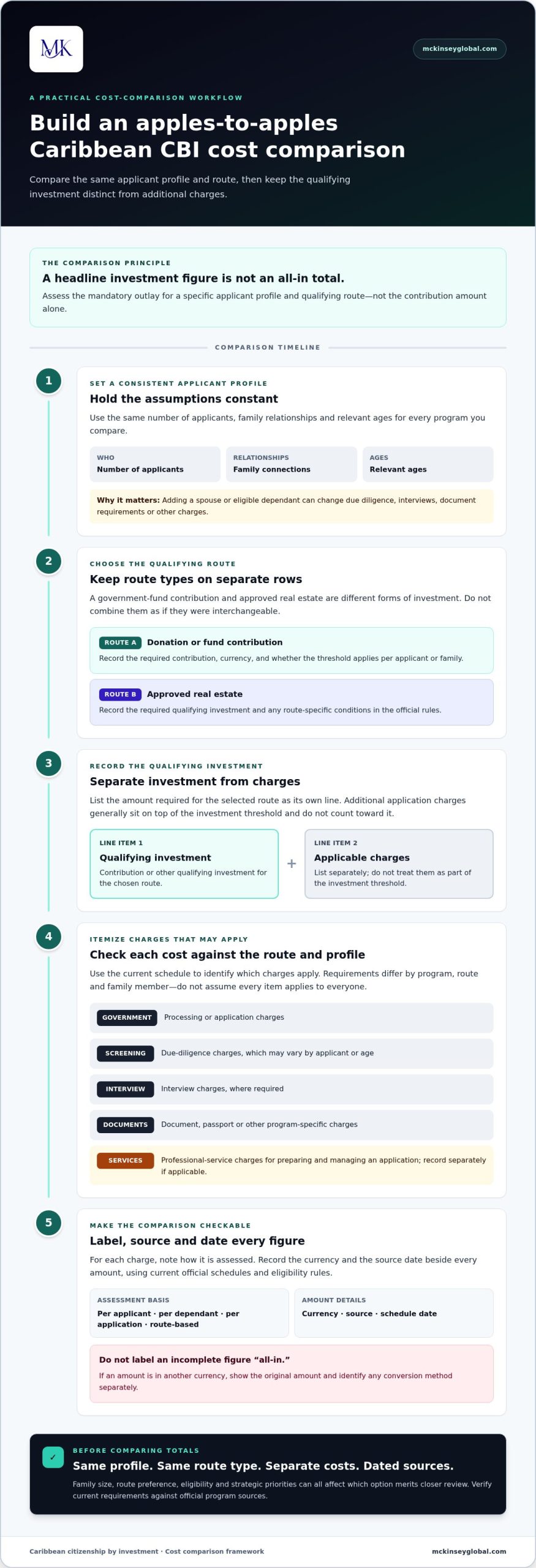
The phrase cheapest Caribbean citizenship by investment 2026 should mean the lowest comparable mandatory outlay for a specific applicant profile and qualifying route, not simply the smallest advertised entry point. To make a useful comparison, hold the assumptions constant: use the same number of applicants, the same family relationships and ages, and a clearly identified route for each program.
This matters because citizenship-by-investment programs can offer different qualifying investment types and charge different application fees. A contribution to a government fund is not equivalent to an investment in approved real estate. Neither should be combined with fees as if every dollar served the same purpose. For general background on investment types and the development of these programs, see Citizenship by Investment on Wikipedia.
Why the headline investment is not the whole cost
The qualifying investment is the amount required for the selected route. Depending on the program, it may be a contribution or another qualifying investment. Other charges are separate and may be payable on top of that amount; they generally do not count toward the investment threshold.
For a comparable estimate, list each potentially applicable charge and note whether it is assessed per application, per applicant or per dependant. Depending on the program and route, the schedule may include:
- Government processing or application charges;
- Due-diligence charges, which may vary by applicant or age;
- Interview charges, where required;
- Document, passport or other program-specific charges; and
- Professional-service charges for preparing and managing an application.
Do not assume every item applies to every program, route or family member. Requirements differ, and an approved real-estate route may involve considerations that do not apply to a contribution route. Compare the cost categories that apply to your chosen route, keeping the investment amount separate from charges that are not credited toward it.
Why one program cannot be cheapest for every applicant
A single applicant and a family are not necessarily comparing the same application. Adding a spouse or other eligible dependant can change how many people are subject to due diligence, interviews, document requirements or other charges. The effect depends on current program rules, including how eligible relationships are defined and whether a dependant’s age affects eligibility or fees.
For example, a household should not multiply a single-applicant estimate by the number of family members and treat the result as a reliable total. Some contributions or routes may use family-based thresholds, while individual charges may still apply. Before comparing schedules, identify each applicant’s relationship and age, then establish which dependants can be included under the applicable rules.
Affordability is only one decision factor. Route preference, eligibility, family composition, mobility objectives and tolerance for financial or procedural commitments all shape strategic fit. Verify each 2026 contribution threshold, fee, eligibility condition and program change against official program sources, and record its publication or effective date. A date-stamped comparison makes your assumptions clear and easier to revisit if requirements change.
How to compare the full cost of Caribbean citizenship by investment
A reliable comparison uses the same applicant assumptions for each program and separates the qualifying investment from additional charges. Put donation and approved real-estate routes on separate rows: they involve different forms of investment and should not be presented as interchangeable ways to meet one threshold. For route-level context, the donation versus real-estate strategy guide explains why the route itself affects the comparison.
Use a worksheet like this for every program under review. Fill in each field from a current official schedule, and do not present an incomplete figure as an all-in total.
| Route | Qualifying investment | Mandatory charges | Applicant profile |
|---|---|---|---|
| Donation or fund contribution | Required contribution; record currency and whether the threshold is per applicant or family | Applicable government, due-diligence, processing, interview and document charges | Number of applicants, relationships and relevant ages |
| Approved real-estate route | Required qualifying investment; note any route-specific conditions in the official rules | Applicable government and application charges; list other required costs separately | Same family and age assumptions used for the donation comparison |
Mark each charge as per applicant, per dependant, per application or route-based, as specified in the official schedule. Record the currency and source date beside every amount. If a figure is in another currency, show the original amount and identify any conversion method separately rather than mixing currencies without explanation.
Which charges belong in an apples-to-apples comparison?
Build the mandatory total from official charges that apply to the selected route and applicant profile. Check government processing, due diligence and interview requirements individually. Include document or other charges only where current rules make them applicable. If a charge varies by age or dependant, calculate it for the actual family composition rather than copying a single-applicant example.
Keep professional advisory fees and third-party expenses distinct from government-imposed charges. If an expense is discretionary, uncertain or dependent on an applicant’s circumstances, exclude it from the mandatory total and show it separately with a clear explanation. This makes the comparison more transparent without implying that every applicant will incur the same additional costs.
How to keep 2026 figures accurate
For each entry, retain the official source, currency, effective or publication date, route and applicant assumptions. For example, the Dominica Citizenship by Investment Official Website is a primary reference for that program’s current information. Apply the same source standard across the comparison instead of mixing government schedules with secondary summaries.
Separate rules currently in force from proposals, policy announcements or commentary that has not become an effective requirement. Recheck schedules before publication and remove or date any figure that cannot be verified. This method gives readers a more defensible basis for assessing the cheapest caribbean citizenship by investment 2026. For a structured review of routes and applicant assumptions, investment migration application guidance can help organize the comparison.
Caribbean citizenship programs compared: where affordability differs
The table compares qualifying route thresholds and selected mandatory charges, not complete application totals. All amounts are in US dollars. The reference dates come from secondary reporting rather than dated official fee schedules, so treat the figures as comparison inputs, not confirmation of current official fees. Before relying on a total, verify each figure, route and family assumption against the relevant government program source.
| Program | Route categories and qualifying amount | Known mandatory charges and applicant assumptions | Reference date and verification status |
|---|---|---|---|
| Antigua and Barbuda | NDF contribution: $230,000 for a single applicant or family of up to four; UWI Fund: $260,000 for a family of six or more; approved real estate: $300,000; business: $400,000 joint investment or $1.5 million for a single investor. | NDF processing: $10,000 single applicant or $20,000 for family up to four. Due diligence: $8,500 main applicant, $5,000 spouse; other dependants vary. | Secondary references dated July to October 2026; verify official schedule and applicable charges. |
| Dominica | EDF contribution: $200,000 single applicant or $250,000 family of up to four; approved real estate: $200,000. | Virtual interview applies to applicants aged 16 and over. Other applicable charges depend on applicant profile and route. | Secondary references dated April to October 2026; verify official schedule and fees. |
| Grenada | NTF contribution: $235,000 for a single applicant or family of up to four; approved real estate: $270,000. | Interview fee: $1,000 per applicant aged 17 or over. Other charges require profile-specific verification. | Secondary references dated September 2026; verify official schedule and fees. |
| St. Kitts and Nevis | SISC contribution: $250,000 for a single applicant or family of up to four; approved developer real estate: $325,000; approved private property: $600,000. | Due diligence: $10,000 main applicant and $7,500 per dependant aged 16 or over. Main applicant interview required. | Secondary references dated 2026; verify official schedule and fees. |
| St. Lucia | NEF contribution: $240,000 for a single applicant or family of up to four; approved real estate: $300,000; National Action Bonds: $300,000 plus $50,000 administrative fee. | Interview required for applicants aged 16 and over. Other charges require profile-specific verification. | Secondary references dated July to September 2026; verify official schedule and fees. |
Compare route structures, not just country names
A contribution and an approved real-estate investment represent different capital commitments. Real estate ties funds to an asset and program conditions; a contribution does not provide an equivalent property interest. Do not assume either route offers a particular resale value or recovery timetable. Antigua and Barbuda’s official citizenship program information is one primary reference for checking its route rules. For route-level context, review the Antigua and Barbuda investment options guide.
What the comparison can conclude
Dominica has the lowest stated contribution threshold for a single applicant among these reference figures, but the available charges do not support declaring it the lowest verified all-in total. Family composition and remaining fees prevent a like-for-like conclusion across all five programs. Grenada provides an additional market comparison. Keep passport access and processing considerations separate from affordability, and verify current details against official sources. The St. Kitts and Nevis strategic guide provides further country-specific context.
Which Caribbean citizenship option may fit your applicant profile?
Build your shortlist around the people applying and the purpose of the citizenship, not a label such as “best for families.” The matrix below shows where to focus your comparison; it does not determine eligibility or declare a lowest-cost winner. For each program, use the same family composition and route type, then apply current official rules to the estimate.
| Applicant profile | Programs to examine | Questions that shape fit |
|---|---|---|
| Solo applicant | Antigua and Barbuda, Dominica, Grenada, St. Kitts and Nevis, and St. Lucia | Does the qualifying route match your preference for a contribution or an approved real-estate investment? Which individual charges apply, and do mobility objectives align with current destination entry rules? |
| Couple | Compare all five using two named applicants and the same route category | How do spouse eligibility, due-diligence charges, interview rules and any family-based threshold affect the full outlay? |
| Family with dependants | Compare all five using each dependant’s relationship and age | Which relatives qualify under current definitions? Which charges apply per person, and do any route thresholds or family options change the calculation? |
Use the matrix as a screening tool, not an eligibility determination. A dependant’s age, relationship to the main applicant or other program-specific conditions may affect whether they can be included and which charges apply. Check those definitions for each jurisdiction before calculating a family total. Do not assume a relative qualifies simply because another program accepts the same relationship.
How family composition changes the affordability question
For a fair comparison, define one consistent household profile and apply it to every program. Identify each applicant, state their relationship to the principal applicant, and record ages where relevant. Then check how each country treats that exact profile and whether published amounts are assessed per person, per application or per family. If eligibility or a fee category is unclear, leave the total unresolved rather than filling the gap with an assumption.
This process shows why the lowest qualifying contribution may not produce the lowest total outlay. A threshold may be structured for a family while additional charges are assessed individually, or dependants may face different requirements. Only a fully matched profile supports a meaningful cost comparison.
Balance cost against route, mobility and long-term plans
Donation and real-estate routes make different demands on capital. A contribution is not a property asset; a real-estate route ties funds to an investment subject to program conditions. Compare those commitments alongside liquidity needs and personal preference, without assuming a property can be resold or funds recovered on a particular timetable.
Mobility objectives also need current verification. Visa-access arrangements and destination entry rules can change, so assess the countries you expect to visit against up-to-date official information rather than relying on a passport ranking. For a closer country-level review, the Dominica passport investment guide provides additional context. For a profile-based review of Caribbean application routes, see citizenship application guidance.
How to verify a 2026 Caribbean citizenship option and proceed with confidence
A sound shortlist is only as reliable as the information behind it. Before choosing a program, follow a documented sequence that connects your objectives and applicant profile to current official rules. This helps test whether the apparent cheapest Caribbean citizenship by investment 2026 remains affordable after accounting for the selected route, family composition and applicable charges.
A practical verification sequence before selecting a program
- Define your objectives. Clarify why you are considering citizenship, which destinations matter to your mobility plans, and whether you prefer a contribution or an approved real-estate route. Keep those priorities distinct from cost so a low threshold does not determine the shortlist by itself.
- Set the applicant assumptions. List the principal applicant and each proposed dependant, including relationships and ages. Use the same profile for every country, then verify eligibility and charges against each program’s current requirements.
- Check official schedules. For each amount or rule, record the official program or government source, currency, publication or effective date, route, and whether the charge applies per person or per application. Include contribution thresholds, processing and due-diligence charges, and relevant eligibility conditions.
- Establish the status of changes. Distinguish requirements in force from proposals, announcements and measures awaiting implementation. Do not include a proposed change in the current total as if it were effective; note it separately and revisit the official source.
- Recalculate and assess fit. Add only charges that apply to the defined profile and route, keeping discretionary expenses separate. Then weigh the comparison against route preference, mobility objectives and longer-term plans.
Record a source date for every cost and eligibility detail, not just the headline contribution. If an official schedule is undated or a fee cannot be verified, mark that part of the comparison as unresolved rather than carrying forward an older estimate. Revisit the material before making a decision, since program rules and charges can change.
How professional guidance supports a considered decision
Accurate figures are one part of a sound application plan. Preparation also involves organizing applicant information, understanding the applicable eligibility criteria and coordinating the steps required for a complete submission. Due diligence is a program process, not a promise of approval; application guidance cannot guarantee a decision or a processing timetable.
McKinsey Citizenship and Residency Solutions provides end-to-end guidance for investment-based citizenship and residency applications, including advisory coverage for Antigua and Barbuda, Dominica, St. Kitts and Nevis, and St. Lucia. Its guidance helps structure the comparison around objectives, routes, family composition and compliance requirements, rather than treating one contribution figure as a universal answer.
For a tailored review of your priorities and applicant profile, explore Caribbean citizenship strategy guidance.
Turn your shortlist into a considered next step
A strong decision does not require choosing the lowest figure in isolation. It requires a clear record of what matters most to you, which trade-offs you can accept, and what information still needs verification. That framework also makes it easier to revisit your shortlist if program rules or your family’s priorities change.
Use the comparison as a starting point for a decision tailored to your circumstances. The cheapest caribbean citizenship by investment 2026 may not be the route that best supports your wider plans. A considered choice weighs affordability alongside eligibility, investment preference and long-term objectives.
For structured guidance on your Caribbean options, discuss your citizenship priorities with McKinsey Citizenship and Residency Solutions.
Frequently Asked Questions
Do I have to live in a Caribbean country after obtaining citizenship by investment?
Usually, acquiring citizenship does not by itself mean you must relocate, but program-specific obligations may apply. For example, Antigua and Barbuda requires a five-day visit within the first five years of citizenship, while Dominica requires in-person travel to collect and renew passports. These are distinct from a general requirement to live in the country. Review the current rules for your selected program and plan for any required travel.
Does Caribbean citizenship automatically change my tax residence?
No. Citizenship and tax residence are separate concepts, and obtaining a second citizenship does not automatically determine where you are tax resident. Your residence may depend on the domestic tax rules of the countries connected to you and your personal circumstances, such as where you live or work. Before applying, consider how the change may interact with your existing tax obligations and obtain advice suited to your circumstances.
Can a Caribbean citizenship-by-investment application include dependent family members?
Yes, some programs allow eligible family members to be included, but categories and conditions differ by jurisdiction. Do not assume a spouse, child or other relative is eligible based on another country’s rules. Age, relationship and dependency status may affect eligibility or required supporting documents. Identify each proposed applicant and verify the selected program’s current definitions before relying on a family-based cost estimate.
Is visa-free travel from a Caribbean passport guaranteed permanently?
No. Visa-free or visa-on-arrival access depends on agreements and entry rules that can change, and each destination may set its own conditions. A passport’s current access is not a permanent guarantee or assurance that every trip will be visa-free. Before travelling, check the destination government’s current entry requirements for your nationality, purpose of visit and travel dates, including transit requirements.
Are the five Caribbean citizenship programs governed by identical rules?
No. Antigua and Barbuda, Dominica, Grenada, St. Kitts and Nevis, and St. Lucia each administer distinct program requirements. Their qualifying routes, applicant and dependant criteria, charges, interviews and other obligations can differ. That is why the cheapest caribbean citizenship by investment 2026 for one profile may not be the most suitable or economical for another. Compare each program’s current official rules rather than assuming a regional standard applies uniformly.
What happens if a citizenship-by-investment application is refused?
A refusal means citizenship is not granted through that application, but the next steps depend on the relevant program’s rules and the reasons given. Read the official decision carefully, note any review or appeal procedure and deadline, and establish how the program treats fees already paid before deciding whether to pursue another route. Do not assume a new application will succeed or that charges will be refunded; confirm the applicable terms with the program authority.