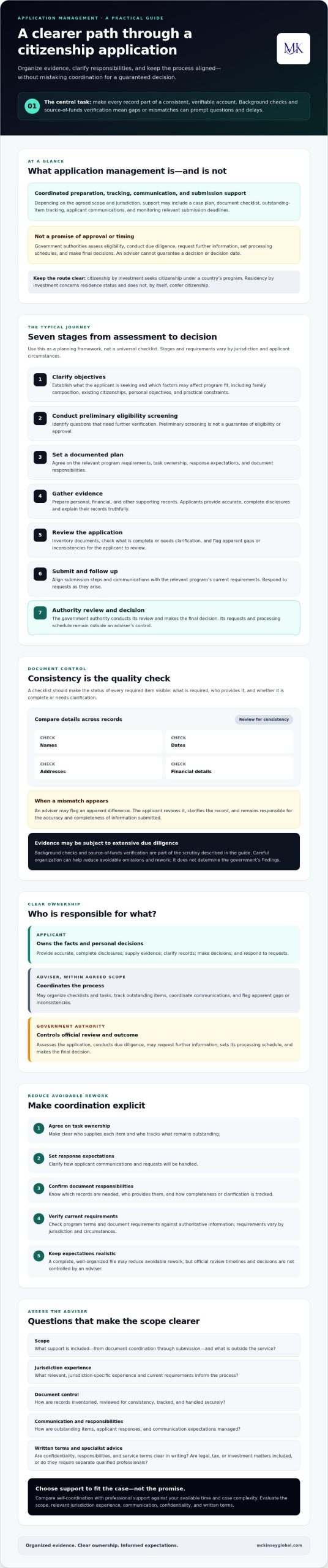
What if the most consequential part of a citizenship application is not choosing a program, but making sure every record presents a consistent, verifiable account? Citizenship by investment application management is the coordination behind that work. Applicants face extensive due diligence, including background checks and source-of-funds verification, so gaps or mismatches can prompt questions and delays.
It is reasonable to want a clear sequence, a precise document checklist, and confidence that someone is tracking what remains outstanding. Effective support is more than general program information, and no adviser can guarantee a government decision. Its value lies in helping organize evidence, identify inconsistencies early, and keep communication and submission steps aligned with the relevant program’s current requirements.
This 2026 guide explains how an application typically progresses, what applicants may need to prepare at each stage, and where their own responsibilities remain central. It also offers a practical framework for assessing an adviser’s role, coordination practices, and jurisdiction-specific knowledge, so you can reduce avoidable omissions and delays while approaching the process with informed expectations.
Key Takeaways
- Clarify what application support includes, from document coordination to submission, and distinguish it from program information or government decision-making.
- Use the application lifecycle to identify when you’ll need to make decisions, provide evidence, and respond to requests. Stages vary by jurisdiction and circumstances.
- Assess citizenship by investment application management by asking how documents are inventoried, reviewed for consistency, and handled securely.
- Reduce avoidable rework by agreeing on task ownership, response expectations, and document responsibilities. Official review timelines remain outside an adviser’s control.
- Compare self-coordination with professional support against your available time and case complexity. Evaluate advisers on scope, relevant jurisdiction experience, communication, confidentiality, and written terms.
What citizenship by investment application management covers, and what it does not
A high-stakes citizenship application involves more than selecting an investment route. Applicants must organize personal, financial, and other supporting records, ensure the information is consistent, and follow the relevant program’s procedures. Careful coordination can make responsibilities clearer, but it cannot replace the applicant’s judgment or the government’s review.
Citizenship by investment application management is coordinated preparation, tracking, communication, and submission support for an application under a citizenship program. Its purpose is to keep required information and tasks organized, not to promise a decision. The distinction between immigration routes matters: citizenship by investment seeks citizenship under a country’s program, while residency by investment concerns a residence status and does not, by itself, confer citizenship. The overview of immigrant investor programs discusses both categories, though applicants should verify current program details with official sources.
What does an application manager coordinate?
Depending on the agreed scope and jurisdiction, an adviser may help establish a case plan, provide or organize a document checklist, track outstanding items, coordinate applicant communications, and monitor relevant submission deadlines. A useful checklist shows what is required, who is responsible for providing it, and whether it is complete or needs clarification.
An adviser may also flag apparent gaps or inconsistencies for the applicant to review. For example, if a name, date, address, or financial detail differs across records, the adviser can raise the discrepancy for clarification before submission. That review does not make the adviser the source of the facts. Applicants remain responsible for accurate, complete disclosures and for explaining their records truthfully.
What application management cannot guarantee
An adviser cannot control an authority’s eligibility assessment, due-diligence findings, request for further information, or processing schedule. A complete and well-organized file may reduce avoidable rework, but it does not ensure approval or a particular decision date. Government authorities assess applications and make final decisions.
Application coordination should also be distinguished from independent legal, tax, or investment advice. Confirm whether those matters are included in the written service scope or require separate qualified professionals. Do not assume an application adviser provides specialist advice simply because it concerns the same investment pathway.
Before proceeding, verify current program terms and document requirements against authoritative information, and confirm the adviser’s jurisdiction-specific scope in writing. Ask how records will be handled, how responsibilities will be allocated, and what communication is included. Clear boundaries support a more reliable process while preserving the applicant’s responsibility for the information submitted.
How a citizenship by investment application moves from assessment to decision
A well-managed case generally progresses from understanding the applicant’s objectives to program assessment, evidence preparation, submission, and follow-up. Exact stages and requirements vary by jurisdiction and applicant circumstances, so use this sequence as a planning framework, not a universal checklist.
The application lifecycle typically moves from objectives and preliminary eligibility screening to a documented plan, evidence gathering, application review, submission, follow-up, and an authority’s decision.
From objectives and preliminary assessment to a documented plan
Before discussing investment routes, clarify what the applicant is seeking and what factors may affect program fit. Relevant considerations include family composition, existing citizenships, personal objectives, and practical constraints. Preliminary screening can identify questions for further verification. It is not a guarantee of eligibility.
Next, the applicant and adviser should confirm the program’s current requirements using authoritative information. They can then agree on responsibilities, expected deliverables, communication channels, and review points. Put the plan in writing so it is clear who is collecting records, checking details, and responding to follow-up.
From evidence preparation to submission and follow-up
Once a route has been selected, the work moves into evidence preparation. The applicant supplies requested records, while the adviser may coordinate the checklist, track outstanding items, and identify apparent inconsistencies for clarification. Translations, certifications, or other formalities may apply depending on the program and document. Verify the specific requirements before arranging them.
- Prepare: Gather the required evidence and clarify gaps or discrepancies with the relevant applicant.
- Review: Check that application details align with supporting records and that required items are accounted for.
- Submit: Coordinate preparation and submission according to the applicable process.
- Follow up: Log questions or requests for additional information, assign responsibility, and coordinate a timely response.
- Await a decision: The responsible authority reviews the case and determines its outcome.
For a jurisdiction-specific illustration, consult this Antigua and Barbuda investment options guide, then verify current requirements with authoritative sources. Citizenship by investment application management can organize evidence and communication, but it cannot control due-diligence findings, government review, or processing time. Timing depends on program rules, the completeness of the file, checks, and government processing. Confirm current expectations rather than relying on a general estimate.
Applicants seeking guidance on program fit and application support can review McKinsey Citizenship and Residency Solutions’ investment migration services and confirm the precise scope, jurisdiction, and terms relevant to their case.
How to evaluate document control, due-diligence preparation, and adviser oversight
For a high-stakes application, useful support should be visible in the way information is organized, reviewed, and accounted for. Strong citizenship by investment application management helps applicants provide accurate disclosures and organized evidence. It does not bypass due diligence or guarantee a favorable assessment. Use the questions below to distinguish defined case controls from broad assurances.
What strong document coordination looks like
A master checklist can show each document’s source, status, expiry date where relevant, and responsible party. Version control clarifies which file is current, while consistency reviews can flag differences in names, dates, addresses, or financial records for the applicant to explain. These checks identify questions. They should never lead to altering or withholding relevant information.
Ask how sensitive records are transmitted, who can access them, how long they are retained, and how they are securely disposed of. Confirm privacy and security arrangements in the written engagement terms rather than relying on general descriptions.
Questions to ask about compliance and quality control
Before engagement, clarify who reviews the file, who communicates with authorized parties, and who obtains the applicant’s approval before submission. Ask how missing evidence, discrepancies, or requests for clarification are recorded, assigned, and escalated. Written responsibilities and regular status updates make it easier to see what remains outstanding and who must act next.
| Application-management function | Useful evidence | Questions to ask an adviser |
|---|---|---|
| Document inventory and version control | A checklist showing item status, source, relevant expiry, and owner | How are current and superseded versions distinguished? |
| Consistency and due-diligence preparation | A process for raising missing details or conflicting records for applicant review | Who reviews discrepancies, and how are explanations documented? |
| Communication and oversight | Written scope, named responsibilities, status updates, and an escalation route | Who handles external communication, and who approves the final file? |
| Privacy and record handling | Written terms describing access, transmission, retention, and disposal | How are sensitive records protected throughout the engagement? |
Evidence can differ by investment route, so confirm current program requirements rather than relying on a generic checklist. This citizenship by investment donation versus real estate strategy may help frame route-specific questions. Ask an adviser to explain which evidence applies to your circumstances, what their review covers, and what remains your responsibility. Clear answers recorded in the service terms provide a practical basis for assessing oversight.
How to prevent avoidable application delays without expecting guaranteed timelines
Applicants can reduce delays caused by preventable gaps, but they cannot control official review, due-diligence findings, or processing schedules. Incomplete evidence, inconsistent records, late responses, and uncertainty over who owns a task can lead to clarification requests and rework. Effective citizenship by investment application management helps keep applicant-controlled tasks visible. It does not guarantee a faster decision.
Applicants control the accuracy and readiness of their submissions. The relevant authority controls its review and processing. Keep that distinction in view when planning. Confirm document rules and current processing expectations directly with the responsible program authority, since requirements vary by jurisdiction and may change.
Applicant actions that support an orderly file
Disclose relevant facts early, and ask for clarification if you are unsure how a question applies to your circumstances. Do not guess, omit information, or alter a record to make it appear consistent. If details differ across documents, flag the discrepancy and seek guidance on how to explain it accurately.
A shared status tracker can reduce uncertainty without requiring a complex system. For each outstanding item, record the responsible person, target date, current status, and reference to the latest document version. Review it at agreed intervals, especially when several family members or advisers have separate responsibilities.
- Confirm that requested evidence is complete and comes from an appropriate source.
- Check names, dates, addresses, and financial details against related records.
- Use only verified documents. Do not submit altered or incomplete records.
- Track open tasks, owners, due dates, and the latest document version.
- Verify jurisdiction-specific requirements, translation or certification rules, and timing through current official guidance.
Managing changes and requests during review
When an official request arrives, record what is being requested, the stated response deadline, the person responsible, and any questions that need professional input. Confirm who will prepare and review the response before it is sent. If a request is unclear, seek clarification through the appropriate channel rather than making assumptions.
Changes in family composition or personal or financial circumstances may be relevant to an application. Notify the responsible adviser promptly and ask whether, how, and when the change must be disclosed. Keep a record of the guidance and any documents provided. Do not rely on a general estimate as a promised outcome. Official processing can vary, and only current jurisdiction-specific information can inform expectations.
For support assessing program fit and application coordination, discuss your citizenship application requirements with McKinsey Citizenship and Residency Solutions and confirm the scope of support applicable to your case.
Choosing citizenship by investment application management and setting clear next steps
The right level of support depends on the application’s complexity and the time, organization, and confidence you can bring to coordinating it yourself. Professional citizenship by investment application management may provide structure, but it does not transfer your responsibility for truthful disclosures or give an adviser control over the government’s decision. Compare the practical value of the proposed support with its scope and terms before engaging.
When professional coordination may be useful
Self-coordination can suit applicants who have time to track requirements, manage correspondence, and organize records across the case. Its advantages include direct oversight of each task and fewer service arrangements to coordinate. Its demands include maintaining document control, following up on open items, and confirming current program requirements independently.
Professional coordination may be useful when an application involves multiple family members, records from several countries, or a substantial volume of documents to track. A defined adviser role can help organize responsibilities and communication, though added complexity does not establish eligibility or predict an outcome. Ask whether the proposed scope addresses the specific coordination challenges in your case.
- Self-coordination: Consider whether you can manage the checklist, document consistency, deadlines, and follow-up while keeping current with program requirements.
- Professional support: Assess whether the adviser’s jurisdiction experience, review process, and communication arrangements address needs you cannot manage efficiently yourself.
What to confirm before starting an engagement
Compare advisers on relevant jurisdiction experience, defined services and exclusions, communication frequency, confidentiality practices, and written terms. Ask who is responsible for each task, how questions or concerns are escalated, what data-handling arrangements apply, and how changes to scope are documented. Confirm the adviser’s professional role in the relevant jurisdiction. Verify current program availability and requirements through authoritative sources before relying on a pathway.
McKinsey Citizenship and Residency Solutions is an independent advisory firm that provides guidance on investment-based citizenship and residency pathways. It is not affiliated with McKinsey & Company, does not make government decisions, and cannot guarantee an application outcome. Confirm which jurisdictions and application-support services are within scope, and distinguish citizenship pathways from residency options when discussing your objectives.
Before committing, compare the written engagement proposal with your actual needs, including the records you expect to coordinate and the responsibilities you will retain. To discuss your investment migration objectives, relevant jurisdictions, and potential service scope, contact McKinsey Citizenship and Residency Solutions for an initial discussion, without assuming eligibility or approval.
Set a Clear Course for Your Next Step
A sound application plan begins with clear responsibilities, reliable records, and realistic expectations. As you assess citizenship by investment application management, focus on whether the proposed support fits your circumstances, explains its scope in writing, and keeps you informed without suggesting it can influence an authority’s decision.
McKinsey Citizenship and Residency Solutions provides advisory support across Caribbean citizenship and international residency pathways, with services focused on investment-based immigration applications. Confirm the relevant jurisdiction, current program requirements, professional role, and specific service scope before deciding how to proceed.
An initial discussion can help you outline your objectives, identify jurisdictions for further consideration, and clarify what kind of application support may be relevant. It does not establish eligibility or guarantee an outcome. To discuss your investment migration objectives, contact McKinsey Citizenship and Residency Solutions.
With informed expectations and a well-defined plan, you can approach the process with greater clarity and confidence.
Frequently Asked Questions
What does citizenship by investment application management include?
Citizenship by investment application management generally includes coordinated case planning, document tracking, application preparation, submission logistics, and follow-up. The exact scope depends on the adviser’s written engagement and the program’s requirements. Applicants remain responsible for accurate and complete disclosures; the relevant government authority assesses the application and makes the decision. Before appointing an adviser, confirm which tasks are included, which are excluded, and who is responsible for each step.
Can an adviser guarantee citizenship by investment approval?
No adviser can guarantee a government decision. An adviser may help organize evidence, explain process requirements, and coordinate communications, but eligibility assessments, due-diligence findings, and approval remain with the relevant authorities. Review how proposed outcomes are described in writing, including any limitations on the adviser’s role. Be cautious of claims promising approval or a fixed result, and verify program requirements directly with current authoritative sources before making decisions.
How long does a citizenship by investment application take to process?
There is no single processing timeline that applies to every jurisdiction and applicant. Timing may depend on current program procedures, the completeness of submitted documents, due-diligence checks, individual circumstances, and official workload. Ask for current, jurisdiction-specific expectations and when that information was verified. Treat estimates as provisional rather than promised completion dates, since an adviser can coordinate an application but cannot control government review or processing.
What documents are needed for a citizenship by investment application?
Document requirements vary by program and applicant, so use the relevant authority’s current guidance rather than relying on a generic online list. An application may call for identity, civil-status, financial, and background-related evidence, with specific formats or supporting records depending on the case. An adviser may help prepare a tailored checklist and identify missing or inconsistent information. Confirm any translation, certification, or validity requirements before submitting documents.
Is citizenship by investment application management the same as legal advice?
No, application coordination and legal advice are distinct services, and an adviser’s permitted role may differ by jurisdiction. Ask who will handle each task, whether qualified legal counsel is involved, and what the written engagement excludes. Do not assume an application-management provider is a law firm or provides legal representation. Verify relevant professional credentials and local requirements directly, particularly if your circumstances raise questions that require legal interpretation.
What should I ask before hiring a citizenship by investment adviser?
Request written terms that explain services, exclusions, responsibilities, and communication arrangements. Ask about relevant experience in your intended jurisdiction, how discrepancies and changing circumstances are handled, and how sensitive documents are transmitted, accessed, retained, and disposed of. Confirm whether legal or tax advice is included or excluded, and who reviews and approves the final submission. McKinsey Citizenship and Residency Solutions is an independent advisory firm, not affiliated with McKinsey & Company. Confirm its current program scope and professional role before engaging.
Can a residency by investment application lead to citizenship?
Residency by investment and citizenship by investment are distinct pathways. Obtaining residency does not automatically confer citizenship. A later application for citizenship, where a pathway exists, may involve separate eligibility conditions, residence rules, and government review. Requirements vary and can change, so verify current rules with the relevant authority before treating a residency program as a route to citizenship. Also distinguish immigration status from tax residency, which is not automatically changed by acquiring a second citizenship.