The passport with the broadest headline appeal may be the wrong starting point for a family. A considered approach to citizenship by investment for high net worth families begins with the outcomes each household needs: practical mobility, suitable options for dependants, and a pathway that can accommodate changing family circumstances and programme rules.
It is understandable to focus first on travel access or a programme’s public profile. Yet citizenship and residency are different legal statuses, and neither should be confused with tax residence or a decision to relocate. Family-member definitions, due-diligence procedures, and ongoing requirements also vary. Comparing these details side by side is more useful than relying on a passport ranking.
This 2026 guide provides a structured way to compare citizenship pathways in Antigua and Barbuda, Dominica, St. Kitts and Nevis, St. Lucia, and Türkiye, alongside residency solutions in Greece, Portugal, Latvia, and the United Arab Emirates. It explains how mobility goals, dependant eligibility, compliance expectations, and long-term plans can shape a shortlist, and clarifies the difference between citizenship by investment and residency by investment. The aim is to help families assess programme fit and plan applications with greater clarity as requirements evolve.
Key Takeaways
- For citizenship by investment for high net worth families, rank household priorities before comparing programme names or headline benefits.
- Map each family member’s eligibility and documentation needs early, then prepare identity and source-of-funds records consistently.
- Compare pathways by family scope, residence expectations, ongoing obligations, and review needs, not by mobility claims alone.
- Use a structured shortlist to assess fit and continuity, bearing in mind that programme rules and individual eligibility can change.
- Organize application planning around clear objectives, eligibility review, document preparation, submission, and ongoing oversight.
Citizenship by investment for high-net-worth families: start with the family’s objectives
Start with the outcome the family needs, not a ranking of passports. Citizenship by investment is a lawful route to nationality linked to a qualifying investment and government approval, subject to the relevant programme’s rules. The Citizenship by investment overview offers general background, but eligibility, family inclusion, and application requirements need to be assessed against current programme rules.
Citizenship and residency are distinct legal statuses. Citizenship establishes nationality and associated rights under that country’s laws; residency generally grants permission to live in a jurisdiction under specified conditions. Neither status automatically determines where a person must live, their tax residence, or their access to public services. Travel access also depends on current laws and destination rules, so it is not an unrestricted entitlement.
What does citizenship by investment mean for a family?
For a household, the programme’s definition of eligible dependants is central. Family members can have different eligibility conditions, and inclusion depends on the applicable rules. Acquiring nationality does not itself relocate the family or settle questions about education, healthcare access, or tax obligations. A second citizenship also does not automatically change tax residence or remove obligations connected to existing citizenships or other jurisdictions. Review these matters separately in light of each family member’s circumstances.
Which family priorities should shape the initial brief?
Separate immediate mobility needs from long-term residence, business, and succession objectives. A family seeking greater flexibility for international travel may weigh options differently from one considering a future move, continuity in children’s education, or the needs of relatives living in several countries.
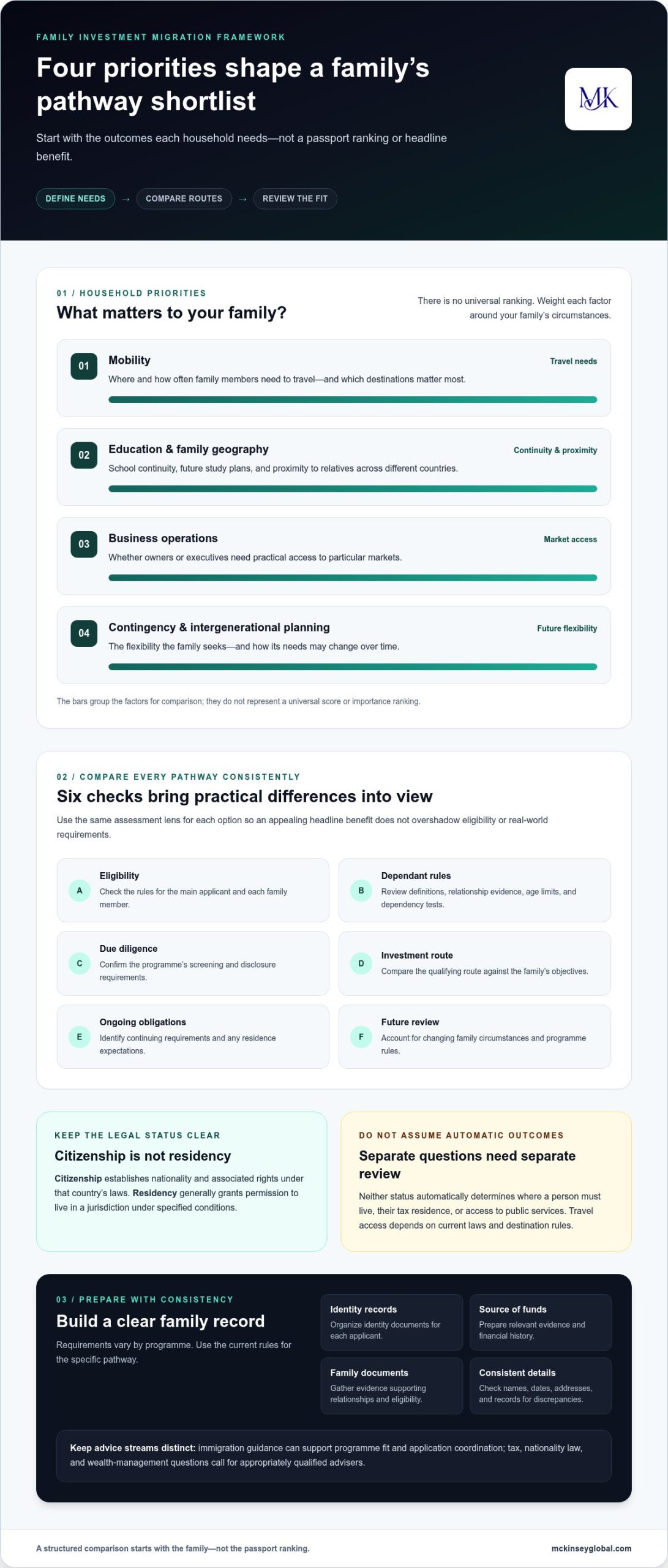
Before comparing programmes, record each family member’s priorities and constraints. Consider:
- Mobility: where and how often family members need to travel, and which destinations matter most.
- Education and family geography: school continuity, future study plans, and proximity to relatives.
- Business operations: whether owners or executives need practical access to particular markets.
- Contingency and intergenerational planning: what flexibility the family seeks and how its needs may change over time.
Relatives may have different preferred destinations or outcomes. A clear family brief brings those differences into view before programme selection begins. It also helps distinguish a citizenship pathway from a residency solution and keeps the assessment focused on the household’s actual priorities.
How to assess investment migration options for dependants, compliance, and continuity
Once the family’s objectives are clear, assess each potential pathway against the same criteria: eligibility, dependant rules, due diligence, investment route, ongoing obligations, and future review needs. A consistent framework makes differences easier to spot and reduces the risk of an attractive headline benefit overshadowing a family member’s eligibility or the programme’s practical requirements. For citizenship by investment for high net worth families, coordinating these considerations is part of disciplined planning.
How do dependant rules affect a family application?
Programmes set their own definitions of eligible dependants and the evidence required to establish each relationship. Age limits, dependency tests, and documentation rules can differ and may change. Map the family composition before comparing routes, including each person’s relationship to the main applicant and any circumstances that could affect eligibility. Confirm the current criteria for each programme rather than assuming that a rule in one jurisdiction applies elsewhere.
What compliance questions belong in the assessment?
Prepare for programme-specific due diligence by organizing identity records, source-of-funds evidence, disclosures, and supporting family documents. Check that names, dates, addresses, and financial histories are consistent across records. Discrepancies may need a clear explanation and supporting evidence. Screening requirements vary, so use the requirements for the specific programme rather than relying on a generic checklist. The Investment Migration Council provides broader context on investment migration practice, while official programme requirements guide application preparation.
Keep different advice streams distinct. Immigration guidance can support programme fit and application coordination; tax, nationality law, and wealth-management questions call for appropriately qualified advisers. A citizenship application does not resolve every legal or financial consideration connected to a family’s international affairs.
Use this checklist to keep the assessment focused:
- Family goals: Record mobility priorities, business needs, education considerations, and longer-term continuity objectives.
- Legal questions: Review eligibility, dependant definitions, disclosure duties, and relevant nationality or residence implications.
- Application tasks: Assign responsibility for identity and family records, source-of-funds documentation, translations or certifications where required, submission coordination, and follow-up.
- Future review: Set a process to revisit programme rules and family circumstances before relying on an earlier assessment.
Because rules can change, review is a continuing planning task, not a one-time formality. Coordinated programme analysis and application preparation help families organize these workstreams. See investment migration application guidance for further support.
Compare citizenship and residency pathways against family priorities
Begin with the status the family seeks, not a country ranking. Citizenship pathways and residency solutions can both support international planning, but they do not provide identical rights or lead to the same outcomes. Use the table as a framework for comparison. Dependant eligibility and application conditions remain subject to current programme rules and individual eligibility.
| Assessment area | Citizenship pathway | Residency pathway |
|---|---|---|
| Status sought | Nationality through a qualifying route and government approval. | Permission to reside under the jurisdiction’s applicable terms. |
| Family scope | Dependant definitions and evidence requirements vary by programme. | Family inclusion and eligibility conditions also vary by route. |
| Residence expectations | Do not assume citizenship requires relocation; verify any programme-specific obligations. | Review residence conditions and any presence or renewal requirements. |
| Obligations and review | Assess investment, due diligence, disclosures, and ongoing responsibilities. | Assess qualifying conditions, renewals, and continuing compliance. |
When might a citizenship pathway merit consideration?
A direct citizenship route may merit consideration when nationality itself is a family objective and residency rights alone are not sufficient. Antigua and Barbuda, St. Kitts and Nevis, Dominica, and St. Lucia are examples of citizenship pathways. Compare their route structures, dependant rules, and due-diligence processes against current programme requirements rather than assuming they are interchangeable. For a closer look at one option, see the Antigua and Barbuda investment options guide.
When might residency by investment align more closely?
Residency solutions in Portugal, Greece, the UAE, and Latvia may suit families whose objective is residence rights, subject to each route’s conditions. Türkiye should be assessed separately as a citizenship-by-investment pathway, not grouped with residency solutions. Residency does not automatically confer citizenship, determine tax residence, or create tax advantages. Those outcomes depend on applicable laws and individual circumstances. The Greece residency by investment guide offers a country-specific starting point.
For citizenship by investment for high net worth families, the better fit is the pathway that aligns with the family’s stated priorities and obligations. Compare family scope, residence expectations, and review needs before weighing promotional benefits, and assess programme conditions as part of the decision.
Build a family shortlist using a practical investment migration decision framework
A disciplined shortlist starts with priorities, not programme names. Before reviewing promotional benefits, have family members rank what matters most: nationality, residence preferences, mobility, business operations, education continuity, or long-term family planning. Ranking these needs makes trade-offs visible and helps prevent a highly publicised benefit from outweighing a requirement that matters more to the household.
Use this sequence to move from broad objectives to a focused comparison:
- Define outcomes. State what the family needs the status to achieve, separating immediate requirements from longer-term aims.
- Map family members. Record each person’s relationship, circumstances relevant to eligibility, and intended use of the status.
- Filter pathways. Remove routes that do not match the family’s objectives or applicable eligibility rules. Keep citizenship and residency options in separate categories.
- Assess obligations. Compare the investment route, application demands, ongoing conditions, and residence expectations using current programme information.
- Shortlist and review. Retain the strongest fits, document unresolved questions, and set a date to revisit requirements before key decisions or submission.
How can families narrow a global programme shortlist?
Apply the same filters to each option: the nationality or residence status sought, preferred jurisdictions, family composition, and how each person expects to use that status. A route that fails to meet a documented objective or applicable eligibility condition should not stay on the shortlist simply because it is well known. Record jurisdiction-specific legal, tax, and family questions for review by appropriately qualified professionals.
How should a family compare trade-offs without overrelying on rankings?
Use a decision matrix rather than a league table. Record verified fit, family inclusion, obligations, flexibility, administrative demands, open questions, dependencies, and the date each item was reviewed. Separate confirmed programme facts from family assumptions and preferences. For example, mark a residence expectation as verified only after reviewing the relevant programme rules. Note disadvantages as clearly as potential benefits.
| Route | Verified fit | Open questions and dependencies | Review date |
|---|---|---|---|
| Option under review | How it aligns with ranked priorities | Eligibility, family evidence, obligations, or professional review | Date checked against official information |
Investment routes can have different structures and obligations. Use the donation versus real estate strategy guide to frame a comparison of route characteristics, then review current programme terms. For citizenship by investment for high net worth families, a useful shortlist reflects documented priorities and transparent trade-offs, not a universal ranking. Develop a family-focused investment migration shortlist with coordinated programme analysis and application planning.
Plan an investment citizenship application with disciplined family oversight
A well-managed application moves through defined stages: clarify family objectives, assess eligibility, confirm the route and current requirements, prepare documents, coordinate submission, and schedule ongoing review. This sequence gives each family member a clear role and helps identify missing information before it affects the application. For citizenship by investment for high net worth families, advisory coordination brings programme analysis and application preparation into an organized process, with decisions and responsibilities kept visible.
What should families prepare before an application begins?
Begin with the current programme checklist, not a generic document list. Depending on the route and each person’s circumstances, records may include identity documents, evidence of family relationships, residence history, financial information, and source-of-funds evidence. Requirements vary, so review the relevant instructions before collecting or submitting documents.
Set up a secure document plan and assign responsibility for each person’s records. Track document status, dates, translations or certifications if required, and questions that need resolution. Consistency matters: identify and accurately explain differences in names, dates, addresses, or financial records rather than leaving them for review to uncover.
How can families maintain oversight after choosing a pathway?
Choosing a route is not the end of family oversight. Set review points for programme rules, application progress, family circumstances, and relevant compliance obligations. Changes in household circumstances or programme requirements may affect planning, so keep decision records and outstanding issues current. Government decisions, processing timelines, and outcomes are never guaranteed.
Investment migration advice can support programme fit, procedural planning, and application-material coordination. It does not replace jurisdiction-specific tax or legal advice. Where those matters are relevant, coordinate immigration planning with independent, appropriately qualified tax and legal advisers so each workstream is considered within its proper scope.
Before submission, review the application as a coordinated family file. Confirm that each applicant’s documents are complete, information is consistent, open issues have been addressed, and the material reflects current programme requirements. Keep a clear record of what was submitted and when, along with planned follow-up and review dates.
Families considering a structured next step can request a confidential strategic consultation to discuss a family-specific investment migration strategy, programme analysis, and application planning.
Move forward with a family-first strategy
The strongest investment migration plan begins with your family’s priorities, then tests each pathway against eligibility, dependant rules, compliance requirements, and future obligations. Citizenship and residency can support different objectives, so distinguish the status sought from decisions about relocation, tax residence, and long-term family planning.
For citizenship by investment for high net worth families, a disciplined shortlist is more useful than a passport ranking. Review programme rules, map each family member’s needs, and keep legal and tax questions within the scope of appropriately qualified advisers. These steps help bring clarity to a complex decision without assuming that any route guarantees a particular outcome.
McKinsey Citizenship and Residency Solutions provides end-to-end guidance for investment-based citizenship and residency applications, with programme coverage across the Caribbean, Europe, and the Middle East. To discuss a family-specific strategy and application planning, request a confidential strategic consultation.
A considered approach can help your family assess its options with greater confidence and plan its next steps with care.
Frequently Asked Questions
Is citizenship by investment suitable for high-net-worth families?
It may be relevant when a family has clear mobility, contingency, or long-term planning objectives. Suitability depends on nationality, family composition, individual eligibility, compliance requirements, and the rights sought. For citizenship by investment for high net worth families, assess acquiring nationality separately from relocating or changing tax residence. Compare current programme rules with individual legal and financial advice before deciding whether a pathway fits the family’s priorities.
Can family members apply together for citizenship by investment?
Some programmes allow eligible family members to be included in an application, but each jurisdiction sets its own dependant definitions and evidence requirements. Age, dependency, relationship, and documentation rules may affect who qualifies and when. Compare the family’s circumstances with the current criteria for each programme under consideration. Do not assume that a definition or document accepted by one jurisdiction will apply to another.
What is the difference between citizenship by investment and residency by investment?
Citizenship by investment is a route to nationality, subject to programme approval and applicable law. Residency by investment provides residence status under the relevant jurisdiction’s rules; it does not automatically lead to citizenship. The rights attached to each status, along with renewal obligations, residence conditions, and any later eligibility criteria, differ by programme. Compare the precise status each route offers with the family’s objectives rather than treating the pathways as interchangeable.
Does a second citizenship automatically reduce a family’s taxes?
No. Acquiring citizenship alone does not establish that a family’s tax obligations will change or disappear. Tax residence, income sources, assets, domicile, and reporting duties may involve separate rules across multiple jurisdictions. Treat potential tax consequences as a separate professional assessment with qualified tax advisers familiar with the family’s circumstances. Programme information is not individual tax advice or a promise of tax savings.
How much does citizenship by investment cost for a family?
Total expenses depend on the jurisdiction, investment route, number of applicants, due-diligence requirements, and other applicable charges. Programme costs and rules can change, so generic figures may not reflect a family’s circumstances or current requirements. Use current official programme materials and a tailored cost breakdown when comparing routes. There is no universally least expensive option for every household, and this guide does not provide programme prices.
Do families have to move to the country to obtain citizenship or residency by investment?
Residence expectations vary by jurisdiction and programme, and citizenship and residency routes may impose different conditions. Do not assume every option requires relocation, or that none does. Before shortlisting, review current requirements for physical presence, renewals, and ongoing residence obligations. Then consider how those conditions align with each family member’s work, education, travel patterns, and intended use of the status.
How long does a family citizenship by investment application take?
Processing periods vary according to programme rules, application completeness, due diligence, and government procedures. Family applications may require additional records, and no adviser can guarantee a decision date or outcome. Refer to current programme guidance for any published estimates, prepare consistent documentation, and allow flexibility in travel, education, and business plans. Application coordination can help organize preparation and submission, but the government retains responsibility for decisions and timelines.