Could a second passport make retirement less practical if it does not grant the right to live where you want? It is a reasonable concern: citizenship by investment can provide a new nationality, while residency by investment is designed to establish residence in a particular country. Neither status, by itself, guarantees healthcare access or tax advantages. Effective citizenship by investment for retirement planning depends on whether your status, intended home, family needs, and financial obligations fit together.
This 2026 guide explains how to assess that fit before committing. You will compare citizenship and residency pathways, consider the lifestyle and mobility each may support, and examine how residence, healthcare access, tax residency, family eligibility, and ongoing compliance can affect a retirement strategy. The overview covers Caribbean citizenship programs and residency pathways in Portugal, Greece, and the UAE. Because rules and obligations vary by jurisdiction, use the comparisons to build a focused shortlist, not to assume that any one status will deliver a particular outcome.
Key Takeaways
- Assess citizenship by investment for retirement planning by starting with where you intend to live, not simply the passport you could obtain.
- Separate citizenship, residence, tax residency, and healthcare access. Each involves distinct rights, rules, and planning considerations.
- Compare Caribbean citizenship options with European and Middle Eastern residency pathways against your priorities rather than a universal ranking.
- Build a practical shortlist by considering retirement timing, family needs, mobility goals, existing obligations, and program requirements.
- A structured review of eligibility, investment routes, and compliance can help you prepare a more focused application plan.
What citizenship by investment can, and cannot, do for retirement planning
Planning retirement across borders means weighing several issues that do not automatically align: immigration status, where you can legally live, tax obligations, healthcare access, and family needs. Citizenship by investment is a legal pathway through which an eligible applicant may acquire citizenship after meeting a country’s requirements and receiving approval. It can form part of a wider retirement strategy, but it does not guarantee a particular retirement outcome. On its own, it does not secure a preferred lifestyle, reduce taxes, provide healthcare, or generate an investment return.
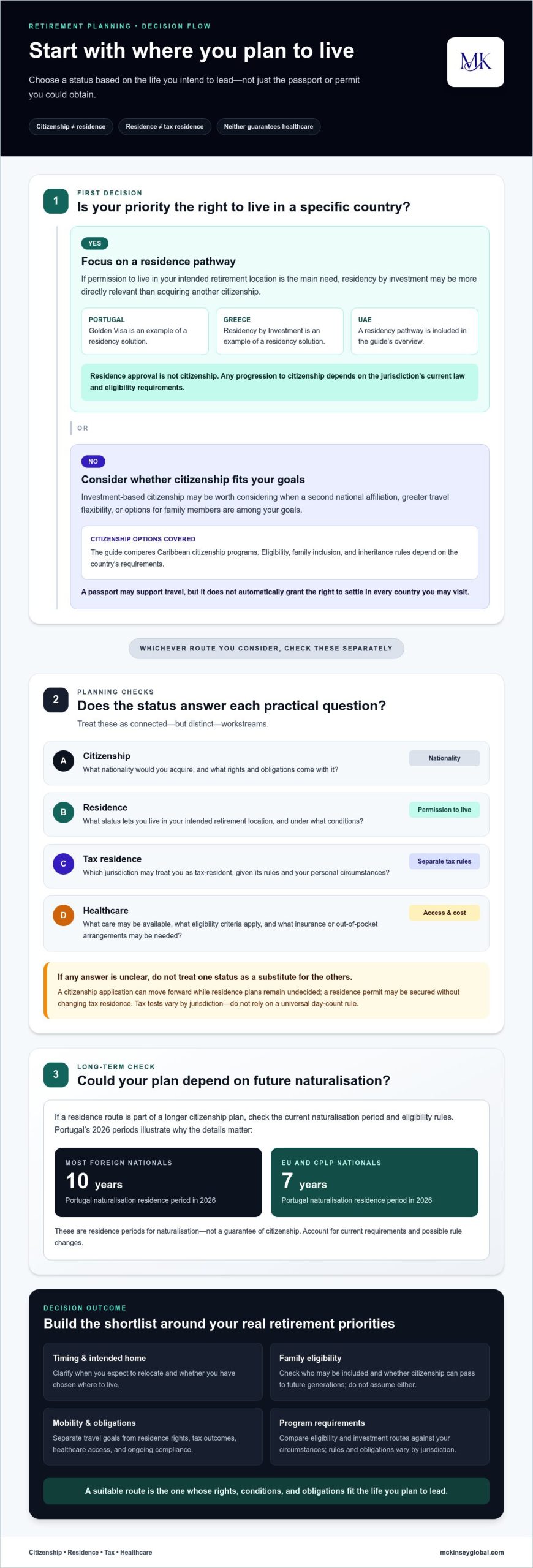
Keep three concepts distinct. Citizenship is legal membership of a country. Residence permission sets where and under what conditions a person may live. Tax residence is determined under applicable tax rules and individual circumstances. A new nationality may provide travel options, but it does not automatically confer the right to settle in every country that allows short-term entry. A passport may facilitate access across borders, but it is not a residence permit for every place where you might want to retire.
For a broad overview of how immigrant investor programs differ, consider the distinction between routes that grant citizenship and those that provide residence. For retirement planning, the practical question is whether a route’s rights and conditions support your intended way of life, not simply whether the status is available.
When investment-based citizenship may fit a retirement plan
Citizenship may be worth considering if greater travel flexibility, a second national affiliation, or options for family members are among your goals. Do not assume that relatives can be included or that citizenship can pass to future generations. Family eligibility and inheritance rules depend on the relevant country’s requirements and should be assessed as part of the comparison.
Start by defining your timing and intended residence. If you plan to relocate soon, determine whether the citizenship route supports residence in the country where you expect to spend retirement. If you want flexibility for a later move, identify what the status actually permits. Keep mobility goals separate from assumptions about tax outcomes, healthcare eligibility, or financial returns, since each requires its own assessment.
When residency by investment may be the more relevant route
If your priority is permission to live in a particular country, a residency-by-investment pathway may be more directly relevant than acquiring another citizenship. Portugal’s Golden Visa and Greece Residency by Investment are examples of residency solutions. Approval for either route should not be treated as citizenship.
Residency can come with conditions that affect how you use the status. Any progression to citizenship depends on the jurisdiction’s current law and eligibility requirements. In 2026, Portugal’s naturalisation residence period is 10 years for most foreign nationals, while the period for EU and CPLP nationals is seven years. This illustrates why a long-term plan should account for current rules, possible changes, and the difference between holding residence and qualifying for naturalisation. For citizenship by investment for retirement planning, match the route to the life you intend to lead, not simply to the status that appears most advantageous.
Align citizenship, residence, tax, and healthcare before choosing a jurisdiction
A passport alone cannot resolve every practical question involved in retiring abroad. It may establish citizenship and support travel, but it does not automatically give you the right to live in a particular country, determine where you owe tax, or qualify you for public healthcare. For citizenship by investment for retirement planning, treat these as connected but separate workstreams. Then test how they fit your intended location and personal circumstances.
A useful planning map separates four questions:
- Citizenship: What nationality would you acquire, and what rights and obligations accompany it?
- Residence: What status allows you to live in your intended retirement location, and under what conditions?
- Tax residence: Which jurisdiction may treat you as resident for tax purposes, given its rules and your personal facts?
- Healthcare: What care can you access, under what eligibility criteria, and with what insurance or out-of-pocket arrangements?
Answering one question does not settle the others. A citizenship application may progress while your residence plans remain undecided. You may also secure a residence permit without changing your tax residence. The plan is more robust when each question has a clear answer and the assumptions behind those answers are reviewed together.
Residence rights and tax residence are different planning questions
Immigration status governs permission to enter, stay, or reside under a country’s rules. Tax residence is a separate legal determination that may depend on factors such as time spent in a jurisdiction, personal ties, and the nature or source of income. The applicable tests vary, so a universal day-count rule is not a reliable planning basis.
Before relocating, organize the facts that may affect your position: the country you are leaving, your expected pattern of presence, income sources, assets, and any filing or reporting duties. Have the relevant rules assessed for each jurisdiction involved. Acquiring citizenship alone does not establish tax residence or automatically end obligations in your former country. Tax outcomes depend on individual circumstances and applicable law, not simply on the passport you hold.
Healthcare, dependants, and continuity of care
Base healthcare planning on the care you and your family may need, rather than assuming that investment status provides access to a public system. For each intended retirement location, examine eligibility, insurance requirements, policy exclusions, access to routine and specialist care, and how coverage would work during a transition between countries.
Include your spouse and dependants in the review. Their immigration status, healthcare eligibility, and continuity of treatment may differ from yours. List ongoing prescriptions, regular appointments, specialist needs, and practical arrangements for maintaining care after a move. These details can affect whether a destination suits your needs, even when its immigration route otherwise aligns with your goals.
McKinsey Citizenship and Residency Solutions is an independent firm, not affiliated with McKinsey & Company, and provides end-to-end support for investment-based citizenship and residency applications. Its investment-migration application support can help organize the immigration workstream alongside the residence, tax, and healthcare questions that shape a retirement plan.
Compare citizenship and residency options against retirement priorities
No jurisdiction is universally best for retirement. A more useful comparison asks what you need the status to do: support a family application, provide a basis for residence, broaden travel options, or fit a specific long-term location. Citizenship pathways in the Caribbean and residency solutions in Europe and the Middle East address different objectives. Compare them against your intended lifestyle rather than a single ranking.
| Retirement priority | Options to examine | Questions to resolve |
|---|---|---|
| Citizenship and family planning | Antigua and Barbuda, St. Kitts and Nevis, Dominica, St. Lucia | Which qualifying routes and family-inclusion rules fit your circumstances? |
| A planned European base | Portugal Golden Visa, Greece Residency by Investment | Does the residence pathway fit your intended stay and long-term plans? |
| A Middle Eastern base | United Arab Emirates residency solutions | Do the residence arrangements suit your actual retirement pattern? |
Caribbean citizenship pathways for mobility and family planning
When comparing Caribbean citizenship, look at route structure as well as how you expect to use the status. Antigua and Barbuda includes a donation route and a University of the West Indies Fund option. Dominica and St. Kitts and Nevis have contribution and real-estate routes, while St. Lucia offers contribution and government-bond pathways. Family eligibility, qualifying requirements, and current obligations differ. Review the Antigua and Barbuda investment options guide and St. Kitts and Nevis citizenship strategy in light of your family composition and intended use of citizenship.
Assess lifestyle fit separately. Consider whether you want a citizenship connection to a Caribbean country, expect to spend time there, or primarily seek broader mobility. A citizenship grant does not itself settle where you may reside, access healthcare, or establish tax residence. Since program rules and obligations can change, verify current 2026 requirements against official program sources before making a commitment.
Residency pathways for a planned base in Europe or the Middle East
Portugal and Greece are relevant when your objective is residence in Europe rather than immediate citizenship. Compare each pathway’s current qualifying routes and conditions with the time you expect to spend in-country, your travel pattern, and whether longer-term settlement or potential naturalisation is part of the plan. The Greece residency by investment guide can help frame that review.
UAE residency solutions may suit a different retirement arrangement, particularly if a planned Middle Eastern base aligns with your personal, family, and practical needs. Assess the actual residence terms against your intended pattern of presence. Do not assume residency determines your tax treatment or healthcare entitlement. For all three locations, review current program conditions through official sources before proceeding.
Use this comparison to create a shortlist, not to reach a verdict. For citizenship by investment for retirement planning, first identify the status your preferred retirement location requires. Then evaluate family fit, lifestyle, and current program obligations against that objective.
Build a retirement-focused shortlist with a practical due-diligence sequence
Build your shortlist around the life you intend to lead, not a program’s headline feature. Define your preferred retirement location, likely timing, family composition, mobility needs, healthcare priorities, and existing financial or reporting obligations. This helps distinguish a citizenship route from a residency route and prevents attractive program features from overshadowing practical fit. For citizenship by investment for retirement planning, follow a clear sequence from personal objectives to a focused program review.
A five-step screening process for retirement applicants
- Set your priorities. Rank intended residence, travel flexibility, family inclusion, healthcare access, and the value you place on maintaining a connection to your current country. Mark which objectives are essential and which are preferences.
- Choose the status that matches the goal. If you want to live in a particular country, assess residence pathways there. If a second nationality and its associated rights are central, examine citizenship routes. Do not treat the two as interchangeable.
- Screen for eligibility. Review current official rules for applicant qualifications, family members, qualifying investment routes, and any presence or post-approval conditions. Remove programs that do not fit your circumstances or intended timeline.
- Prepare for documentation and due diligence. Identify records needed to explain the lawful source and transfer of funds, verify identity and family relationships, and support application disclosures. Requirements differ by program, so resolve gaps and inconsistencies before filing.
- Map continuing obligations. Record any ongoing residence, reporting, investment-holding, renewal, or other compliance conditions that apply after approval. Check how these obligations fit your retirement routine and maintain a calendar for future deadlines.
Coordinate immigration planning with independent tax and financial advice
Immigration eligibility is only one part of the decision. Before committing to a route or changing your residence, prepare specific questions for qualified tax and financial professionals in the jurisdictions relevant to you. These may include how a move affects departure obligations, income from different sources, pension treatment, asset location, estate planning, and reporting duties. Answers depend on your individual facts and applicable law, so do not rely on a general tax comparison or assume a particular benefit.
Keep the workstreams coordinated. Immigration advisers can structure the program shortlist and application process, while independent tax and financial professionals assess their respective areas. This separation supports careful decision-making without treating citizenship or residence as a promise of a particular financial result.
Once your priorities and preliminary questions are clear, discuss a retirement-focused investment migration strategy with McKinsey Citizenship and Residency Solutions, an independent firm not affiliated with McKinsey & Company. Its end-to-end application support covers investment-based citizenship and residency options across the Caribbean, Europe, and the Middle East.
How McKinsey Citizenship and Residency Solutions can support the next step
Once you have defined where you may want to retire and what status you need, the next challenge is turning those priorities into an application plan. McKinsey Citizenship and Residency Solutions advises on investment-based citizenship and residency applications across the Caribbean, Europe, and the Middle East. The firm helps structure the immigration comparison and application process around your objectives, eligibility profile, and the requirements of the jurisdictions under consideration.
This distinction matters. Citizenship and residency pathways confer different forms of status, and neither should be selected on the assumption that it will automatically provide residence rights elsewhere, healthcare access, or a particular tax outcome. A retirement-focused review tests each option against your intended location, family needs, mobility objectives, and capacity to meet applicable program obligations.
From retirement objectives to a jurisdiction shortlist
An advisor can organize your priorities into a structured comparison: which countries offer a relevant citizenship or residency route, what current qualifying pathways apply, and what eligibility or documentation issues need attention. Depending on your objectives, the shortlist may include Caribbean citizenship options such as Antigua and Barbuda, St. Kitts and Nevis, Dominica, or St. Lucia; European residency pathways such as Portugal and Greece; or UAE residency solutions. Türkiye and Latvia may also be relevant options to assess against your plans.
A shortlist is not a guarantee of eligibility. Each program has its own rules, application requirements, and compliance checks, which can change. An orderly process includes reviewing current official program information, identifying the records needed to support an application, and preparing documentation consistently across the file. Careful document management can surface missing information or discrepancies early, while coordinated application planning keeps the selected route connected to your retirement objectives.
For citizenship by investment for retirement planning, the useful outcome is more than a list of programs. It is a reasoned shortlist that distinguishes citizenship from residence, explains why each option may fit, and identifies questions to resolve before proceeding.
Prepare for a focused initial discussion
Make an initial discussion more productive by preparing a concise outline of your plans. Include your preferred regions, anticipated retirement timing, family members who may be included, travel priorities, and any existing immigration or financial obligations that could affect the decision. Note which goals are essential and which remain flexible. This gives the comparison a practical starting point instead of allowing program features to set the agenda.
Keep tax and healthcare questions visible, but direct them to qualified professionals in the relevant jurisdictions. For example, flag questions about cross-border income, pension and asset reporting, estate arrangements, healthcare eligibility, and continuity of care. Immigration application support can be coordinated with those separate reviews without promising outcomes beyond the applicable rules.
McKinsey Citizenship and Residency Solutions is an independent firm and is not affiliated with McKinsey & Company. If you are ready to develop a focused shortlist, explore investment-based citizenship and residency guidance and discuss the priorities shaping your retirement plans.
Make your next step a clearer retirement plan
Turn broad aspirations into decisions you can test: where you may want to live, when you expect to move, and which family, mobility, and compliance factors matter most. A well-defined brief makes it easier to distinguish an attractive possibility from a pathway that genuinely supports your plans.
Approach citizenship by investment for retirement planning as a long-term decision, with current program requirements and your personal circumstances at its centre. You do not need to resolve every cross-border question at once. Start by identifying priorities, recording uncertainties, and organizing the issues that require specialist review.
McKinsey Citizenship and Residency Solutions is an independent firm and is not affiliated with McKinsey & Company. Its advisory work can help translate your objectives into a structured discussion about investment-based immigration applications. Explore investment-based citizenship and residency guidance and take a considered first step toward a retirement plan built around your priorities.
Frequently Asked Questions
Can citizenship by investment determine where I am tax resident?
No. Acquiring a passport does not, by itself, make you tax resident in that country or end obligations elsewhere. Tax treatment depends on applicable law and your circumstances, including residence patterns, income, assets, and personal ties. For example, a retiree receiving pension income from one country while spending time in another may have obligations to review in both. Obtain qualified advice covering the proposed jurisdiction and any country where you already have tax or reporting duties.
Is citizenship by investment the same as residency by investment?
No. Citizenship concerns nationality and the rights attached to it. Residency permission allows you to live in a jurisdiction subject to specified conditions. The application route, eligibility criteria, and obligations differ. If your priority is establishing a home in a particular country, determine whether the pathway grants residence there rather than assuming a second passport does. When comparing routes, record the status each one grants and the conditions attached to maintaining it.
Can my spouse and dependants be included in an investment migration application?
Some programs may allow eligible family members to apply with a principal applicant, but qualifying relationships, evidence, and other criteria vary. Do not infer a relative’s eligibility from their place in your household or financial arrangements. Before choosing a route, prepare a family list and note relevant identity, relationship, and dependency records. Compare each person’s eligibility and the status they could receive under current program rules, which may change.
Does citizenship by investment automatically provide healthcare coverage?
No. Citizenship or another investment-based status does not necessarily qualify you for public healthcare or provide insurance coverage. Before relocating, examine how access works for your specific status and whether private insurance is needed, including any exclusions that may affect existing conditions. For example, someone receiving regular treatment should plan how prescriptions, specialist appointments, and medical records will be managed during and after a move, rather than relying on nationality alone.
Can I keep my current citizenship after acquiring another nationality?
It depends on the laws of the countries involved and your circumstances. Acquiring another nationality does not automatically resolve requirements linked to your existing citizenship. Before applying, ask qualified advisers familiar with both jurisdictions to review current rules, including any notification, documentation, or nationality-related obligations. This review is especially relevant if family members may apply too, since rules and consequences can differ among individuals and may not be identical for every applicant.
What should retirees compare before selecting an investment migration program?
Compare the status granted, your ability to use it as intended, family eligibility, documentation demands, due-diligence procedures, and continuing obligations. For citizenship by investment for retirement planning, also note questions about pensions, asset reporting, existing nationalities, and healthcare arrangements that need separate professional review. A practical shortlist can explain why you are retaining or eliminating each option and help identify unresolved issues before a full application assessment.