
What if a citizenship application doesn’t require you to relocate, but still requires you to travel, attend an appointment, or meet other obligations? Citizenship by investment without a residency requirement can let you maintain your existing lifestyle, yet “no residency” does not always mean “no physical presence.”
It’s understandable to focus first on whether a program requires you to live in the country. A more useful comparison looks at the full process: which visits, interviews, or biometric steps may apply, how rules differ by jurisdiction, and whether a second citizenship fits your family and compliance priorities. This guide explains how to assess those questions without assuming requirements are identical across programs.
We’ll consider pathways in the Caribbean and Türkiye, including examples of limited presence requirements, and distinguish citizenship programs from residency-by-investment routes. You’ll also see why nationality, tax residence, and family circumstances merit separate review, and how to build a practical shortlist around mobility, travel commitments, and long-term planning. The aim is a clear framework for comparing options, not an assumption that one program suits every applicant.
Key Takeaways
- Understand what “no residency requirement” means, and distinguish a minimum residence period from application-stage presence requirements.
- Use the citizenship by investment without residency requirement comparison to assess how rules differ across Antigua and Barbuda, Dominica, St. Kitts and Nevis, St. Lucia, and Türkiye.
- Compare jurisdiction-specific obligations against your family needs, travel constraints, and compliance priorities instead of relying on broad claims.
- Apply a five-step framework to develop a practical shortlist, while recognizing that no minimum residence does not mean automatic approval or the absence of other obligations.
- Learn how structured advisory guidance can help map your objectives, applicable rules, documents, and application stages.
What “citizenship by investment without a residency requirement” means
The phrase describes a pathway where an applicant may not need to live in the country for a general minimum period as a condition of applying for citizenship. It is a narrow description, not a promise that the process can be completed remotely. Each jurisdiction sets its own rules, which may distinguish ongoing residence from specific steps that require an applicant to be physically present.
That distinction matters because “no residency” can sound more comprehensive than it is. It does not establish that you qualify, guarantee approval, or remove screening and documentation requirements. Start by separating four questions: must you live there, must you visit, what legal status are you applying for, and when might a passport be issued?
Residence, physical presence, and citizenship are different concepts
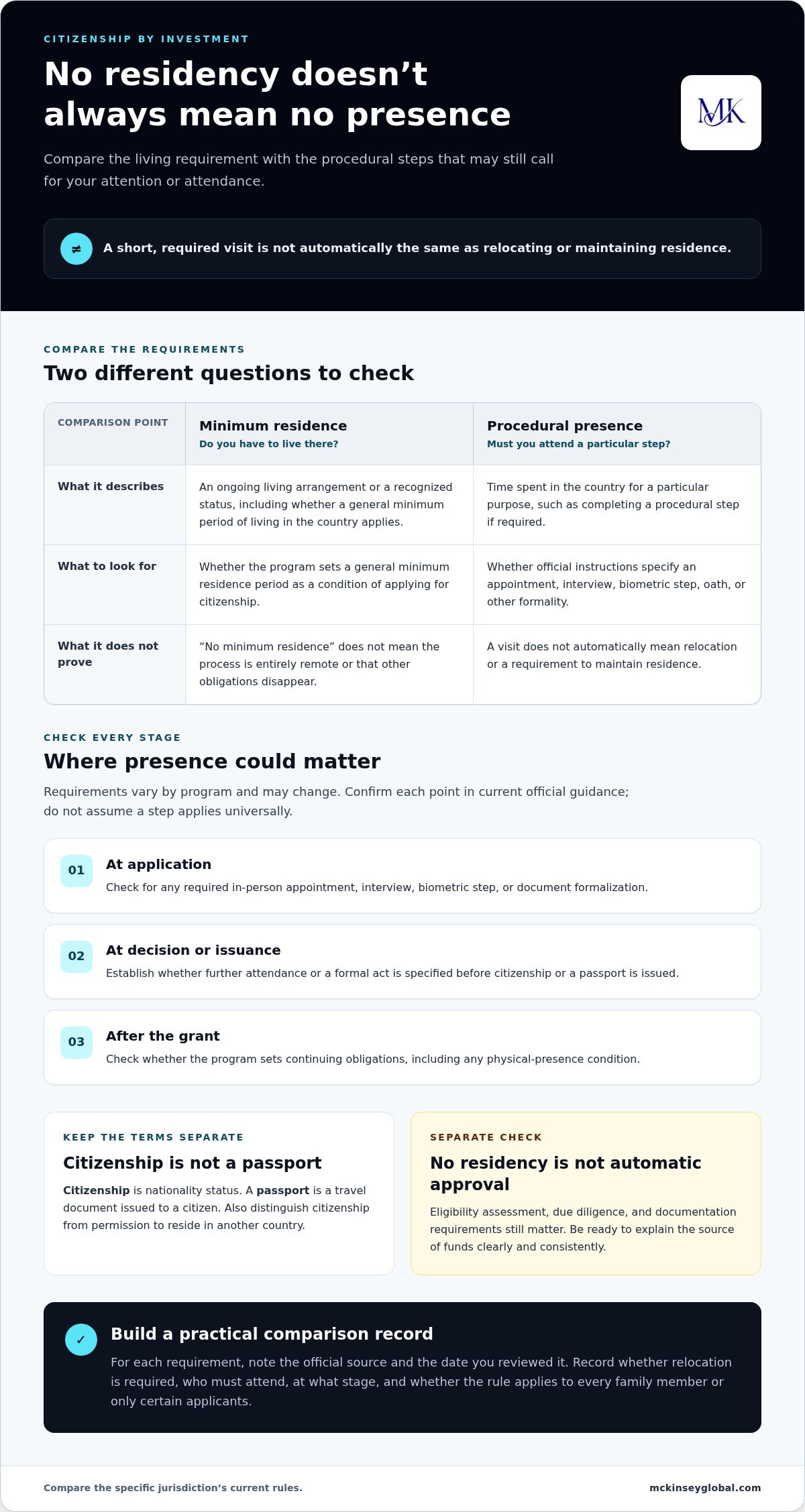
Residence generally describes an ongoing living arrangement or a recognized status, rather than a short trip. Physical presence means time spent in the country for a particular purpose, such as completing a procedural step if the program requires it. A visit therefore does not automatically mean that an applicant must relocate or maintain residence.
Citizenship is nationality status. It is distinct from permission to reside in another country, and it should not be confused with a passport, which is a travel document issued to a citizen. The Citizenship by Investment programs overview provides broader context, but prospective applicants still need to assess the specific rules of the jurisdiction they are considering.
Why investors look for citizenship without relocation
For applicants with established work, family, or residence commitments, moving countries may not be practical. A pathway without a general minimum residence period can be relevant to those seeking another nationality while continuing to live their existing lives. Whether that option is useful depends on personal objectives; citizenship may serve different planning needs from a residence permit.
Mobility is often part of the decision, but no citizenship should be treated as a guarantee of particular travel access. Visa arrangements can change, and travel privileges are only one factor alongside family plans, compliance responsibilities, and the applicant’s existing nationality position. The effects can depend on the laws and circumstances involved, so review them separately.
Use “no residency requirement” as a starting point, not a conclusion. Review the current program rules for a minimum residence period, identify any separate visits or application-stage steps, and establish how citizenship and passport issuance are handled. A no-residency pathway remains subject to eligibility assessment and due diligence. An investment does not mean automatic citizenship. Understanding this distinction helps you compare options before weighing jurisdiction-specific requirements.
What no-residency citizenship pathways may still require
A pathway without a general minimum residence period can still involve steps that require your attention, documentation, or presence. Separate requirements that apply during the application from obligations that may continue after citizenship is granted. These are distinct questions, and a program’s marketing description is not a substitute for its current official rules.
Residence requirements govern how long an applicant must live in a country; procedural presence requirements govern whether the applicant must attend a particular step in person. For contrast, the U.S. Citizenship and Immigration Services explains continuous residence requirements for naturalization in the United States. That framework differs from investment citizenship programs. Compare the rules for the specific jurisdiction rather than assuming all pathways work alike.
Visits, interviews, and formalities to verify
Before shortlisting a program, review official guidance for every stage at which presence could matter. The rules may address interviews, biometric enrollment, an oath, or other formalities, but applicants should not assume that any one step applies universally. Requirements can vary by program and may change, so distinguish mandatory instructions from case-specific arrangements.
- At application: identify any required in-person appointment, interview, biometric step, or document formalization.
- At decision or issuance: establish whether further attendance or a formal act is specified before citizenship or a passport is issued.
- After grant: check whether the program sets continuing obligations, including any physical-presence condition.
For each requirement, record the official source and the date you reviewed it. A practical comparison should show whether relocation is required, who must attend, at what stage, and whether the rule applies to every family member or only certain applicants.
Due diligence and continuing compliance
No-residency wording does not remove due diligence. Be prepared for identity and background checks and to explain the source of funds clearly and consistently. Differences between forms and supporting documents can prompt avoidable questions. Organize records carefully, disclose information accurately, and address gaps transparently rather than assuming they are immaterial.
Separate application duties from wider personal obligations. Citizenship does not, by itself, determine tax residence or resolve the rules that may apply in another country. Those consequences depend on relevant laws and individual circumstances, including existing nationality and residence ties, and call for appropriate professional review.
For a citizenship by investment without residency requirement, verify current official program guidance, map each procedural step, and assess continuing duties before committing. McKinsey Citizenship and Residency Solutions provides investment-migration advisory support to organize jurisdiction rules, documents, and application stages around personal and family priorities. Structured application guidance can make that assessment more systematic, without implying eligibility or a particular outcome.
How relevant programs compare on residence requirements
A useful comparison separates a minimum period of residence from any in-person application step. The table below is a screening tool, not a definitive statement of current law. Treat reported details as points to verify against current official program guidance before making travel or application decisions.
Caribbean citizenship programs to assess
For each jurisdiction, compare the same criteria: whether applicants must reside in-country, whether a procedural visit may apply, how dependants are treated, and when you verified the rule. This distinction can materially affect planning. Research reports a limited presence condition for Antigua and Barbuda and biometric enrollment for St. Kitts and Nevis. Confirm both details against authoritative program guidance before relying on them.
| Jurisdiction | Residence rule | Possible presence steps | Family scope | Official-source verification date |
|---|---|---|---|---|
| Antigua and Barbuda | Research reports five days of presence within the first five years. Confirm the current rule and how it is applied. | Check whether application-stage attendance or other formalities apply. | Confirm which family members are included and whether requirements differ. | Record the date you verify the current official guidance. |
| Dominica | Confirm the current residence condition; do not infer it from the program category. | Verify current interview, biometric, oath, or other attendance instructions. | Check eligibility and procedural steps for each proposed dependant. | Record the date you verify the current official guidance. |
| St. Kitts and Nevis | Confirm the current minimum-residence rule independently. | Research reports mandatory in-person biometric enrollment. Verify the current official instructions. | Confirm how applicant and dependant steps may differ. | Record the date you verify the current official guidance. |
| St. Lucia | Confirm the current residence condition through official guidance. | Check current application and post-approval formalities for presence requirements. | Confirm family eligibility and any separate attendance requirements. | Record the date you verify the current official guidance. |
| Türkiye | Assess the condition under the specific investment route and current rules. | Verify any required appointments or other procedural presence directly. | Confirm the treatment of family members under the applicable route. | Record the date you verify the current official guidance. |
For route-specific context, the donation versus real estate strategy guide can help frame how investment choice may affect an overall comparison. It does not replace checking residence and presence rules.
More detail on two Caribbean options is available in the Antigua and Barbuda investment guide and the St. Kitts and Nevis citizenship guide. Use each alongside current official program material.
Türkiye and the limits of broad comparisons
Assess Türkiye separately rather than measuring it against Caribbean rules by assumption. The investment route, applicant profile, family composition, and procedural instructions may all affect the practical comparison. Before forming a shortlist, record the official source and verification date for each rule, then compare the requirements with your travel and family constraints.
How to assess a no-residency pathway for your circumstances
A useful shortlist starts with your circumstances, not a promise of convenience. A citizenship by investment without residency requirement may reduce relocation demands, but it does not mean there are no obligations or that approval is automatic. Use a structured review to assess whether a program’s rules, application steps, and wider implications fit your priorities.
Match program criteria to personal and family priorities
Define the purpose of a second citizenship before comparing jurisdictions. Your priorities might include mobility, family planning, or maintaining future options, but the value of each depends on your circumstances. Assess family eligibility and dependant requirements under the selected program’s current rules rather than assuming they match another jurisdiction’s criteria.
A five-step decision framework
- Set your objectives. Identify the outcome you seek and distinguish citizenship goals from a need for residence permission. A residence-by-investment route may be more relevant if your objective is to live in a particular country.
- Map residence constraints. Record how much time you can realistically spend abroad, whether you can attend required appointments, and which travel or work commitments limit your flexibility.
- Assess family needs. List the family members you hope to include and note their individual circumstances. Compare their eligibility and procedural requirements with current program rules.
- Review compliance demands. Identify the documents, source-of-funds explanations, background information, and disclosures you may need to prepare. Check that records across forms and supporting documents are accurate and consistent.
- Plan professional review. Have the jurisdiction’s current rules and your personal circumstances assessed before making a commitment. This can help identify questions for legal, tax, or other qualified advice without treating one review as a substitute for another.
Create a compliance-led shortlist
For each candidate, maintain a concise record of the official source reviewed, the review date, the residence rule, any possible in-person steps, and the family scope. Add a separate document checklist that includes identity records, source-of-funds materials, and disclosures that may require professional assessment. This makes gaps visible and helps you compare options on the same basis instead of relying on broad labels such as “no residence.”
Keep tax planning distinct from citizenship planning. A new nationality does not, by itself, settle your tax residence or obligations in another country. Review personal tax questions with a qualified tax professional familiar with the relevant jurisdictions and your circumstances.
Once your priorities and constraints are clear, assess citizenship-by-investment routes in that context. McKinsey Citizenship and Residency Solutions provides structured support to assess program rules against personal, family, and compliance priorities through investment-migration advisory services.
Plan your citizenship application with structured advisory support
Once you have identified potential jurisdictions, the next challenge is turning a broad preference into an application plan grounded in current requirements. An adviser can organize the assessment around your objectives, family circumstances, residence preferences, and the rules for each route. For citizenship by investment without a residency requirement, this means examining both the stated residence conditions and the practical steps involved in preparing and submitting an application.
McKinsey Citizenship and Residency Solutions is an independent investment-migration advisory firm, not McKinsey & Company. It provides end-to-end guidance for investment-based immigration applications, including mapping relevant program rules, organizing required documents, and coordinating application stages. Advisory support can help bring structure to the process, but government authorities make eligibility and approval decisions. No adviser can guarantee citizenship, visa-free access, or a particular processing time.
What a structured advisory process can clarify
An initial review can establish what you are seeking, which family members may be relevant, and how much travel or time away from your current residence is practical. Jurisdiction-specific rules can then inform a realistic shortlist and a sequence for gathering information. This helps distinguish a generally attractive option from a route whose requirements fit your circumstances and readiness.
Application planning can also clarify responsibilities. An adviser can help identify document categories, flag information that needs consistent treatment across forms and supporting records, and coordinate the steps required for submission. Your role remains active: accurate disclosure and timely provision of complete records are central to a well-organized application, while decisions remain with the relevant authorities.
Prepare for an informed consultation
A concise preparation file can make an initial discussion more focused. Organize the information below, noting gaps or questions rather than making assumptions about how a program will treat them:
- Identity details and current and previous nationalities relevant to the application.
- Family composition and which relatives you may wish to include.
- A general outline of investment-source information and supporting records available.
- Current residence commitments, travel limitations, and any presence constraints.
- Your intended outcome, such as family planning, mobility, or broader optionality.
Keep tax questions separate from citizenship-route selection. If a new nationality could affect your tax position or obligations elsewhere, discuss those personal questions with a qualified tax professional familiar with the relevant jurisdictions. An investment-migration adviser can help coordinate the program assessment, but that does not replace individualized tax advice.
When you are ready to move from general research to jurisdiction-specific planning, a focused discussion can help clarify program fit, documents, and application stages in light of your priorities. Discuss your citizenship application planning when you are prepared to assess the next steps.
Turn your shortlist into a considered plan
Before advancing a citizenship by investment without residency requirement, turn your preferred option into a decision record. Note why it fits your objectives, which assumptions still need review, and what would cause you to reconsider. This creates a disciplined basis for planning, especially when family circumstances, residence commitments, or program rules may evolve.
Investment-migration advisory support can connect those priorities with jurisdiction requirements, document preparation, and application stages. McKinsey Citizenship and Residency Solutions supports investment-based citizenship and residency applications, with program coverage across the Caribbean, Europe, and the Middle East. Its role is to guide and coordinate the application process, not to determine government decisions or promise an outcome.
If you are ready to assess which routes align with your priorities, discuss your investment migration objectives with our advisory team. A measured conversation can help you define the questions that matter and identify a practical next step, with your decision remaining informed and firmly your own.
Frequently Asked Questions
Is citizenship by investment without a residency requirement the same as never visiting the country?
No. A citizenship by investment without residency requirement may still involve a specific visit for an application procedure. An applicant who can travel briefly but cannot relocate for months should distinguish those constraints when reviewing a program’s official instructions. Check whether attendance applies to the principal applicant, dependants, or both, and whether the step occurs before or after a decision. A general “no residency” description cannot settle those details.
Can I keep my current citizenship if I obtain citizenship by investment?
Possibly, but the answer depends on the nationality laws of both countries involved. Before applying, identify whether your current country permits dual nationality, requires notification, or attaches consequences to acquiring another citizenship. A rule allowing dual nationality in the new country does not establish that your existing country treats it the same way. Review authoritative sources for both jurisdictions and obtain qualified legal advice on your specific status.
Does a second citizenship automatically change my tax residence?
No. Acquiring citizenship does not, by itself, establish that your tax residence has changed. If you obtain a second passport but continue to live and work in the same country, do not assume your tax position has changed solely because of that new nationality. Tax rules may involve more than one jurisdiction and other personal factors. Keep citizenship and tax planning distinct, and consult a qualified tax professional familiar with the relevant countries.
Can family members be included in a citizenship-by-investment application?
Sometimes, subject to the selected program’s current definition of eligible family members and its evidence requirements. A spouse, child, or other relative may be treated differently depending on relationship, age, or dependency criteria. Before choosing a route for family reasons, list everyone you hope to include and review the official rules for each person. This can show whether separate records or explanations will be needed for particular applicants.
What documents may applicants need for a citizenship-by-investment application?
Document requirements vary, but applicants may need identity and civil-status records, background information, and records explaining investment funds. Compare names, dates, and other details across passports, certificates, and financial records, then flag inconsistencies for review. Official guidance determines acceptable formats, certifications, and translations. Keep copies of submitted materials and track which version was provided so any follow-up can be answered accurately.
How long does a citizenship-by-investment application take?
There is no single timeline that applies to every program or applicant. The time involved can depend on the current review process, how complete the application is, and whether authorities request further information. For planning, separate the time needed to assemble documents from the government’s assessment period, and avoid making fixed travel or financial commitments based only on an estimate. Use current official program guidance and allow for possible requests during review.
Does citizenship by investment guarantee visa-free travel to particular countries?
No. A passport does not guarantee permanent visa-free entry to any destination. Entry conditions are set by the destination country and may depend on travel purpose, length of stay, and rules in force at the time. Before booking a trip or relying on access for business, confirm requirements through the destination’s official guidance. Assess a citizenship option against broader objectives as well, since travel arrangements can change after a program decision.