The era of the “budget” Caribbean passport has officially ended, replaced by a new standard of rigorous compliance and harmonized investment thresholds. For high-net-worth investors, staying informed about the updated Dominica citizenship by investment requirements is no longer optional; it’s a prerequisite for a successful application in a landscape defined by heightened scrutiny. You likely recognize that the recent price adjustments and enhanced due diligence protocols have added layers of complexity to a once-straightforward process, creating uncertainty for those seeking long-term security.
This strategic guide provides a comprehensive analysis of the financial, legal, and procedural criteria necessary to secure your status in the post-2024 regulatory environment. We’ll examine the total capital outlay for both the Economic Diversification Fund and real estate options, detail the mandatory interview process, and clarify the expanded rules for multi-generational family inclusion. By the end of this briefing, you’ll have a predictable timeline for approval and the assurance that your investment aligns with the highest international standards of program longevity and procedural integrity.
Key Takeaways
- Evaluate the distinct financial obligations between the Economic Diversification Fund and real estate pathways to align your investment with long-term strategic objectives.
- Master the refined Dominica citizenship by investment requirements, including the mandatory virtual interview process now required for all applicants aged 16 and older.
- Establish a predictable 6-9 month approval timeline by adhering to a disciplined application lifecycle that emphasizes rigorous pre-screening and document integrity.
- Clarify the complex rules for family inclusion to ensure that spouse, children, and elderly dependents are successfully integrated under the latest 2026 regulatory standards.
- Leverage professional advisory to mitigate the risks associated with the 2024 Caribbean Memorandum of Agreement and ensure absolute compliance with international due diligence standards.
The Evolution of Dominica’s Citizenship by Investment Landscape
Dominica’s program stands as one of the world’s most enduring pathways to secondary nationality, operating continuously since 1993 under the authority of Section 101 of the Constitution. While its longevity provides a foundation of trust, the 2026 regulatory environment represents a significant departure from historical norms. The primary catalyst for this shift was the 2024 Memorandum of Agreement (MoA) signed among five Caribbean nations, which effectively ended the era of price competition in the region. Understanding the modern Dominica citizenship by investment requirements involves recognizing this transition from a high-volume model to a harmonized, premium jurisdiction that prioritizes security and international compliance.
The current landscape reflects a strategic commitment to program longevity over short-term capital influx. By establishing a minimum investment floor of $200,000, Dominica has aligned its standards with global expectations, ensuring the passport remains a respected travel document. This evolution doesn’t just change the entry price; it signals a fundamental shift in how the nation vets its future citizens. Investors now enter a ecosystem defined by meticulous oversight, where the value of the citizenship is protected by the rigor of its entry criteria.
Legal Framework and 2026 Regulatory Updates
The Citizenship Act, along with its recent amendments, provides the statutory basis for all investment migration activities. In 2026, the Citizenship by Investment Unit (CBIU) operates with an expanded mandate to maintain program integrity through enhanced due diligence. This isn’t merely a procedural hurdle; it’s a response to international pressure from the European Union and the United Kingdom to ensure that only individuals of the highest caliber gain access. The vetting process now includes multi-layered financial auditing and mandatory identity verification, reflecting a disciplined approach to risk mitigation that safeguards both the investor and the host nation.
Strategic Value of Dominican Citizenship
In a volatile geopolitical climate, the Dominican passport serves as a critical “Plan B” for high-net-worth families. It grants visa-free or visa-on-arrival access to over 140 jurisdictions, including the UK and the Schengen Area, facilitating global mobility without the constraints of traditional residency. Within the broader context of Immigrant Investor Programs, Dominica’s offering is particularly noted for its acceptance of multiple nationalities. This feature is essential for sophisticated wealth management, allowing for the diversification of legal standing alongside financial assets. The program’s stability ensures that citizenship isn’t just a travel document, but a long-term strategic asset for global commerce and personal security.
Financial Contribution Tiers: Economic Fund vs. Real Estate
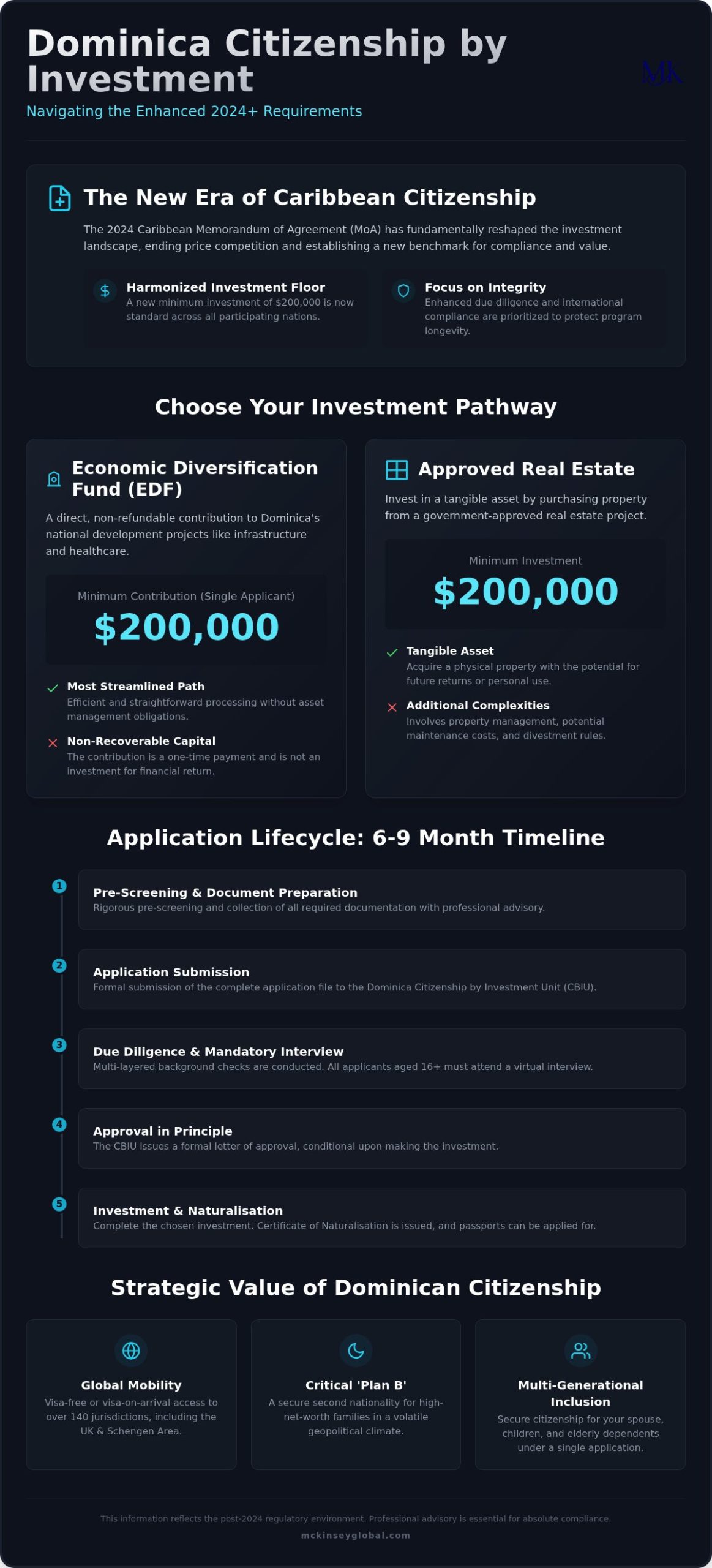
The 2024 Memorandum of Agreement among Caribbean nations fundamentally restructured the financial landscape for applicants. Under these harmonized standards, the minimum capital requirement for the program now starts at $200,000 USD, regardless of the chosen investment pathway. This unified floor ensures that Dominica citizenship by investment requirements remain competitive while upholding the program’s long-term sustainability. Investors must choose between a liquid contribution to the state or the acquisition of tangible assets, each carrying distinct fiscal implications and procedural obligations.
Option 1: The Economic Diversification Fund (EDF)
Choosing the Economic Diversification Fund serves as the most streamlined route to citizenship, involving a direct, non-refundable contribution to the government. For a single applicant, the minimum threshold is $200,000 USD, with the total amount scaling as family members are added to the petition. While this capital is not recoverable, it eliminates the complexities associated with property management and future divestment. These funds are strategically allocated toward national infrastructure, healthcare, and social development projects, directly contributing to the island’s economic resilience. This path provides a clean, efficient financial exit from the application process once naturalization is complete.
Option 2: Government-Approved Real Estate Investment
Investors seeking a tangible asset class may opt for government-approved real estate with a minimum entry point of $200,000 USD. This pathway typically involves purchasing shares in high-end luxury resorts or eco-lodges that have been vetted by Dominica’s Citizenship by Investment Unit for their viability and compliance. However, this option requires a higher total capital outlay due to additional government fees: $75,000 USD for a single applicant and $100,000 USD for a family. There are also strict mandatory holding periods to consider. The property must be retained for at least three years, which extends to five years if the asset is sold to another CBI investor. For those navigating these multi-year commitments, securing a disciplined advisory partner ensures that the investment remains compliant with evolving resale regulations.
Beyond the core investment, all applicants are subject to rigorous due diligence and processing charges. These non-refundable costs cover the extensive background checks and the mandatory interview protocol required for everyone aged 16 and older. Adhering to these financial Dominica citizenship by investment requirements is essential for maintaining the program’s global standing and ensuring that every candidate meets the highest standards of integrity. While the commitment is significant, it reflects the premium nature of the 2026 Dominican status.
Stringent Eligibility and the Mandatory Interview Protocol
The 2026 regulatory framework prioritizes character and financial transparency above all other considerations. To meet the Dominica citizenship by investment requirements, primary applicants must be at least 18 years of age and possess a clean criminal record from their country of birth and any jurisdiction where they’ve resided for more than six months. Compliance also extends to physical health: every applicant must undergo comprehensive medical examinations, including mandatory HIV testing. These baseline criteria ensure that the program’s reputation remains untarnished within the global community, protecting the long-term value of the status for all successful candidates.
Documenting the source of funds (SOF) represents the most significant point of friction in the modern application process. The Citizenship by Investment Unit requires an exhaustive paper trail that accounts for the legal origin of the investment capital. This involves providing audited financial statements, employment contracts, or evidence of asset liquidation. Failure to provide a clear, logical narrative for wealth accumulation is the primary cause of application delays or rejections. Maintaining procedural integrity during this phase is essential for a predictable approval timeline.
The Virtual Interview: Preparation and Expectations
The 2026 vetting process includes an enhanced mandatory virtual interview for all applicants aged 16 and older. These sessions are conducted in English via secure, government-approved platforms, though certified translators are available if required. The dialogue focuses on three critical areas: identity verification, business background, and a verbal confirmation of the source of wealth. Detailed guidelines from the Official Dominica Citizenship by Investment Unit confirm that consistency between verbal statements and submitted documentation is paramount. Professional advisory is vital here to ensure that applicants are prepared for the high-stakes nature of this interaction.
Dependent Inclusion Rules for Families
Dominica remains a preferred choice for multi-generational families, provided they adhere to specific inclusion rules. The primary applicant can include a spouse and children under the age of 18 without additional academic proof. However, adult children between the ages of 18 and 30 must be enrolled in full-time higher education and remain substantially supported by the main applicant. For the older generation, parents and grandparents over the age of 65 are eligible for inclusion if they can demonstrate significant financial dependence on the primary investor. Managing these complex family integrations requires a disciplined approach to documentation to ensure every family member meets the rigorous 2026 standards.
The Application Lifecycle: From Submission to Naturalisation
Achieving status through the program requires a methodical approach that prioritizes procedural accuracy over speed. The 2026 application lifecycle is structured to ensure that every successful candidate aligns with the nation’s high-security standards. This journey is not merely a transaction; it’s a guided progression through five distinct stages of evaluation and compliance. To begin your journey with a pre-screened, high-probability application, you can consult with our strategic advisors to ensure your profile meets every requirement before formal submission.
The process begins with a strategic consultation and pre-screening. This initial phase involves a meticulous internal audit of the applicant’s background and financial history to mitigate risk. Once the file is deemed robust, the second step focuses on document compilation. Authorized agents manage the complex dossier, ensuring all translations and certifications meet the Dominica citizenship by investment requirements. The third stage is the formal submission to the Citizenship by Investment Unit (CBIU), which triggers the commencement of multi-jurisdictional due diligence.
The fourth stage involves the mandatory virtual interview and background verification. As detailed in previous sections, this is a critical identity and intent check. Finally, the fifth stage is the issuance of the “Approval in Principle.” Only after this official notification does the applicant transfer the committed investment funds. Upon verification of the transfer, the government issues the Naturalisation Certificate, marking the legal conclusion of the process.
Timeline and Processing Expectations for 2026
In the current regulatory environment, investors should anticipate a duration of 6 to 9 months from the initial submission to the issuance of a passport. While some outdated sources suggest shorter windows, the enhanced vetting protocols of 2026 require a more deliberate pace. Factors such as incomplete financial histories or complex corporate structures can introduce delays. Maintaining “decision-ready” files is the most effective way to expedite the CBIU review and avoid unnecessary requests for additional information.
Post-Approval Formalities
Once the Naturalisation Certificate is secured, new citizens must complete the taking of the Oath of Allegiance. This is a formal procedure that establishes the legal bond between the individual and the Commonwealth of Dominica. Following this, the passport is issued with specific validity periods. For adults and children over 16, the document remains valid for 10 years. For children under 16, it’s valid for 5 years. Understanding these ongoing Dominica citizenship by investment requirements is essential for maintaining your global mobility and ensuring timely renewals in the future.
Strategic Alignment: Why Professional Advisory is Essential
The sophisticated nature of the 2026 regulatory framework means that navigating the Dominica citizenship by investment requirements now demands the insight of a seasoned global strategist. It’s no longer sufficient to simply compile documents; applicants must present a narrative that withstands the scrutiny of multi-layered international vetting. McKinsey Citizenship and Residency Solutions operates as a disciplined framework for this process, acting as a meticulous gatekeeper for high-net-worth families. Our methodology focuses on strategic risk mitigation: we identify potential due diligence red flags through rigorous pre-screening before any dossier reaches government authorities. This proactive evaluation minimizes uncertainty and ensures that every application is presented with the highest level of procedural integrity.
The Role of the Authorised Agent
Under Dominican law, individuals are prohibited from submitting applications directly to the government; instead, they must engage an authorised agent to manage the petition. Selecting a partner with a proven track record of integrity is the most critical decision in the entire process. An expert advisor does more than facilitate a transaction; they integrate your Dominican status into a broader global residency and citizenship strategy. This approach ensures that your new nationality complements existing assets and supports your long-term objectives for mobility and wealth preservation within a secure legal structure.
Portfolio Diversification Through Citizenship
For many investors, the decision involves a comparative analysis of regional options, such as St. Kitts and Nevis citizenship by investment. While both jurisdictions offer significant benefits, the choice depends on specific goals regarding family inclusion, capital outlay, and intended travel patterns. Dominica remains a premier choice for those seeking a balance of established legal precedent and competitive entry thresholds. Our role is to ensure that your investment goals align perfectly with the most suitable Caribbean jurisdiction, providing a stable foundation for your family’s future.
Beyond the initial acquisition of a passport, a professional partnership provides ongoing support for the complexities of global tax and compliance realities. The responsibilities of citizenship don’t end at naturalisation; they require a commitment to maintaining status through a changing international landscape. To begin this journey with the clarity and precision your wealth deserves, we invite you to secure your global future with a professional briefing.
Securing Your Global Legacy in a Harmonized Caribbean
The transition to a premium, high-security regional standard has fundamentally redefined the path to Dominican nationality. Success in 2026 requires more than just meeting the capital floor; it demands a meticulous approach to the updated Dominica citizenship by investment requirements. By prioritizing financial transparency and preparing for the mandatory virtual interview, families can secure a status that offers unparalleled global mobility and long-term stability. Navigating this complex regulatory environment is a high-stakes endeavor that leaves no room for procedural ambiguity or incomplete documentation.
McKinsey Citizenship and Residency Solutions provides the disciplined, high-touch advisory necessary to manage your application with absolute confidentiality. Our deep expertise in the 2024 Caribbean MOA regulatory framework ensures that your dossier is not only compliant but strategically positioned for approval within the anticipated 6-9 month window. When you’re ready to advance your global strategy with a partner who values precision and security above all else, we invite you to Request a Strategic Consultation for Dominica Citizenship. Your journey toward a secure and prosperous future begins with a single, well-informed step.
Frequently Asked Questions
What is the minimum investment for Dominica citizenship in 2026?
The minimum investment for Dominica citizenship in 2026 is $200,000 USD. This threshold applies to both the non-refundable contribution to the Economic Diversification Fund and the acquisition of government-approved real estate. While the base investment is harmonized, the real estate pathway requires additional government fees starting at $75,000 for a single applicant. These Dominica citizenship by investment requirements reflect the 2024 regional agreement to maintain program integrity and value.
Can I include my siblings in my Dominica citizenship application?
Siblings cannot be included as dependents in a Dominica citizenship application under current 2026 regulations. The program strictly defines eligible family members as spouses, children under 18, and adult children aged 18 to 30 who are in full-time education. Parents and grandparents over 65 who are substantially supported by the main applicant are also eligible. Siblings must submit independent applications and meet the full investment criteria on their own merits.
Is there a residency requirement to maintain Dominican citizenship?
There is no residency requirement to maintain your status as a Dominican citizen. Unlike residency-by-investment programs in Europe, Dominica doesn’t mandate that you spend any time on the island before, during, or after the application process. This flexibility allows high-net-worth individuals to secure global mobility and a stable jurisdiction without disrupting their existing professional or personal lives in their home country. The process remains entirely remote and investment-focused.
How does the mandatory interview work for applicants?
The mandatory interview is a secure virtual session required for all applicants aged 16 and older. It’s conducted in English, though certified translators can be arranged if necessary. During the session, officials verify your identity and discuss your business background and source of wealth. This protocol is a cornerstone of the Dominica citizenship by investment requirements, ensuring that every new citizen meets the highest global standards of transparency and integrity.
What are the tax implications of becoming a citizen of Dominica?
Becoming a citizen of Dominica offers significant fiscal advantages, as the nation doesn’t impose taxes on global income, capital gains, or inheritance. These favorable policies make the jurisdiction an attractive hub for sophisticated wealth management and international tax planning. However, investors should always consult with their domestic tax advisors to understand how dual nationality affects their reporting obligations in their current country of residence to ensure total compliance.
How long does the entire Dominica CBI process take in 2026?
The entire application process in 2026 typically takes between 6 and 9 months from the moment of submission to the issuance of the passport. This timeline accounts for the multi-layered due diligence checks and the mandatory virtual interview. While previous years saw shorter processing windows, the current regulatory landscape prioritizes thorough vetting to safeguard the program’s international standing and ensure the continued visa-free access for all Dominican passport holders.
Can the real estate investment be sold after I obtain citizenship?
You can sell your real estate investment after a mandatory holding period is satisfied. To maintain the integrity of the investment, the property must be held for at least three years before it can be sold on the general market. If you intend to sell the asset to another individual seeking citizenship through the program, the holding period extends to five years. This structure ensures a stable and sustainable real estate market for all stakeholders.
What happens if my application for Dominica citizenship is rejected?
If an application is rejected, all government processing and due diligence fees are non-refundable. Rejections usually stem from inconsistencies in financial documentation or undisclosed background issues discovered during the vetting process. This risk underscores the necessity of professional pre-screening. By identifying potential red flags before formal submission, investors can mitigate the danger of a public rejection and protect their capital from being lost on a failed petition.