In the current climate of global mobility, the most expensive mistake an investor can make is prioritizing a low entry price over the legal durability of their residency status. You likely understand that the window for traditional european union residency by investment programs is narrowing as oversight increases and due diligence becomes more exhaustive. Selecting a jurisdiction based on outdated data or superficial benefits often leads to unforeseen tax liabilities or sudden regulatory shifts that can jeopardize your long-term objectives and family security.
This article provides a disciplined framework for comparing the most resilient programs available in 2026, specifically focusing on the strategic advantages of Greece, Portugal, and Latvia. You’ll gain the clarity needed to navigate complex compliance requirements while securing Schengen Area mobility and asset diversification in a stable currency. We’ll examine the specific variables that define a successful application; this includes managing golden visa processing times, vetting investment vehicles, and evaluating the genuine potential for future citizenship within a secure secondary home.
Key Takeaways
- Identify the European Commission’s 2026 stance on investment migration to ensure your chosen pathway offers long-term legal durability and regulatory compliance.
- Compare the specific strategic advantages of the Portugal, Greece, and Latvia programs to determine the optimal european union residency by investment for your unique profile.
- Utilize a five-pillar framework to assess the “Total Cost of Ownership,” evaluating capital requirements alongside mobility, family security, and potential exit strategies.
- Master the complex due diligence and “Source of Wealth” documentation required to protect your global reputation during the transition toward permanent residency.
- Align your residency objectives with broader global wealth and estate goals through a disciplined, boutique advisory approach that minimizes procedural uncertainty.
The Paradigm Shift: EU Residency by Investment in 2026
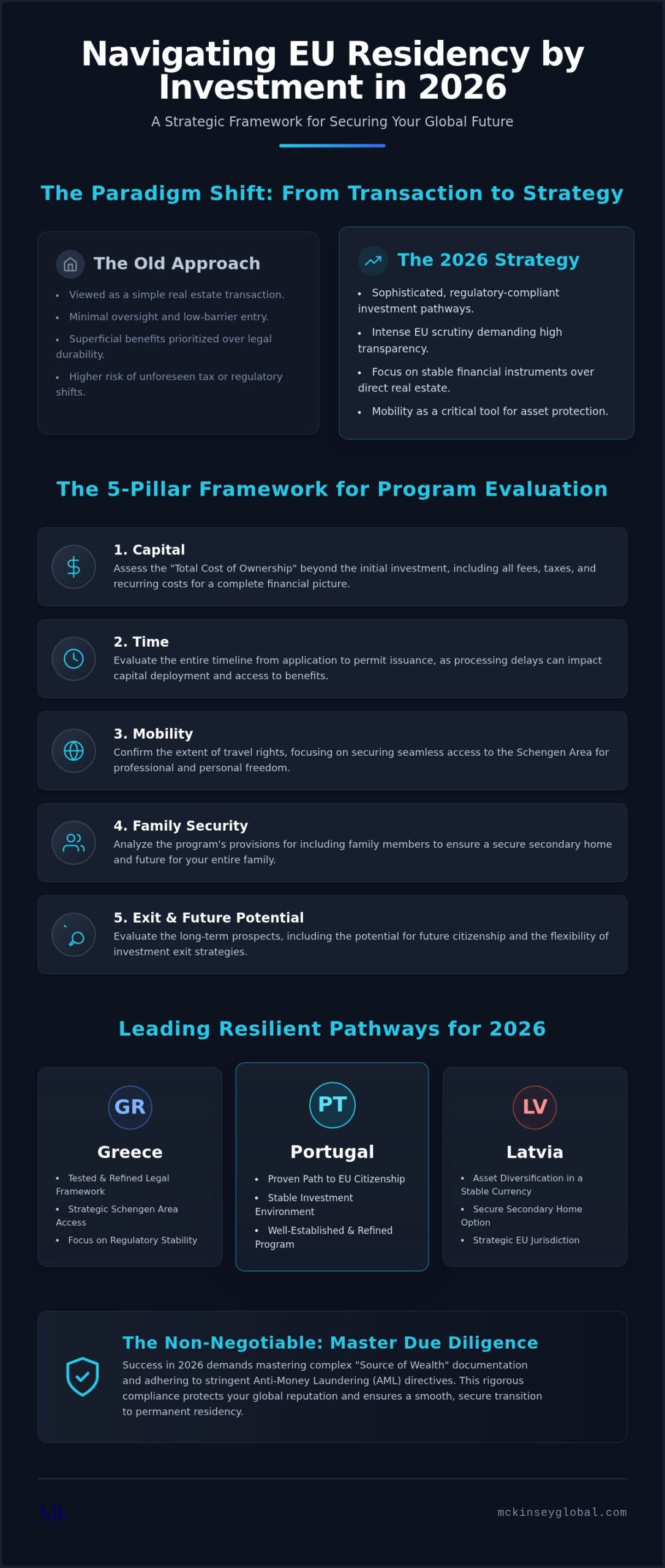
The concept of european union residency by investment has undergone a fundamental transformation. In previous years, these programs were often viewed as transactional real estate acquisitions with minimal oversight. In 2026, they’ve matured into sophisticated, regulatory-compliant investment pathways. The European Commission has intensified its scrutiny of Golden Visa structures, demanding higher standards of transparency and security across all member states. This shift ensures that only the most disciplined programs survive. It provides investors with a more stable and predictable environment for their capital, though it requires a much higher level of initial due diligence and professional vetting.
High-net-worth individuals are increasingly moving away from direct real estate. They now favor diversified financial instruments, such as private equity funds, venture capital, or direct capital transfers. These options offer superior liquidity and significantly fewer management burdens than physical property. Securing a european union residency by investment through capital markets often provides a faster route to approval than traditional property routes. These structures align more closely with the strategic needs of global business innovators who require seamless access to the Schengen Area for professional and personal reasons. Mobility isn’t a luxury. It’s a critical tool for asset protection and international commerce in a volatile global market.
The Evolution of Residency vs. Citizenship
A residency permit offers immediate benefits, primarily the right to reside and travel within the EU. However, it’s vital to distinguish between a physical residency permit and tax residency. The latter carries distinct legal and financial obligations that vary by jurisdiction. While the immediate goal is mobility and security, the long-term objective for most remains the transition to an EU passport. This progression requires careful adherence to stay requirements and continuous compliance with the host nation’s evolving legal framework, making professional oversight indispensable for long-term success.
Regulatory Trends and Market Stability
The 2026 landscape differs significantly from the real estate boom of the previous decade. Modern programs are shaped by stringent anti-money laundering (AML) directives, which have replaced the low-barrier entry points of the past. Stability is now the primary metric for program selection. Investors prioritize jurisdictions like Greece, Portugal, and Latvia, where legal frameworks have been tested and refined. Understanding golden visa processing times and vetting compliance are essential steps in mitigating the risks associated with regulatory volatility and ensuring a secure secondary home for family members.
Evaluating the Value Proposition: Strategic Comparison Frameworks
Determining the optimal pathway for european union residency by investment requires a departure from superficial cost comparisons toward a rigorous evaluation of long-term utility. A sophisticated investor views residency not as a product, but as a strategic asset that must be measured against a multi-dimensional framework. We utilize the Five Pillars of Investment Migration to provide this clarity: Capital, Time, Mobility, Family, and Exit. Each pillar represents a critical variable that influences the overall success and durability of the residency status.
Assessing the “Total Cost of Ownership” is a prerequisite for any high-stakes application. This analysis extends beyond the initial capital outlay to include recurring legal fees, document procurement costs, and the nuances of long-term tax liabilities. For instance, while some programs offer lower entry thresholds, the cumulative cost of mandatory renewals and stringent physical presence requirements can erode the initial financial advantage. Understanding the variance in golden visa processing times is equally vital, as delays in approval can defer the realization of mobility benefits and impact the timing of capital deployment.
- Capital: The total liquidity required, including unrecoverable government fees and administrative costs.
- Time: The duration until the permit is issued and the mandatory physical stay required to maintain status.
- Mobility: The scope of visa-free access and the ease of relocating assets across borders.
- Family: The ability to include multi-generational dependents, such as elderly parents or adult children, in a single application.
- Exit: The legal and financial mechanisms available for capital repatriation once the residency or citizenship objective is met.
Investment Security and Capital Preservation
In the 2026 regulatory environment, the security of the underlying asset is paramount. Investors must choose between government bonds, private equity funds, and business capital transfers, each carrying a distinct risk profile. While government bonds offer a traditional sense of security, many HNWIs now prioritize private equity funds for their potential for higher returns and professional management within EU-regulated frameworks. Evaluating the liquidity of these assets is essential; you must have a clear understanding of when and how capital can be repatriated without compromising your residency status.
Mobility and Global Integration
Schengen Area travel privileges remain a primary driver for investment, providing a seamless solution for international business leaders who operate across European borders. Beyond convenience, residency serves as a robust “Plan B,” offering a secure secondary home and insurance against domestic economic or political volatility. Strategic mobility is the ability to relocate assets and family within 72 hours.
Comparative Analysis of Leading EU Residency Pathways
Choosing the right jurisdiction for european union residency by investment requires a granular understanding of how each program aligns with your long-term capital and lifestyle goals. While the overarching benefits of Schengen access remain constant, the operational details of these programs have diverged significantly in 2026. We focus our analysis on Greece, Portugal, and Latvia, as these nations offer the most robust frameworks for investors who prioritize stability and a clear path to permanent status. Each jurisdiction serves a distinct strategic purpose, from Northern European market entry to Mediterranean lifestyle integration.
Portugal: The Balanced Strategy
Portugal remains a premier choice for those who prioritize a low physical presence requirement. The Portugal Golden Visa investment fund option has become the definitive pathway following the closure of the real estate route for residency purposes. This fund-based approach offers professional management and asset diversification, while the seven-day annual presence requirement stays a global benchmark for flexibility. By the fifth year, investors are eligible to apply for citizenship, provided they meet basic language and tie-to-country requirements. It’s one of the most efficient timelines in the region for non-residents.
Greece and Latvia: Regional Powerhouses
Greece continues to attract significant capital through its residency program, which combines a Mediterranean lifestyle with a permanent residency permit from the outset. In 2026, navigating the Greek market requires attention to tiered investment thresholds. These regulations direct capital toward specific regions and property types to manage local housing pressures. Investors must be increasingly selective, ensuring their asset acquisition complies with the latest zoning and heritage preservation rules to secure their status.
Latvia serves as a strategic gateway for those focused on Northern European market integration. It often presents a high-value entry point with lower capital thresholds compared to its Southern European counterparts. This makes it an attractive option for business innovators who require a legal base in the Baltic region to oversee operations in Scandinavia and Germany. While Italy and Malta offer bespoke solutions for ultra-high-net-worth individuals, including specialized tax regimes, the programs in Greece, Portugal, and Latvia provide the most versatile european union residency by investment solutions for a broader range of strategic investors.
Compliance, Due Diligence, and the Transition to EU Citizenship
Securing european union residency by investment in 2026 is no longer a simple administrative task; it’s a rigorous exercise in financial transparency. The European Commission’s updated directives have mandated that all member states implement exhaustive “Source of Wealth” (SOW) protocols. These checks go beyond basic bank statements to examine the historical accumulation of capital over decades. Failing to provide a clear, documented lineage of funds can lead to immediate application rejection or, worse, long-term reputational damage. Engaging with golden visa advisory services is essential to ensure that your documentation meets these elevated standards before submission.
Modern background checks now involve multi-layered coordination between local authorities and international agencies, including Interpol and Europol. These protocols are designed to identify any political exposure or regulatory discrepancies that might pose a risk to the host nation. Opting for “unvetted” or low-compliance programs is a significant risk to your global standing. A disciplined approach to compliance doesn’t just secure a permit; it protects your legacy. For expert guidance in managing these complex vetting requirements, you should consult with a specialist migration advisor.
The Vetting Process: A Step-by-Step Briefing
The journey begins with a meticulous pre-screening phase where we identify potential hurdles in your financial or professional history. Once cleared, the process moves to document procurement. This involves managing international apostilles and certified translations for dozens of legal instruments. After submission, our role shifts to monitoring and handling any Requests for Evidence (RFEs). Authorities often issue these detailed inquiries to clarify specific transactions. Prompt, precise responses are critical to maintaining the integrity of your application timeline.
Achieving the Final Goal: Citizenship
Transitioning from a residency permit to a passport requires a nuanced understanding of the “Path to Passport” in each jurisdiction. While european union residency by investment grants the right to live and travel, citizenship demands further commitment. Portugal, for instance, requires a basic A2 level of language proficiency, whereas Greece and Latvia have more stringent linguistic and cultural integration hurdles. It’s also important to distinguish between legal residence, which allows for minimal physical presence in some programs, and the physical residency often required for naturalization. EU citizenship is the ultimate hedge against geopolitical instability.
Strategic Advisory: Aligning Residency with Global Wealth Goals
A successful strategy for european union residency by investment requires more than a simple selection of a jurisdiction. It demands a boutique advisory approach that prioritizes your specific financial profile and long-term legacy goals. Unlike mass-market agencies that treat migration as a transactional service, our focus remains on providing a disciplined framework. We integrate residency planning into your broader tax and estate strategy, ensuring that your international mobility doesn’t create unforeseen liabilities or regulatory conflicts in other areas of your wealth management. This level of precision is vital when moving significant capital across borders.
Managing expectations is central to our professional commitment. We provide detailed, data-driven insights into golden visa processing times 2026 to ensure your capital deployment aligns with the regulatory reality of the current fiscal year. McKinsey Citizenship and Residency Solutions operates with the procedural integrity and absolute confidentiality required for high-stakes applications. We act as a meticulous gatekeeper, shielding our clients from the uncertainty of evolving EU policies while maintaining a steady focus on long-term stability and risk mitigation.
Bespoke Portfolio Alignment
We meticulously match your investment profile to the most appropriate program types, balancing your preference for conservative assets or growth-oriented vehicles. For investors seeking capital preservation, the stable capital requirements of Latvia provide a clear entry point into Northern European markets. For those focused on higher yields and a path to a passport, the Portugal fund route offers a sophisticated, professionally managed alternative. Our partnership doesn’t end with the issuance of a permit. We manage the complex logistics of local integration and provide continuous monitoring to ensure your residency remains compliant as member state laws change.
Next Steps for the Global Investor
Your journey begins with a comprehensive consultation to define your primary objective: immediate Schengen mobility or a multi-year path to citizenship. Once your goal is established, we initiate a due diligence kick-off that emphasizes early document preparation. This proactive stance is the most effective way to prevent administrative delays and ensure a smooth vetting process. Finally, we provide a formal recommendation that selects the optimal jurisdiction for your family’s future. This choice is based on a rigorous evaluation of security, mobility, and the potential for asset diversification in a stable currency.
Securing Your Global Legacy Through Strategic Residency
The landscape of european union residency by investment has transitioned from a simple property acquisition model to a complex, fund-based regulatory framework. Success in 2026 depends on your ability to navigate stringent due diligence requirements while aligning your capital with stable, high-performance assets in jurisdictions like Greece, Portugal, or Latvia. It’s no longer enough to meet an investment threshold; you must ensure the procedural integrity of your application to protect your global reputation and family’s future.
With over five years of boutique expertise and specialized knowledge of the 2026 fund-based investment landscape, we provide the meticulous guidance necessary for high-stakes migration. Our focus on disciplined vetting and end-to-end management minimizes uncertainty in an increasingly volatile environment. Consult with a Strategic Advisor on EU Residency Pathways to define a secure and prosperous path for your international interests. Your family’s future deserves the clarity of a seasoned strategist.
Frequently Asked Questions
Is European Union residency by investment still available in 2026?
Yes, several programs remain active, though they operate under enhanced regulatory frameworks. Jurisdictions like Greece, Portugal, and Latvia continue to offer pathways, provided investors adhere to the 2026 compliance standards. These programs have shifted away from direct real estate in some regions, favoring fund-based investments or capital transfers that align with European Commission directives. It’s essential to verify the current legal status of each program before deploying capital.
How much does it cost to get EU residency by investment?
The total cost of acquisition varies significantly based on the chosen jurisdiction and investment vehicle. Beyond the primary capital requirement, investors must account for government fees, legal advisory costs, and document procurement expenses. For example, Latvia often represents a more accessible entry point compared to the tiered thresholds found in the Greek market. You should evaluate the total cost of ownership over a five-year period to understand the full financial commitment required.
Which EU country has the easiest residency by investment program?
Ease is defined by your specific objectives, whether you prioritize lower capital thresholds or minimal physical presence. Latvia is frequently cited for its straightforward capital transfer requirements and accessible entry points for Northern European market access. Conversely, Portugal is favored by those seeking a path to citizenship with only a seven-day annual stay requirement. Selecting the optimal european union residency by investment depends on balancing your liquidity needs with your long-term mobility goals.
Can I include my family in my EU residency application?
Yes, most programs allow for the inclusion of immediate family members within a single application. This typically encompasses a spouse and dependent children, though some jurisdictions also permit the inclusion of dependent parents. Maintaining multi-generational residency requires meticulous documentation of dependency and shared household status. Each member must pass the same rigorous background checks and due diligence protocols as the primary applicant to ensure the integrity of the family’s residency status.
Do I need to live in the country to maintain my EU residency?
Physical presence requirements vary by program. Portugal is notable for its flexible seven-day annual stay requirement, which appeals to global business leaders who don’t wish to relocate fully. In contrast, other jurisdictions may require more significant time on the ground if your ultimate goal is permanent residency or citizenship. It’s vital to distinguish between the requirements for maintaining a permit and the stricter presence rules often mandated for tax residency or naturalization.
What is the difference between EU residency and EU citizenship?
EU residency provides the legal right to reside in a specific member state and travel visa-free within the Schengen Area. Citizenship is the definitive goal, granting a passport, the right to vote, and the ability to live and work anywhere in the European Union. While residency is a prerequisite, the transition to citizenship involves additional hurdles; these include language proficiency tests and a proven history of legal residence over a period of five to ten years.
Can I work in any EU country with a residency permit from one member state?
A residency permit generally grants the right to work only within the country that issued the permit. While the permit facilitates seamless travel across the Schengen Area for up to 90 days in any 180-day period, it doesn’t provide an automatic right to employment in other member states. To work elsewhere, you’d typically need to secure a specific work permit for that nation or wait until you have achieved long-term resident status or full EU citizenship.
How long does it take to process an EU residency by investment application in 2026?
Processing timelines in 2026 are influenced by increased due diligence requirements and the volume of applications in specific jurisdictions. While some programs may issue initial approvals within six to nine months, complex cases involving extensive vetting can take longer. It’s critical to manage expectations by reviewing current golden visa processing times and ensuring all documentation is apostilled correctly. Early document preparation is the most effective way to mitigate administrative delays and secure your status.