In 2026, the success of a residency application is determined less by the capital invested and more by the precision of the submission timeline. For the sophisticated investor, the primary obstacle isn’t the financial threshold but the unpredictable nature of golden visa processing times. You’ve likely realized that capital remains unproductive while applications sit in government backlogs; this creates a significant opportunity cost that compounds with every month of delay. It’s often difficult to reconcile strategic tax and lifestyle goals when faced with regulatory volatility and administrative friction.
This guide provides the clarity required to secure your global residency with surgical precision. We’ve compiled an expert-verified 2026 processing guide and submission checklist to help you manage these complexities effectively. You’ll gain a predictable timeline for residency that aligns with your long-term wealth and mobility objectives. We’ll examine current backlogs across premier jurisdictions like Greece, Portugal, and the Caribbean while outlining the exact procedural steps necessary to minimize delays and protect your capital’s liquidity during the transition.
Key Takeaways
- It’s essential to understand how 2026’s enhanced due diligence standards affect application speed so you can adjust your global mobility strategy accordingly.
- Identify the most efficient jurisdictions by comparing the 12-24 month European window with the 4-8 month timelines offered in the Caribbean.
- Learn how a meticulous pre-submission audit reduces golden visa processing times by preemptively resolving complex Source of Wealth documentation issues.
- Master the protocols for responding to government inquiries within 48 hours to prevent administrative friction from stalling your residency approval.
- Don’t leave your residency timeline to chance; align it with specific tax and lifestyle goals through a structured management approach that prioritizes long-term stability.
The 2026 Global Residency Landscape: Why Timelines Are Shifting
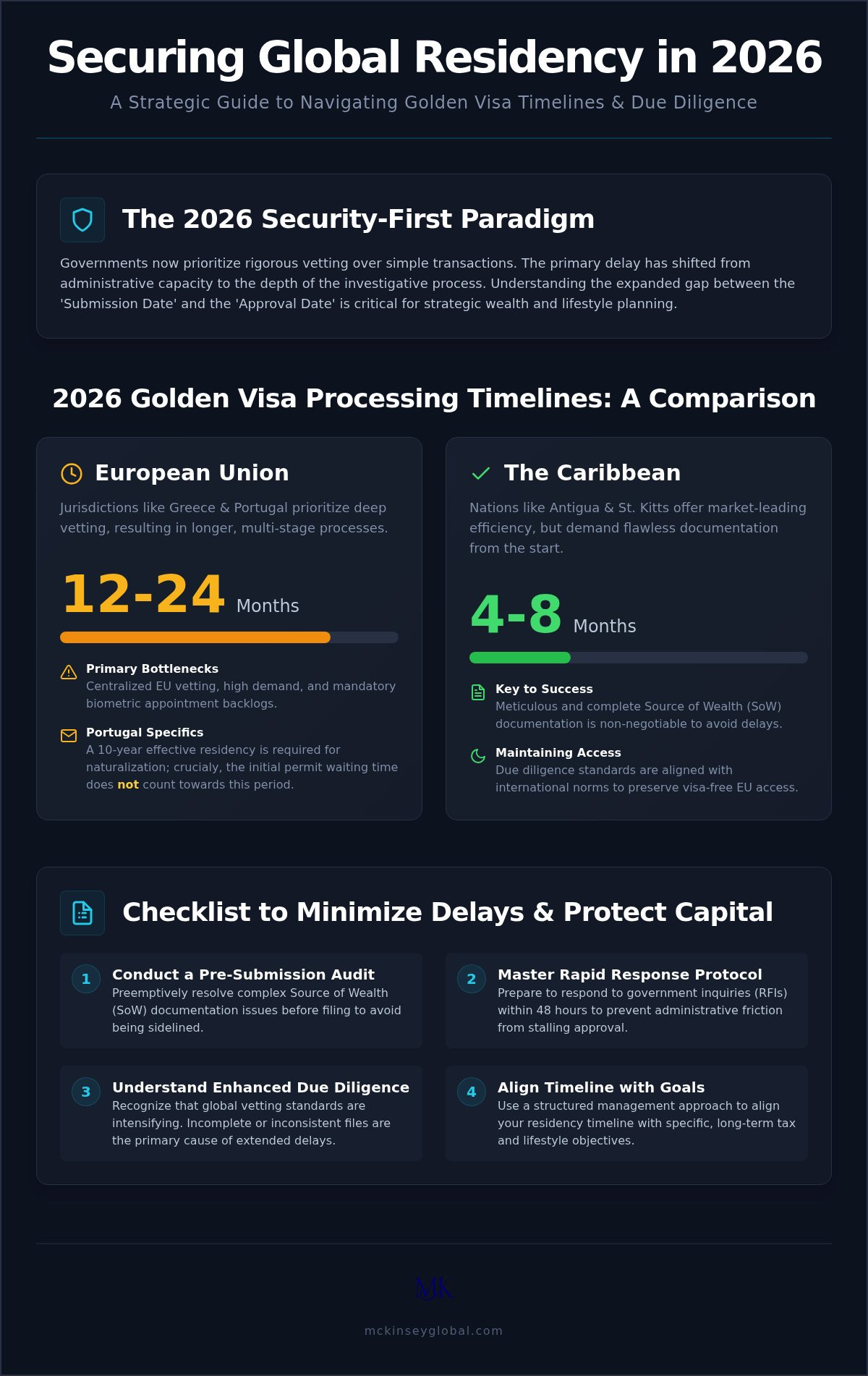
The 2026 investment migration environment is defined by a security-first paradigm that has fundamentally altered the pace of residency acquisition. Governments no longer view high-net-worth migration as a simple transaction; instead, they treat it as a rigorous vetting exercise. This transition has led to a noticeable divergence in golden visa processing times, where the primary delay is no longer administrative capacity but the depth of the investigative process. For the strategic investor, understanding the distinction between the “Submission Date” and the “Approval Date” is vital. While the submission date fulfills your immediate application requirements, the approval date is what triggers statutory residency rights and tax residency eligibility. In 2026, the delta between these two milestones has expanded, necessitating a more sophisticated approach to lifestyle and capital planning.
The Impact of the 2026 Portugal Nationality Law
Portugal remains a primary focus for global investors, yet recent legislative updates have introduced new complexities. The 2026 Nationality Law now requires a ten-year period of effective residency before an individual can apply for naturalization. Crucially, the time spent waiting for the initial residence permit to be issued is currently excluded from this ten-year threshold. This change places a premium on early and accurate file submission. Investors utilizing the Portugal Golden Visa investment fund option must account for this extended timeline when calculating their path to EU citizenship. Delaying the start of the process by even a few months can result in years of additional waiting before citizenship eligibility is reached.
Vetting Standards and Administrative Backlogs
Centralized EU vetting protocols have become the standard for all residency applications within the Schengen Area. This initiative aims to harmonize security checks across member states, which has inadvertently created a new bottleneck stage during the background verification phase. Simultaneously, Caribbean nations such as Antigua and St. Kitts have aligned their due diligence standards with international norms to preserve their crucial visa-free access to the European Union. While these programs remain efficient, the increased scrutiny on Source of Wealth (SoW) documentation means that incomplete files are often sidelined. Golden visa processing times are now highly sensitive to the quality of the initial filing; a single discrepancy can trigger a Request for Information (RFI) that adds months to the overall duration.
2026 Comparative Timeline: Europe, Caribbean, and the Middle East
Strategic jurisdictional selection is the most significant lever an investor can pull to control their residency trajectory. In the current global climate, golden visa processing times vary significantly based on regional administrative capacity and the complexity of local due diligence frameworks. While some regions prioritize speed to attract immediate capital, others focus on meticulous vetting to ensure long-term stability within their borders. Understanding these benchmarks allows for the strategic alignment of residency with tax and lifestyle goals.
European Residency Timelines (Greece & Latvia)
The European Union currently presents a 12-24 month window for most residency-by-investment programs, particularly for Greece and Portugal. In Greece, high demand for Schengen zone access has led to a saturation of local decentralized administrations; this often results in significant delays for biometric appointments, which are a mandatory step in the process. Latvia offers a Northern European alternative with distinct processing dynamics that can sometimes bypass the Mediterranean bottlenecks. Across all EU jurisdictions, the role of biometric scheduling remains the primary cause of timeline drift. Investors should anticipate a methodical, multi-stage process where initial approval is only the first of several administrative hurdles. For a detailed comparison of how Greece, Portugal, and Latvia stack up against one another, our analysis of European Union residency by investment programs in 2026 provides the jurisdictional framework needed to make an informed decision.
Caribbean and Global Citizenship Speed
Caribbean nations continue to lead the market in terms of efficiency, maintaining golden visa processing times of 4-8 months for most applicants. Antigua and Barbuda remains a preferred choice for those requiring a swift transition, provided the initial documentation is flawless. For more detailed pathway analysis, investors should refer to the Antigua and Barbuda Investment Options 2026 Guide. St. Kitts and Nevis also offers an “Accelerated Application Process” for a premium, though availability is subject to government capacity and current backlog volumes. These programs are ideal for those who prioritize a predictable timeline and wish to minimize the opportunity cost of locked capital.
The Middle East has emerged as a high-speed alternative, with the UAE and Türkiye offering processing benchmarks of 2-4 months. These jurisdictions have streamlined their digital infrastructure to facilitate rapid vetting and approval. Despite these impressive speeds, “Timeline Drift” can still occur due to external factors such as international bank transfer delays or the time required to apostille documents in an applicant’s home country. Consulting with a seasoned residency strategist can help identify these hidden delays before they impact your broader objectives. By accounting for these variables, you can ensure your transition to a new jurisdiction remains disciplined and predictable.
The Pre-Submission Audit Checklist: Eliminating Administrative Lag
The McKinsey “Zero-Error” Philosophy dictates that the most significant influence an applicant has over golden visa processing times occurs before the file ever reaches a government desk. During the initial 30-day preparation phase, a meticulous audit of all documentation is required to preemptively address the complexities of modern due diligence. This period isn’t merely for collection; it’s for the strategic evaluation of every data point to ensure absolute alignment with jurisdictional expectations. Source of Wealth (SoW) documentation remains the primary cause of administrative lag. In 2026, governments require an unbroken chain of evidence that accounts for capital accumulation over several decades. Standardizing international documents is another critical hurdle. Every certificate must undergo a formal apostille process and be translated by accredited professionals to meet strict legal standards. If these details are overlooked, the application will likely face a Request for Information (RFI), which resets the government’s internal clock and extends the waiting period indefinitely.
Financial and Investment Documentation
Investment execution must be synchronized with the application submission to avoid capital being held in escrow longer than necessary. We require verifying fund transfers and investment certificates to ensure they meet 2026 compliance standards. High-stakes vetting now involves preparing multi-jurisdictional tax records that provide a clear view of an investor’s global footprint. Bank statements must strictly adhere to the “look-back” periods specified by the program; these typically range from six to twelve months of transaction history. Any unexplained large deposits can trigger a secondary audit, which significantly impacts golden visa processing times and introduces unnecessary risk to the approval process.
Personal and Legal Record Integrity
Maintaining the integrity of personal records is essential to prevent secondary processing waves. Police clearance certificates are particularly sensitive, as most jurisdictions only recognize them within a six-month validity window from the date of issuance. If your background check expires during the government’s review, you’ll need to restart the procurement process. Medical certifications must also be handled with care to ensure they comply with local health department standards. Finally, documenting all dependents at the outset is vital. Adding family members later in the process often causes a complete reassessment of the file, which inevitably delays the primary applicant’s final approval.
Managing the “Waiting Room”: Post-Submission Strategies
The period following application submission is often mischaracterized as a passive waiting phase. In 2026, however, the most successful investors treat this interval as an active management cycle. Professional status monitoring serves as a vital bridge between the applicant and government authorities; it ensures that the file remains active and visible within the administrative system. A key component of this strategy is preparing for the Request for Information (RFI). When a government body requires clarification on source of wealth or personal history, the response should ideally be delivered within 48 hours. This level of responsiveness signals a commitment to transparency and can prevent golden visa processing times from extending into multi-year delays. If an application remains stagnant without professional oversight, it risks being deprioritized in favor of more responsive files.
Proactive Communication with Regulatory Bodies
Authorized agents play a critical role in interfacing with regulatory bodies like Portugal’s AIMA or the Greek Ministry of Migration. Maintaining a “File in Good Standing” requires more than just waiting for a letter; it involves periodic inquiries to confirm that no new legislative shifts have retroactively affected the submission. It’s essential to distinguish between a “normal” delay, which reflects standard seasonal backlogs, and an “exceptional” delay that may indicate an internal administrative error. Strategic intervention at the 12-month mark can often resolve minor clerical issues that would otherwise stall an approval for another year. To ensure your file receives this level of scrutiny, you may consult with our residency specialists for a comprehensive status evaluation.
Mobility and Lifestyle Planning
While residency is pending, maintaining global mobility is a primary concern for high-net-worth individuals. Many applicants utilize existing visa waivers or bridge visas to manage their travel requirements during the processing gap. Some investors employ the UAE or Caribbean programs as “speed-hedges”; they secure these faster alternatives to provide immediate security while waiting for a longer-term European permit. It’s equally important to ensure that tax residency status is not inadvertently triggered during this period. Spending excessive time in a target jurisdiction before a permit is granted can create complex tax obligations that were not part of the initial strategic plan. Risk mitigation becomes paramount if golden visa processing times exceed the 24-month mark. In such cases, a formal review of the legal framework and a potential jurisdictional pivot may be necessary to protect the investor’s long-term interests.
McKinsey Solutions: Strategic Precision in Investment Migration
McKinsey Citizenship and Residency Solutions operates as a disciplined gatekeeper for high-net-worth individuals seeking global mobility. Our end-to-end management of the application lifecycle is designed to eliminate the uncertainty often associated with international residency. A central pillar of our methodology is the “McKinsey Audit,” a rigorous pre-submission review that identifies and resolves potential discrepancies before they reach government adjudicators. By maintaining a lower RFI (Request for Information) rate than industry averages, we effectively compress golden visa processing times and ensure that our clients’ capital remains strategically aligned with their long-term goals. We’ve refined our internal protocols to include bespoke jurisdictional matching, which evaluates your specific timeline needs against the shifting benchmarks of global programs. We prioritize precision over volume, focusing on the meticulous alignment of complex variables to provide a stable path toward residency or citizenship while ensuring your wealth is protected throughout the transition.
Why Professional Advisory is Non-Negotiable in 2026
Navigating the 2026 regulatory shifts requires more than just legal knowledge; it demands the insight of a seasoned strategist who understands the intersection of global commerce and immigration law. As jurisdictions update their naturalization requirements and vetting protocols, the value of a global perspective becomes indispensable. Engaging professional golden visa advisory services is essential to evaluate which programs, from the Caribbean speed leaders to the established European pathways, offer the most secure and efficient route for your family and wealth structure. It’s essential to recognize that professional advisory isn’t just a convenience in this environment, it’s a prerequisite for risk mitigation. You’re invited to contact us for a confidential consultation to discuss your global mobility strategy and ensure your residency goals are met with professional gravity and discretion.
Next Steps for Global Investors
The journey toward a secure second residency begins with a comprehensive initial assessment of your investment goals and specific timeline requirements. Once a jurisdiction is selected, we move immediately to the execution of the Pre-Submission Audit to ensure every document meets the highest standards of compliance. This disciplined approach is essential for those who wish to secure their family’s future while minimizing the administrative friction that often characterizes golden visa processing times in 2026. We manage the entire lifecycle, from the initial fund transfer to the final issuance of the residence permit, providing a structured and predictable roadmap. You don’t have to leave your global mobility to chance. Secure your family’s future with a residency plan that values order, compliance, and strategic foresight above all else.
Securing Your Global Mobility with Strategic Foresight
Integrating residency into your broader wealth and lifestyle strategy requires more than just capital; it necessitates a disciplined adherence to evolving regulatory frameworks. In 2026, the variables influencing golden visa processing times are increasingly complex, making the role of a meticulous gatekeeper essential. By prioritizing a “Zero-Error” pre-submission audit and maintaining active status monitoring, you can mitigate the risks of administrative friction and unpredictable government backlogs. It’s vital to ensure that your application doesn’t just meet the minimum requirements but is optimized for the current vetting environment.
As a boutique advisory with over five years of high-stakes experience, McKinsey Citizenship and Residency Solutions specializes in navigating these Caribbean and European investment migration landscapes. Our expertise in 2026 regulatory compliance ensures that your application is handled with the precision and confidentiality your profile demands. We invite you to Consult with a McKinsey Global Strategist on Your Residency Timeline to align your objectives with a predictable and secure roadmap. Your transition to a new jurisdiction should be a seamless progression toward long-term stability and global access.
Frequently Asked Questions
How long does the Portugal Golden Visa take in 2026?
Portugal’s residency application window currently ranges between 12 and 24 months. This duration is primarily influenced by the ongoing restructuring of AIMA and the high volume of legacy applications within the system. While the 2026 Nationality Law has adjusted the naturalization thresholds, the initial permit issuance remains the most significant administrative bottleneck. Investors should prepare for a methodical verification process that prioritizes comprehensive security vetting over immediate processing speed.
What is the fastest Golden Visa program available right now?
The United Arab Emirates residency solutions represent the fastest path in the current market, with benchmarks typically falling between 2 and 4 months. If your objective is citizenship rather than residency, Antigua and Barbuda and St. Kitts and Nevis offer efficient processing windows of 4 to 8 months. These jurisdictions utilize streamlined digital vetting protocols that minimize administrative friction. Selecting these programs is a strategic choice for investors who prioritize immediate mobility.
Does the waiting time for a Golden Visa count toward citizenship?
Citizenship eligibility criteria vary significantly by jurisdiction and specific legal framework. In Portugal, the 2026 Nationality Law clarifies that the ten-year residency threshold for naturalization only begins once the initial residence permit is issued; time spent in the application queue is excluded. Conversely, Caribbean programs grant citizenship immediately upon approval of the investment. Understanding these legal nuances is essential for aligning your investment with long-term naturalization and lifestyle goals.
Can I speed up my Golden Visa processing time?
While government timelines are not directly negotiable, you can optimize your golden visa processing times through a meticulous pre-submission audit. Eliminating document discrepancies and ensuring Source of Wealth records are comprehensive prevents the issuance of a Request for Information (RFI). Responding to any government inquiries within 48 hours is also a critical factor. A disciplined approach to the initial preparation phase remains the most effective method for bypassing common administrative lags.
What happens if my Golden Visa application is delayed beyond the estimated time?
If an application exceeds the 24-month mark, a formal status evaluation is necessary to determine if the delay is exceptional. Authorized agents should interface directly with regulatory bodies to confirm the file’s standing and ensure no clerical errors have occurred. In some cases, missing biometric appointments or expired police certificates can stall a file indefinitely. If a delay becomes untenable, we evaluate risk mitigation strategies, which may include a strategic jurisdictional pivot.
Do Caribbean citizenship programs process faster than European residency?
Caribbean citizenship programs are demonstrably faster than European residency options in the 2026 landscape. Antigua, St. Kitts, and St. Lucia typically complete the vetting process within 4 to 8 months, whereas Greece and Portugal require 12 to 24 months. This disparity is due to the Caribbean’s centralized processing units and their focus on investment-based citizenship. For investors facing urgent deadlines, the Caribbean offers a more predictable and efficient administrative lifecycle compared to the European Union.
Is there an “Accelerated” option for the Greece Golden Visa in 2026?
There is no formal “accelerated” processing option for the Greece Golden Visa in 2026. However, the Greek Ministry of Migration has implemented digital infrastructure improvements to manage the high volume of Schengen-zone applications. The primary delay in Greece remains the scheduling of biometric appointments at decentralized administrations. Investors can minimize their wait by submitting a flawless file that avoids secondary audits, but they should anticipate a standard 12 to 18-month window.
How does the UAE Golden Visa timeline compare to European options?
The UAE Golden Visa timeline is significantly more efficient than European alternatives, often concluding within 2 to 4 months. This speed is facilitated by the UAE’s advanced e-government services and a residency framework designed for rapid investor integration. European programs, by contrast, involve multi-layered vetting and biometric requirements that extend golden visa processing times to 24 months. The UAE remains a superior choice for individuals who require immediate residency without the administrative friction common in Europe.