The fastest citizenship by investment program on paper may not be the fastest route to a passport. Comparisons of the fastest citizenship by investment programs 2026 can be misleading when one estimate measures time to an initial decision and another includes later steps, such as citizenship registration or passport issuance.
Speed matters, but your actual schedule can also depend on document readiness, due diligence, and the complexity of a family application. Delays at any of these points can widen the gap between a published estimate and an applicant’s experience. It is also important to distinguish direct citizenship programs from residency-by-investment routes, which grant residency first and may require years before naturalisation.
This comparison explains how to assess timeline estimates consistently, what can slow an application, and how to weigh speed against program fit. It focuses on direct citizenship routes and separates applicant preparation from government processing, so you can compare options without treating a published estimate as a promise.
Key Takeaways
- Compare the fastest citizenship by investment programs 2026 by checking which application stages each published timeline covers.
- Trace the route from eligibility review to passport issuance, separating applicant-led preparation from government processing.
- Assess Antigua and Barbuda, Dominica, St. Kitts and Nevis, St. Lucia, and Türkiye using consistent timeline stages and current official guidance.
- Weigh eligibility, family circumstances, timeline evidence, and strategic fit. The shortest estimate does not guarantee the quickest individual outcome.
- Use a structured assessment to clarify objectives, organise records, and plan the application process.
What Does Fastest Citizenship by Investment Mean in 2026?
“Fastest” is useful only when the clock has a defined start and finish. A published estimate might measure the period after an application is formally submitted, while an applicant may want to know the full journey from preparing documents to receiving a passport. These are different measures and should not be compared as if they describe the same process.
To compare the fastest citizenship by investment programs 2026, first establish whether a route grants citizenship directly or offers residency with a possible path to naturalisation later. The broader category of immigrant investor programs includes both citizenship and residence pathways, but their timelines and outcomes differ.
Which stages should a citizenship timeline include?
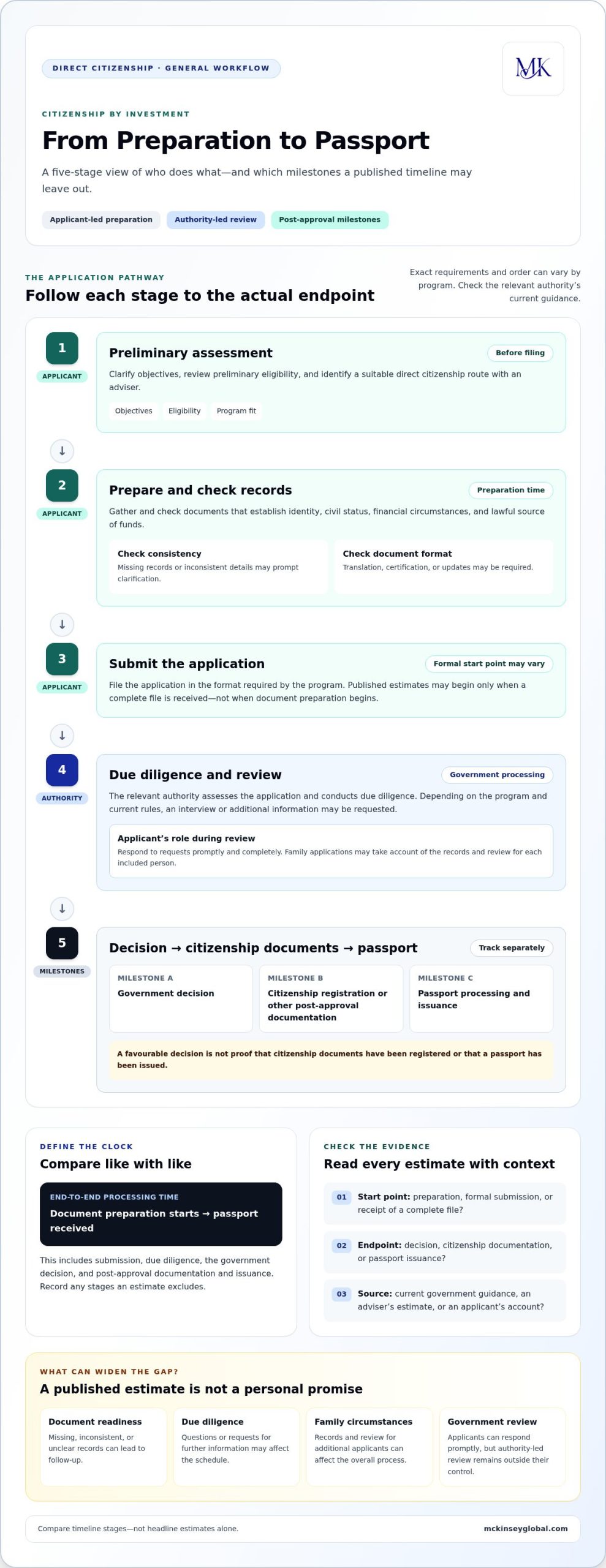
A useful timeline follows the application through document preparation, formal submission, due diligence, a government decision, and post-approval citizenship documentation and passport issuance. Published estimates may cover only some of these stages. One estimate may start when a complete file is received; another may describe the decision period without including the steps that follow.
When reviewing an estimate, note its start point and endpoint, its publication date, and its source. Separate current guidance from the relevant government authority from an adviser’s estimate or an applicant’s reported experience. Those accounts can add context, but they are not equivalent evidence of an official processing standard.
Does a fast application mean fast passport issuance?
No. Approval and issuance are separate milestones. A favourable decision does not establish that citizenship documents have been registered or that a passport has been issued. Treat a headline processing estimate as a measure of the full journey only if its source clearly includes the post-approval steps.
End-to-end processing time is the elapsed period from the start of applicant document preparation to receipt of the passport. It includes submission, due diligence, the government decision, and post-approval documentation and issuance. Use this definition to compare routes, and record any stages the published estimate excludes.
The schedule can vary with eligibility, the completeness and consistency of records, due diligence questions, and the circumstances of additional family applicants. Organised preparation and prompt responses can help prevent avoidable applicant-side delays, but government review remains outside an applicant’s control. For a fair 2026 comparison, check current guidance from the relevant program authority and record the date, start point, and endpoint of each estimate. This makes it easier to distinguish meaningful timeline differences from differences in how estimates are presented.
How Citizenship-by-Investment Applications Move from Preparation to Passport
A citizenship application combines applicant-led preparation with authority-led review. Exact requirements vary by program, so use this as a general workflow rather than assuming every application follows an identical order. When comparing the fastest citizenship by investment programs 2026, check current official guidance for any stage-specific processing estimate.
What happens before an application is submitted?
Before submission, the applicant and adviser clarify objectives, assess preliminary eligibility, and identify a suitable direct citizenship route. They then assemble records to establish identity, civil status, financial circumstances, and the lawful source of funds. Requirements and formats vary by program; documents may need translation, certification, or updating.
Careful preparation can reduce avoidable follow-up, but it cannot guarantee approval or a faster government decision. Missing records, inconsistent personal details, or unclear supporting evidence may prompt requests for clarification and extend preparation or review time.
What happens during review and after a decision?
After submission, the relevant authority assesses the application and conducts due diligence. Depending on the program and current rules, applicants may also be asked to attend an interview or provide additional information. These steps are authority-led, while timely and complete responses to requests remain the applicant’s responsibility. In a family application, the records and review for each included person may affect the overall schedule.
A favourable decision may not be the final milestone. Citizenship registration or other post-approval documentation can precede passport processing. Track these steps separately instead of assuming they are included in the initial decision estimate.
- 1. Preliminary assessment: Applicant and adviser review objectives, eligibility, and program fit.
- 2. Record preparation: The applicant gathers and checks identity, civil-status, financial, and source-of-funds documents.
- 3. Submission: The application is filed in the format required by the relevant program.
- 4. Due diligence and review: Government authorities assess the application and may request further information or an interview where applicable.
- 5. Decision and post-approval steps: Following a decision, any required citizenship documentation and passport processing proceed as separate milestones.
For each published estimate, record the start and end points and whether the information comes from an official authority, an adviser, or an applicant’s account. Do not assign a duration to a stage unless current guidance supports it. McKinsey Citizenship and Residency Solutions provides guidance and application management to help organise records and navigate process requirements. Learn more about discuss your citizenship application as part of a considered program assessment.
Which Direct Citizenship Programs May Be Fastest in 2026?
A responsible comparison of the fastest citizenship by investment programs 2026 should not rank countries using estimates with different starting points or endpoints. The table below lists direct citizenship pathways and the timeline details to compare for each. Apply the same checks to every option: current eligibility, the source and date of the estimate, when its clock starts, and which milestone it measures.
How do Caribbean citizenship programs compare on speed?
Antigua and Barbuda, Dominica, St. Kitts and Nevis, and St. Lucia are direct citizenship pathways to assess on the same basis. Before comparing published estimates, check the current guidance from each relevant program unit. Confirm whether the clock begins at submission or acceptance of a complete application, and whether it ends at a decision, citizenship documentation, or passport issuance.
| Program | Eligibility route | Published processing-stage definition | Official source verification status |
|---|---|---|---|
| Antigua and Barbuda | Citizenship-by-investment application under current program rules | Compare the stages included in the current published estimate | Check current eligibility, estimate date, start point, and endpoint with the official program unit |
| Dominica | Citizenship-by-investment application under current program rules | Compare the stages included in the current published estimate | Check current eligibility, estimate date, start point, and endpoint with the official program unit |
| St. Kitts and Nevis | Citizenship-by-investment application under current program rules | Compare the stages included in the current published estimate | Check current eligibility, estimate date, start point, and endpoint with the official program unit |
| St. Lucia | Citizenship-by-investment application under current program rules | Compare the stages included in the current published estimate | Check current eligibility, estimate date, start point, and endpoint with the official program unit |
| Türkiye | Investment-based direct citizenship application under current program rules | Compare the stages included in the current published estimate | Check current eligibility, estimate date, start point, and endpoint with the official authority |
For program-specific context, see the Antigua and Barbuda investment options guide and the St. Kitts and Nevis citizenship guide. Use these guides to frame eligibility and route selection, then compare timeline claims against current official guidance.
How should Türkiye citizenship be compared with Caribbean routes?
Türkiye belongs in this comparison as a direct citizenship pathway, not as a residency-only option. Compare the application stages with those of the Caribbean programs rather than placing unlike headline estimates side by side. The qualifying investment route can also shape an applicant’s preparation; the donation versus real estate strategy guide provides relevant context. Eligibility and processing procedures can change, so confirm current requirements and timeline definitions with the relevant government authority before drawing conclusions.
How to Choose a Fast Program Without Letting Speed Create Risk
A short published estimate is one factor, not a reliable prediction of an individual outcome. Use this four-part framework to assess whether a route is practical and aligned with your objectives:
- Eligibility: Confirm that the applicant and any family members meet the current program criteria.
- Verified timeline: Compare estimates only when their source, date, starting point, and endpoint are clear.
- Family circumstances: Account for each applicant’s records and any case-specific documentation requirements.
- Strategic fit: Consider the citizenship or residency outcome, mobility needs, family priorities, and ongoing compliance obligations.
This framework is more useful than choosing a program because it appears first in a list of the fastest citizenship by investment programs 2026. A government estimate describes a process, not a guaranteed personal schedule. Applicant readiness and file complexity also matter.
Which applicant factors can affect an individual timeline?
Preparation can influence how smoothly an application moves through applicant-led steps. Check that identity and civil-status records are complete and consistent. Financial and source-of-funds documents should support the information provided. Required translations or other document formalities also take coordination.
Complex ownership structures may require additional records to explain the origin and movement of funds. A family application can add documentation for each included person, and authorities may request clarification if information is incomplete or inconsistent. Responding promptly helps manage the applicant’s part of the process, but preparation cannot control the timing of government review. Avoid assuming a fixed delay without current official evidence.
How should speed compare with long-term objectives?
Start with the outcome you need. If direct citizenship is your objective, compare citizenship-by-investment routes by eligibility, verified stages, family circumstances, and strategic fit. If residency is the immediate goal, Portugal’s Golden Visa, Greece residency, or UAE residency solutions belong in a different category: they provide residency, not immediate citizenship. Any later naturalisation is a separate process governed by applicable rules and eligibility. It should not be counted as part of a direct citizenship timeline.
Weigh mobility objectives against family needs and the responsibilities that accompany the chosen status. A route that appears faster may not be appropriate if it does not meet your eligibility or long-term priorities. For a structured comparison of relevant options, review citizenship and residency pathways with an adviser who can assess the process against your circumstances.
Plan a Realistic 2026 Citizenship Application with Expert Guidance
A sound application plan begins with the outcome you seek, not a headline processing estimate. McKinsey Citizenship and Residency Solutions advises on investment-based citizenship and residency applications, providing guidance and application management. The advisory team can help structure the preparation and comparison process, while government authorities retain responsibility for decisions and processing. No adviser can guarantee approval, citizenship, or a fixed completion date.
What should an initial program assessment establish?
An initial assessment should clarify your objectives, family circumstances, and preferred direct-citizenship pathways. It should identify which program requirements apply to your situation and which official sources provide current eligibility and timeline information. A route that fits one applicant may not suit another household’s circumstances or objectives.
Preparation can then focus on the records and application stages relevant to the selected pathway. Coordinated guidance and management can help identify gaps, align documents, and plan responses to follow-up requests. The aim is a clear, case-specific process, not a promise of accelerated approval.
What are the next steps for comparing programs?
Build a shortlist using information that can be compared consistently. For each option, record the source and publication date of the government timeline, the event that starts its clock, and the milestone at which it ends. Keep adviser estimates and applicant-reported experiences separate from official guidance, and note any stages the published estimate excludes.
- Clarify objectives: Define the citizenship, mobility, and family outcomes that matter to you.
- Assess eligibility: Review relevant program criteria for the principal applicant and accompanying family members.
- Compare verified timelines: Use dated government information and consistent start and end points.
- Prepare records: Organise identity, civil-status, financial, and source-of-funds documentation for the selected route.
- Plan submission: Set a preparation sequence and account for due diligence, possible clarification requests, and post-approval steps.
Even a well-prepared application remains subject to individual circumstances and government review. Document complexity, family composition, and requests for additional information may affect the schedule. Build room for variation into your plan instead of relying on a single estimate.
McKinsey Citizenship and Residency Solutions is an independent advisory firm, not an affiliate of McKinsey & Company. If you are considering the fastest citizenship by investment programs 2026, request an assessment of suitable citizenship pathways and discuss an investment-migration plan with the advisory team.
Make Your Next Citizenship Decision with Clarity
The fastest citizenship by investment programs 2026 can only be compared fairly when timeline stages are clearly defined and supported by current government information. A headline estimate may not cover the full journey from document preparation through due diligence, a decision, citizenship documentation, and passport issuance. Eligibility, family circumstances, and file readiness also shape the process.
Keep the objective in focus: direct citizenship and residency routes offer different outcomes, and speed alone should not determine your choice. A careful assessment considers program fit alongside the stages and requirements that apply to your circumstances.
McKinsey Citizenship and Residency Solutions advises on Caribbean citizenship programs and Türkiye citizenship by investment, with end-to-end guidance for investment-based immigration applications. This support can bring structure to preparation and application management, but it cannot guarantee approval or a fixed completion date.
For a discussion of suitable pathways and a considered application plan, discuss your citizenship-by-investment options with our advisory team. With clear priorities and informed guidance, you can move forward with greater confidence.
Frequently Asked Questions
Which citizenship by investment program is the fastest in 2026?
No single program can be named the fastest for every applicant using headline estimates alone. Compare the fastest citizenship by investment programs 2026 using current government information that identifies the estimate’s date, starting point, and endpoint. Some estimates may cover application review but exclude citizenship registration or passport issuance. Individual eligibility, due diligence, and file readiness also affect the schedule, so a published comparison is not a guarantee of personal timing.
How long does citizenship by investment take?
Timing varies by program and by which stages a published estimate includes. A timeline may begin when an application is submitted or accepted as complete, then cover due diligence and a government decision. Citizenship documentation and passport issuance may follow separately. For a realistic expectation, check current official guidance and distinguish its stated processing period from the full journey, including preparation and post-approval steps.
Can you get citizenship by investment in a few months?
Some programs publish estimates measured in months, but that does not mean every applicant will receive citizenship and a passport within that period. The stated duration may cover only part of the process, and an individual case may involve further document requests, due diligence, or post-approval steps. Before relying on a short estimate, check what it measures with the relevant government authority and consider your file readiness.
What happens if a citizenship by investment application is delayed?
A delay may result from incomplete or inconsistent records, a request for clarification, additional due diligence, or government processing. Review the authority’s request carefully, respond with the required information, and keep a record of submitted documents and communications. If an adviser manages the application, coordinated guidance can help organise responses and clarify the next procedural steps. A delay does not determine the application’s outcome or establish a new completion date.
Is citizenship by investment the same as residency by investment?
No. Citizenship by investment is a direct citizenship pathway, while residency by investment grants residency status rather than immediate citizenship. Programs such as the Portugal Golden Visa, Greece Residency by Investment, and UAE residency solutions belong to the residency category. Any later naturalisation is a separate process subject to its own eligibility and rules. Compare routes according to the status you seek, rather than treating residency and citizenship timelines as interchangeable.
Does the advertised processing time include passport issuance?
Not necessarily. An estimate may refer only to the period from submission to a government decision, with citizenship registration or documentation and passport processing occurring afterward. Check the source’s definition and confirm its start and end points before comparing it with another program’s timeline. Unless the estimate explicitly includes passport issuance, treat that milestone as separate and do not assume the decision date is the date a passport will be received.
Can family members apply with the main citizenship by investment applicant?
Family members may be eligible to apply with a principal applicant, depending on the program’s current rules and each person’s circumstances. The application may require identity, civil-status, and other supporting records for every included family member. Additional applicants can affect preparation and review, so assess household eligibility and documentation as part of the initial program comparison. Confirm current family-member criteria with the relevant government authority before planning a submission.