The quickest published approval is not always the quickest route to residence. The fastest residency by investment Europe offers may seem clear on paper: Latvia is reported at 60-90 days, while Hungary’s Guest Investor Program is cited at approximately 1-3 months. But these figures may measure different stages and may exclude preparation, document checks, permit issuance, or individual circumstances. A short headline timeline can therefore create a misleading comparison.
It’s reasonable to want a clear answer about which European option moves fastest. This 2026 comparison distinguishes reported processing times from the broader journey from preparation to residence. It also considers eligibility and how each route may fit longer-term objectives. The comparison covers timeline benchmarks for Latvia, Greece, Portugal, Italy, and Hungary, and explains why the shortest estimate may not be the most suitable choice. With a clearer view of what each timeline measures, you can assess which programs merit closer consideration and identify a next step that fits your circumstances.
Key Takeaways
- Compare the fastest residency by investment Europe options by the stage each timeline measures, not by headline estimates alone.
- Separate application preparation, review, decision, and permit issuance to form a more realistic view of the full journey.
- Assess eligibility, renewal conditions, physical-presence requirements, and intended use alongside processing speed.
- Organize your objectives and supporting evidence before submission. Consistent documentation can help reduce avoidable clarification requests.
- Compare Greece, Portugal, and Latvia against your readiness and longer-term residence objectives to identify routes for closer assessment.
What does fastest residency by investment in Europe actually mean?
Residency by investment is a route through which an eligible foreign national may obtain permission to reside in a country by meeting its investment and other program requirements. A residence permit is not citizenship: it does not itself confer nationality or a passport. This distinction matters when comparing the fastest residency by investment Europe options, because an advertised processing estimate usually describes only one part of the journey.
“Golden visa” is a widely used label for investment-linked residence schemes, although their structures and conditions differ by country. Golden visa programs offers a general overview of the term and its common features. For an individual application, the relevant country’s current official guidance should take precedence, particularly on eligibility, family members, residence rights, and permit conditions.
Processing time versus time to residence
A published processing estimate may start when an application is submitted, when it is accepted as complete, or at another defined point. Preparation happens before that clock begins. Gathering records, arranging translations or certifications where required, and resolving inconsistencies can extend the overall timeline without appearing in the official processing figure.
For a useful comparison, separate the journey into these stages:
- Preparation: Confirm eligibility and assemble the required evidence.
- Submission: File the application through the relevant process.
- Review: Authorities assess the application and may request additional information.
- Decision: The application receives an outcome, which is distinct from the permit itself.
- Permit issuance: Complete any remaining appointment or administrative steps before the residence document is issued.
Not every published estimate covers all five stages. Some report review or decision time; others may describe a broader interval through permit issuance. Appointment availability and requests for clarification can also affect an applicant’s experience. Treat estimates as benchmarks tied to a stated stage, not guaranteed dates for every case. A complete, consistent submission can help limit avoidable questions, but it cannot control government processing.
What a European residency-by-investment permit provides
At a high level, a residence permit authorizes its holder to reside in the issuing country, subject to that program’s terms. The precise scope, validity, renewal conditions, and any physical-presence expectations depend on the jurisdiction and permit category. Family inclusion also varies: programs may define eligible relatives and evidence requirements differently.
Residence and citizenship are separate legal statuses. A permit may support a longer-term plan, but it does not automatically lead to citizenship. Any later application is subject to its own rules and eligibility criteria. Before relying on a timeline or planning around residence rights, consult the current official guidance for the specific program. Comparing the same stages across countries is the best starting point for assessing which route may be faster for your circumstances.
Which European residency-by-investment programs have the shortest reported timelines?
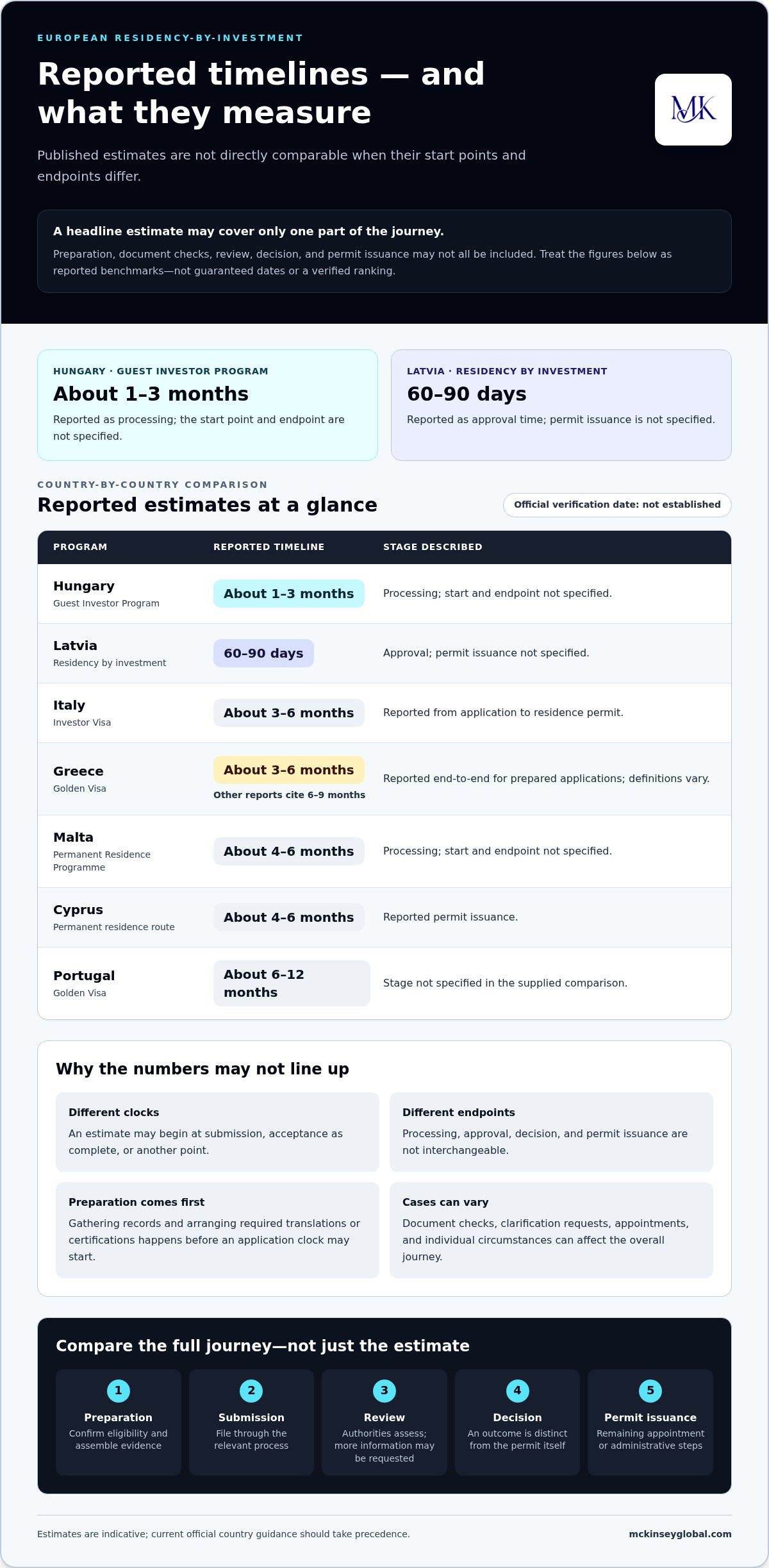
Reported estimates suggest that several European routes may move relatively quickly, but the figures below do not establish a verified ranking. The research snapshot is dated October 16, 2026, and does not provide dated official sources confirming each estimate or a uniform starting point. Treat the figures as indicative and compare them with current government guidance. You cannot identify the fastest residency by investment Europe option by comparing numbers alone when the measured stages differ.
How to read published European processing estimates
Check whether an estimate identifies when its clock starts, what event ends it, and whether it comes from official guidance or a private advisory source. “Approval,” “processing,” and “time to permit” are not interchangeable. The table distinguishes reported stage descriptions where available. “Not established” means the supplied information does not specify a reliable official verification date or consistent start point.
| Program | Route | Reported timeline | Measured stage reported | Official verification date |
|---|---|---|---|---|
| Hungary | Guest Investor Program | About 1-3 months | Processing; start and endpoint not specified | Not established |
| Latvia | Residency by investment | 60-90 days | Approval; permit issuance not specified | Not established |
| Italy | Investor Visa | About 3-6 months | Reported from application to residence permit | Not established |
| Greece | Golden Visa | About 3-6 months; other reports cite 6-9 | Reported end-to-end for prepared applications; definitions vary | Not established |
| Malta | Permanent Residence Programme | About 4-6 months | Processing; start and endpoint not specified | Not established |
| Cyprus | Permanent residence route | About 4-6 months | Reported permit issuance | Not established |
| Portugal | Golden Visa | About 6-12 months for 2026 applications; other estimates are longer | Reported process; exact stage not specified | Not established |
Where Greece, Portugal, and Latvia fit in the comparison
These three routes merit comparison, but the estimates do not support a definitive speed ranking. Latvia’s figure refers to approvals, Greece’s reports describe a broader process with differing ranges, and Portugal’s estimate does not define a precise stage. Compare current qualifying pathways and official instructions, then consider how your preparation and circumstances may affect the journey. A closer review of Greece residency-by-investment strategy can help frame the Greek route against your personal objectives.
Before relying on a benchmark, record its publication date, source, start event, endpoint, and whether it includes permit issuance. Official guidance may describe procedure without guaranteeing an individual timeline. Private estimates can provide context, but they are not government commitments. McKinsey Citizenship and Residency Solutions provides investment-migration advisory for Greece, Portugal, and Latvia. An individualized program assessment can help compare eligibility, timing, and residence objectives across these routes.
Does a faster European residency route mean a better investment choice?
No. A shorter reported timeline can be valuable, but it does not show that a program suits a particular investor. The practical choice depends on whether you qualify, can meet the route’s requirements, and will receive residence rights that support your intended use. The headline estimate is only one decision factor, especially when published figures measure different stages.
Compare each option against the same questions: Is the route currently open to you? What conditions apply to renewal? Are there physical-presence expectations? Can eligible family members be included, and what evidence must they provide? Does the permit support your actual plans, such as relocating, establishing a base for your family, or facilitating business travel? A route that appears fast may be less suitable if its conditions do not align with those priorities.
When speed should carry more weight
Speed deserves greater consideration when it is tied to a defined deadline, such as a planned relocation, a family move, or a business need. In that situation, assess a realistic timeline for the relevant application stage and allow time for preparation and later permit steps. A promotional estimate that starts after an application is accepted may not help if you have not assembled the required evidence. Investment routes also involve eligibility assessment and government review; speed does not bypass either.
Build a practical schedule around your own readiness. Identify the required documents, estimate how quickly you can obtain them, and distinguish the authority’s review period from the time needed to complete the full process. If timing is critical, treat uncertainty as a planning risk rather than assuming the shortest advertised figure will apply. No estimate guarantees an individual decision date.
When long-term fit should take priority
If your objective is sustained residence rather than a permit by a particular date, give greater weight to the conditions that continue after approval. Consider whether you intend to live in the country, how renewal requirements fit your plans, and whether family eligibility meets your needs. Future mobility goals also require careful interpretation: the rights attached to a residence permit depend on its jurisdiction and are not the same as citizenship or a national passport.
Immigration residence, tax residence, and citizenship are distinct concepts. Holding a residence permit does not, by itself, settle your tax status or establish eligibility for citizenship. Tax consequences depend on personal circumstances and the relevant jurisdictions, so obtain appropriate tax and legal advice before structuring a move or investment around them.
For Portugal, reviewing program conditions alongside your personal objectives is more useful than treating speed as the sole criterion. A tailored residency program assessment can help organize the comparison around eligibility, timing, and long-term residence goals.
How can applicants reduce avoidable delays in a residency-by-investment application?
Preparation cannot control government processing, but it can reduce delays caused by missing, inconsistent, or late applicant information. A readiness plan helps you identify dependencies before filing and manage responsibilities afterward. This is especially useful when comparing the fastest residency by investment Europe options: a reported processing estimate does not account for time spent resolving preventable gaps in an individual application.
- Define objectives. Clarify who intends to reside in the country, whether family members will apply, and what the residence is meant to support. These priorities help shape the timeline and evidence plan.
- Assess eligibility. Review current program criteria for the principal applicant and any family members. Identify questions or potential gaps early instead of assuming a published route applies to every investor.
- Select the route. Confirm that the chosen qualifying pathway fits your objectives and that you can document the requirements. Programs differ, and rules may change, so use current official guidance.
- Map the evidence. Create a checklist for identity, source-of-funds, family, and investment records. Assign responsibility for obtaining each item and note dependencies, such as documents that must be issued before others can be prepared.
- Review and submit. Check that the file follows the required format and that names, dates, and supporting details align across records. Submit through the prescribed channel and retain a clear copy of the application.
- Follow through. Track milestones, official requests, deadlines, and the person responsible for each response. Keep correspondence and submitted material organized so follow-up can be handled accurately.
Prepare the application file before submission
Use a document matrix to compare each required item with the evidence gathered. Check spelling and date consistency across identity documents, civil records, translations, and supporting materials. A variation may require an explanation. Verify validity periods, certification requirements, translation rules, file formats, and submission instructions against current official program guidance. These checks can help prevent avoidable clarification requests, though they cannot eliminate them.
Completeness involves more than collecting documents. The evidence should support a coherent account, with each record serving a clear purpose and any discrepancies addressed transparently. For investment-related evidence, make sure the materials correspond to the selected route and its current requirements. Avoid relying on a checklist prepared for another jurisdiction or an earlier version of a program.
Manage the process after filing
After submission, maintain a simple record of filing dates, correspondence, requested information, due dates, and completed actions. If authorities request clarification, respond to the specific question with complete, consistent supporting material. Prompt follow-through can reduce delays attributable to the applicant, but official due diligence, review queues, and decisions remain program-specific and outside an applicant’s or adviser’s control.
Structured application support can help coordinate evidence and process milestones without promising faster government decisions. McKinsey Citizenship and Residency Solutions provides investment-migration application support. Explore application support to organize preparation around your objectives and selected route.
How should investors choose and plan a European residency-by-investment route?
A sound choice begins with your intended use of residence, not a speed ranking. Once your objectives and eligibility are clear, published timelines can help distinguish options, provided you understand their measured stages and verify current program conditions. Greece, Portugal, and Latvia may each merit an individualized assessment, but none should be treated as a guaranteed faster route for every applicant.
Build a shortlist around objectives and eligibility
Start by setting out the practical requirements the permit must meet. Consider the main applicant’s profile, intended residence, family needs, readiness to prepare evidence, and obligations you can accommodate over time. Then compare each potential route against current official requirements before treating it as viable. This prevents a short estimate from taking priority over a fundamental eligibility or residence condition.
- Residence purpose: Define whether the priority is relocation, a family residence option, or another residence objective.
- Applicant profile: Identify eligibility factors and any evidence needed to demonstrate them.
- Family needs: Establish who may need to be included and assess the relevant program’s criteria.
- Ongoing obligations: Review renewal conditions and any physical-presence expectations against your plans.
- Timing and readiness: Compare estimates only after noting the stage measured, and consider how prepared your documentation is.
This framework helps turn a broad list of European programs into a manageable shortlist. Keep a route under consideration only when its current rules, required evidence, and residence conditions align with your circumstances. Processing speed is relevant, but it is one criterion among several.
Move from comparison to a structured assessment
Before making a decision, prepare a concise applicant profile. State your residence objective, desired timing, family members involved, evidence already available, and jurisdictions under consideration. Note any unresolved eligibility questions. This summary gives an assessment a practical starting point and helps identify what must be verified against official guidance before developing an application plan.
McKinsey Citizenship and Residency Solutions provides investment-migration advisory and application support, including for Greece, Portugal, and Latvia. Its work can structure eligibility review, route analysis, documentation planning, and application management around an investor’s objectives and readiness. The firm is an independent boutique advisory and is not affiliated with McKinsey & Company. Advisory support can organize the process; it cannot guarantee approval or control government processing decisions.
Moving from comparison to planning starts with a clear view of your objectives, eligibility, and preferred European jurisdictions. A structured assessment can help you evaluate the next step without relying on a headline timeline alone.
Set a Clear Direction for Your Residency Plan
Turn your comparison into a decision brief: identify the outcome you need, the conditions you can meet, the evidence you can prepare, and the timing that is genuinely workable. This makes it easier to distinguish a route advertised as quick from one that fits your circumstances and plans. The right choice may not be the fastest residency by investment Europe appears to offer. It is the route whose verified requirements and residence conditions are workable for you.
A considered strategy can also bring unanswered questions to light before they become obstacles, from family eligibility to renewal planning and the practical scope of residence rights. Use the assessment to establish priorities and organize the next application steps, while allowing for the fact that official review remains outside an applicant’s control.
For a confidential discussion of your objectives and potential residency pathways, request a confidential residency strategy consultation.
Frequently Asked Questions
Which European country offers the fastest residency by investment?
There is no definitive answer unless current timelines measure the same stages. Reported 2026 estimates place Hungary’s Guest Investor Program at approximately 1-3 months and Latvia’s route at 60-90 days, but these figures may use different start points and endpoints. Treat them as indicative, not proof that one route is universally fastest. Review current program eligibility and official processing guidance before making plans based on a timeline.
How long does residency by investment in Europe take from preparation to permit issuance?
The full journey varies by program and applicant, and a processing estimate alone cannot establish a reliable duration. Preparation time depends on how quickly you can assemble acceptable records, while review and permit issuance follow the relevant authority’s procedures. For planning, map your document readiness and any program-specific appointments or follow-up steps, then compare that schedule with official guidance rather than relying only on an advertised application-processing period.
Is a European Golden Visa processing-time estimate a guarantee?
No. An estimate is a planning reference, not a promise of an individual outcome or decision date. Processing may vary with the application, requests for additional information, administrative requirements, and the authority’s workload. Before using a published figure, identify its source and the event it measures, such as application submission, acceptance, or a decision. Build flexibility into relocation, school, or business arrangements that depend on permit issuance.
Can residency by investment in Europe lead to citizenship?
It may provide a route to apply for citizenship in some jurisdictions, but residence permission does not automatically become citizenship. A later application is assessed under separate nationality rules, which can include conditions relating to residence history and other eligibility factors. If you are planning eventual naturalization, assess the destination’s current citizenship criteria independently of the investment-residence application. Do not treat a permit as a promise of a passport.
Does obtaining residency by investment automatically make someone a tax resident?
No. Immigration residence and tax residence are separate determinations, and a residence permit alone does not establish an individual’s tax status. Relevant factors depend on personal circumstances and the laws of the jurisdictions involved. Before changing residence, review where you live and work, how your existing tax position may be affected, and what reporting obligations may apply with a qualified tax professional familiar with the relevant countries.
What documents can help prevent delays in a European residency-by-investment application?
Common evidence categories include identity and civil-status records, source-of-funds materials, documents relating to eligible family members, and proof connected to the selected investment route. The exact list depends on the program and applicant. Check that names and dates match across records, and verify translation, certification, validity, and file-format requirements against current official instructions. A well-organized file can reduce avoidable clarification requests, though it cannot control government review.