The most powerful passport may be the wrong place to start. A sound global residency and citizenship strategy begins with what you need it to achieve: greater mobility, a place to live, options for your family, or a pathway that supports long-term plans. Passport rankings alone can obscure important differences between jurisdictions and between residency rights and citizenship rights.
If you’re finding programs difficult to compare, that uncertainty is understandable. Eligibility, investment routes, residence conditions, and compliance obligations vary. Rules and personal circumstances can also change over time. A second passport does not automatically alter your tax responsibilities.
This article offers a practical framework for setting priorities, comparing pathways against consistent criteria, and accounting for family needs, compliance, and future plans. It also explains when to verify current information and seek qualified professional guidance, so your next step reflects your circumstances rather than a generic ranking.
Key Takeaways
- Start your global residency and citizenship strategy by defining the outcomes that matter to you and your family before comparing jurisdictions.
- Assess eligibility and application requirements early, including due diligence, source-of-funds records, and disclosure obligations.
- Compare pathway categories using consistent criteria such as status sought, residence expectations, ongoing obligations, and family eligibility.
- Do not assume that obtaining a second status changes your tax residence or removes existing obligations. Seek qualified advice based on your circumstances.
- Prepare a goals brief, shortlist relevant investment-based pathways, verify current requirements, and organize documentation before proceeding.
What a global residency and citizenship strategy is designed to achieve
A global residency and citizenship strategy coordinates lawful status options with your personal, family, and business priorities. The aim is not to secure a particular passport at any cost. It is to identify pathways that may fit your circumstances, then assess their requirements and implications. Investment-based immigration is one possible route. Eligibility, procedures, and outcomes depend on the jurisdiction’s current rules and the applicant’s individual circumstances.
In brief: “A global residency and citizenship strategy is a structured plan for evaluating lawful status pathways against defined priorities. It guides decisions but cannot guarantee an immigration outcome.” A program may appear strategically suitable without making you eligible or ensuring that an application will be approved.
Residency and citizenship serve different planning functions
Residency generally gives permission to live in a jurisdiction under specified terms. Those terms vary, so check what a particular status allows and what conditions apply. Do not assume that residency will automatically lead to permanent status or citizenship.
Citizenship is a distinct legal status, with rights and duties determined by the country’s laws. “Nationality” can have a specific meaning in a country’s legal framework and may not be used identically to citizenship in every context. The overview of immigrant investor programs introduces residence-by-investment and citizenship-by-investment as separate pathways. Verify the practical rights attached to any status under the relevant jurisdiction’s laws.
Start with the outcome, not the passport ranking
A ranking can highlight broad differences, but it cannot tell you which option fits your needs. Start with the questions your strategy should answer. Where do you need the right to live? Which destinations matter for travel? Do you need permission to work, or are you planning for a child’s education or your family’s longer-term residence? Separate immediate mobility goals from plans to establish residence or seek citizenship over time.
Then compare available routes against your circumstances. Investment pathways may differ in the status they offer, their eligibility tests, and their application processes. Family inclusion and residence expectations can differ too. Check these details against current official requirements rather than inferring them from a program’s label or reputation.
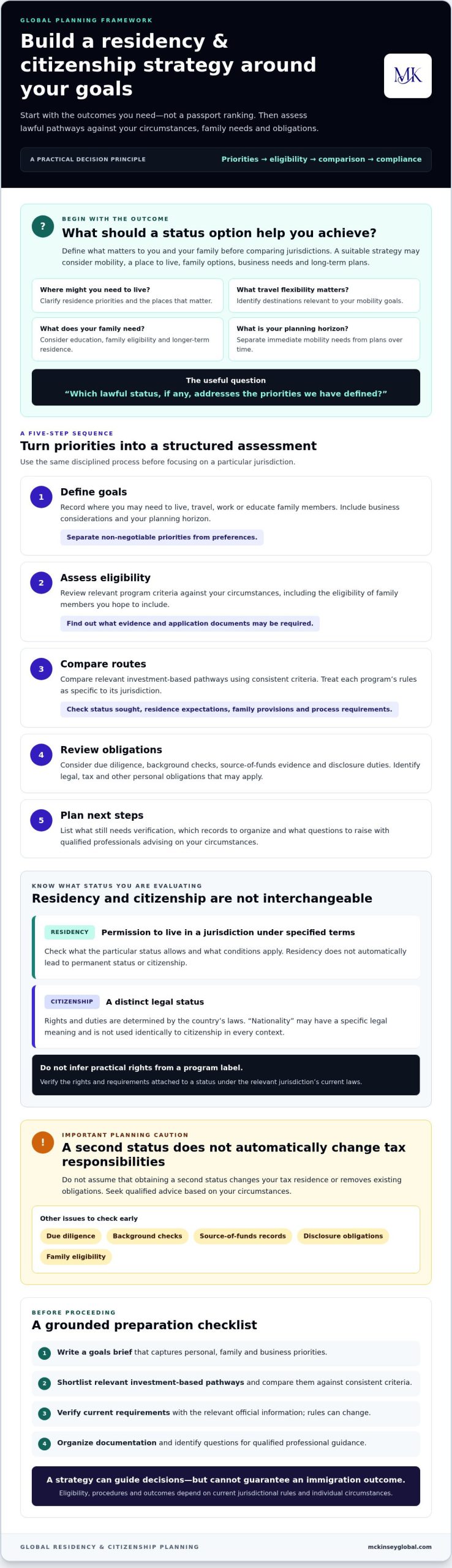
The useful question is not “Which passport ranks highest?” but “Which lawful status, if any, addresses the priorities we have defined?” This keeps personal objectives, family considerations, business needs, and realistic eligibility in view before you decide what to investigate next.
Build a global strategy around objectives, eligibility, and compliance
A practical global residency and citizenship strategy follows a clear sequence. Moving directly from a desired benefit to a favored jurisdiction can leave important questions unanswered: Do you qualify? Does the route fit your family? What documentation might you need? Use these steps to turn broad priorities into a structured assessment:
- 1. Define goals. Record where you may need to live, travel, work, or educate family members. Include business considerations and your planning horizon. Separate non-negotiable priorities from preferences you could trade off.
- 2. Assess eligibility. Review relevant program criteria against your circumstances, including the eligibility of family members you hope to include. Find out what evidence and application documents may be required instead of assuming a route is available to you.
- 3. Compare routes. Assess suitable investment-based pathways against the same criteria, including the status sought, residence expectations, family provisions, and process requirements. Treat each program’s rules as specific to that jurisdiction.
- 4. Review obligations. Consider due diligence, background checks, source-of-funds evidence, and disclosure duties. Identify legal, tax, and other personal obligations that may apply before committing to a route.
- 5. Plan next steps. List information that still needs verification, records to organize, and questions for qualified professionals advising on your individual circumstances.
Translate priorities into decision criteria
Make your goals specific enough to guide a comparison. For example, distinguish a near-term need for travel flexibility from a longer-term intention to live in a particular region. Consider family composition, business needs, and how much time you realistically expect to spend in a jurisdiction. Mark each criterion as essential or negotiable. Check family-member eligibility and documentation requirements against current program guidance, since they can differ between routes.
Assess compliance before shortlisting
Due diligence is not just a final administrative step. It can affect whether a route is suitable from the outset. Applicants may need to provide complete disclosures and evidence supporting the lawful source of funds. Authorities set program-specific requirements and retain decision-making authority over applications.
Review compliance before choosing a jurisdiction. A route that does not fit your documentation, disclosure, or personal circumstances is not a sound strategic option. Seek qualified legal and tax advice about individual obligations. General program comparisons cannot determine your legal position or tax outcome. Requirements and procedures can change, so verify current information before acting.
For investment-based pathways across the Caribbean, Europe, and the Middle East, an adviser can help compare options and coordinate research, documentation, and application support. Learn about investment-based immigration guidance.
Compare residency and citizenship pathways without relying on rankings
Begin with the status you are seeking, not a league table of passports or programs. In a global residency and citizenship strategy, compare pathway categories using consistent criteria, then verify each jurisdiction’s current rules. An option’s relevance depends on your objectives and eligibility, not its place in a general ranking.
| Comparison factor | Residency-by-investment pathway | Citizenship-by-investment pathway |
|---|---|---|
| Status sought | Permission to reside, subject to the route’s terms. | Citizenship, a distinct legal status governed by the country’s laws. |
| Residence expectations | Check any presence, renewal, or other conditions attached to the specific route. | Confirm whether the program sets residence or other participation requirements. |
| Eligibility | Review the route’s criteria against the applicant’s circumstances. | Review citizenship-specific criteria and due-diligence requirements. |
| Obligations | Establish ongoing conditions, disclosures, and renewal responsibilities. | Establish application disclosures and any continuing duties under applicable law. |
| Family considerations | Verify which family members may qualify and what evidence is required. | Confirm family eligibility and documentation under the specific program. |
This framework helps organize a comparison. It does not confirm that a route is currently available or that you qualify. Program details can change. Check jurisdiction-specific requirements against authoritative, current information before making decisions.
When residency-by-investment routes may fit the objective
These routes may be relevant when your main aim is lawful residence, subject to the conditions of a particular pathway. Portugal, Greece, the United Arab Emirates, and Latvia are examples of jurisdictions within the firm’s advisory scope. Their inclusion is not a recommendation. Confirm current availability, eligibility, residence expectations, and obligations for each route.
When citizenship-by-investment routes may fit the objective
If citizenship itself is your goal, compare citizenship pathways separately from residence options. Pay particular attention to eligibility, due diligence, and family documentation. Antigua and Barbuda, St. Kitts and Nevis, Dominica, and St. Lucia are examples of Caribbean jurisdictions in the firm’s scope. For jurisdiction-specific background, see the guides to Antigua and Barbuda investment options and St. Kitts and Nevis citizenship by investment. Verify current program rules before relying on details in any guide.
Use the comparison to identify routes that merit further review rather than trying to name a universal “winner.” An adviser can help organize an assessment of investment-based pathways. Qualified legal and tax professionals can address obligations specific to your circumstances.
Manage the main strategic risks before choosing a route
A second residence permit or citizenship does not automatically change where you are tax-resident, remove obligations in another country, or protect wealth. Immigration status and tax treatment are assessed under different legal frameworks. Relevant facts may include where you live, your personal circumstances, applicable residence rules, and any relevant tax treaties.
“Immigration status is not a determination of tax residence, and a status decision is not a substitute for independent tax advice.” Treat immigration and tax as connected but separate workstreams in your global residency and citizenship strategy. Before proceeding, consult qualified tax and legal advisers who can assess your circumstances and the laws that apply. Do not rely on assumptions of automatic tax savings, the removal of existing obligations, or guaranteed wealth protection.
Separate immigration decisions from tax and wealth planning
Citizenship or residence in a new jurisdiction may be one relevant fact, but it does not settle every tax question. The implications depend on your circumstances, the rules of the countries involved, and potentially applicable treaties. A pathway that fits an immigration objective may not align with your wider tax or financial position. Obtain independent professional analysis before making decisions based on an anticipated tax result.
Plan for due diligence and changing requirements
Application preparation requires careful coordination. Applicants may need to assemble complete, consistent records, explain the lawful source of funds, and make required disclosures. Evidence and procedures are program-specific, so confirm what applies instead of assuming that documents prepared for one application will meet another jurisdiction’s requirements. Authorities make the decisions, and a well-prepared file cannot guarantee approval.
Rules, eligibility criteria, application procedures, and personal circumstances can change. Recheck official program information and seek appropriate professional guidance when evaluating a route and again before filing. Consider how a change in family composition, residence plans, or business circumstances could affect suitability or documentation. Do not base a decision on a promise of fast processing or an assumption that program terms will remain unchanged.
As a practical risk review, record the assumptions behind your preferred route, identify facts that require legal or tax advice, and note when key requirements were last verified. This gives you a clear basis for reassessment if circumstances or official rules change. It also helps avoid treating an immigration pathway as a solution to every cross-border concern.
For structured support comparing investment-based immigration pathways and coordinating application research and documentation, review residency and citizenship advisory services.
Turn the strategy into a structured advisory and implementation plan
Once your priorities and risks are clear, turn them into an implementation plan with defined decisions, responsibilities, and verification points. A disciplined process helps you move from broad aims to a manageable review of investment-based pathways without treating any application outcome as certain.
- Prepare a goals brief. Summarize family composition, residence plans, mobility needs, business considerations, and timing priorities. Note which outcomes are essential and which are preferences.
- Review candidate routes. Identify investment-based pathways that appear relevant to your objectives and circumstances. Compare the status, eligibility, conditions, and family provisions for each.
- Verify current requirements. Confirm program availability, eligibility criteria, investment routes, and application procedures through current official information and appropriate professional advice.
- Plan documentation. Identify records that may be needed, including identity and family documents, disclosures, and evidence concerning source of funds. Organize responsibilities and follow-up questions before preparing an application.
This sequence applies whether you are considering residence or citizenship. For a jurisdiction-specific starting point, consult the Greece residency by investment guide, then independently verify current requirements before relying on program details.
Prepare for an initial strategy discussion
A concise brief can make an advisory discussion more focused. Include a high-level account of your investment capacity and the source-of-funds records you may be able to provide. Avoid sending sensitive documents until you understand how the information will be handled. Consider asking:
- Which investment-based pathways fall within the adviser’s scope?
- What work will the adviser coordinate, and what remains your responsibility?
- How will updates, document requests, and changes in requirements be communicated?
- Which questions require separate legal or tax advice from qualified professionals?
Choose support that matches the pathway
McKinsey Citizenship and Residency Solutions advises on investment-based immigration pathways across the Caribbean, Europe, and the Middle East, and provides application support that can help coordinate research, documentation, and process management. It is an independent boutique advisory firm and is not affiliated with McKinsey & Company. Its role is advisory; it does not act as a direct real estate broker. Government authorities set requirements and decide applications, and no adviser can guarantee an outcome.
For a practical next step, discuss your objectives and potentially eligible investment-based routes. Bring your goals brief and use the conversation to clarify the adviser’s scope, current requirements, and where independent professional advice may also be needed.
Make your next decision with clarity
A sound global residency and citizenship strategy starts with defined objectives, not passport rankings. Distinguish the rights associated with residence from those of citizenship, then compare relevant pathways against your eligibility, family priorities, obligations, and long-term plans. Before choosing a route, verify current requirements and consider how documentation, due diligence, and tax or legal questions apply to your circumstances.
There is no universal pathway, and no adviser can guarantee an immigration decision. Structured guidance can help make the comparison and application process more coordinated. McKinsey Citizenship and Residency Solutions advises on investment-based pathways across the Caribbean, Europe, and the Middle East, and provides end-to-end application support.
If you are ready to clarify your objectives and review potentially suitable routes, request a discussion about your global residency and citizenship objectives. With clear priorities and appropriate professional guidance, you can take the next step with a plan grounded in your circumstances.
Frequently Asked Questions
What is a global residency and citizenship strategy?
A global residency and citizenship strategy is a structured way to assess lawful status pathways against your personal, family, and business priorities. It starts by clarifying the outcomes you seek, then compares relevant routes, eligibility, residence expectations, and obligations. Investment-based immigration may be one option, but suitability depends on individual circumstances and current program requirements. Planning can support informed decisions, but it cannot guarantee eligibility, approval, or a particular immigration outcome.
What is the difference between residency by investment and citizenship by investment?
Residency by investment generally refers to a route to permission to reside in a jurisdiction, subject to that route’s conditions. Citizenship by investment refers to a pathway through which an eligible applicant may seek citizenship under a country’s laws. These statuses are not interchangeable: residency does not itself confer citizenship, and the rights and obligations of each status differ. Check the specific program’s requirements and legal effects before comparing pathways.
Can residency by investment lead to citizenship?
It may be possible in some jurisdictions, but residency by investment does not automatically lead to citizenship. A later citizenship application may depend on the country’s laws, qualifying residence, eligibility criteria, documentation, and other conditions in force at the time. Routes and requirements vary, and rules can change. Before relying on the possibility of future citizenship, verify current official requirements and seek qualified legal advice for your circumstances.
Does a second citizenship automatically change my tax residence?
No. Acquiring a second citizenship does not automatically change your tax residence or remove tax and reporting obligations elsewhere. Tax outcomes depend on the facts of your situation, applicable residence rules, relevant treaties, and other jurisdiction-specific considerations. Immigration status and tax residence are separate questions. Consult an independent, qualified tax adviser before making decisions based on an expected tax result. A general program comparison cannot determine your individual tax position.
How do I compare global residency and citizenship programs?
Start with the outcome you need, then compare candidate routes using consistent criteria: status sought, residence expectations, eligibility, application obligations, and family considerations. Decide whether your priority is lawful residence or citizenship, and distinguish essential needs from preferences. Do not rely on rankings alone. Verify current program availability and requirements with authoritative sources, since details can change, and seek professional guidance when legal or tax questions depend on your circumstances.
What documents may be required for an investment-migration application?
Requirements depend on the program and the applicant’s circumstances. Application materials may include identity and civil-status records, information about eligible family members, financial records, evidence supporting the lawful source of funds, and complete disclosures. Authorities may request additional documents or specify how records must be prepared. Confirm the current checklist and procedures for the selected route before gathering or submitting sensitive materials, and coordinate with appropriate professionals where needed.
Can an adviser guarantee approval for a citizenship or residency application?
No adviser can guarantee that a citizenship or residency application will be approved. Government authorities set program requirements, assess applications, and make the final decision. An adviser may help compare investment-based pathways and coordinate research, documentation, and application support, but that work cannot replace eligibility requirements or control the decision. Before engaging support, clarify its scope, your responsibilities, and which legal or tax questions require advice from qualified independent professionals.