What if the right residency route has less to do with your job title than with how you plan to qualify? A golden visa for digital nomads can sound like a dedicated permit, but the terms describe different routes: remote work explains how you earn, while a golden visa is based on an eligible investment. A digital nomad visa, by contrast, is generally designed for people who meet a country’s requirements for remote work and income.
The distinction can feel unclear, especially when both options may support living abroad. A remote professional may be able to pursue investment-based residency, but remote work alone doesn’t qualify someone for a golden visa. Residency also doesn’t automatically settle work authorization or tax obligations.
This guide explains how the routes differ and what to consider when matching them to your work, investment capacity, family needs, and long-term plans. Portugal and Greece are discussed as examples of investment-based residency, separate from digital nomad visas. The goal is to help you identify which route merits further assessment and approach an application with realistic expectations about compliance and documentation.
Key Takeaways
- Use the phrase golden visa for digital nomads as a starting point for research, not as evidence of a single visa category.
- Assess mobility, longer-term residence, family plans, and investment objectives separately before weighing residency options.
- Compare each route by its purpose, qualification basis, work-permission considerations, and planning horizon. Conditions vary by jurisdiction.
- Build a 2026 assessment around your objectives, route type, eligibility, compliance obligations, and supporting documents.
- Structured application guidance can help bring investment parameters and remote-work goals into a clear, compliance-aware strategy.
Golden visa for digital nomads: what the term means, and what it does not
Digital nomad status concerns remote work; a golden visa usually refers to residency obtained through a qualifying investment. The phrase “golden visa for digital nomads” is best understood as a search query about how remote professionals might pursue investment-based residency, not as the name of a single, standardized visa category.
The distinction matters because similar relocation goals do not make the underlying permissions interchangeable. A remote worker may explore an investment route, but working remotely does not satisfy an investment requirement. Likewise, holding a residence permit does not automatically answer whether the person may work for a local employer, become a citizen, or be treated as a tax resident.
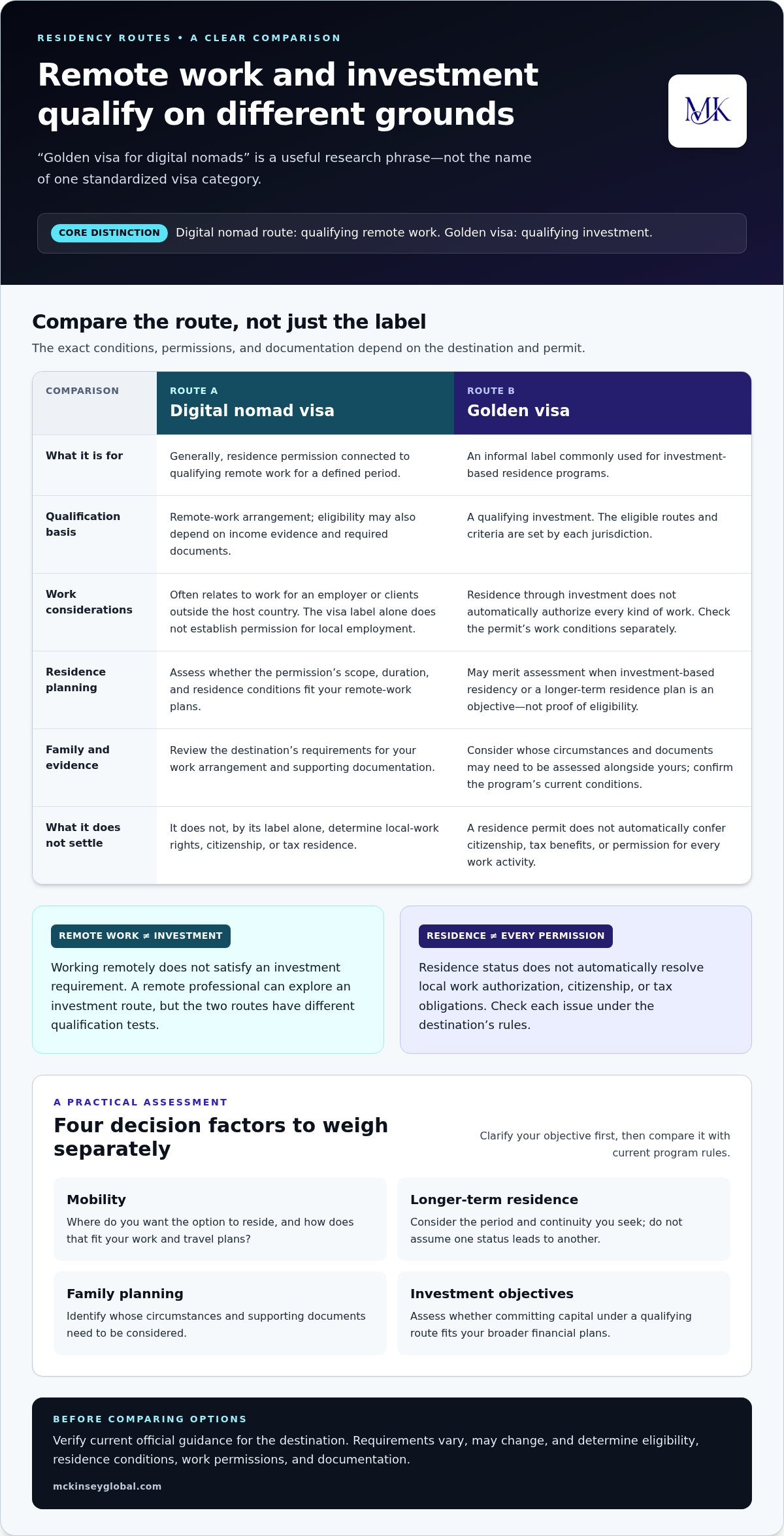
In brief: a digital nomad visa is generally tied to qualifying remote work; a golden visa is generally tied to qualifying investment. That shorthand is useful, but it is not a substitute for reviewing the legal conditions of a specific destination and permit.
What is a digital nomad visa?
A digital nomad visa is generally a residence permission for a defined period connected to remote work, often performed for an employer or clients outside the host country. Its purpose and legal structure differ by destination. Eligibility may depend on the applicant’s work arrangement, income evidence, or other required documentation, while local rules determine which activities the visa permits. The visa’s label alone does not establish permission to take local employment.
Before relying on this route, distinguish permission to perform remote work from the right to work in the host country’s local labour market. Review current official immigration guidance for the destination, including the scope and duration of the permission, eligible work arrangements, and relevant residence conditions. Requirements can change, so general descriptions are a starting point, not a determination of eligibility.
What does a golden visa usually refer to?
“Golden visa” is an informal label commonly applied to investment-based residence programs. As a general introduction, Golden visa programs describes the broader concept; each jurisdiction sets its own investment routes and residence conditions. Options and criteria differ, and a program’s name alone does not establish which investment qualifies or what rights the resulting permit grants.
Investment-based residency and remote-work permission are separate questions. A residence permit may not authorize every kind of work, and permission to reside does not automatically confer citizenship or tax benefits. Nor does it settle tax residence, which depends on applicable rules and individual circumstances. A digital nomad considering an investment route should assess the investment criteria, residence conditions, work permissions, and potential tax obligations separately.
For a sound comparison, identify the specific outcome you need before focusing on terminology. Is your priority permission to reside while working remotely, a residence option linked to investment, or a longer-term mobility plan? Treat each as a separate objective, then verify the current official rules. This helps prevent a broad label from being mistaken for a complete account of eligibility, rights, or obligations.
How investment-based residency can fit a digital nomad’s longer-term plan
A remote-work arrangement may meet someone’s immediate relocation needs, while longer-term plans raise different questions: where they want the option to reside, how their family’s needs may evolve, and whether they are prepared to make an eligible investment. These considerations can make an investment-residency route worth assessing, but they do not mean every digital nomad needs to invest or will qualify.
Choose a route based on your residence objective, not the “digital nomad” label. First clarify what you want the status to support, then assess whether an investment-based program aligns with that goal and your circumstances. A remote-work visa and an investment-residency route may have different eligibility tests, documentation, conditions, and permissions. Don’t assume one replaces the other.
When might an investor-residency route merit consideration?
This route may merit consideration if your planning extends beyond a defined remote-work stay, if investment-based residency is itself an objective, or if you are evaluating possible residence arrangements for family members. These are reasons to assess a route, not proof of eligibility. Compare them with your capacity and priorities, and check whether the destination’s current requirements fit before treating the route as a practical option.
Make the assessment more precise by separating four decision criteria:
- Mobility: Identify where you want the option to reside and how that fits your work and travel plans.
- Longer-term residence: Consider the period and continuity of residence you are seeking, without assuming one status leads to another.
- Family planning: Determine whose circumstances and documentation need to be considered alongside yours.
- Investment objectives: Assess whether committing capital under a qualifying route is consistent with your broader financial plans.
Then compare the relevant program rules with your remote-work arrangements. Residence permission, permitted work, and tax residence remain distinct matters, and the conditions depend on jurisdiction and personal circumstances. Keeping them separate helps prevent an attractive label from obscuring practical obligations.
How do Portugal and Greece fit the comparison?
Portugal Golden Visa and Greece Residency by Investment are examples of investment-residency routes, not digital nomad visas. They show why country-specific assessment matters: eligibility, qualifying investment options, residence conditions, and application procedures must be evaluated under each program’s current rules. For jurisdiction-specific context, see this Greece residency by investment guide.
McKinsey Citizenship and Residency Solutions provides investment-migration advisory and application support for residency applications, including Portugal and Greece. If an investment route appears aligned with your objectives, explore investment-residency advisory support to structure your assessment and application planning. The aim is to clarify fit, requirements, and documentation, not to presume an outcome.
Digital nomad visa vs. golden visa: compare the decision, not just the label
Choosing between a digital nomad visa and investment-based residency starts with the permission you need, not the terminology used in a search. A remote-work permit and a residency-by-investment permit have different qualifying bases. In particular, a residency-by-investment permit is not automatically a digital nomad work visa: it does not, by itself, establish permission to work remotely or take local employment. The comparison below describes general distinctions only. Verify current rules and rights for the specific jurisdiction.
Purpose
A digital nomad visa generally supports a defined stay connected to remote work. A golden visa generally refers to residence linked to a qualifying investment.
Typical basis
A digital nomad route may assess remote-work arrangements and other destination-specific criteria. An investment route assesses eligibility under the program’s qualifying investment rules.
Work-permission question
For either route, establish which work activities the permit allows. Don’t assume that permission to reside authorizes local employment or remote work in every circumstance.
Planning horizon
A nomad visa may suit a defined remote-work stay; investment residency may be considered as part of longer-term residence planning. Neither label guarantees a particular future status.
Which route better matches your work and residence plans?
Begin with your expected work duration and destination. If your immediate goal is to live in a country while continuing eligible remote work, assess its digital nomad route and the conditions attached to that permission. Your employer, clients, work location, and intended length of stay may raise questions that country-specific rules address differently.
If your objective includes making a qualifying investment or planning for residence over a longer horizon, investor residency may warrant separate assessment. That does not make it the better choice for every remote professional. The investment basis, application requirements, residence conditions, permitted activities, family needs, and mobility priorities all matter.
Some people may examine both routes, but should not assume one substitutes for the other. Separate the questions: what permission lets you reside, what work can you perform under it, and what obligations arise from your personal circumstances? An immigration adviser can help assess investment-residency fit and application planning. Immigration guidance is not a substitute for tax advice.
Does either route determine your tax position?
No. Immigration status alone does not settle tax residence or tax obligations. Physical presence, personal circumstances, and local rules may be relevant, but their application depends on the jurisdiction and individual facts. Don’t treat a residence permit as evidence of tax savings, exemption, or a particular tax outcome.
Before committing to a move or investment, coordinate immigration planning with professional tax advice suited to the countries and circumstances involved. Verify current rules using authoritative sources and qualified professionals. A route may align with your residence objective while still carrying separate work, tax, and compliance considerations.
A practical 2026 framework for assessing residency and compliance
A structured assessment can prevent an appealing residency label from being mistaken for a suitable route. Investment residency may not fit a digital nomad whose only need is temporary permission to live somewhere while working remotely. The phrase “golden visa for digital nomads” doesn’t remove the need to assess your objectives, eligibility, and obligations against the rules of a specific program.
What should you assess before selecting a route?
Work through these questions in sequence. Keep verified program requirements separate from general planning questions: the first determine whether you may qualify, while the second help you decide whether the route fits your life and plans.
- Define your objectives. Record your intended length of stay, destination preferences, work arrangement, family needs, and whether you have an investment objective. Separate the practical need to work remotely from any desire for longer-term residence or mobility.
- Identify the route type. Determine whether your priority points toward a remote-work visa or an investment-based residence program. Don’t treat one as a substitute for the other; each may have a different purpose and eligibility test.
- Assess eligibility. Compare your circumstances with the program’s current official requirements. Mark which criteria are formal eligibility conditions and which are planning preferences, such as location or a future residence pattern.
- Map obligations. Review residence conditions, permitted activities, and compliance considerations using current official information. Consider how your expected time in the destination and personal circumstances could affect wider planning, including tax questions that require separate professional advice.
- Plan documentation. Identify the records and supporting materials the relevant application process requires. Build a document plan before proceeding, keeping in mind that requirements and procedures can vary by program and applicant circumstances.
How can applicants prepare for a compliant process?
Once a route appears worth assessing, organize the information that supports your application and keep it accurate and consistent across forms and supporting records. Differences in dates, work details, family information, or investment documentation can create avoidable questions. The precise materials and due diligence depend on the program and individual circumstances, so use current official guidance to establish the applicable requirements.
For another illustration of how investment-residency strategies can be compared across jurisdictions, consider this Turkey and UAE residency comparison. It can help frame the issues to examine, but any decision still requires assessing current rules against your objectives.
McKinsey Citizenship and Residency Solutions provides application guidance and management for investment-based residency. Explore investment-residency application support to assess how a route may align with your mobility plans and compliance considerations.
Plan a golden-visa strategy around your remote-work and residency goals
A sound strategy begins with the outcome you need, not the label attached to a visa. Clarify whether your priority is permission to work remotely during a defined stay, a residence option linked to investment, or a broader mobility plan. Then assess how your work needs, residence objectives, investment parameters, family circumstances, and compliance considerations fit together. A golden visa for digital nomads is not a single route that suits every remote professional.
What an investment-migration adviser contributes
For applicants considering investment-based residency, an adviser can organize the assessment around personal objectives and relevant program pathways. McKinsey Citizenship and Residency Solutions provides investment-migration advisory and application guidance and management, including for Portugal Golden Visa, Greece Residency by Investment, and United Arab Emirates residency solutions. These are distinct options, and their suitability depends on the applicant’s circumstances and the current rules of each jurisdiction.
Support can bring structure to a process involving program selection, eligibility assessment, application preparation, and procedural requirements. It can also help clarify which questions relate to immigration permission and which require separate consideration, such as tax advice. The purpose is careful planning and procedural clarity, not a promise of approval, work authorization, citizenship, or a particular tax result.
A considered next step for globally mobile applicants
Before beginning a residency strategy discussion, write down the decision factors that will shape your assessment:
- Residence objective: State where you want to reside and for what purpose, distinguishing a temporary stay from a longer-term plan.
- Work requirements: Describe your remote-work arrangement and identify the permissions you need to carry it out lawfully.
- Investment parameters: Set out whether investment-based residency is a genuine objective and what considerations will guide that decision.
- Personal circumstances: Include family needs, anticipated residence patterns, and any relevant compliance or tax-planning questions.
- Program information: Use current official sources to understand the applicable eligibility criteria, investment routes, residence conditions, and application procedures.
This preparation helps distinguish a route that addresses a specific remote-work need from one that may form part of an investment-led residence plan. It also gives an adviser a clearer basis for discussing relevant pathways, documentation, and procedures. Don’t assume a program fits simply because it is described as a golden visa.
If investment-based residency aligns with your objectives, explore advisory support for residency applications with McKinsey Citizenship and Residency Solutions.
Make your next residency decision with a clear plan
Before taking action, turn your priorities into a concise decision brief: the residence outcome you seek, the work permission you need, your investment parameters, the family circumstances that may affect planning, and compliance questions requiring specialist input. This gives you a practical basis for deciding whether a golden visa for digital nomads is relevant to your objectives, rather than relying on the phrase alone.
If investment-based residency merits further consideration, McKinsey Citizenship and Residency Solutions provides investment-migration advisory and application management, including for Portugal, Greece, and the United Arab Emirates. These pathways are distinct, and a considered assessment should account for the applicable program and your individual circumstances without presuming a particular result.
Take the next step at a measured pace, with your objectives and documentation in view. Explore investment-based residency solutions and begin shaping a strategy around your plans. Clear priorities can make a complex decision more manageable.
Frequently Asked Questions
Is a golden visa the same as a digital nomad visa?
No. The terms refer to different types of residence routes, and their shared association with living abroad does not make their permissions equivalent. Before applying, identify the exact permit category and review its official conditions, including what activities it allows and how renewal works. For example, someone planning to keep serving foreign clients should verify that their intended work arrangement is permitted under the specific residence status they are considering.
Can digital nomads apply for a golden visa?
Yes, a digital nomad may apply if they independently meet the requirements of a specific investment-based residence program. Remote work alone does not establish eligibility. A golden visa for digital nomads is not a special category based on occupation; the applicant’s investment route, personal circumstances, and supporting evidence are central to the assessment. Before committing capital, review the program’s current criteria and consider whether the residence conditions fit your plans.
Do golden visas allow remote work?
Not automatically. Permission to reside and permission to work are separate matters, and the permit’s conditions and local rules determine which activities are allowed. For instance, working remotely for an overseas employer and providing services to clients based in the host country may raise different questions. Before relocating, describe your work arrangement accurately and verify how the relevant authorities treat it under the specific status, rather than relying on a broad visa label.
Does a golden visa change my tax residence?
No, receiving a residence permit does not by itself determine your tax residence. The relevant analysis may involve time spent in a country, personal circumstances, and the jurisdiction’s tax rules. Keep a record of travel dates and where you live and work, since these details may help a qualified tax professional assess your position. Review tax questions separately from immigration eligibility, and seek advice tailored to the countries involved before changing your residence pattern.
Is Portugal’s Golden Visa a digital nomad visa?
No. Portugal Golden Visa is an investment-based residency route, not a digital nomad visa. Someone considering both should compare the purpose and criteria of each route rather than assuming remote work satisfies investment-program requirements. The assessment may include the current qualifying route, application conditions, and residence rules, alongside any separate permission needed for the person’s work. Verify the latest official program information before making plans or financial commitments.
What should digital nomads compare before choosing a residency route?
Compare the permit’s purpose, eligibility basis, permitted activities, residence conditions, family provisions, investment obligations, and renewal rules. Then consider how your expected travel and work pattern fits those conditions. Keep separate notes for confirmed official requirements, questions about your personal circumstances, and tax matters requiring professional advice. This helps identify which route deserves further assessment without relying on country rankings or assuming one permit resolves every immigration and compliance question.